Private Issues

In a recent post on ViralRead, I listed five technology issues that will be hot-buttons in the next six to eight months.  Privacy was at the top of the list.

The NSA/PRISM revelations have exposed that Federal authorities can pull information from technology companies.  For many Americans, the concept of a little surveillance in exchange for thwarted attacks is a fair trade.  Hammering the Obama Administration on the facts of this “scandal” likely won’t be a long-term political winner, and the Administration can’t scale back terrorism investigations while blood still stains the sidewalks in Boston.

And here’s a dose of reality: the “personal” information that the government was getting from the likes of Facebook and Google?  It’s information that people volunteered.  Google doesn’t know anything about you until you search for “Winged Monkeys in Chaps” – even if you’re totally only looking it up for a friend.  Facebook only has pictures of your kids when you upload them.  Your cell phone only triangulates your location via GPS after you buy the phone.  These creature comforts may seem difficult to live without, so we buy the products, use the services, and participate in the networks.  We should understand there are consequences to giving our data to a third party.  It’s not bad that we do it, but we need to be careful.

It is a short jump, though, from “Wow, look at all the stuff the NSA got from Facebook!” to “Hey, why does Facebook have all this stuff in the first place?”  Suddenly, tech companies are the easy bad guys.

This possibility is a likely reason Google is fighting to tell everyone what they forked over to the NSA.

Why Microsoft’s Bing Ads Suck

An ad for Microsoft’s Bing search engine came on TV last night.  The message, obviously, is that Bing is better than Google:

That’s a cute commercial, but it will never allow Microsoft to topple Google’s search dominance.  Neither will the “Bing It On” challenge commercials that demonstrate Bing’s supposed superiority.  Compare Bing’s factual analysis of which search engine is better with this:
Google’s commercial tugs at your heart strings.  Forget about searching for Chinese delivery places or a good deal on hardwood floor installation; Google is there with you while you live your life and save your treasured memories.  It’s an effective emotional appeal, which keeps Google’s TV presence more appealing than Microsoft’s. Microsoft got this back in 1995, when they used the Rolling Stones’ “Start Me Up” to roll out the then-new Windows 95 and its Start Button.  Commercials of the time were low on the facts of the new operating system but heavy on the new frontiers offered by the new generation of computers.

Going multi-screen: #Facebook #adds #hastags

Cross-posted at ViralRead.

Facebook now allows users to include clickable hashtags in their posts.  The decision seems Twitter-inspired, right?

Sort of, but not completely. Though they are using the tags made popular by Twitter, Facebook’s new feature has just as much to do with an old media dinosaur – namely, live television:

During primetime television alone, there are between 88 and 100 million Americans engaged on Facebook – roughly a Super Bowl-sized audience every single night. The recent “Red Wedding” episode of Game of Thrones, received over 1.5 million mentions on Facebook, representing a significant portion of the 5.2 million people who watched the show. And this year’s Oscars buzz reached an all-time high on Facebook with over 66.5 million interactions, including likes, comments, and posts.

Speaking of the Big Game, recall that Super Bowl Sunday was a big night for Twitter this year – half of the commercials mentioned Twitter in one way or another.  Watch almost any live programming and you’ll catch hashtags superimposed on the screen almost as ubiquitously as the logo of the channel you’re watching.  All this takes advantage of multi-screen media consumption – the fact that audiences usually mess around on their phones and tablets while zoning out in front of the warming glow of TV.

And if you’re a show, product, or even a politician in a debate you want to own both of those screens.  Facebook wants to be a gateway to the buzz – and the sweet, sweet marketing dollars that follow it.

(Via AllFacebook.)

Online video more effective, say online video makers

This story is making the rounds: ad executives are pimping online video as more effective than TV advertising.

Anecdotally, there are many reasons that theorem makes sense.  With DVR culture firmly entrenched, TV commercials have become almost universally fast-forward-throughable with the exception of news, and sports, and Wheel of Fortune.  Online video viewership is skyrocketing.

On the other hand, there are reasons why an ad executive would want to trend more toward online video ads.  Online videos have a higher likelihood of going viral and creating positive buzz so that the ad execs can use empty phrases like “go viral” and “create buzz.”  Viewership is easily measured, giving agencies something to report to the client.  And if they flop no one notices.  A bad Superbowl commercial gets a hundred million hands hitting a hundred million foreheads, but a bad online video can drift to oblivion (unless it’s REALLY bad).

It also sounds really good to say that online video is the wave of the future.  There’s nothing to back up whether online video advertising actually drives sales more or less; but an agency exec who suggests skepticism will sound like a dinosaur.

This isn’t to say online video isn’t a great medium for message delivery.  I think it’s probably the best, and that’s my opinion.  This study asks marketing executives, and it was done by an outfit called EMarketer.com.  It’s not exactly unbiased.

Thank the first responders, then enjoy the SPAM

Everyone has been standing with Boston and Massachusetts over the past week.  Finally, according to the Boston Globe, some political folks figured out a way to benefit from it.  The Democrats get the dubious honor of finishing first in the race to tastelessness:

Democratic National Committee chairwoman Debbie Wasserman Schultz was behind this tasteless tactic, sending out an email and tweet asking people to sign a supposed “thank you note” to the first responders. That would be nice except for the fact that in order to “sign” the note, you have to give the Democratic party your email account and ZIP code.

“We’ll collect every note we get and deliver them to Massachusetts Governor Deval Patrick and Boston Mayor Tom Men­ino so they can pass along your 
 sentiments,” 
 Wasserman 
 Schultz writes.

A note to the brave police and firefighters?  How sweet.  All you have to do to “sign” it is yield enough information that the DNC can figure out who your Member of Congress is and a way to contact you.  More important, they can tag you as someone who cares about first responders.  Then, if they were so inclined during the next budget crisis and certainly during  the next campaign, the Democrats can reach out to you and tell you how voting for their person means safety, while voting for the Republican means a living in a post-apocalyptic war zone where warlords fight each other over guns and gasoline while neo-feudal serfs cower in terror.

That is, if the Democrats were interested in using first responders as political chess pieces, which they would never do.

The NRCC’s new digs: Orange you glad it isn’t red and blue?

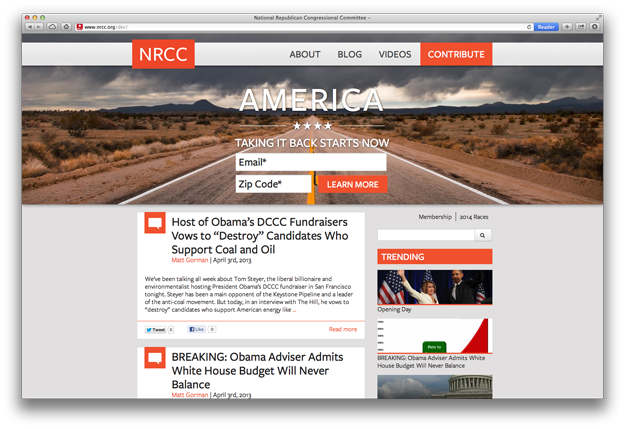
The National Journal has a sneak peek at the NRCC’s new, Buzzfeed-esque website, set to launch sometime in the next few days.  Since the dawn of 2013, the NRCC has been quietly and not-so-quietly doing some good things to get House Republicans (and prospective House Republicans) positioned well for 2014 – rootsHQ has a good write-up of that.

On the design side, though, check out the lack of traditional colors:

Home-v1

Contrast that with any of the other alphabet soup committees on either side.  There’s occasional splashes of black and yellow, but mostly red, white, and blue.  The NRCC is trying to stand out from those sites, and the early peek suggests they’re doing it right.

This should especially help drive donations and activism on behalf of Republican candidates.  The cynical analyst might point out that the only people who will visit a party committee website is someone with a keen interest in politics.  The average citizen won’t look to the NRCC as a destination for content, though they might see content in other venues like Pinterest or Facebook.  But those with a keen interest in Republican politics want something different from the party after the previous two Presidential elections when old white guys didn’t do so well.  They want a different tone, and something they can believe in.  By showing a fresh, new look – combined with the more aggressive and pop-culture-influenced messaging strategy they’ve been sharpening for a few months – the NRCC can satisfy the thirst among the activist class for a fresher look and feel.

Twitter predicts the Oscars… sort of

New Media Strategies predicted most of the major Oscar winners looking at social media data.  Brandwatch pulled a similar trick.

America has plenty of elections, from the crucially important annuals like the Oscars or the meaningless Presidential elections that we only bother with every four years.  In many of them, online networks and social media can predict results – winning candidates tend to be mentioned more on Twitter or liked more on Facebook.

While some will jump to the conclusion that online chatter will drive the support that pushes a candidate over the edge, that’s an over-simplistic reading of the situation.  Social media posts are tea leaves of human behavior, but not usually the initial driver.  It’s worth watching data trends and extrapolating results, but trying to create those data trends to ensure a specific outcome is a waste of time.  Daniel Day Lewis didn’t win an Oscar with social buzz, he won by making the legislative posturing surrounding the passage of the 13th Amendment interesting and engaging.  He didn’t even have to slay any vampires, so that was good too.  Similarly, online activity follows good political candidates, it doesn’t create them.

(Sidebar: What kind of a sick joke is it that Lincoln Motor Company is a subsidiary of Ford?)

If the correlation between online data and reality was more direct, according to Google we’d all have the flu by now.


Not just what it says, but where

Michael Turk had a great post on the center-right’s tech/data gap yesterday – but the best part was where he wrote it, in the American Spectator.

Spoiler alert: Turk warned that investing in new technology is not enough, that Republicans need smart people thinking about human behavior and voting patterns as well.  Good call: It’s not enough to figure out how people are interacting with a campaign, since most people in their right mind run away from political communication.  There’s an academic component in figuring out how to reach these people and keep them from running.  (Unless you use glue traps, of course, but there’s some questionable legality there.)

Ok, the right needs thinkers.  Where do they come from?  Political parties are good for resources, but not always innovation.  Remember that while much of the Obama infrastructure has been bequeathed unto the Democrat National Committee, it was the Obama campaign that built all the new toys.  Plus, if the eggheads don’t show immediate dividends, Republican candidates will wonder why the national party money that could be helping them win air wars is being spent to pay Lewis Skolnick.

The best spot for a bunch of data nerds is somewhere in the non-profit universe – whether it’s with an educational foundation like Heritage, an activist group like Americans for Prosperity or FreedomWorks, or a super PAC like American Crossroads/Crossroads GPS/Conservative Victory/Crossroads: The Next Generation.  With no donation limits, these groups can make a much better case to the big-ticket donors they’ll need to get the ball rolling.  Since the checks can be bigger, it’ll take fewer of them.

Conservative movement non-profits could be better positioned to start the process.  That makes The American Spectator a pretty good place to raise the issue.

The Googlization of Government

Rep. Tim Huelskamp has been banging the drum on a proposed Health and Human Services rule that would mandate insurance companies share patient data with the federal government.  The purpose of the program ostensibly noble – the administration wants to collect as much data on health care as possible to determine.  But Huelkamp correctly notes that data is not always secure.  Companies and governments lose personal data on customers and citizens periodically.

In a related story, Google revealed that the US government asks the search company for more user data than any other government on the planet.  In fact, there were more requests for Google data than there were wiretaps on phones last year.

While Google may look skeptically on the government requests for information, the HHS program sounds like something out of Google labs – aggregating data about users of the health care system to ensure better future outcomes.  Just as Google has multiple touch points where it meets its users (search, YouTube, Android, Gmail, etc.), so does the government.  What if they started connecting the dots?  We send tax returns in each year, so the IRS knows how much we make, where we live, whether we own or rent, what we do for a living.  On a state level, readily available voter registration data tells them how often we vote and may even give them a good idea how we would vote, based on primary voting history.  That doesn’t even get into people who participate in federal programs for medical help, student loans, social security, or public assistance.  And it doesn’t take into account the possibility of government looking elsewhere for data.  Today it’s Google, but a host of other companies are out there looking at what you but, what magazines you subscribe to, how often you gas up your car, and what TV shows you watch.

Eventually, other government agencies could follow the same model as HHS, expanding their data points on each citizen.  That’s when it could get really interesting, especially if some enterprising staffer in some agency realizes all the information that’s pouring in.  Imagine if the roadblocks between executive agencies came down, all the data was in one big pile?  The administration could be an even more voracious consumer of data, and use if to create detailed analyses of national trends, attitudes, and issues.  Here’s a video representation of how this might look:

A campaign or company wouldn’t use available data to recruit new customers or make life better for existing ones.  When I go to Amazon or Best Buy’s website, they look at what I’ve bought in the past and make recommendations; it’s simply good business.  An executive agency, which is supposed to strive for efficiency, would pick up on this trend as a way to streamline government services.  The difference, though, is that if you’re creeped out, you can always shop somewhere else.


Romney’s online ads and offline issues

Last week, Mashable and David Weigel both noted that Mitt Romney has been investing in web ads, but that he has yet to run an actual TV commercial in the early primary states (or any other states, obviously).  Mashable chalks it up to a money-saving move that has the added benefit of appealing to young voters:

It’s possible the candidates are waiting to amass more funds to pay for more-expensive airtime. Or, they could be engaged in an informal standoff for who will try to rule the airwaves.

On the other hand, web ads are a smart move. They are relatively cheaper to make and broadcast and naturally appeal to younger, web-savvy voters — traditionally a weak spot for Republicans.

After the criticism he took in last night’s debate, though, a web-focused strategy makes perfect sense for Mitt Romney.  The video which spawned last week’s round of coverage chided the Obama Administration on trade and intellectual property rights, which isn’t exactly a front-page-news-making issue.  It does, however, speak to some key audiences.  It’s one thing to say you appeal to philosophical conservatives who view government as an instrument to protect citizens’ rights and voters whose views align with business and commerce; but Romney’s ad deals brings up a niche issue that demonstrates an understanding of these voters’ motivations and concerns.

These are also the types of voters who are probably still deciding whether or not a Romney Presidency would be better enough than an Obama Presidency to be excited about a Romney candidacy.  Despite the fireworks of last night’s debate and this morning’s conventional wisdom that the other candidates put him on the defensive, Romney still carries the mantle of inevitability as the 2012 Republican nominee.  He still has plenty of people to convince to avoid being an also-ran in the same category as former inevitable nominees Bob Dole and John McCain.  He won’t be able to explain away his Massachusetts health plan, but online video gives him a medium to show conservatives he understands other issues.