Study: Still waiting on that online advocacy revolution

A new study released by a troika of new media firms (2ndSix, TribeEffect, and Chris Lisi Communications) charts some surprising trends in online advocacy – more accurately, the lack thereof.

The study evaluates 102 top trade associations, membership organizations, and other groups with political advocacy goals and charts their use of a number of online tools – everything from collecting email sign ups to Twitter to blog badges to Facebook and everything in between.  Most of the tools considered were either free or low-cost; yet the study found a surprising lack of use:

Overall, there is a lag in the implementation of the new media tools.  Many of the organizations reviewed in this report have not yet embraced or employed many of the readily accessible online communication and social media tools… 76% of the most commonly used social media tools are not being utilized to communicate with members, voters and other constituencies.

On the heels of the Obama Campaign, Washington D.C. was abuzz with the possibilities of online campaigns.  So what gives?

There are three things to consider when wondering why the digital wave hasn’t crashed the banks of the Potomac.  First, online and social media are new, and some of the key decision-makers in these groups may not understand them fully.  Being fully committed to online activity means surrendering some message control and directly engaging people who have negative comments.  That may resonate with the front line folks, but senior management will usually have to deeply consider what amounts to a change of strategy.

The second item to consider – which draws a bit from the first – is that social media activity can be difficult to quantify to important stakeholders.  Anyone can build a Facebook page with 5,000 fans given the resources; but translating that to action can be difficult.  In other words: if you work for a health insurance trade group, and you recruit 5,000 Facebook fans or Twitter followers from all over the country, how many are going to be able to call Sen. Olympia Snowe’s office to tell her she shouldn’t bow down to the Democrats’ health care overhaul?

There’s a third and final item to keep in mind.  The study itself admits that it doesn’t evaluate the effectiveness of the various tactics employed by each organization – in other words, the study simply charts charted whether a group has a presence on Facebook, but not whether that presence helped further their policy goals.  Just like a real-world toolbox, and online toolbox has  implements for a variety of uses.  But just as you wouldn’t use a screw driver to pound nails into a plank of wood, you might look at your online goals and decide that Twitter or LinkedIn just isn’t right for you.
Because I switched to WordPress, this will never apply to me

New York is investigating whether a blogger is considered self-employed or unemployed.  The decision hinges on the buck-per-day revenues she generated from Google ads on her blog.  When the former lawyer reported the revenue, the state launched an investigation into whether she still deserved unemployment benefits.

The site is still up, and the ads have been removed – which means New York’s Department of Labor succeeded in keeping a laid-off lawyer from experimenting with new revenue streams which could have lead to gainful self-employment.  Good job!

New and improved but with room for improvement

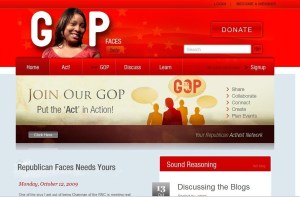
GOPscreenshot

The Republican Party re-launched GOP.com today.  In addition to discussions about the party platform, the site includes multiple opportunities for grassroots participation.  The home page shows the latest from the most important social networks.

These are all positive elements, and the timing is good – Republican excitement is naturally regenerating after the defeats of 2006 and 2008 just like a starfish regenerates an arm, and this provides an channel for that excitement.

The site seems to be a bit slow, though – which makes it tough to explore since the content is spread out fairly widely across the site.  With multiple blogs and action centers, the site has lots of nooks and crannies.  That’s probably better in the long term, but as an infant site, GOP.com looks a little light on content.  Sub sections feel a little barren.

Because content is king, the Republican Party will need more meat on the bones.  Since they have good avenues for user generated content, that’s more about increasing visibility – something they should have the infrastructure to do anyway.

One BILLION hits… per day

On the third anniversary of its acquisition by Google, YouTube is celebrating that it now averages a billion views each day.

There’s another way to measure their success, though: The term “YouTube video” has also entered the cultural lexicon to define short, viral, online video – the same way “Xerox” was used for years as a synonym for photocopies.  YouTube isn’t just on your computer screen, it’s in your head.

Twitter might actually make money!

On the heels of the Associated Press floating the idea of charging search engines for its bulldog edition content comes the news that Twitter is in talks with both Microsoft and Google to include tweets in their search results.  This may be a business model that actually works.

Search engines are, by nature, aggregators of content and serve as the doorway to the internet.  With two search engines competing for market share, that means each must be on the top of their game.  For sites like Twitter, that means their large user base (which generates relevant, in-demand content) is pretty valuable to someone conducting a search query.

These deals would also be the first answers the question of how Twitter will actually monetize that content.  This arrangement would allow Twitter users to take advantage of a still-free service and actually help them attract traffic; it would mean a stream of revenue for Twitter that doesn’t involve someone saying, “Yeah, that sounds like a good idea, so I’ll write a check until you figure out how it makes money”; and it gives Microsoft and Google a way to provide better search results to increase their market share (which attracts advertisers.

It’s a good model, and like the AP’s plan, it takes advantage of the fact that, for the first time in a while, there is legitimate competition among search engines.  This doesn’t work on an internet where one search engine is clearly dominant.  And even though Google is the clear leader in search engine market share right now, Microsoft has the resources to stay in the game for a long time.

Texans can be so creative

The Texas A&M chapter of Young Conservatives of Texas found a new way to illustrate what mandated health insurance.  According to CampusReform, they have launched an online petition to oppose the “Health Care Draft.”

Their basic message is good because it makes the health care debate more personal for each individual.  The health care debate takes on a different meaning when the discussion isn’t about insuring everybody but about the fines and jail time you could serve for not having health insurance.

For $3, I would have posted this earlier

The entire readership of this blog emailed me about the story that the Associated Press may try to charge a fee for their displaying their news content early.  (Thanks, Mom.)  At first, this seems dumb – trying to delay access to online content sound like trying to put toothpaste back in a tube – once it’s out, it gets everywhere.  But this is less about re-inventing content distribution than it is about recognizing what AP CEO Tom Curley calls an “enviable moment.”

A year ago, relevance meant the top result on a Google search – and doing whatever Google said you had to do to make that happen.  In general, that’s still true.  But since Microsoft is serious about making their Bing search engine a serious competitor to Google, that means that both Google and Bing must be more mindful of that their search results deliver content which is relevant.  If Bing’s news aggregator is posting AP stories before Google News, that’s one more reason for users to move over.

For the AP, it’s not a long-term business strategy – but it is a chance to take advantage of a brewing search war.

Wizards find one less excuse for losing

The Washington Wizards are streamlining their 250-page playbook – and adding more information at the same time.

At the start of training camp this week, each player received an iPod with a pre-loaded playbook.  In addition to standard diagrams of each play, the iPods were loaded with videos – to demonstrate the plays – and schedule information.  As the season moves along, coaches will use the iPods to distribute scouting reports and other updates.

This use of technology made me think about the applications to political efforts – and reminded me a little bit of the portable DVD players used by Rep.Patrick McHenry when he ran for Congress in 2004. Way back then, door-to-door volunteers delivered video messages from McHenry to voters.  In 2010, those volunteers might be armed with a personal video message, voter history, precinct walking sheets, polling locations,and megabytes of other information which is constantly being updated – literally in the palms of their hands.

Just as all the technology in the world won’t win a campaign without a good message, the Wizards can’t rely on gadgets to crack the 20-win barrier.  But given last year’s results, it can’t hurt.

There’s no app for that

Apple has rejected a proposed iPhone application because it is, as ReadWriteWeb reports, “politically charged.”  The app in question helps advocates for nationalized, single-payer health insurance organize and make an impact – or it would, if anyone could download it.

There are plenty of people who would disagree with the app’s goal.  But, as with any speech, the answer is to respond in kind – perhaps to create another app that helps people organize and speak out for a patient-driven health care system.

Apple has every right to reject any app it wants.  That may not be the best business decision, though.  Part of the iPhone’s appeal is it’s ability to be the Swiss army knife of mobile devices through the various applications.  By rejecting political applications, Apple is cutting out a large segment of potential users.  (And incidentally, the Obama campaign released a similar app about a year ago to help mobilize voters and volunteers.)

If this move was an attempt to avoid political controversy, Apple couldn’t have gotten it more wrong.

Online activity isn’t always good

Mashable is one of the best blogs out there talking about all the next big things. Their post today on the imminent announcement of the NBA’s social media policy is a great example of why expert advice about online media should be taken with a grain of salt.  In reading the tea leaves on what limitations the NBA might create on its players use of social media and networks, Adam Ostrow calls the NFL’s policies unnecessarily stringent:

The NFL recently reinforced its reputation as the “No Fun League” by banning all social media activity by players, their representatives, and team personnel both during and 90 minutes before and after games.

Actually, that restriction isn’t so bad.  Considering that there are extremely intricate guidelines about sharing information – especially on injury reports – a careless update on Facebook or Twitter can inadvertently tip a team’s hand.

There’s always a case to be made for maximizing your communications avenues.  But given recent player conduct, the NFL offers a good example of when it may be a good idea to sacrifice a little transparency for message control.