New Facebook Groups and organizing

The launch of Facebook’s new Groups feature last week was largely overshadowed by this week’s Bing/Facebook social search announcement and the success of Facebook: The Movie (a.k.a. The Social Network).  But in online organizing circles, the new feature presents some questions about the future of online organizing – namely how

The answer to those questions depend on who is asking them.

The Basics of Groups

Facebook Groups is essentially the love child of a glorified list serv and a wiki, with similar functions as Google groups.  Group members can send blast messages to the rest of the group, chat, and share content.  What makes Groups a bit more interesting than a list serv is that a user creates a group, he or she can add other users without their permission.  Adding someone to a group is as easy as tagging them in a photograph.  If you’re a Facebook user, you can be added to a group without actively joining (barring some privacy setting adjustments, of course).

Groups vs. Pages

Facebook’s pages are easy to set up, and getting a user to join a fan page is as easy as having them click a “like” button.  That’s why many campaigns, causes, organizations, and companies use these pages – aside from operating like a website within Facebook, it’s relatively easy to rack up big numbers of followers if you have some money to spend on Facebook’s cost-effective advertising.  Communication with followers is somewhat passive – your posts wind up in their news feed, but you can’t send mass messages – so followers are not always engaged.

Groups are even easier to build than Pages, thanks to the aforementioned tag-style recruitment method.  Group members can be engaged more actively that page followers, but a group administrator has less  control over the direction of the discussions that take place among group members.  This is fine if you are using Facebook Groups for discussions among members of a task force or working group, but gets problematic if you want to use it for a political or issue campaign that relies heavily on message discipline.  If you’re part of a small group of activists, though – such as a local Tea Party group – Groups as it currently exists can be very helpful.  In many ways, Groups is built for the citizen activist.

Groups and the API

“As it currently exists,” though, may be the operative phrase thanks to the recruitment-as-tagging method mentioned above and another, potentially quite powerful facet of Groups: the open API that lets applications access, communicate, and essentially mine information from Groups:

The API currently enables developers to pull a Group’s basic info including name, description, owner, last updated time, and privacy setting; access the Group’s picture, view existing posts; see all members; and post to the Group… The API will allow developers to build applications over the feature, such as Group feed readers, Group recommendation engines, and more.

What this means is that smart online organizers will use Groups as a recruiting tool, reaching out to these small, self-organized communities to build “like” counts on pages or to join other groups, depending on their specific goals.

(Of course, with all the controversy Facebook and other online networks have suffered due to privacy loopholes, this may not last long.)

The Real Nature of Facebook Politics

Either way, Groups illustrates something very important about Facebook organizing: Recruiting for volume is less and less important than recruiting large numbers of the right kind of connections, either as group members or page followers.  Having 100,000 followers or 1,000 members is, ultimately, no big deal – all it takes is money for ads or the chutzpah to tag all your friends (and some of their friends, perhaps).  The real question is what those followers and members do to help your ultimate goal – whether that goal is votes in an election or a phone call to elected representatives.

“Likes” are cheap, but action is valuable.
It’s still a Google world

Today’s announcement that Facebook and Bing are joining forces is being hailed as a major blow to Google.  But before we start chiseling a headstone, let’s think about Google’s week so far:

All this adds up to the fact that Bing may lap Google in the search battle, but that’s swiftly becoming less important to Google’s business model – which has always been about collecting data from different points of your daily life and using that to serve you ads.

Maybe the wind farm doesn’t obviously fit into that (although, their servers crank up an awful lot of heat and use lots of electricity to crunch all your data).  But turning the family TV room into a Google-fueled den and knowing exactly where people are driving are both pretty advantageous for an advertising company.  The possibilities for each of these technologies in 20 years is mind-blowing.

Facebook will continue to be valuable because of the value it offers in organizing our relationships, but Google remains one step ahead in its quest to organize (and monetize) the world’s information.


Old media covers new media; avoids scowl, snarky comments

If you missed it over the weekend (like I did), Fox News Channel ran a couple interesting segments on campaigns using text messaging to reach out to voters, including this one:

It’s good that there’s attention paid to campaigns using new, emerging technologies, but if a campaign tactic is only there to get free media then it probably isn’t worth it.  But as the piece indicates, mobile phone screens are valuable because they are always with people, and text messages have very high open rates.  Smart campaigns are recognizing this and, where it makes sense, instituting tactics that take advantage of this.  One example is Carly Fiorina’s use of realGood Technologies‘ mobile phone bank – a platform which transforms any mobile phone into a terminal for a campaign call center.

Many of the high profile 2010 races aren’t using any text messaging outreach – after all, midterm electorates tend to skew older and turnout is usually lower.  But some of these campaigns offer a good preview for mobile campaigning for the 2012 Presidential election


Angle’s strategy: a wise investment

News has been slow coming out that a Harry Reid staffer pulled off the kind of stock market trick that would make Gordon Gecko come out of retirement for a sequel, doubling an investment in part on the results of legislation that was already moving through Congress.  (And leave it to a retiring Member of Congress, Brian Baird, to actually file a bill that holds Congress and their staffers to the same standards they have set for those evil Wall Street speculators.)

But as dumb as it was to pull such a stunt, Reid’s opponent Sharron Angle is keeping wisely mum.  Politico chalks it up to a “don’t trust media” strategy, but what could Angle gain from blasting Reid.

As Reid’s opponent, Angle is just about the worst person to criticize him – she’s a vested interest.  If the media carries the torch on the story, Angle is best to stay out of the way – and if they don’t, the NRSC’s independent expenditure division will likely jump on the story if there’s any political hay to be made.

Why should Angle sling the mud if others are willing to do the dirty work?

The Least Interesting Man in Washington State

According to this ad, that title is held by Dino Rossi.  It’s a great find by Project Virginia

This is a great model for an independent expenditure ad.  Instead of beating the viewer over the head with sinister music and wild claims, it’s creative and funny – and frames the election in a way the Rossi campaign couldn’t (and probably shouldn’t).  Best of all, it praises Rossi while poking a bit of fun at him – making it much more credible to the undecided voter.  With polls split down the middle in that race, Rossi could use any edge he can get.

The I’s have it

The Democrats may be knocking Republicans for being a party without new ideas, but the DNC’s strategy for exciting its base seems to be about a cult of personality.  A message to activists over President Obama’s signature makes that very clear:

I come into this election with clear eyes.

I am proud of all we have achieved together, but I am mindful of all that remains to be done.

I know some out there are frustrated by the pace of our progress. I want you to know I’m frustrated, too.

But with so much riding on the outcome of this election, I need everyone to get in this game.

If you’re scoring at home, that’s six I’s in the first five sentences.  And for a base that, much like George W. Bush’s in 2004, might be frustrated by the administration’s inability to deliver the ideologically pure achievements many had envisioned in the days after the 2008 election.

There’s no public option.  Democrats themselves are divided on the Bush tax cuts, so a tax hike on the wealthy job creators is unlikely.  There is no card check procedure to make it easier to organize unions.  The financial reform bill lost a lot of teeth from where it started, and massive sums of money have been spent on corporate welfare.  So what’s left to excite a liberal base that has to be excited if the Democrats are to maintain full control of Congress?

The answer is apparently a couple of pages from W’s playbook:  1) Make the election about resolve rather than results (recall Bush’s 2004 message, “You may not always agree with me, but you know where I stand”?) and 2) Remind your ardent supporters that the other side is much, much worse.  In 2004 it inspired enough activists to pull a vulnerable incumbent President over the finish line against a poor opposition candidate, so it will likely resonate in some places.  Since the hardcore activist in California is different from the hardcore activist in North Carolina or Virginia, it may not help universally, but at this point Democratic strategy is more about stopping losses than making gains.

The real question, though, is whether the 13 million activists on the Organizing for America list that received this email are still excited enough to volunteer their time for Barack Obama again.

An extended break

Since I’ll be away for a couple of weeks, here are some of what pass for greatest hits when you run a two-bit nickel and dime blog:

Girls gone civic

In news from last last week, here are two college-age women in a dorm room with a video camera who got the attention of a Senator:

Sure, it may give the feeling of being a “staged reality” video, but it’s one way to make the “take action” tab on an advocacy campaign website a little more effective.  If you browse through advocacy campaign sites, you see these tabs frequently: the “take action” button that lets you put in your zip code and send an email message to your representative on Capitol Hill.  It’s easy to do – and the people in charge of reading the messages know it’s easy, because they get hundreds of thousands of them each day.  Sometimes there are also options to call, but consultants don’t like those options because calls are hard to track and don’t offer obvious, easy sharing on Facebook and Twitter to make a cause go viral.

The dirty little secret of the “take action” tab is that most Members of Congress – or, more accurately, their staff members in charge of answering constituent concerns – don’t care about your emails because they can’t – they simply don’t have the time to respond to one-click activism.  Phone calls get more attention (and in-person meetings are the best), but many folks are intimidated at the idea of dealing directly with a Congressional office.

Whether or not this video was actually a set-up by the Servicemembers Legal Defense Network (which obviously, from the video opposes Don’t Ask Don’t Tell) it’s a good model for other issue campaigns to actually show people taking action.

The heroines, Lauren and Ellie, lead by example and make the call to lower the intimidation factor.  Then they gather friends and get them to call. And by posting their call on YouTube, Lauren and Ellie prompted a response from Senator Michael Bennett – elevating their involvement from one-on-one communication between a constituent and a representative to a public discourse in the virtual town square.

Best of all, the video not only promotes more effective activism, but makes phone calls a viral tactic as well.  Just scroll down the video’s YouTube page and check out the response videos where people show themselves calling their own representatives in Congress.

More on mobile: the “App Class”

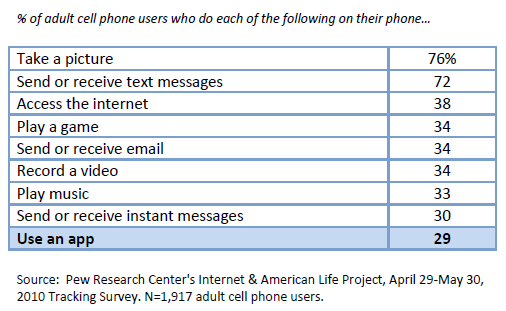
To follow up on a post about using mobile tactics from earlier this week, a Pew Research survey on mobile contains some interesting findings.  Unfortunately, Pew’s headline (as well as Mashable’s post covering it) miss an important aspect for campaigns.

Both highlight that the survey says one out of four adults use mobile apps.  This is true – behold this chart (courtesy Mashable):

Where they see market growth (correctly), issue and candidate campaigns have to see stratification.  There are two mobile Americas: one which uses their mobile phone for games, music, news, directions, shopping, updating social networks, and other varied pursuits – an “App Class,” if you will – and another which really looks at the phone simply as a simple communication device to pass information viavoice (and occasionally text and picture).  About one out of three people look at their phone as a handheld computer.

If a campaign, therefore, is going to invest in an application, for instance, the design process has to consider that most people will not use it.  That doesn’t mean pulling the plug on the app – in fact, because the penetration of app-driven phones keeps increasing, it’s only a matter of time before every campaign has to have a customized app.  (Consultants, start your engines!)  What it does mean is that a wise campaign will ensure their app does the things the App Class will want to do.  As an example, it may be a better idea to have apps that connect with back-end campaign data to help precinct walkers and staff than to have apps that help people find their polling place.

Making online/mobile strategies count

Matt Lewis had me back on his podcast today, and we discuss the balance campaigns must strike between different tech tactics.  Specifically, we chat about Florida gubernatorial candidate Rick Scott’s very deliberate decision to avoid text messaging in favor of email to announce his running mate.  In this case, the Scott campaign decided that emails were more valuable to their campaign strategy than mobile numbers.  (Given Florida’s elderly population, it was probably a wise choice.  Also facto in the power of email’s reach – John Boehner actually sent an email update to his supporter list to draw attention to a tweet.  It sounds redundant but it’s actually the best way to make the tweet gets seen.)

As Matt and I discussed, the rumor from Scott’s consultants is that he is not averse to spending money – so this was an educated decision.

I’m excited to see the implementation of good mobile strategy – and text messaging is going in some exciting directions.  But too often, the people with resources to burn don’t stop to think through their online strategy.  This is especially true with issue or candidate campaigns which use tools like Facebook for messaging, but really don’t know what to do with their 10,000-person follower list after everyone clicks the like button.

To use an old-school campaign example, imagine going door to door for a candidate.  When the voter opens the door, you ask, “Hey, are you going to vote for my guy?”  The voter says, “Yup!” and the conversation ends.  You don’t take down their name, address, or phone number, or even ask if they’d like a lawn sign.  The same is true if think taking action on an issue you care about ends when you send an email to your Member of Congress.  Chances are, that email will be counted and deleted because the staff knows how easy it is for any crazy person to send them an email.  (That’s why advanced follow up is always recommended.)

No matter how advanced your tactic, if it isn’t applied with some measurable and impactful result, it’s a waste of time and resources.