A spokesman for Mr. Corbett, Kevin Harley, said the subpoena had nothing to do with the criticism of the attorney general… He said the subpoena was related to a criminal case concerning Brett Cott, a former political aide convicted in a political scandal known as Bonusgate. That long-running investigation concerns bonuses paid to legislative staff members and whether they were illegally related to political campaign work.
For Corbett’s sake, I hope this isn’t simply an attempt to shut up anonymous critics, because it’s hard to think of a less effective way to do it. Consider that, between themboth, the accounts probably have no more than 1,000 unique followers, and that comes after a round of national press coverage that has surely inflated those totals. Everything Corbett has done has only driven more eyeballs their way. And any type of censorship – or perceived censorship – of political speech tends to be a bad issue for a candidate.
The online team employed a phased rollout approach, recognizing that the need to have something up online early trumped the need to launch a website with all the bells and whistles. And the back end content management system of the site was built so that anyone could update it – in other words, instead of the “website guy” having the keys and being the only one able to drive the campaign’s online presence, everyone got their own car. It provided for a streamlined, slick, and – ultimately – victorious campaign.
The online campaign didn’t win PA-12 for Mark Critz by itself, but no online campaign is capable of that. It was successful by the measure that matters: it didn’t get in the way of a the other parts of a well-run campaign.
Augmented reality is a pretty neat trick, using markers picked up by webcams (or cameras on mobile devices) to display images that others can’t see. This has been around for a while, but it usually required some type of narcotic substance; now it can be harnessed through technology without ingesting hallucinogens.
With smartphones becoming a hub of political activist activity, the next question is: how does the next “revolutionary” campaign use this technology?
The easiest way will be to turn lawn signs and other advertisements into instant sources of new information. The typical lawn sign is pretty simple: it has a name and, maybe, a slogan but little else. Augmented reality would allow passers by to point their iPhone or other mobile device and instantly have access to a much broader range of text and information.
But for many campaign operatives, the more fun part might be finding a way to piggyback messages about an opponent onto his or her own signs – the messaging equivalent of Bugs Bunny drawing a mustache on a wanted poster of Yosemite Sam.
Web comic XKCD – which chronicles stick figures discussing physics, science fiction, and computer programming – has unwittingly (or possibly wittingly) touched off a mini-controversy on Wikipedia.
The original comic featured a made-up word made up of words that dealt with making up words (with the original words, ostensibly, disproportionately popular on Wikipedia). Don’t be ashamed if that seems tough to follow – any web comic that has an explanatory blog is pretty high-end stuff to begin with. What isn’t tough to follow is that some enterprising fans created a Wikipedia entry for the made up word.
The ensuing debate among Wikipedia users and site editors took 19,000 words and resulted in searches for the word (“malamanteau”) redirecting to XKCD’s own Wikipedia entry. But it illustrates a good cautionary tale for user-generated content: it’s best to have good site rules up in advance in case you want to maintain any semblance of message control down the line.
And it’s also good to keep an eye on Wikipedia. Anyone can edit it, including people who might not have good things to say about you.
YouTube is celebrating not only turning five, but reaching 2 billion views per day. In the decade before YouTube, internet publishing and blogging had become commonplace. But though the internet had long been a place where anyone could put their work out there (as long as they didn’t mind not getting paid for it), YouTube’s video sharing platform – along with technology that made quality video devices cheaper – turned everyone into a video producer. Anyone could be Cecil B. DeMille.
That said, not everyone can effectively communicate on YouTube.
1. Video is now essential to message delivery.
Political communication has always been a matter of telling stories, and no medium can tell a story like video. In 1960, the story of the cool, collected, and telegenic JFK as the harbinger of a new political generation was cemented by his now-famous debate performance; in 2008, the story of Barack Obama as the idealistic, optimistic harbinger of a new political generation was cemented by a music video adapted from one of his speeches that seized upon the phrase, “Yes We Can.”
Politicians can try to position themselves with stump speeches and media appearances, and their surrogates can attempt to provide “objective” support. People believe what they see. That makes effective online video a must-have.
The reality of modern politics is that if you can’t make your case in a YouTube video, you have no chance of winning the hearts and minds of the public.
2. Brevity is art.
Part of the “effectiveness” factor is being able to boil an argument down to the point where it fits in a two-to-five-minute video clip. Case in point: one citizen activist was able, in 1:38, to sum up just how insignificant a 2009 federal budget cut proposal was:
3. The best ideas come from others.
The best part about YouTube is the opportunity for participation from the initiated, regardless of their “official” role. Obama’s nascent 2008 campaign had a lot of energy, yet it was tough for people to discern exactly what kind of change he offered. All Democrats were, in fact, plugging away at that theme after eight years of a Republican administration. But one Obama supporter – whose involvement in the campaign was tangential, though his enthusiasm wasn’t – summed it up by repurposing a famous 1984 Macintosh commercial:
The Obama campaign could not have cut this ad – it’s too direct, and it uses images and clips which are most likely protected by copyright. By supporting user generated content like this, YouTube invited a new level of citizen participation.
4. Compelling content is the most important factor in attracting an audience.
Never has publishing content been easier. Yet because of this, never has it been more important to create quality content: media consumers have plenty of choices.
It’s counter-intuitive: We think of the internet as this highly personalized frontier, where each user has the utmost control over the news he or she reads or the entertainment he or she consumes. Humans are social beings, and the internet augments that.
YouTube’s comments, video responses, subscriptions, and other site tools make it more than a place to post and share media; YouTube is a social network built on user connections.
But more that, YouTube success is based on the ability of an idea to pass from one person to another. High-ranked YouTube videos don’t amass viewers from independent searches, they come from recommendations. It’s the most obvious viral medium.
In January, Scott Brown’s campaign successfully used an internet-based phone bank from anywhere function to rally supporters from across the country; a Senate seat in California would be an equally significant pickup for Republicans. If Fiorina goes on to win the Republican Primary and takes out Sen. Boxer, this tactic will be held up as one of the big Republican success stories of 2010.
TechRepublican points to this pretty cool video about the continued significance of social networking:
The importance of online engagement is nothing new to businesses and politicians – at least, it shouldn’t be. Still, even those who appreciate the power of this communication don’t seem to grasp the underlying principles.
One set of stats stood out from this video: while only 14% of people polled trust advertisements, 78% trust recommendations from friends. Those aren’t necessarily Facebook friends, either; the more technology becomes integrated in our lives, the more it exposes our human nature. We trust people we know more than those we don’t know. Political strategists from the nineteenth century understood the need for voters to hear from local party leaders, and no substitute has ever worked.
Plouffe said the campaign was built using the Internet to engage voters in volunteering, contributing money and “sharing the message” amongst themselves. Connecting these people — not only to the campaign but to each other — helped them build trust with prospective voters they engaged both online and face-to-face.
“There is a lack of trust — in government, in business leaders, in academic leaders, even in faith leaders,” Plouffe said. But, he said, “People trust each other.”
Forget about local – all politics are personal, and always has been.
SNL’s target audience has always tended to be younger, and as such the show must constantly adapt to changing times. Tapping White to host in response to popular demand is a good start, as is the Backstage blog which includes sketches cut at the last minute. But SNL can do even more:
1. More online video content
I don’t know how many times I’ve wanted to make a post using an obscure SNL sketch to make a point. And honestly, there’s no reason (other than to promote DVD sales) for SNL not to have a library of all their sketches available on YouTube. Currently, only select sketches are available.
Aside from my selfish reasons, having every sketch ever made available could be a good business decision for SNL. Old, obscure sketches could become viral sensations when exposed to a new audience. And then there’s the social factor: For many folks, watching SNL is a social activity, and so any sketch can become an inside joke among friends – whether or not it’s a “classic.” An otherwise unfunny 1999 sketch where Horatio Sanz repeatedly screams, “a bear ate my parents!” was pretty lame, but it would get plenty of laughs from some of my UMass chums if I sent them a link to it. You and your friends probably have sketches like that too. SNL is missing out by not tapping into that emotion – it keeps viewers loyal.
By inviting submissions and letting viewers vote on which one should be on TV, SNL can not only build a great interactive relationship with their audience, but also find cheap talent.
Offering a season-long, election-style contest between two good comedic actors for a spot hosting the season finale would not only be comedy gold, but would reach into those actors’ networks – their Facebook fans and Twitter followers would suddenly have a reason to visit SNL’s website, and to recruit friends to do the same.
After yesterday’s crisis management advice for BP, it seems fair to look at what the world’s current least-favorite oil company has been up to online in its response to the oil spill in the Gulf of Mexico.
BP devoted a section their company website as a central repository of information about their cleanup efforts. The pages are very fact-heavy, along with two video responses from BP officials and several pages of pictures. Essentially, BP’s branded response to the crisis is an online press kit. While the breadth of information is impressive, this is an exclusively one-way channel.
There are, however, other venues. BP is one of the driving forces behind DeepWaterHorizonResponse.com, plus an associated Facebook page and Twitter feed. As one might expect, the Facebook page is the best of the group; Deep Water Horizon officials respond to comments with measured, polite answers to legitimate questions; and harsh critics are not censored. It helps that the initiative is not branded as coming solely from BP, thus diffusing some strong emotions folks likely feel toward the company.
It would be nice to see more from the efforts on the ground beyond a few pictures on all of BP’s online properties, something that could evolve as the campaign matures. It’s a decent enough first step for BP, but it will only work if it’s the first step of many.
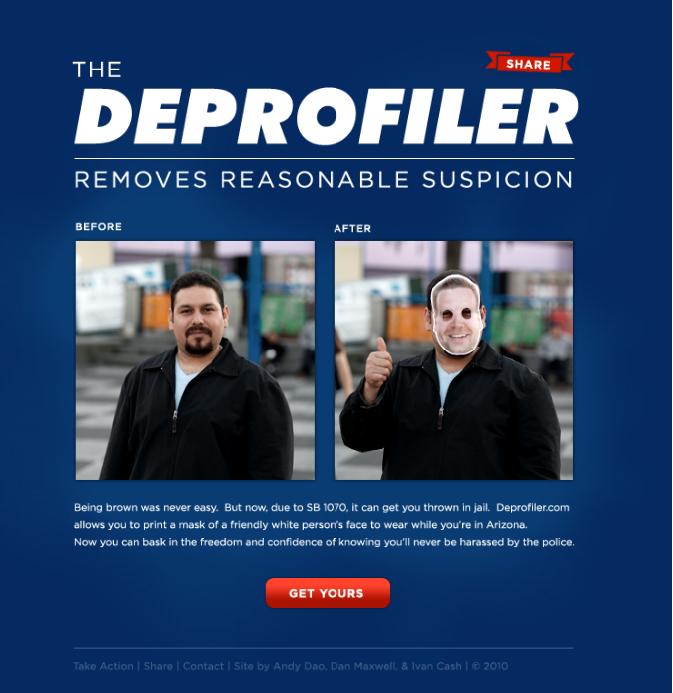
Whether you agree or not on the effect of the law, the site is really good – largely due to its simplicity.
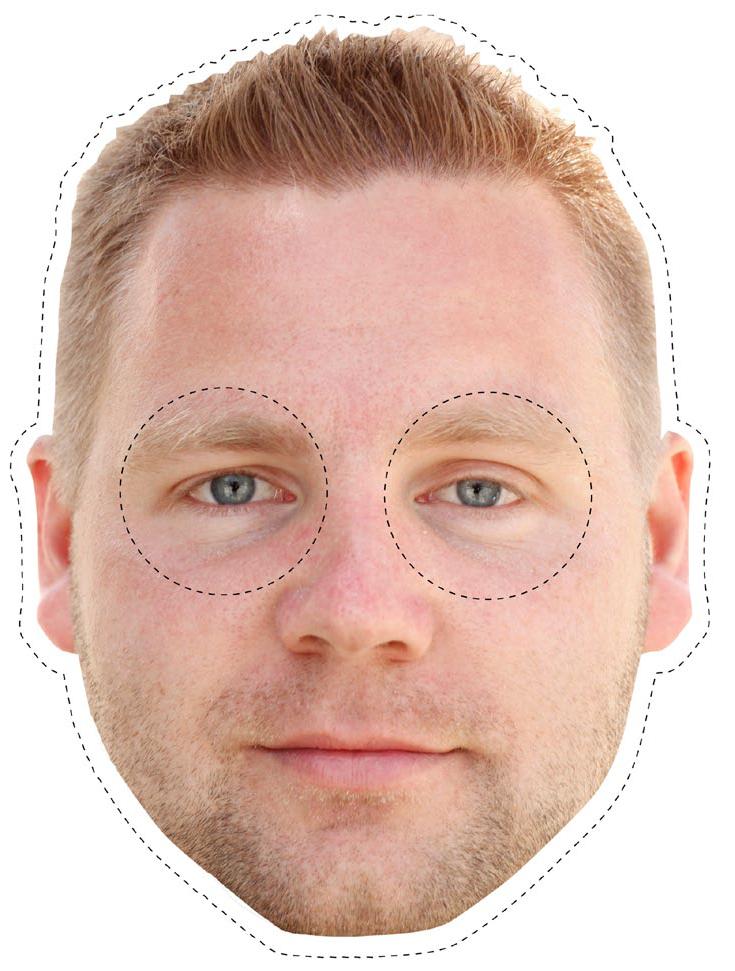
The design is basic and minimalist, and there aren’t a ton of extraneous functions. There isn’t any space wasted with background fact sheets for anyone who hasn’t heard of the issue. There are only two prominent features: downloading a mask and sharing with a friend.
In other words, the site doesn’t get in the way of its own message.
The most powerful communication is word of mouth. This site simplifies an important issue, makes its point, plays it for smart yuks, and gets out of the way while you send it out to your social networks.
 Jim Eltringham