A brief history of online video and elections, 2004-2010

This week, YouTube announced their top videos of 2010.  In a post over at Pundit League, I followed up with my Top Five Political Videos of 2010.

My top five is far less scientific than YouTube’s, and for good reason: while YouTube’s list is a Casey Kasem-style countdown of the videos that had earned the most views, my list ranks videos based on significance.  In other words, I’m wasn’t trying to measure videos based on their impact on the campaign, but rather use the videos as a barometer of what went on in 2010.

In fact, online video offers a glimpse into the big story of every election cycle since 2004:

2004: This Land – Pre-YouTube, JibJab’sWoody Guthrie send-up featured President Bush and John Kerry neatly summarizing campaign themes.  Bush claimed Kerry looked like Frankenstein, Kerry said Bush was a right-wing nutjob.  That the close election turned as it did was evidence that Bush’s accusations rang truer with the electorate.

2006: Macaca – George Allen could very well have been the Republican candidate for President in 2008 if he hadn’t slipped up and unwittingly used a word that may or may not be an ethnic slur.  As it was, Allen became the symbol of a Republican establishment so cloistered and out of touch they could point to the one guy at a rally who was holding a video camera and say something offensive.

2008: Yes We Can – Between this independent video and Shepherd Fairey’s “Hope” illustration, the 2008 Obama was smart enough to seize on creative elements produced outside the campaign structure.  From early in the primary season, the Yes We Can video established the Obama candidacy as more than a simple election effort, but as a once-in a generation opportunity to change politics as usual.  More than any online network or social media outreach, the core theme of a new and different kind of politics growing up added excitement and motivation to Obama’s support.

2010: A Generational Choice / Rep. Bob Etheridge covers the Who – Marco Rubio captured the themes of tea party movement in his impassioned web commercial for his successful Senate bid.  And Bob Etheridge’s hilarious confrontation of an investigative student underscored the Democrats’ arrogance, comfort with power, and lack of connection with voters.

Notably, all videos on this list save Senator-elect Rubio’s “A Generational Choice” were produced outside of the “official” campaigns, coming from interested and passionate citizens; in fact, two captured politicians in  moments when they let their guard down.  Yet intentionally or not, each video captured an important element of the election cycle.  Elections aren’t (usually) won or lost based on a two-minute internet video; but video can act as a signpost and give some indication of how a campaign is going.

Email marketing done right

The Wife received an email today from Adare Manor, one of the places we stayed during our honeymoon:

The email also included a message:

May you be surrounded by the warmth of home, the love of family & the company of good friends.  Happy Thanksgiving from Adare Manor.

It may seem simple, but it stands out because Adare Manor is in Ireland, and Thanksgiving – at least, the one that’s happening this week, is an American holiday.  They sent us a card for a holiday they don’t even celebrate – and judging by the message, they seem to have a good idea of what the holiday is all about, too.

Too often, online communication – especially through email lists – is treated like a broadcast medium.  It takes little more than some strategic thought and an investment of time to do things like segment out your list and craft your text carefully.  Sometimes, those running email programs lose sight of the fact that each row in their database of addresses is attached to a real person.

Sure, Adare Manor is trying to find ways to remind me that they exist, and encourage me to come back and stay there if I find myself in western Ireland again.  But they’re doing it based on what’s on my mind right now.  Even though there are probably tens of thousands of past American patrons who stayed in Adare and who received that same email, it feels personal.

Americans for Prosperity helps lower holiday week productivity

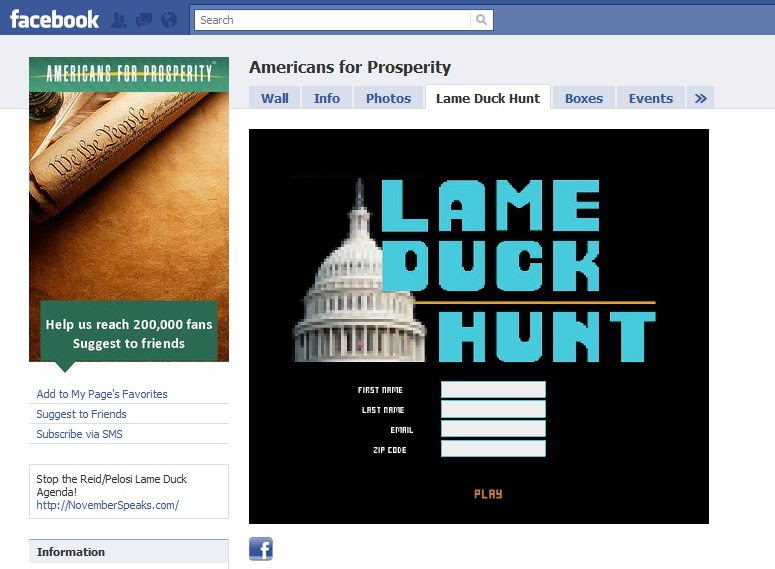
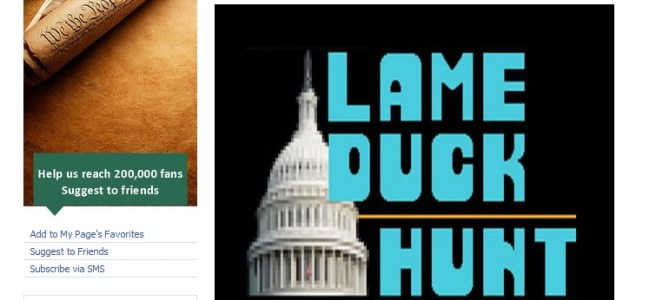
Channeling 1980s classic Nintendo games, Americans for Prosperity has a fun game called “Lame Duck Hunt” on one tab of their Facebook page.

The game isn’t all that challenging, though the gloating images of Nancy Pelosi and Harry Reid that taunt you when you miss make it slightly more frustrating than it needs to be.  This isn’t a game review, though, it’s a strategy review, and there are a few things AFP gets very right.

First, you can’t play the game without surrendering an email address and a zip code, meaning that anyone who participates in this little time-waster tells AFP which Congressional district they live in and how to get in touch with them.

(You do have to re-submit your information each time you play, which discourages repeat users.)

Once you’re in, you predictably shoot down ducks, which then disappear in a cloud of feathers and leave behind warnings like “Higher Debt,” “Card Check,” or “Huge Tax Hikes” – the policies which ostensibly could be the result of the lame duck Congress.  You can then share your score with friends.

This is where AFP’s aim starts going awry.  The game never offers any backing for the labels – there are no details about suggested or proposed legislation which would lead to union bailouts, huge tax hikes, or higher debt.  The message at the end invites me to “visit the Americans for Prosperity website” for more information – but there is no link.  Contrast that with the game released by the U.S. Chamber of Commerce last week, This Way to Jobs, a digital version of Chutes and Ladders which outlined the pitfalls of launching a small business.

Further, I have played the game several times (for… uh… research, for this post – that’s the ticket).  That means I’ve entered my email address multiple times, and haven’t yet received a follow-up auto-responder email.  After anyone plays the game, a quick follow up email inviting further action – while the issues are still fresh in the player’s head – could help AFP determine who is really on board with their policy agenda and who just hates video ducks.

Ideally, the game over screen and follow up communication would also allow users to identify what future actions they would be willing to take.  At the very least, it would invite a user to become a fan of AFP’s Facebook page.

These extra steps may not help with the lame duck agenda, but 2011 will be a critical year as the Republicans and Democrats try to set themselves up for success in 2012.  Lame Duck Hunt is a cool idea, and well-timed – between the impending holiday and people taking off work early to beat traffic, Thanksgiving week ranks only ahead of the dead week between Christmas and New Years in terms of productivity.  To that end, it’s guaranteed to bring web traffic – and it looks like AFP was content with that.

Project Titan: A new generation of Facebook messaging. And probably SPAM.

Facebook announced “Project Titan” this week.  With a code name like that, one might have wished for the press conference to open with Mark Zuckerberg bellowing, “Welcome to the world of tomorrow!”

Unfortunately, there was no such bellow.

There was, however, an unveiling of a drastically revamped Facebook messaging service.   The new interface is supposed to allow users to integrate Facebook’s internal traditional messaging and chat features, but what really sticks out is the entry of Facebook email address into the equation.

This is the biggest opening of Facebook’s walled garden yet.  And aside from the obvious possibility of an email client (like Microsoft’s Outlook) operating as your Facebook inbox, there’s the possibility that a person – or, more likely, a campaign or company – can send you a Facebook message as easily as they send an email.  It could open the door for mass-messaging through the Facebook environment – even though Facebook is taking steps to keep that from happening.

For all their efforts, though, the fact is that there are plenty of campaigns and companies who want to seize upon Facebook data just to have another avenue of communication – and a good Facebook app can expose this data pretty easily, with the user’s tacit permission.  Most likely, Project Titan is not the final iteration of Facebook’s messaging platform.

Anuzis highlights tech experience

After announcing his bid for the RNC chair last week by highlighting Michael Steele’s shortcomings in fundraising and the ground game, Saul Anuzis predictably started highlighting his tech-friendly background as a point of difference between him and the incumbent.

“It’s critical we integrated new media into everyday politics. It works, it’s efficient and we need to do it,” Anuzis told The Hill when contacted over the weekend. He also said his candidacy has already sparked enthusiasm among social networking aficianados.

What will excite online activists even more is that Anuzis isn’t making the election all about technology to begin with.  His initial announcement dealt with main, overarching problems he saw in the RNC.  Anuzis then brought up technology as a response to how he would deal with those problems.

Whether or not he is ultimately successful, arguing for technology as a means rather than an end prevents Anuzis from being labeled as a niche “tech candidate” and positions him as a more serious challenger.

Do you still get this joke?

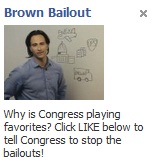
FedEx is spending lots of money on online advertising hammering away at an proposed regulatory change that would benefit UPS.  Using the parlance of our times, they are calling it the “Brown Bailout” – since the term “bailout” has such high negative connotations.

I’ve criticized this campaign before for tactical flaws – many of which have been corrected in the year since it launched.  And the people in charge of the campaign messages have always done a good job of explaining a complex issue completely in a simple – and funny – way with great videos.

But here’s the rub: those videos, while once effective, are outdated.  Those UPS whiteboard commercials are two or three years old, and the company has moved to an ad campaign which highlights “logistics.”  If FedEx’s government affairs division wanted to really hammer UPS, the new ads are quite mockable.

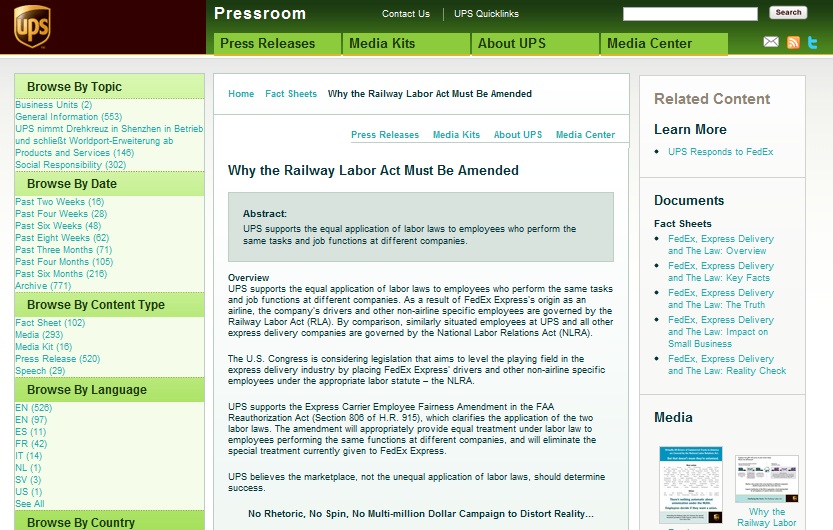
By recycling a year-old campaign, FedEx is taking a shortcut.  It would be like bringing a knife to a gun fight – but luckily for them, UPS is bringing a whiffle bat.  In the year and a half since FedEx has been running the Brown Bailout campaign, the best UPS could muster is this visually thrilling online press kit that could serve as that antidote to caffeine scientists have been searching for:


The race for 2012 started last week

With the mid-term elections fresh in the rear view mirror, the serious contenders for the 2012 Presidential nomination are unofficially kicking off their campaigns.  And the two likely front runners, Tim Pawlenty and Mitt Romney, have started with a pretty smart Facebook strategy.

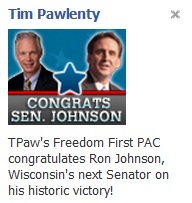
At TechRepublican, Ethan Demme noticed Mitt Romney’s new Facebook ads running immediately after the election, congratulating “high profile” candidates.  Tim Pawlenty has been doing the same thing.  But the strategy appears to be even more specific than that.  Here are the ads I saw:

What does incoming Arkansas Congressman Tim Griffin have in common with the Feingold-conquering Wisconsonite Senator-elect Ron Johnson?  Turns out, I’ve clicked “like” on both of their Facebook pages.  (I’ve also seen Romney ads supporting former and future Iowa Governor Terry Branstad, whose Facebook page I’ve also liked.)  In other words, I’m a self-identified supporter of these politicians – a factor that Facebook’s ad platform allows campaigns to take into account when they target advertising.

By playing on the interest of possible supporters, Romney and Pawlenty share an excellent outreach strategy.  The question will become what each campaign does with the supporters they recruit.  Pawlenty has already made a push to take advantage of Facebook’s capability for activation through interactive town halls, while Romney’s page is more or less a one-way communications channel – but neither has taken a decisive lead in innovation on this platform.

Effect and cause: social campaign strategy and election victories

Facebook pointed out yesterday that House candidates with more popular Facebook pages won 74% of the time, while Senate candidates with more likes winning at an 81% clip.  This is quite a trend, but the metric goes a bit deeper than clicking a like button on a politicians Facebook page.  It means very little to have thousands of Facebook fans, given how inexpensive Facebook advertising is.

It’s just a hunch, but I bet an evaluation of other online metrics would indicate the same thing.  The winning candidates probably had more Twitter followers, YouTube subscribers, and email list members, too.  People joining these lists involve self-identifying as a supporter of a candidate.  It doesn’t lead directly to victory, but it’s a good indication that a campaign is doing the right things that will lead to victory, such as reaching out to people and getting them involved.

Having a horde of Facebook fans is the symptom – not a goal – of a well-run campaign.

RapLeaf and opposition research

This week, the Wall Street Journal discussed just how fine online targeting companies can get thanks to online behavioral targeting companies like RapLeaf.  For what it’s worth, RapLeaf seems to make a good faith effort to keep certain personally identifiable information private, but that’s a little like putting toothpaste back in a tube.

So here’s an interesting hypothetical: does this become part of campaign opposition research?

Obviously, a campaign couldn’t call up RapLeaf for a file on a particular user, but there are other ways to get private records.  Medical records are the best example: one candidate will release full medical records to demonstrate a clean bill of health; if an opponent doesn’t do the same thing, it looks like they have something to hide.

Let’s say a squeaky clean candidate goes to RapLeaf and wants to buy the file they have on him or her.  After a thorough review by the campaign staff, the record is released to the media.  The opponent has to do the same thing, right?

It could be interesting to see where candidates spend their time online.  We as an electorate would be able to peer into the brains behind the names on the ballot.  Sure, we would learn where they get their news, what pundits they read, and what issues are really the most important to them.  But we could also learn how much time they spend playing Farmville, which YouTube videos of windsurfing ostriches they’ve commented on, and whether they’re into midget porn.

In other words, it could offer a treasure trove of embarrassing and/or hilarious moments for the campaigns of tomorrow.

Foursquare fights back

Just after Gowalla started getting some nice press for their campaign activity, Foursquare fought back by acquiescing to Jordan Raynor’s suggestion and creating an “I Voted” Badge.   Foursquare is also hosting an “I Voted” website, which will track polling place check-ins nationwide.

As Foursquare looks to cement their lead in the location-based network game, it’s a wise move to become involved in politics.  But there’s a danger in entering the political space to “encourage civic participation”; Generic get-out-the-vote efforts simply can’t match the passion of a hotly contested election.  A non partisan GOTV worker might knock on your door and encourage you to get to the polls by citing the need for participation to support Democracy; a partisan GOTV effort will tell you why the world might just end if you stay home and let evil win.  Which is more likely to encourage action?

By engaging with campaigns, Gowalla’s political strategy fuels the more effective of these two methods and encourages market expansion.  The “I Voted” concept is a good start, but Foursquare will have to continue to expand and integrate with individual campaigns to continue its dominance of the location-based social network market.