The NRCC’s new digs: Orange you glad it isn’t red and blue?

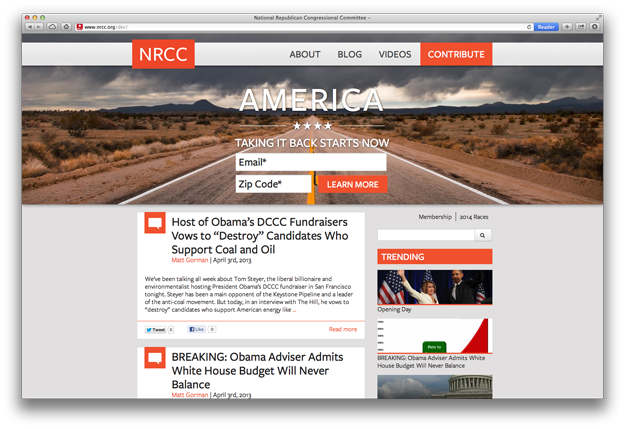
The National Journal has a sneak peek at the NRCC’s new, Buzzfeed-esque website, set to launch sometime in the next few days.  Since the dawn of 2013, the NRCC has been quietly and not-so-quietly doing some good things to get House Republicans (and prospective House Republicans) positioned well for 2014 – rootsHQ has a good write-up of that.

On the design side, though, check out the lack of traditional colors:
Home-v1

Contrast that with any of the other alphabet soup committees on either side.  There’s occasional splashes of black and yellow, but mostly red, white, and blue.  The NRCC is trying to stand out from those sites, and the early peek suggests they’re doing it right.

This should especially help drive donations and activism on behalf of Republican candidates.  The cynical analyst might point out that the only people who will visit a party committee website is someone with a keen interest in politics.  The average citizen won’t look to the NRCC as a destination for content, though they might see content in other venues like Pinterest or Facebook.  But those with a keen interest in Republican politics want something different from the party after the previous two Presidential elections when old white guys didn’t do so well.  They want a different tone, and something they can believe in.  By showing a fresh, new look – combined with the more aggressive and pop-culture-influenced messaging strategy they’ve been sharpening for a few months – the NRCC can satisfy the thirst among the activist class for a fresher look and feel.
Romney’s online ads and offline issues

Last week, Mashable and David Weigel both noted that Mitt Romney has been investing in web ads, but that he has yet to run an actual TV commercial in the early primary states (or any other states, obviously).  Mashable chalks it up to a money-saving move that has the added benefit of appealing to young voters:

It’s possible the candidates are waiting to amass more funds to pay for more-expensive airtime. Or, they could be engaged in an informal standoff for who will try to rule the airwaves.

On the other hand, web ads are a smart move. They are relatively cheaper to make and broadcast and naturally appeal to younger, web-savvy voters — traditionally a weak spot for Republicans.

After the criticism he took in last night’s debate, though, a web-focused strategy makes perfect sense for Mitt Romney.  The video which spawned last week’s round of coverage chided the Obama Administration on trade and intellectual property rights, which isn’t exactly a front-page-news-making issue.  It does, however, speak to some key audiences.  It’s one thing to say you appeal to philosophical conservatives who view government as an instrument to protect citizens’ rights and voters whose views align with business and commerce; but Romney’s ad deals brings up a niche issue that demonstrates an understanding of these voters’ motivations and concerns.

These are also the types of voters who are probably still deciding whether or not a Romney Presidency would be better enough than an Obama Presidency to be excited about a Romney candidacy.  Despite the fireworks of last night’s debate and this morning’s conventional wisdom that the other candidates put him on the defensive, Romney still carries the mantle of inevitability as the 2012 Republican nominee.  He still has plenty of people to convince to avoid being an also-ran in the same category as former inevitable nominees Bob Dole and John McCain.  He won’t be able to explain away his Massachusetts health plan, but online video gives him a medium to show conservatives he understands other issues.

Weed the People

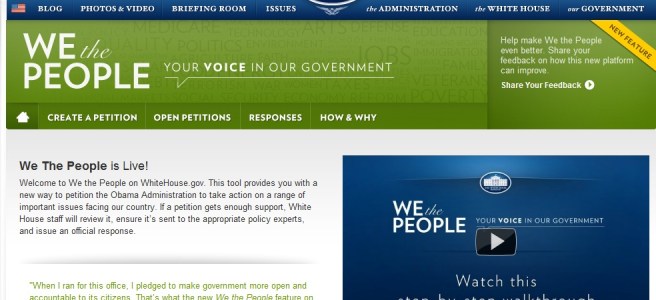
We the People have spoken, and according to the White House’s citizen-driven petition site, the most important issue in America is: the legalization of marijuana.

The White House launched We the People last month as a way to provide commoners like you and me a “direct line to the White House on issues and concerns that matter most” to us.  So far, a petition to legalize pot is the top performer, according to The Hill.  The call for decriminalization has attracted over 50,000 signatures.  It also illustrates nicely why the site is such a waste of time for serious advocacy campaigns:

[National Organization for the Reform of Marijuana Laws Executive Director Allen] St. Pierre said online petitions help spread the word and generate supporters who can call and write Congress, but they have not translated into the real-world pressure — and money — needed for his side to win.

St. Pierre is right: online petition campaigns are an excellent way to find and recruit audience.  So how many supporters did this online petition generate?

None.

To sign the petition, site visitors had to create an account on WhiteHouse.gov.  That means that the White House has their contact information (along with whatever issues are important to them) but NORML gets nothing.  Had NORML hosted the petition on their own site, they might have been able to collect signers’ contact information and email address, which would have allowed them to go back to those folks later with calls to action – such as calling or writing Congress.

At least NORML got some good press out of it, which could indirectly recruit grassroots support.  But if NORML – or any other issue advocacy group – wants to generate real impact, pointing people to the White House’s petition platform isn’t going to work.

Online petitions can recruit and mobilize supporters, but they’re better as a starting point, rather than a finish line.  Since We the People doesn’t allow for the next steps, NORML’s apparent success is actually a wasted effort.

Cross-posted on PunditLeague.us.

Isn’t it good Norwegian video?

Some friends from Norway’s Conservative Party, Høyre, posted a new video on Facebook this week promoting the party’s youth auxiliary.   You don’t have to understand the language to appreciate the video:

Exciting, isn’t it?  Between the smiling faces, you have a good mix of high production value sequences and grassrootsy-looking handheld camera shots, plus a testimonial or two thrown in for good measure.  It’s also a great study in how little words matter to the effect a video has; the music and editing style portray the party’s youth wing and edgy and optimistic better than any script could.

Governing Is Campaigning by Other Means

Earlier this week, I pointed out in The Daily Caller how much the new website for the Consumer Financial Protection Bureau looks and operates like an advocacy campaign site.  The Obama Administration can use the recently launched ConsumerFinance.gov to identify potential grassroots, third-party supporters.  Since the agency will undoubtedly be targeted for being both a regulatory behemoth and a waste of already-scarce money, there’s a good chance it will need such supporters.

It’s actually quite a smart move – and the left side of the aisle isn’t the only place you can see it in action. ClickZ points out that a new video from the New Jersey’s Governor’s office looks an awful lot like the type of video a political candidate might use:

And they’re right.  The ad wizards who came up with this one – just like the ones who built the CFPB website – understand that winning public opinion while in office is just as important as winning public opinion on the first Tuesday in November.

Will you go the f*** to a bookstore?

CNET has a neat interview with author Adam Mansbach, who wrote the now-viral release valve for frustrated parents, Go the F*** to Sleep.  Between YouTube videos of the leaked galley copy and an audiobook version read by professional badass Samuel L. Jackson, the book has been shared, forwarded, posted on Facbook walls and – ultimately – bought.

The leaked galley copy made its way around the web awfully quick:

Mansbach, a novelist, never intended the world to be able to see his book, for free, online, and before the print version was available. “To show how Web-savvy we were, ” he says self-deprecatingly, “We were trying to do cease and desist orders at first.”… And clearly, there’s more to the success of “Go the F*** to Sleep” than its accidental marketing campaign. Mansbach realizes that it’s the product itself, which touches a deep nerve with parents, that’s at least as important to its success. As the full PDF version of the book circulated, he says, “People were able to see that we delivered on the promise of the premise. That it wasn’t a one-note joke. It was beautiful, an art object.”

Mansbach notes that while he doesn’t support piracy in general, it worked in this campaign.  Like a new band that got discovered giving away downloaded songs on MySpace five years ago (or Napster ten years ago), there was a value in giving away content.  Since most purchases of the book will probably be gag gifts for parents of infants or young children, having the book out there doesn’t hurt sales.  No one is going to skip out on buying the book because Samuel L. Jackson spoiled the ending.

Piracy is wrong, because a writer should have control over his or her own work.  That said, the accidental marketing ploy represents something that every political or product campaign sees as the Holy Grail: people genuinely liking what the campaign is trying to sell and telling their friends.  That only works when the content is good – and when the content is good, letting it speak for itself may be the best marketing there is.

GOP nabs headlines, OFA nabs volunteers

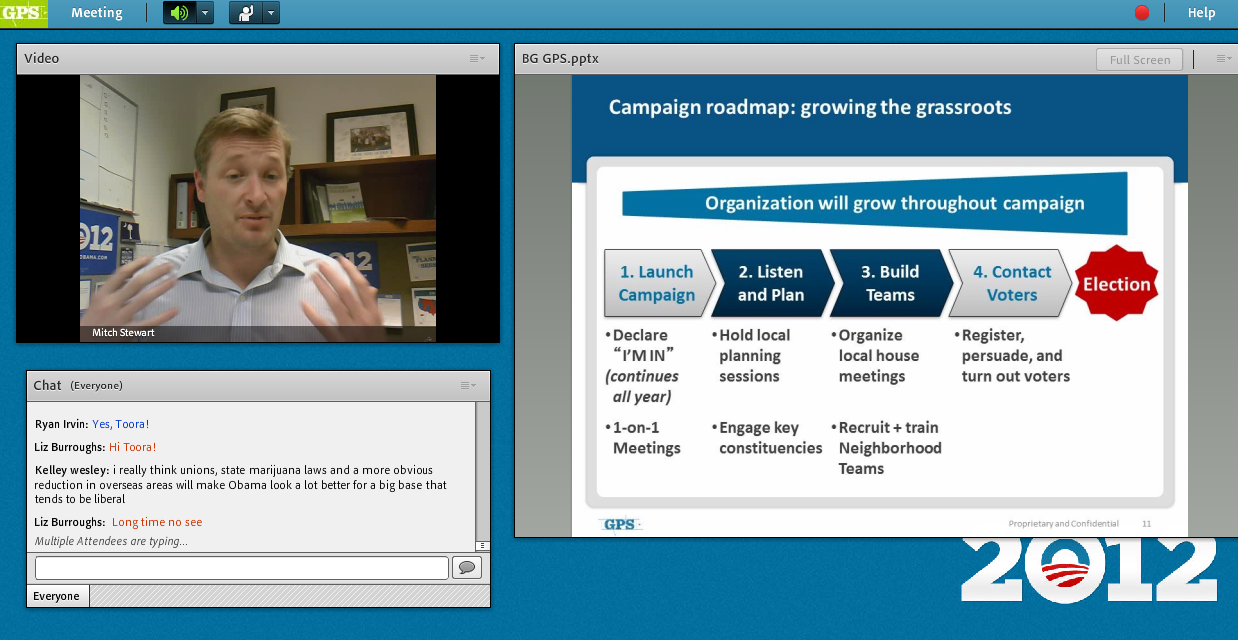
While the Republican contenders and pretenders debated in the Granite State, the Obama Campaign quietly kicked off what it hopes will be a “summer of team building” with an online volunteer briefing.  Organizing for America’s Mitch Stewart led the largely unsurprising session, sketching out the campaign’s overall plan for recruiting volunteers and getting out the vote.  There were, however, some tactical points that were worth noting.

Just like the 2008 incarnation of the Obama campaign – and, really, any organization worth its salt – Obama/Biden ’12 seems rightly obsessed with amassing volunteers and securing firm commitments to action.  The central effort seemed to be a push to ask volunteers to host house parties, recruiting After Stewart’s overview of the basics, the webinar asked participants whether they could either host or attend a house party (along with inviting others to attend as well).

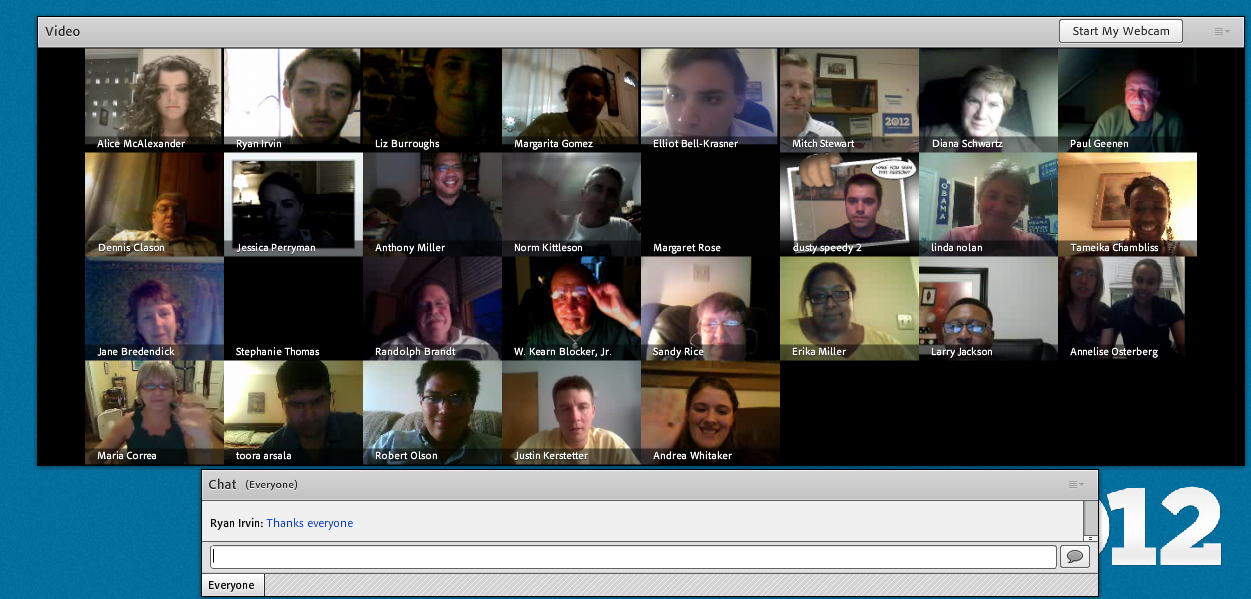
The neatest part came at the end, when participants were invited to turn on their webcams.  A collage of the real-time feeds allowed participants to see and even wave to each other:

This is another early preview of what figures to be a consistent theme for Obama ’12.  Remember that the announcement video for the re-election effort did not feature the candidate, instead focusing on campaign surrogates and volunteers.   Other faces – including, wherever possible, those of grassroots supporters – will allow the Obama campaign to create a wall of separation between the candidate and the dirty business of politics.

The result? Obama looks Presidential while his subordinates ramp up the country’s first billion-dollar campaign.

Cross-posted at PunditLeague.us.

RNC jumps right on the Ryan budget plan

On Friday, the RNC sent out an email calling for supporters to sign a petition in support of Congressman Paul Ryan’s budget proposal.  Quick, huh?

Speed kills, and this RNC email came over a month after Ryan uploaded his YouTube video outlining the problem with continuing government spending.  That gave the Democrats a month to complain that the GOP budget proposal would strip old people of their medicine like a starving robot.  The RNC is a little bit late to the party on this one.

On the plus side, the email does direct activists back to a petition, where they can register their support and send their own brief message.  If the RNC is doing things right, that means the folks on the email list who respond to this email will be tracked and identified for the upcoming Presidential races.  If those people live in some place like Ohio, they should be on the extra-special, “we need these people to go to the polls and I bet they’d drag four people” list.

The spending issue isn’t going away, and there’s plenty of time to re-frame the debate.  For the RNC it’s better late than never.

Small is huge nowadays

Two seemingly unrelated pieces of patriotism struck me as oddly similar this week.  The first was, obviously, the raid that killed Osama bin Laden.  The second was the not-quite-safe-for-work homage to George Washington from cartoonist Brad Neely.

Neely’s work is kind of out there, but for those who share his sense of humor it’s spot on.  (A sample line: “And we danced, like those people in the hyper-tight light of fried chicken commercials!”  Seriously, what does that even mean?)  Even with limited exposure in venues like Cartoon Network’s Adult Swim, Neely’s two or three minute videos are especially suited to a YouTube audience.

Obviously, the Navy SEALS who took down bin Laden crafted a much more significant piece of work on Sunday.  Their achievement, though, was a reflection of a changing military environment just as Neely’s videos reflect a changing media environment.

The major military conflicts to stop terrorism after September 11 targeted nations – specifically, Afghanistan and Iraq.  The plan was to smoke out terrorists by pressuring state sponsors of terrorism.  We found that the strength of our armored columns had limited effectiveness confronting the independent contractors who made up Al Qaeda’s network.  We could contain the snake, but we couldn’t do the one thing we set out to do.

It’s significant, then, that the bin Laden kill mission was set up by intelligence and espionage, and executed by a couple dozen elite servicemen.  There was no invasion of Pakistan, simply a precise action focused on a single piece of property within the country.  One can’t help but suspect that had our leaders not announced the mission’s success, the rest of the world might never have known bin Laden was dead.

A small, elite unit was all it took to snuff out the world’s leading terrorist.  George Washington (who crossed the Delaware for a surprise attack) would be proud.