Here’s a nifty video from the NRCC (via TechRepublican):
Tag: online tactics
How many friends do you get to keep?
The Sunlight Foundation went into the weekend with a hit piece on the much-maligned re-designed GOP.com. Over at TechRepublican, James Richardson started the week with a well-researched rebuttal, noting that Sunlight missed a couple of items in the shadows in decrying the projects price tag.
But for the site’s well-documented technical faults, on the internet content is king, so there’s at least reason to laud the Republican new media operation: The Facebook Friendship Fairness Czar application. The application tallies the number of your friends and assesses a “tax” reflecting how many you have over the average Facebook user’s 120-friend total. It’s a pretty neat way to needle the Obama Administration’s tendency to entrust policy decisions to executives with no Congressional oversight. The postcard alerting you of your tax is actually kind of funny, too:

Facebook is a necessity for any new media operation – even MySpace knows that now. That means finding creative ways to connect and keep people coming back. Even if GOP.com has its problems, at least the Republican party is thinking strategically.
Virginia Voter Values Video
The Family Foundation, a socially conservative Virginia organization, is putting a new twist on the old tactic of a candidate scorecard by releasing theirs as a video:
It’s good, but pretty basic. The video format gives the opportunity to include powerful imagery, and a group like the Family Foundation should be able to capitalize – shots of folks sitting down to dinner, or other family-friendly scenes would be much better than the waving American flag in the background.
(The Family Foundation may have had a good reason for being spartan – taking or even implying a stance for or against a candidate could have repercussions on tax-exempt status. And hey, at least they’re trying.)
Study: Still waiting on that online advocacy revolution
A new study released by a troika of new media firms (2ndSix, TribeEffect, and Chris Lisi Communications) charts some surprising trends in online advocacy – more accurately, the lack thereof.
The study evaluates 102 top trade associations, membership organizations, and other groups with political advocacy goals and charts their use of a number of online tools – everything from collecting email sign ups to Twitter to blog badges to Facebook and everything in between. Most of the tools considered were either free or low-cost; yet the study found a surprising lack of use:
Overall, there is a lag in the implementation of the new media tools. Many of the organizations reviewed in this report have not yet embraced or employed many of the readily accessible online communication and social media tools… 76% of the most commonly used social media tools are not being utilized to communicate with members, voters and other constituencies.
On the heels of the Obama Campaign, Washington D.C. was abuzz with the possibilities of online campaigns. So what gives?
There are three things to consider when wondering why the digital wave hasn’t crashed the banks of the Potomac. First, online and social media are new, and some of the key decision-makers in these groups may not understand them fully. Being fully committed to online activity means surrendering some message control and directly engaging people who have negative comments. That may resonate with the front line folks, but senior management will usually have to deeply consider what amounts to a change of strategy.
The second item to consider – which draws a bit from the first – is that social media activity can be difficult to quantify to important stakeholders. Anyone can build a Facebook page with 5,000 fans given the resources; but translating that to action can be difficult. In other words: if you work for a health insurance trade group, and you recruit 5,000 Facebook fans or Twitter followers from all over the country, how many are going to be able to call Sen. Olympia Snowe’s office to tell her she shouldn’t bow down to the Democrats’ health care overhaul?
There’s a third and final item to keep in mind. The study itself admits that it doesn’t evaluate the effectiveness of the various tactics employed by each organization – in other words, the study simply charts charted whether a group has a presence on Facebook, but not whether that presence helped further their policy goals. Just like a real-world toolbox, and online toolbox has implements for a variety of uses. But just as you wouldn’t use a screw driver to pound nails into a plank of wood, you might look at your online goals and decide that Twitter or LinkedIn just isn’t right for you.
New and improved but with room for improvement
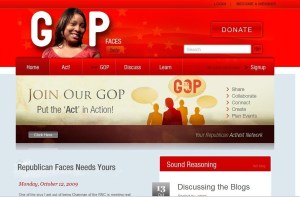
The Republican Party re-launched GOP.com today. In addition to discussions about the party platform, the site includes multiple opportunities for grassroots participation. The home page shows the latest from the most important social networks.
These are all positive elements, and the timing is good – Republican excitement is naturally regenerating after the defeats of 2006 and 2008 just like a starfish regenerates an arm, and this provides an channel for that excitement.
The site seems to be a bit slow, though – which makes it tough to explore since the content is spread out fairly widely across the site. With multiple blogs and action centers, the site has lots of nooks and crannies. That’s probably better in the long term, but as an infant site, GOP.com looks a little light on content. Sub sections feel a little barren.
Because content is king, the Republican Party will need more meat on the bones. Since they have good avenues for user generated content, that’s more about increasing visibility – something they should have the infrastructure to do anyway.
One BILLION hits… per day
On the third anniversary of its acquisition by Google, YouTube is celebrating that it now averages a billion views each day.
There’s another way to measure their success, though: The term “YouTube video” has also entered the cultural lexicon to define short, viral, online video – the same way “Xerox” was used for years as a synonym for photocopies. YouTube isn’t just on your computer screen, it’s in your head.
There’s no app for that
Apple has rejected a proposed iPhone application because it is, as ReadWriteWeb reports, “politically charged.” The app in question helps advocates for nationalized, single-payer health insurance organize and make an impact – or it would, if anyone could download it.
There are plenty of people who would disagree with the app’s goal. But, as with any speech, the answer is to respond in kind – perhaps to create another app that helps people organize and speak out for a patient-driven health care system.
Apple has every right to reject any app it wants. That may not be the best business decision, though. Part of the iPhone’s appeal is it’s ability to be the Swiss army knife of mobile devices through the various applications. By rejecting political applications, Apple is cutting out a large segment of potential users. (And incidentally, the Obama campaign released a similar app about a year ago to help mobilize voters and volunteers.)
If this move was an attempt to avoid political controversy, Apple couldn’t have gotten it more wrong.
We all know the media landscape is changing, but…
As this video (the fourth in a series) points out, sometimes the surprise isn’t that the media landscape is changing, but how fast:
Wanted: Online “community organizer”
The latest controversy surrounding ACORN came about because of an excellent viral YouTube video. James O’Keefe and Hannah Giles made a point others had made (that ACORN is corrupt) but did so in a funny, entertaining way.
Since the ensuing furor was sparked by online tactics, ACORN is striking back with this job listing for a Social Media Organizer. Telling is this part of the job description:
Developing new and innovative methods for the use of social networking technologies, including video, to enhance community organizing.
ACORN must have learned that if you’re business is community organizing, it’s probably not good to get out-organized.
 Jim Eltringham