140-character sponsorships

Though they haven’t shown up quite yet, the phrase of the day is “sponsored tweets” – Twitter’s long-overdue way to make money off its product. (When you hear anyone say “sponsored tweets,” scream real loud!)

I’ve searched a few terms that seemed like good candidates for these ads to show up but haven’t seen a sponsored tweet yet – which may be the first time anyone has ever wanted to see advertising but couldn’t find it.

Sponsored tweets do offer a new political tactic in advance of the 2010 elections.  Candidates have been using Google ads to frame themselves and their opponents for years, and 2010 will be no exception.  Search engine and Facebook ads, though, are closer to traditional advertising: you see creative (text or a picture), and if it’s interesting enough you take some sort of action.  Clicking on an online ad is a more instant (and measurable) reaction that buying something after seeing a television commercial, but the concept is the same.

Twitter ads appear to be more message advertising – so the “creative” may not even come directly from the ad sponsor.  Lets say you’re working for Republican Keith Fimian, running against Rep. Gerald Connolly to represent Virginia’s lovely 10th district (which includes this blog).  If someone searches for Connolly on Twitter, you might sponsor a tweet from a voter or activist – rather than from the official Fimian campaign Twitter account – that calls on Connolly to get heaved out of office.

This strategy has been tested somewhat with Google ads, but mostly as a joke – searching for John McCain, for instance, might bring up sponsored links for the AARP.   But Twitter ads give brands – political or corporate – a chance to use third party voices to frame search results.  No doubt this will become as much art as science as the 2010 elections approach.

A very maverick-y negative ad

That John McCain, two years after being his party’s standard-bearer, is fighting for his political life in a primary against talk show host J.D. Hayworth is telling of how urgently many GOP activists want a cathartic cleansing of Republicans of recent vintage.  However, an online video released by the McCain camp makes an argument that the conservative movement needs effective messengers as much as effective messages.

The message is subtle even if the delivery is not: the GOP has a message problem that goes beyond government policy, and the elevation of a voice like Hayworth’s would add to the stereotype.   One would assume that McCain’s campaign has internal poling numbers which show this is a strong field for them to play on, and that Republican primary voters are vulnerable to fears that Hayworth will be perceived as a joke.

The McCain folks are certainly careful to tread cautiously to avoid offending activists – they use extreme-sounding quotes from Hayworth, but on selective issues.  For instance, the video doesn’t take a stand on gay marriage, but it does quote Hayworth’s hyperbolic comparison of gay marriage to bestiality.  This is followed by Hayworth overreacting to an off-hand comment from a political opponent who promised to metaphorically drive a stake through Hayworth’s heart – echoing the over-the-top rhetoric of some Democrats after the recent health care debate.

With this video, McCain tries to tell conservatives that Hayworth is simply not strong enough to carry their flag.  It’s a pretty sophisticated message – and a good one for McCain to deliver, given his at-times-contentious relationship with conservative activists. And the video is funny, which always helps.

McCain does make one mistake in the presentation of his case that’s worth a chuckle or two.  A quick glance of the official John McCain YouTube channel offers potential for misunderstanding; the thumbnail for the video happens to be the screen frame reading “Expose Obama’s Secret Kenyan Birthplace” – and it looks more like a campaign promise than a joke.

Crowdsourcing commencement

My former employer, the Leadership Institute, is collecting information on college commencement speakers through its Campus Reform blog.  And, instead of emailing their contacts and scanning the internet looking for that information (as we used to do back in my day) they’re relying on the wisdom of crowds to help them fill in information.  Users who don’t see their school or alma mater on the list can email the information, presumably to LI Worldwide Headquarters in Arlington, Va.

The list, predictably, shows a leftward bias, so LI further helps out by sharing tips on how to take action and provide a counter to the speakers.

Hopefully LI’s call to action will result in student-filmed user videos of the commencement speeches themselves.  Most of the big speakers – such as President Obama and other national politicians – will have their comments on C-SPAN, of course, but that won’t be the case for everyone.  Wouldn’t you be interested to see the things discussed during commencement season?

Automatic to the People

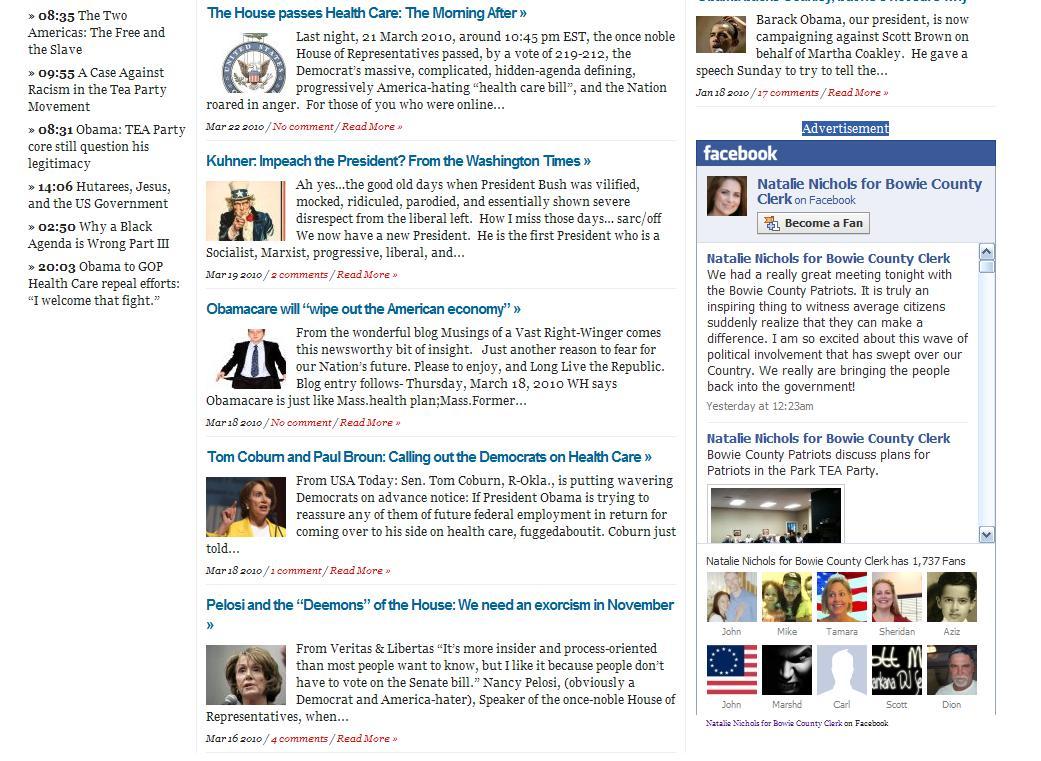
Readers of Political Integrity Now – or, most likely, any of several other websites – may have caught a nifty advertising tactic from Natalie Nichols, who’s running for Clerk down in Bowie County, Texas.  Nichols’s campaign is using ads to direct people right to her Facebook page through a Fan Box.

Facebook created Fan Box widgets to let visitors of a given website see the corresponding fan page without having to click through or anything.  Nichols is putting her Fan Box on other people’s networks by making it the creative of her ad campaign:

Nichols has a nice looking website, so why wouldn’t she just direct people back there and wow them with the flashy design?  Because as impressive as it may look, people don’t visit Nichols’ campaign website every day.  Many do visit Facebook every day.  By directing people to the Facebook page, Nichols is getting people where they already operate.  People who join her Facebook fan page are probably more likely to take further action down the road than folks who sign up for an email list and then forget two days later.

The Facebook Fan Box also has an advantages that shouldn’t be overlooked: it shows the pictures of people who have joined up.  People are hard-wired to look for images of other people, and ads which feature people tend to draw our eyes more successfully.  Nichols didn’t even have to design such an ad – she let the fan box do the work.

Best of all, readers of Political Integrity Now – or any other site on which the Fan Box appears – can join the cause in one click.  Thus they are able to take a small yet significant action without leaving the site they were on in the first place.

NewTube

YouTube’s new design for its video player pages debuted yesterday.  The new, streamlined style highlights the video itself, with comments and share links underneath:

Previously, YouTube video pages had focused many of their functions “above the fold”: most of the functions and options were arranged so they could sit on your computer screen simultaneously with the video.  Like a work desk that has every document you need somewhere on the desktop, clutter accompanied convenience.  This design is more vertical and simple.

More subtle are some of the functional shifts: YouTube’s ratings system has been replaced with a Facebook-style “like” button, and the comment system has been tweaked to prioritize video responses and comments from frequent video uploaders and power users.

Perhaps most interesting is the explanation behind the changes, as reported by Wired:

Two members of YouTube’s team mentioned the fact that people watch YouTube for an average of 15 minutes at a time, while they tend to watch a staggering five hours of television at a stretch. YouTube aims to shrink that gap with its new playlists, which will present a selection of similar songs if you’re watching a music video, for instance. You’ll also see search results that follow you around the site so you can check out a number of them in succession, and rollover previews at the top of the screen.

Playing “What If”: A political privacy scandal

Successes of the past five or six years have made online grassroots outreach an absolute necessity for any serious campaign for major office.  And every day, the possibilities for online activism multiply in seemingly exponential rates.  The art of the online possible has grown from a framed wall painting into the Sistine Chapel, and the smart campaigns kept up.

Sadly, that’s probably where the problems will come from.

Consider mashups like Checkin Mania – a site that merges information various location-based networks and Google Maps.   Sites which merge data from various sources are popular with users because they can consolidate information – in this case, it helps you find your friends,  even if one is using Gowalla and another is using Foursquare.  The next “revolutionary” campaign will likely have components like this; when you sign up for Obama/Biden 2012 (or Pawlenty 2012, or Romney 2012, or Zombie Reagan 2012) you would have the ability to link other services as well.  In fact, you might even be able to sign up with Facebook Connect, immediately linking your Facebook profile and all other information that you reveal somewhat publicly.

Now, here’s where the what-ifs get interesting.

This means there will be lots of information flowing around not only the campaign site, but to and from several interconnected sites.  Leaks and mistakes are inevitable, and not from hackers – from random items being posted to networks the user did not intend to post them to.  It may mean embarrassing Facebook pictures being shared on the campaign site; it may means your meeting at the bondage club gets tweeted to your Twitter following.

Sound too far-fetched?  Facebook gets knocked for privacy violations every few months – most recently for an information-sharing in their privacy policyGoogle  Buzz was famously lazy about privacy considerations in its rollout.  And they optimize user experiences in social networks for a living, that’s how they earn their food money.

These mistakes come from innovation – designers trying to come up with ways to make the sites and services they offer easier.  Campaign tech teams worth their salt do the same – the lower the barrier to entry, the more supporters you can attract.

When you have a political team that – like Facebook’s development group – gets starry-eyed while looking at the art of the possible, some details on that fresco are bound to be missed.  When they are, the opposing campaign will be ready to pounce.

This isn’t to say campaigns should stop innovating.  But the “what if” game is an important part of innovating in the high stakes environment of political campaigns.  Privacy is becoming an ever more important issue on the web.  If companies like Google and Facebook have to be ready for these concerns, campaigns must be ready as well.

Bringing the politics to you

Minnesota Governor/2012 Presidential hopeful Tim Pawlenty is holding a  town hall meeting tomorrow.  Last night, California Senate candidate Chuck DeVore held a fundraiser with Andrew Breitbart.

You can go to either of these events without being in Minnesota or California – both will be online.  (Though, if you want to attend the DeVore event, you’re going to have to also find a way to channel 1.21 gigawatts into the flux capacitor, which may cost more than the $50 minimum donation.)

In Pawlenty’s case, the two-term governor is attempting to build a national base in advance of his 2012 run for the White House.  For people nosing around and still feeling out the contenders, it’s a low barrier of entry.   With the first primaries still more than 20 months away, Pawlenty wisely doesn’t want to burn out his activists; at the same time he wants to start building a list of engaged supporters.  Some of his likely primary opponents (like Mitt Romney, Mike Huckabee, and maybe Sarah Palin) already have exposure and campaign infrastructure from 2008.  The town hall could help Pawlenty catch up and – maybe even more important – allows him to build the perception of his candidacy being more firmly rooted in ideas than personality.

DeVore is trying to broaden his base, too – and continue extending his brand as one of the leaders among Republicans in the use of online tactics.  Thus far in the primary, DeVore has been the Martin Short of the Three Amigos running for the Republican nomination.  (If you’re wondering, Steve Martin was the best Amigo, followed closely by Chevy Chase.  Barbara Boxer is already El Guapo.)  The virtual pizza party may not put him on the Republican ticket to face Boxer in 2010, but it’s a good idea – one that could help other Republicans in 2010 or even DeVore himself in a future race.  After all, winning campaigns aren’t the only ones with good ideas.

CoCoBama

The official logo of Conan O’Brien’s upcoming Legally Prohibited from Being Funny On Television tour is based on the now-familiar illustration of a stoic O’Brien standing against the American flag, gray but for the bold orange pompadour rising from his head like a mighty wave rising from the ocean.  It may be the icon of Team CoCo, but it didn’t come from Team CoCo: the graphic was created by Mike Mitchell, an enthusiastic artist who had nothing to do with O’Brien other than being an avid fan with an idea and some spare time.

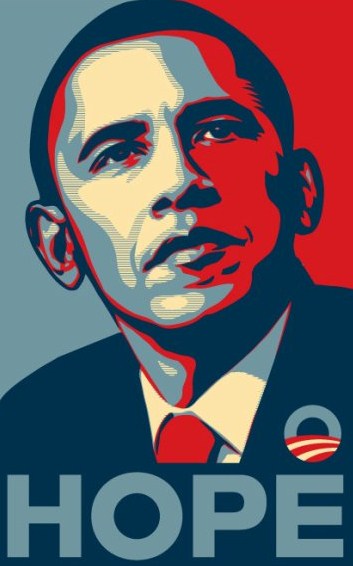
Largely on the back of the massive outpouring of support he enjoyed in the final weeks of his Tonight Show run, O’Brien stands to make a lot of money wherever he lands this fall.  O’Brien will be rewarded for embracing that organic excitement.  It’s similar to the smart moves made by the 2008 Obama Campaign, which enjoyed the creation of a similar iconic image created by Shepherd Fairey – an enthusiastic artist who had nothing to do with the campaign, but had an idea and some spare time.

A technical term for this is “advocate-generated content.”  Even that mouthful is easier said than done.  You can’t force people to identify with a cause, let alone feel so strongly about it that they are willing to make art.  Both Team CoCo and Obama 2008 benefited from a simple, direct, and resonant message.  The fancy artwork was just a symptom.

Where you at?

Facebook plans to add a feature that would let you keep tabs on your friends’ locations (and vice versa).  Like many of Facebook’s tweaks in recent years, this isn’t original – many of the next wave of social networking tools are location-based.

Details are still forthcoming, but the evolution of location data in social networking will be particularly interesting.  As Facebook has learned – and as Google found out when it unveiled its Buzz tool – just because we like to share stuff about our lives doesn’t mean we want to surrender our privacy.  In fact, we want to have the opportunity to separate a little from our digital selves now and again.  Location data chips away a little bit more of that wall.

The utility is pretty clear for businesses, politicians, social butterflies, and other folks who want to be found.  (And it’s also pretty clear for Facebook, which can now allow brick-and-mortar stores to serve ads to people near their physical location.)  To make it worth their while, Facebook and others would be smart to make location data available as a one-way street: to let me find out who’s close to me without letting them know where I am.

Hunting Demon Sheep

The Chuck DeVore for Senate campaign has declared open season on Demon Sheep.  Visitors to demonsheep.org can squish, shear, crisp, or mock the ill-conceived star of a Carly Fiorina campaign video:

Aside from being a fun concept, the microsite does all the right things – it lets users share their demon sheep hunting with friends, and hits hunters up for small donations.

The original “Demon Sheep” web video was designed to distinguish Fiorina from GOP primary opponent Tom Campbell – casting Campbell as a FCINO, or “Fiscal Conservative in Name Only.”  The campy quasi-religious imagery a low-budget sheep costume that looks like it was a pilfered sample from a carpet store made for internet mockery.  But it also made for viral viewing, giving an audience for the negative points the video makes about Campbell.

Though the Demon Sheep video doesn’t mention DeVore, he’s doing his best to capitalize – and as Matt Lewis and I discussed weeks ago, DeVore’s campaign stands to gain the most if Fiorina and Campbell descend into a harshly negative campaign that damages both.

This effort can be successful in targeting conservative activists nationwide for support and donations.  The drawback for the DeVore folks is timing.  Demon Sheep is a month old, and while bizarre, the opportunity to latch onto the initial wave of coverage has long passed.