IT’S A TRAP: The Ground Zero Mosque

On the Today show this morning, Dick Armey and Matt Kibbe of FreedomWorks sat down to talk about their new book, Give Us Liberty: A Tea Party Manifesto.  FreedomWorks is well-positioned to ride the wave of citizen unrest that gave rise to the tea party – they’ve been making the case for less government for years.

So of course the first thing they were asked about was… the proposed mosque at ground zero.

Armey and Kibbe are both bright, so they immediately accused President Obama of weighing in on the mosque controversy to change the subject from “failed economic policies.”

Clearly, the President will score no political points with his lukewarm two-step of supporting the right to build a mosque while not supporting the mosque.  But there is a real threat that the controversy could muddy the GOP’s year-long message that government is trying to do too much with calls for government intervention in New York zoning decisions. As Gov. Chris Christie notes, Republicans run a risk by trying to turn the mosque controversy into their central campaign platform – especially with so many other messages that could work better.

Republican hopefuls must strike a balance between reminding people that the President disagrees with them on the mosque and using it to underscore the inability to trust the federal government to solve problems:

  • “The President is commenting on a local government zoning matter instead of paying attention to national priorities.”
  • “The President is talking about mosques while the rest of the country tries to figure out how to get out from under the failed stimulus package and get the economy moving again.”
  • ‘”The construction jobs building the mosque must be their best idea for job creation.”

See?  This stuff practically writes itself, and would allow Republicans to pivot to more substantive arguments about why they will make life better for the American people.

The GOP has plenty to talk about as November approaches.  Armey and Kibbe offer an excellent lesson: the mosque is a good conversation starter, but it shouldn’t dominate the discussion.

Is Maxine Waters about to be James O’Keefe’s next YouTube star?

Mr. ACORN pimp himself, James O’Keefe, announced via Twitter today that Rep. Maxine Waters would be the subject of his next series of videos.  Here’s the preview:

Two things are evident: O’Keefe still understands the power of online video, and he still understands the power of timing.

The ethics charges flying around various Democrats are starting to look like a trend – much like Republican scandals leading up to the 2006 election painted the picture of a power-happy party inviting a rude awakening at the hands of voters.  Getting Waters on camera in a sting operation like this could make the ethics violations very real to voter and underscore the broken promises of Democratic gains in 2006 and 2008.

But on top of that, you can’t say enough about O’Keefe’s media-savvy release strategy, either.

By releasing a teaser, O’Keefe capitalizes on this week’s news cycle about Waters and her ethics charges.  After controversy surrounding his presence in a Senate office earlier this year (and the storm surrounding his associate Andrew Breitbart’s role in the Shirley Sherrod affair), he can expect that this initial release will lead to a round of denouncement from left-leaning talking heads; for a while the story will be that James O’Keefe has a Waters video.  The Congresswoman’s office will likely be asked to comment; maybe she’ll even say something embarrassing and unwittingly drum up more coverage.

True, O’Keefe could have gotten just as much coverage this week by releasing a completed video.  But what about next week?  This strategy allows O’Keefe, after the initial frenzy, to drop a second video and get another round of coverage.  And, the vile and hatred he receives from the left this week may make the release of the full video that much more newsworthy.

If it sounds familiar, it should – it’s exactly how O’Keefe and Breitbart set up ACORN to take itself down.

Grading the new new GOP.com

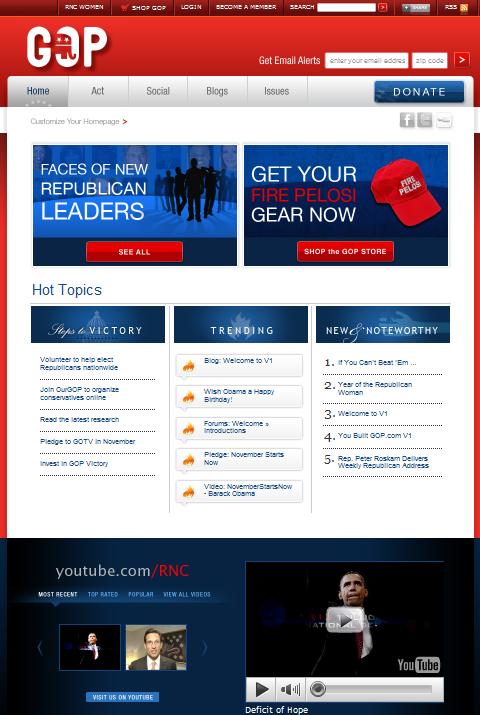
The RNC re-relaunched GOP.com this week.  The last reboot, back in October, was a better site than they had before, but was met with scorn and derision from the tech world. So how is the new version any different?

Design: B-

The site is clean, simple, and open, and the red-white-and-blue motif isn’t terribly over the top.  It’s definitely pleasing to the eye, even if it is a bit boxy.  It moves much quicker than the old site, which was bogged down with technical problems from day one.

But use the site some more and there are a few things that are just out of place.  For instance, GOP.com incorporates video into several blogs and other elements, but these videos are sometimes tough to find.  For instance, in the screen shot on the left, the video player is buried at the bottom.  That may be due to the fact that President Obama’s image is on the player, but that’s still too valuable to bury.  Further, other sections of the site miss out on drawing the eye with video – opting instead to post a link to the YouTube channel rather than a recent video.

Content: C-

The good news is that a section highlights Republican women running for office this year, which is something the party should be playing up.  Unfortunately, some of the cringe-inducing aspects of the old site remain – such as a Republican Hall of Fame featuring Jackie Robinson (who wasn’t a Republican) and Frederick Douglass in a bend-over-backward attempt to reclaim the black vote.

The Issues section has a nifty carousel of the big issues of the time, plus a brief blurb on each.  This is a missed opportunity; in 2008 Barack Obama used the issues section of his campaign website to dive deep into various policy proposals.  Obviously, a party is different from a candidate in that there are many different opinions and angles on any given issue.  The solution might be to have candidates and party VIPs weigh in with policy briefs.  The RNC could set overarching policy positions, but the site could act as a repository of opinions from Republican politicians. It’s the same principle both parties use in tapping a specific elected leader – rather than the party chairman – to deliver rebuttals to the State of the Union address or the party’s weekly address.

I also found it hard to find out who the Republican candidate is in my Congressional district and what I could do to help.  I ended up going through the state party’s website to do so.  Also missing on the main Action center was any obvious link to voter registration information, which is pretty basic.

The chairman still has a blog – mercifully not called “What up?” anymore – and the RNC seems intent to create most of the official content in-house.  This is a waste of effort down on South Capitol street – it seems like an aggregation of Tweets, blogs, and conservative media outlets would be a better way to go, and underscore that the party’s ideals permeate outside the beltway.

Now, the good news: the Blogs section, while having maybe one or two blogs more than they need, has a developers blog to discuss technological aspects of the party infrastructure.  That could be fun to watch.

Utility: A

This isn’t the most obvious part of the site – I had to click around a bit to stumble on it – but the our.GOP.com community aspect has some promise.  Aside from the basics of allowing users to set up profiles and blogs, there’s this:

And this:

These two features allow Republican activists to define for themselves what it means to be a Republican activists.  That invites involvement, which makes it easier later on to ask those activists to participate in more defined campaign activities when the time comes.  It could also make activists better, not just by promoting great ideas but also by tapping into the wisdom of crowds to help fine-tune messages and materials.

The site also integrates user IDs from other online sources, so you can easily sign up with a Facebook, Aol, Google, etc. account.  Besides streamlining the process, that will help the GOP identify where and who the activists are, and target future communications accordingly.  It also translates actions taken on GOP.com to social networks, and increases the likelihood of virality.

Overall: A-

I logged on to the new RNC.com wanting to hate it, but even with plenty of room for improvement, is has the elements of a very good tool for activists.

I spent 16 years of school trying to convince teachers and professors that grading on potential rather than actual product.  They didn’t buy it, but I did, and that gets GOP.com over the hump and into the A-range.  What it lacks in content can be made up for by the social elements of our.GOP.  For the rank and file voter, the lack of local information and voter registration details makes this site less helpful; hard core activists, however, should find it useful.
The right way to lose

It isn’t going out on a limb to say that Len Britton likely won’t beat Patrick Leahy to become the next U.S. Senator from Vermont.  But he has used a couple of campaign videos to point out the problem of government overspending, and who foots the bill:

In another video, the creepy government guy hands Billy and his family a check for their share of the national debt.  When Billy points out that it’s a lot of money, creepy government guy taunts, “Better get a paper route, Billy!”

The videos have received national attention, because they deliver a message in a creative, funny way.  They’re also excellent examples of the right way to run an extremely uphill race.

I’m not very familiar with Britton’s campaign, so he could be an insane, foil hat-wearing Lyndon Larouche backer who thinks that the destruction of the Death Star was God’s revenge for the Empire’s tolerance of same-sex Jawa marriage.  But based on this limited sample, Britton uses his underdog status to make his point in a way that would scare off many campaigns in the thick of a close race. If Britton were to drop this strategy to rant about the President’s birth certificate, Sarah Palin’s baby, or some other conspiracy theory for the deranged the damage to his personal credibility will be dwarfed by the damage he does to the Republican brand.

Britton may wind up underfunded, and his videos may be limited to their viral appeal, and it may not be enough to keep Leahy from wiping the floor with him come November.  But this isn’t the last election in Vermont, so this video and the messages it carries can still set the table for victory – even if it isn’t until Billy’s old enough to vote.

Messaging Social Security

The Washington Examiner’s Chris Stirewalt correctly writes today that Republican lawmakers have to craft a better, pro-active message to take advantage of voter disillusionment this year.  Townhall’s Maggie Gallagher throws a wet blanket on an issue that gets many on the right-of-center side excited: Social Security reform.

Gallagher claims that any effort to include an overhaul of social security into the talking points would meet with utter doom, citing President Bush’s failed 2005 effort as evidence that the American people are not on board with the concept:

[P]olls showed the more he talked, the less Americans liked it… “Three months after President Bush launched his drive to restructure Social Security by creating private investment accounts, public support for his program remains weak, with only 35 percent of Americans now saying they approve of his handling of the issue, according to a new Washington Post-ABC News poll,” The Washington Post reported on March 15, 2005. “Moreover, 58 percent of those polled this time said the more they hear about Bush’s plan, the less they like it.”

And this was before the stock market crashed, and ordinary people at or nearing the age of retirement lost huge chunks of their investment portfolios. Yet in 2010, one of the GOP’s bright young stars, Paul Ryan of Wisconsin, pulled together a deficit reduction plan that called once again for the partial privatization of Social Security, and leading conservatives piled on the praise.

Gallagher may be right that Social Security is a difficult election year, but it isn’t impossible.  Entitlement reform is tricky, with demagoguery from parties who feel they will be injured.  But remember that the American people were for Social Security reform before they were against it.  And entitlement reform will have much better traction in the current political environment if properly framed

Bush’s mistake in 2005 was that he was left vulnerable to a coalition of labor and senior voices.  The effort to make the necessary reforms will need a few new messages and strategies, such as:

  • Accurately positioning reform as the creation of the retirement system of the future, versus the retirement system of 1930.
  • Appeals to seniors that promising to protect their benefits while allow their children and grandchildren more freedom for their own retirement.
  • Engagement of young (age 22-35) members of the work force, who have the most to lose from a government-run retirement plan.
  • Tracking and satirizing Democrat, union, and AARP efforts to smear the plan.
  • Putting a real face on the people who stand to benefit from reform.

Gallagher is dead-on, however, in identifying Social Security as a probable Democratic talking point in 2010 (why stop now, after all?).  It has already started in the Nevada Senate race.  The need to counter this messaging is critical for Republicans.

Co-stanza!

To follow up on the trend of politicians seeking to avoid YouTube, some – like Florida State Rep Mike Weinstein – have gone the other direction with a video Mediaite’s Steven Jessop has (rightfully) called the “Cheesiest Campaign Video Ever”:

Cringe-worthy, isn’t it?  Jessop compares it to Bruce Springsteen’s Dancing in the Dark video.  It took me back to syndicated Saturday-morning kids shows on independent stations like WPIX in the early 1990s, where kids dressed like stunt doubles for Screech would bop around on stage in neon orange t-shirts and denim overalls.  And, it turns out, the company that produced the video makes educational programming for kids, so that’s probably what they were going for.

So it’s a bad campaign tactic, right?  Not so fast.  I thought so at first, too, but then I sat down to make fun of it, and the song stuck in my head.  Jessop pointed it out in his post, and by gum he’s right: the song is pretty catchy.  Like a commercial jingle, it’s annoying at first, then you hear it a few times and you’re humming it in the shower.

Weinstein is an incumbent, so though it may make him seem a little out of touch with younger voters it probably won’t hurt – though they’ll probably lose Kenny Loggins’ vote.

Burying the lede: Whitman’s tech strategy

Catching up on some news from this weekend… From the San Jose Mercury News (via TechRepublican): “Whitman campaign counting on tech to fidht Democrats’ boots on the ground.”  The article mostly recounts Meg Whitman’s advantage in technology spending and notes that Jerry Brown’s strategy relies heavily on union organizers making “workplace visits.”  (No word on whether those visits involve lead pipes or any other aggressive GOTV strategies.)

The headline and lede make it sound like Whitman is simply spending money, but the details show a bit more refined strategy than that:

Whitman has also made use of increasingly sophisticated database technology to “micro-target” voters through an aggressive mail program. First made popular by GOP strategist Karl Rove in the 2004 presidential election, micro-targeting goes far beyond using bare-bones demographic information such as age and income. Voters get targeted mailers and phone calls based on the kind of cars they drive, food they eat and magazines they buy.

During the primary campaign, many Whitman volunteers eschewed traditional “boiler rooms” and joined online phone banks so they could dial for dollars in their pajamas — or ask voters for their support and record information on them while sitting on a beach with their BlackBerrys.

The technology expenditures appear to be put toward the purpose of making GOTV tactics – like phone calls and mailings – more efficient and easier for volunteers.  And, the article points out that the union goons are doing the same thing – identifying non-union “red county” voters who share their outlook on political issues and reaching out to them.

Tellingly, the missing link here is the Brown campaign, and the article quotes Brown himself calling Whitman’s $2.7 million in online spending wasteful.  The reality, though, is that any campaign tactic costs money.  The fabled 2008 Obama  campaign – still the most prominent example of online organizing – outspent the McCain campaign online, making wise early investments.  The technology didn’t create excitement, but it gave the campaign a way to harness it and translate it into votes.

The article likens Brown’s website to the 1974 Plymouth that Brown used to drive around to demonstrate his working class street cred.  The comparison is apt if Brown really thinks there is a dichotomy between online organizing and “boots on the ground.”  A car made in 1974 and a car made in 2010 both operate basically the same way, but the 2010 model has newer, more effective parts that allow it to perform more efficiently.

Maybe he could take some of that Matlock money and apply it to his site?

Whitman campaign counting on tech to fight Democrats’ boots on the ground

Hunting Macaca

Politico’s headline “Democrats seek ‘Macaca moments” aptly describes the DNC’s new Accountability Project, which invites citizens to record and upload videos of Republican politicians saying dumb things.

Because it’s actually a good idea, this has resulted in some hand-wringing on the right amid fears that Democrats are better at grassroots internetting than Republicans.  But that ignores why this is a good idea: the Accountability Project is a national aggregator and message device.  It seeks to crowdsource the Democrats’ messaging to take to most loony Republicans they can find and hold them up as the standard.  It is a pretty clear attempt to re-gain the reins of the national policy debate, which have slipped through the Democrats’ fingers in the past few months.

All that said, by driving messages that show the Republicans are out of touch, Democrats will save their skin and keep control in November.  (They may have done so anyway, but a few macaca moments will help curb GOP momentum.)

So how to combat this?  It’s pretty easy.

Republicans have cameras too, and Democrats are just as prone to saying and doing stupid stuff in front of those cameras.  What if some enterprising conservative with a flip cam catches them in a gaffe, then uploads the video?  It would seem the obvious way to hold the Accountability Project accountable.

Compliment FAIL

FAIL Blog is upset.  A Meg Whitman campaign web video about Jerry Brown’s decades of political failure uses an image of their website.  The Cheezburger Network, the company that runs the FAIL Blog and other similar successful but vapid sites, has asked for an apology and for the video to be removed.

Here’s the video:

The FAIL Blog image, like the YouTube image, is a stylistic inclusion to frame the points.  But what FAIL Blog fails to understand is just how much of a compliment their inclusion is.  The video doesn’t use the image of FAIL Blog as an endorsement, but as an illustration of the depth of Brown’s incompetence.  The video’s point is that Brown is so inept, he belongs on FAIL Blog.

Usually, being synonymous with failure is a bad thing.  Ask the folks behind the Hindenburg, the Edsel,New Coke, Pepsi Clear, the DC Metro, and Jimmy Carter.  FAIL Blog should probably be embracing this.  Privately, they may very well be, if they’re smart.  But it makes for a bigger story if they complain that Whitman has somehow wronged them.  After all, we probably wouldn’t be talking about them if they didn’t pipe up.

It’s still better than WGN

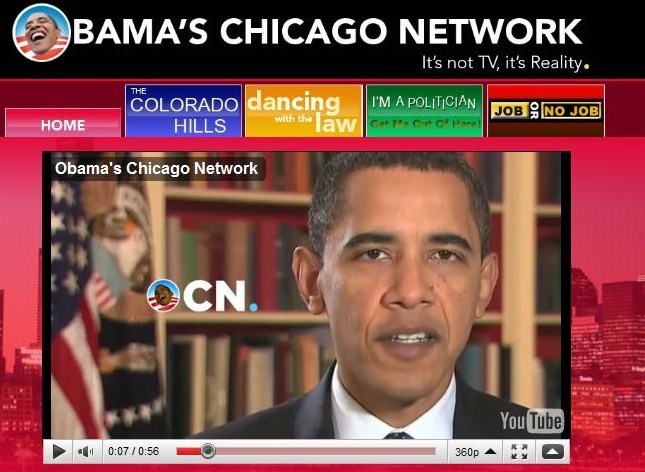
Looking to keep stories about the White House’s dabbling in primary elections alive, the RNC launched the “Obama Chicago Network” in an email to supporters this afternoon.

The site boasts four “shows” that deal with various negative stories surrounding the Sestak/Romanoff could-have-been-bribery affairs, plus Rod Blagojevich thrown in for fun:

Even if it is somewhat dated in the pop culture references (some of the shows they are spoofing are past their prime or canceled), it’s pretty funny, makes good use of news clips, and has a poll to collect people’s contact information.  With Blagojevich in the news, it does a good job of tying the administration As a lead generator, the site is good, but it’s missing something that could make it a really useful tool for Republican messaging: a section where users could “pitch” their own shows.  Not only is audience participation a good thing, but it might make for some must-see TV.