Americans for Prosperity helps lower holiday week productivity

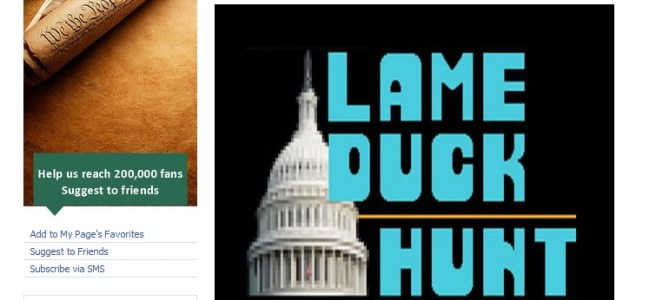
Channeling 1980s classic Nintendo games, Americans for Prosperity has a fun game called “Lame Duck Hunt” on one tab of their Facebook page.

The game isn’t all that challenging, though the gloating images of Nancy Pelosi and Harry Reid that taunt you when you miss make it slightly more frustrating than it needs to be.  This isn’t a game review, though, it’s a strategy review, and there are a few things AFP gets very right.

First, you can’t play the game without surrendering an email address and a zip code, meaning that anyone who participates in this little time-waster tells AFP which Congressional district they live in and how to get in touch with them.
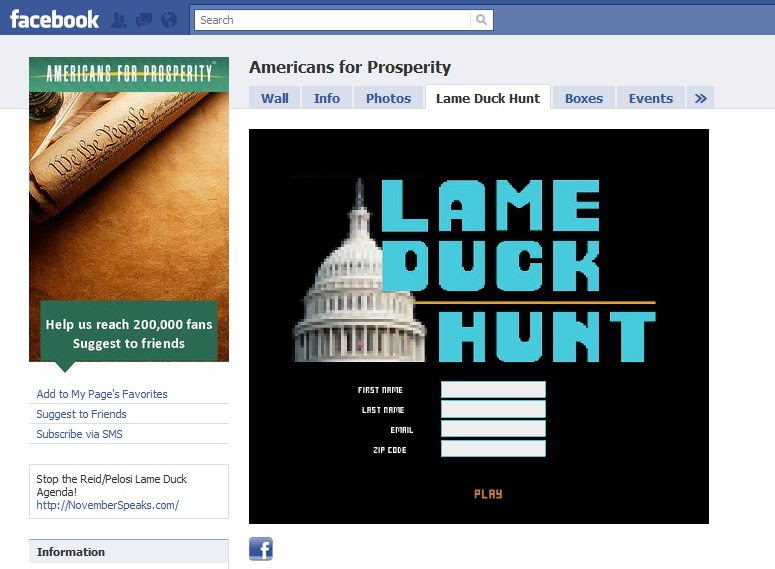
(You do have to re-submit your information each time you play, which discourages repeat users.)

Once you’re in, you predictably shoot down ducks, which then disappear in a cloud of feathers and leave behind warnings like “Higher Debt,” “Card Check,” or “Huge Tax Hikes” – the policies which ostensibly could be the result of the lame duck Congress.  You can then share your score with friends.

This is where AFP’s aim starts going awry.  The game never offers any backing for the labels – there are no details about suggested or proposed legislation which would lead to union bailouts, huge tax hikes, or higher debt.  The message at the end invites me to “visit the Americans for Prosperity website” for more information – but there is no link.  Contrast that with the game released by the U.S. Chamber of Commerce last week, This Way to Jobs, a digital version of Chutes and Ladders which outlined the pitfalls of launching a small business.

Further, I have played the game several times (for… uh… research, for this post – that’s the ticket).  That means I’ve entered my email address multiple times, and haven’t yet received a follow-up auto-responder email.  After anyone plays the game, a quick follow up email inviting further action – while the issues are still fresh in the player’s head – could help AFP determine who is really on board with their policy agenda and who just hates video ducks.

Ideally, the game over screen and follow up communication would also allow users to identify what future actions they would be willing to take.  At the very least, it would invite a user to become a fan of AFP’s Facebook page.

These extra steps may not help with the lame duck agenda, but 2011 will be a critical year as the Republicans and Democrats try to set themselves up for success in 2012.  Lame Duck Hunt is a cool idea, and well-timed – between the impending holiday and people taking off work early to beat traffic, Thanksgiving week ranks only ahead of the dead week between Christmas and New Years in terms of productivity.  To that end, it’s guaranteed to bring web traffic – and it looks like AFP was content with that.

Anuzis highlights tech experience

After announcing his bid for the RNC chair last week by highlighting Michael Steele’s shortcomings in fundraising and the ground game, Saul Anuzis predictably started highlighting his tech-friendly background as a point of difference between him and the incumbent.

“It’s critical we integrated new media into everyday politics. It works, it’s efficient and we need to do it,” Anuzis told The Hill when contacted over the weekend. He also said his candidacy has already sparked enthusiasm among social networking aficianados.

What will excite online activists even more is that Anuzis isn’t making the election all about technology to begin with.  His initial announcement dealt with main, overarching problems he saw in the RNC.  Anuzis then brought up technology as a response to how he would deal with those problems.

Whether or not he is ultimately successful, arguing for technology as a means rather than an end prevents Anuzis from being labeled as a niche “tech candidate” and positions him as a more serious challenger.

There might be money in mobile (literally)

The FEC is thinking about allowing contributions via text message in a ruling expected this fall, allowing campaigns to capitalize on the same small-dollar, high-volume donation campaigns that worked so well for American Red Cross efforts in Haiti.

The potential for campaigns is fairly obvious – campaign rallies, events, and even media appearances could become fundraising opportunities.   But consider the fact that few campaigns spent lots of time collecting mobile numbers in 2010.  How many members of this year’s House freshman class will regret a lack of investment in mobile for the 2010 election when they begin their 2012 reelection efforts?

Dumbphones, Presidential campaigns, and mobile politics

The Republican primary campaigns for President of the United States are – let’s face it – already underway.  That means tactical discussion are coming soon – the term “tactical discussion” being defined as giddy blog posts about who is using what new toys – and that will include a discussion of mobile phone strategy.

But in this realm, it may not be the new toys that win out, but new uses for old toys.  Dumbphones – i.e., cell phones that aren’t tiny pocket computers like the Droids and the iPhones of the world – are outselling their smartphone brethren by a rate of four to one and inspiring creative, text-message based usage.

Outside of Carly Fiorina’s losing bid to unseat Senator Barbara Boxer, there were few high-profile examples of campaigns incorporating mobile technologies.  And given the lack of smartphone penetration, fancy apps aren’t always as wise an investment for campaigns, which target broad sections of the electorate, as they are for institutions like think tanks, which are trying to reach media and other thought leaders.

Still, the vast majority of phones on the market are capable of text messaging – and in fact, three out of four mobile users use this feature, compare to less than one out of three who use smartphone apps.  This math says that if a Presidential campaign is looking to be smart with its mobile strategy, they should think dumb.

The race for 2012 started last week

With the mid-term elections fresh in the rear view mirror, the serious contenders for the 2012 Presidential nomination are unofficially kicking off their campaigns.  And the two likely front runners, Tim Pawlenty and Mitt Romney, have started with a pretty smart Facebook strategy.

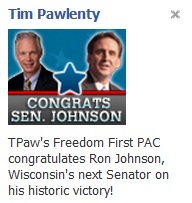
At TechRepublican, Ethan Demme noticed Mitt Romney’s new Facebook ads running immediately after the election, congratulating “high profile” candidates.  Tim Pawlenty has been doing the same thing.  But the strategy appears to be even more specific than that.  Here are the ads I saw:

What does incoming Arkansas Congressman Tim Griffin have in common with the Feingold-conquering Wisconsonite Senator-elect Ron Johnson?  Turns out, I’ve clicked “like” on both of their Facebook pages.  (I’ve also seen Romney ads supporting former and future Iowa Governor Terry Branstad, whose Facebook page I’ve also liked.)  In other words, I’m a self-identified supporter of these politicians – a factor that Facebook’s ad platform allows campaigns to take into account when they target advertising.

By playing on the interest of possible supporters, Romney and Pawlenty share an excellent outreach strategy.  The question will become what each campaign does with the supporters they recruit.  Pawlenty has already made a push to take advantage of Facebook’s capability for activation through interactive town halls, while Romney’s page is more or less a one-way communications channel – but neither has taken a decisive lead in innovation on this platform.

Effect and cause: social campaign strategy and election victories

Facebook pointed out yesterday that House candidates with more popular Facebook pages won 74% of the time, while Senate candidates with more likes winning at an 81% clip.  This is quite a trend, but the metric goes a bit deeper than clicking a like button on a politicians Facebook page.  It means very little to have thousands of Facebook fans, given how inexpensive Facebook advertising is.

It’s just a hunch, but I bet an evaluation of other online metrics would indicate the same thing.  The winning candidates probably had more Twitter followers, YouTube subscribers, and email list members, too.  People joining these lists involve self-identifying as a supporter of a candidate.  It doesn’t lead directly to victory, but it’s a good indication that a campaign is doing the right things that will lead to victory, such as reaching out to people and getting them involved.

Having a horde of Facebook fans is the symptom – not a goal – of a well-run campaign.

Foursquare fights back

Just after Gowalla started getting some nice press for their campaign activity, Foursquare fought back by acquiescing to Jordan Raynor’s suggestion and creating an “I Voted” Badge.   Foursquare is also hosting an “I Voted” website, which will track polling place check-ins nationwide.

As Foursquare looks to cement their lead in the location-based network game, it’s a wise move to become involved in politics.  But there’s a danger in entering the political space to “encourage civic participation”; Generic get-out-the-vote efforts simply can’t match the passion of a hotly contested election.  A non partisan GOTV worker might knock on your door and encourage you to get to the polls by citing the need for participation to support Democracy; a partisan GOTV effort will tell you why the world might just end if you stay home and let evil win.  Which is more likely to encourage action?

By engaging with campaigns, Gowalla’s political strategy fuels the more effective of these two methods and encourages market expansion.  The “I Voted” concept is a good start, but Foursquare will have to continue to expand and integrate with individual campaigns to continue its dominance of the location-based social network market.

The anti-social, anti-mobile election?

On Sunday, a Politico headline said that “smart-phone ads not yet political“;  today, the lament was that campaigns aren’t investing in social media.  This is 2010.  We’ve had four years of social networking plus the legendary 2008 Obama Campaign under our belts to prove the value of online organizing.  So what gives?

The answer, as usual, lies beyond the headlines – and the fact that politics goes beyond the campaign trail.

For instance, last week three major think tanks launched iPhone apps.  This is smart for them because their target market is nation-wide – so they have plenty of people to pull from.  If only 29% of mobile phone users use applications, that bodes well for a research-based think tank; it bodes poorly for an organization trying to pull a broad audience to the polls on election day.

Remember that the campaigns of this year are plural.  The Republican presidential primary campaigns, as well as the Obama 12 effort, will doubtless do their homework and aggregate the best ideas from the 2010 winners (and maybe even some of the losers) and spend a good bit of time in 2011.  So mobile apps, text messaging, location-based networks, and other new gadgets are still on track to make a big impact in 2012.

One secret to social success

It’s a little silly, and it’s definitely mixed schtick, but Conversation Agent’s Top Ten Reasons Conan O’Brien’s Social Media Stuff is Better than Yours has a few kernels of truth:

7.   Conan is having fun; you’re “engaging” customers…

6.   Conan’s staff is on a mission; yours has a mission statement…

3.   Conan’s team started their social media effort three months prior to launch. You started yours three days after launch.

As O’Brien counts down to his basic-cable resurrection, his promotional team is smartly using social media tools to catch a wave of excitement from the comic’s rabid following.  Much like the 2008 Obama campaign, they are playing off fan-generated imagery.  But at the heart of it, O’Brien and his team are just trying to make people laugh and have fun, and let that shine through.

The pursuit of success in online tactics has to flow from a genuine enthusiasm.  Campaigns – for both candidates and issues – often see their social strategies fail because they try to adapt their campaign to online tactics, rather than adapting online tactics to the campaign.