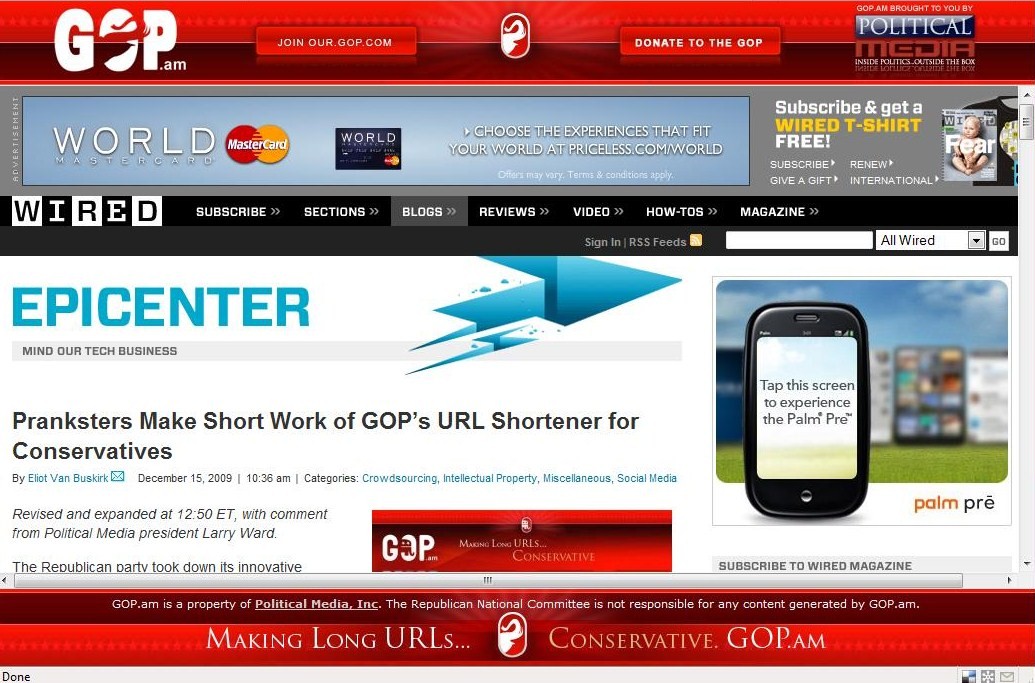
Happy Tea Party Day

On this date in history, a group of rabble-rousers dumped tea into Boston Harbor to protest what they determined was excessive taxation and government regulation.   Depending on perspective, they were either patriots carrying the banner of freedom, reckless instigators, or terrorists.  (To quote the fine philosopher Obi-wan Kenobi,  “Many of the truths we cling to depend greatly on our own point of view.”)

In today’s political parlance, the term “Tea Party” means something entirely different.  But curiously, this movement which took it’s name from the 1773 event also carries some of the same baggage.

There can be no doubt that the tea party events have created excitement around conservative activism that hasn’t been seen in some time.  Colin Delaney of Tech President notes that the movement boasts savvy organizers, focusing on creating online fund raising and voter data networks. And while in generic ballots, so-called “Tea Party Candidates” have polled better than Republicans, that doesn’t necessarily mean electoral defeat for the GOP.  It will encourage establishment Republicans to take the small-government ideals of the Tea Party movement seriously.

The Tea Party movement does have one key challenge, and that is the plethora of groups taking credit.  As the old saying (not by Obi-Wan) goes, failure is an orphan, but success has many fathers.  As established, inside-the-beltway conservatives angle for the support (and money) of the tea partiers, the risk is that activists will be turned off by the perception that outsiders are taking over their movement.
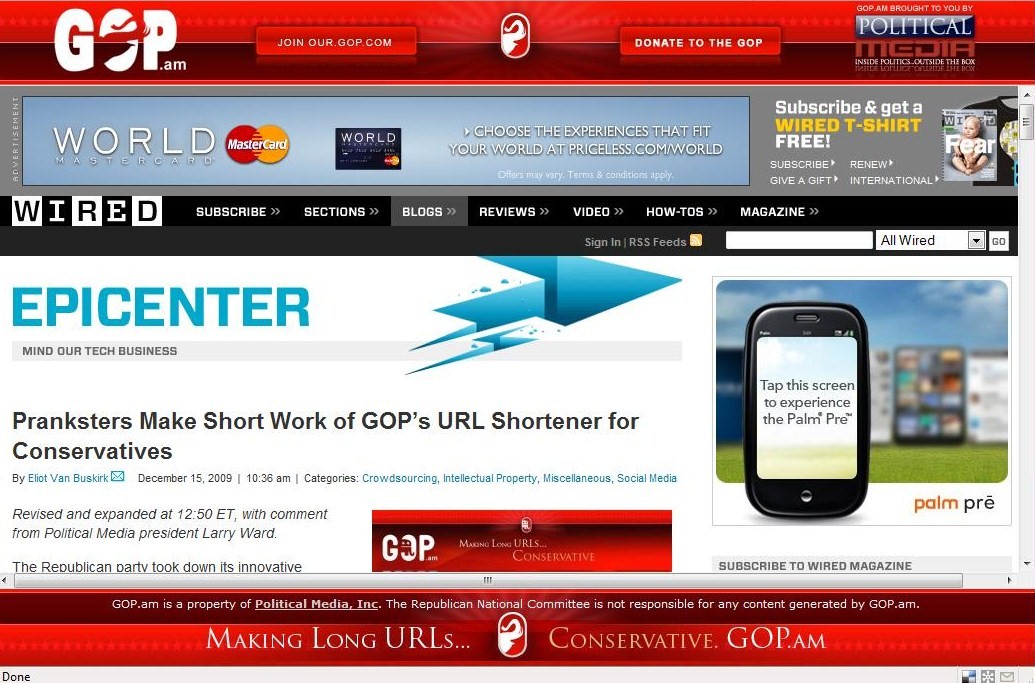
That’s one small URL for the GOP…

The Republican Party caught plenty of deserved flack for the hamfisted rollout of its website this year, but in the last couple of days there has actually been a pretty innovative development from the online right: the GOP.am URL shortener.

There are plenty of these handy devices for condensing website addresses, but GOP.am is different because it frames every website with banners directing users back to the sign up and donate sections of the GOP website.

Playful pranksters have used the link to put the GOP brand around less-than savory sites.  And, as the Bivings Report notes, the banners take up lots of space and have no obvious method for users to get rid of them.

But it’s also significant that this is not, as of yet, an official RNC project.  Remember that during the 2008 campaign, the Obama campaign benefited from user-generated videos and iPhone applications.   Even their MySpace page was started by a supporter.

Political movements which are successful online or offline have major components which are created by activists outside of the major party.  That makes projects like GOP.am important benchmarks to measure grassroots innovation – even if it isn’t perfect.

What was that about eggs and baskets?

The ACLU’s largest anonymous donor is no longer anonymous – and no longer a donor.  As mentioned on Dan Flynn’s FlynnFiles, David Gelbaum can no longer afford to write his annual $19 million check – a figure which represents one quarter of the group’s annual donations.  Combined with money he gave to the Sierra Club and groups that returning Iraq and Afghanistan veterans, Gelbaum’s withdrawal from philanthropy represents a lost $81 million in donations.

Anyone who has drawn a check from a non-profit group (especially one that is more political than charitable, as I have) can attest, economic years like 2008 and 2009 usually mean reduced donations, which lead to layoffs and budget cuts.  Of course, it’s more work to have a donor strategy with more individual donors giving smaller amounts, but dispersing the financial burden of an organization is like building a car with a wider wheel base or a house with a wider foundation – it’s just more stable.

No organization in their right mind would turn down a yearly check of $19 million.  At the same time, part of the reality of the non-profit world is understanding that at any time, any given donation can go away.  Maybe the ACLU knows this, maybe they don’t, but in either case they have provided a cautionary tale for other non-profits.

I would say that it sucks to get this kind of news around Christmas, but that might be overly religious.

He should have sung “Tomorrow”

President Obama is calling for a new stimulus package, this one specifically targeted to create jobs.  Though the President is no doubt a gifted orator, one can’t help but feel like the speech to the Brookings Institution was a little familiar… But where have we heard it before?

Of course, this speech comes on the same day that news broke that $6 million of the last stimulus went to PR work coordinated by firms run by Democratic operative Mark Penn.

Maybe the President should have looked at this speech instead:

Everyone quit breathing!

The Obama administration is expected to name carbon dioxide a pollutant today – which makes it easier to regulate without Congressional approval.  According to second grade science class, carbon dioxide is one of the essential ingredients for life – plants need it for photosynthesis.   Still, too much of anything is bad, which begs the question of whether dihydrogen monoxide – a substance which can now be found on over three quarters of the Earth’s surface – is next:

The Year in Google

Google has released their 2009 Zeitgeist report – a summary of popular search trends along various topics.  Lists like this are usually predictable – the most-searched-for baseball team was the Yankees; the alphabet soup of AIG, GM, and TARP led bailout-related searches.

But search results can also give a good concept of popular thinking on key news topics.  For instance, the top term used in healthcare-related searches is “Obama.”  That seems to indicate that, for better or worse, people are closely identifying the President with the health care reform issue.  Also interesting is that the Heritage Foundation was the #5 search term in this category – which could mean that Americans are open to hearing alternatives to what has been circulating on Capitol Hill.

Google also looks at localized search topics for several major cities.  Movie theaters and school websites dominated the results, especially colleges.  In DC, the top term was “fcps blackboard” – the portal for the Fairfax County public school system.  This actually says a lot about the Washington, DC workforce and commuting patterns.  (I knew I had company on my daily commutes into and out of Your Nation’s Capital from Merrifield, but had no idea it was enough to alter search results; Metro clearly needs more trains.)

That education websites are so popular also notes another trend.  Around the Thanksgiving table this year, my soon-to-be brother and sister in law commented that they hadn’t seen their daughter’s recent report card, despite the marking period having ended.  They explained that they just check her grades online.

Pollsters can call voters, ask questions, track answers, and get a pretty good idea of what folks are thinking.  Still, there’s an element of the Heisenberg Uncertainty Principle in that method – that the very act of measuring could affect the responses to poll questions.  Internet searches are somewhat anonymous.

As the old saying goes, you are who you are when no one is watching.

Playing two sides against Afghanistan

It’s one thing for a politician to draw criticism for a policy from his opponents, but the reaction to President Obama’s Afghani-plan speech last night from the left is potentially more problematic.

Obama’s speech was unsurprising – not only had his plans for troop escalation been the worst kept secret in Washington for weeks, he promised to do as much during the campaign last year.  Still, pundits like Michael Moore – normally a water boy for all issue blue – have issued strongly worded rebukes against such a strategy.

Moore’s warning, in an open letter, that Obama would “destroy the hopes and dreams so many millions have placed in” him suggests that he wasn’t paying attention to the substance of Obama’s campaign rhetoric.  As a likeable candidate, Obama made it easy for folks like Moore to ignore policy details and revel in the fact that their newest candidate wasn’t a wonkish robot (like Al Gore in 2000) or a New England blue blood (like John Kerry).

Unfortunately for the President, that raises expectations to the level of his follower’s wildest dreams – not a good thing in an environment where success or failure often comes down to the size of the yardstick.

New Moon, Old fashioned?

Conservatives complaining about the left-leaning bias of movies and TV shows is nothing new – and with each shrill criticism comes another round of shut-up-and-just-enjoy-the-movie eye rolling.  It turns out the whining comes from both sides of the aisle.

Campus Progress is none too fond of the #1 movie of last weekend; apparently the vampire flick New Moon is rife with disturbing hidden messages. For instance, a conversation about whether werewolves are born as werewolves or whether they choose to become werewolves is decried in light of the lack of gay relationships in the movie.  On top of this is what the author calls:

“[A] disturbingly explicit anti-premarital sex message which ends the movie… despite knowing the Mormon background of Meyer, I couldn’t believe that the director and screenwriter would have let the end credits roll without undertaking some sort of criticism of the ideas espoused by the main characters in the final scene.”

It sounds like these Mormon vampires are undead-set on pushing a social agenda.  Clearly, this movie about werewolves fighting vampires must be answered; and the best way to fight speech is, as always, with speech.  Maybe the folks who agree with Campus Progress can find some way to get a movie made which deals with alternative lifestyles, or one that puts promiscuous teenagers in a more positive light.

Basketball with a public option

What’s the problem with having a public option as part of a health care reform package?  This video does a good job of exposing the fallacy that a government-run insurance program simply expands competition on an even field – or, in this case, court.

enator Dodd

Letters:

· Ted Keyes – Financial professional, active member of numerous greater Hartford business organizations and Dodd supporter ( has spoken with Dodd over the years on litigation reform issues, specifically Class Action).

· Ryan Kennedy – Former personal aide to Dodd.  Ryan began a career in financial services about 5 years ago after leaving Dodd’s staff.  He is a supporter, contributor and son of Dodd’s close friend, Brendan Kennedy.

· Mark Austin – Private Capital Group

Web postings:

· http://philosophyofexperience.blogspot.com/2009/11/dodd-turns-bank-reform-into-gift-to.html

· http://donpesci.blogspot.com/2009/11/dodd-dancing-with-scheme-liability.html

Sen. Bayh

Letters:

· Martin Wright – CPA and the CFO for Laibe Corp.

· State Representative Matt Bell (R-Avilla) – He is forwarding a previous securities letter along with a new cover letter.

· Deirdre Tiernan – CPA for the Indiana Rural Electrical Cooperatives.

· Michael Brenner – CPA for the Indiana Rural Electrical Cooperatives.

Phone call:

· Chris Belch – Partner in the bankruptcy firm Lynch and Belch. He spoke to Ellen Chube, Senator Bayh’s Banking LA.  According to Ellen the Senator is reviewing the language and she could not speak specifically to section 984. She did say the Senator feels the House version provides too much financial regulation.

Web/Email:

· Indiana Manufacturers Assoc. – Included language on the Bill in their morning email blast to 8,000 members on 11/17.

Sen. Schumer

Letters/email:

· Mark Gjonaj – Treasurer, Albanian American Chamber of Commerce, to Marty Brennan with a copy of a letter he had previously sent in on scheme liability.

· Ralph Coti – Owner of Coti and Sugrue, a well-known law firm in New York City. He’s dealt with Schumer in the past.

· George Darden – Mayor, Village of Spring Valley

Phone call:

· Armen Meyer – High level staffer for NYS Banking Superintendent Richard Neiman.  Called Jona Crain, Schumer’s LA for the banking committee, to express the superintendent’s views about the single regulator proposal and the negative impact it has on New York: destabilization of the state charter, removing expertise of a state partner, and giving banks no reason to stay in New York. He said JC wasn’t forthcoming with position of Schumer, but was very receptive to the opposition points despite public comments made by Schumer.