It’s in the dictionary now, and can’t be “unworded”

The verb “unfriend” is in the Oxford American Dictionary Word of the Year.  (It is also now officially a word.)

Of all the verbiage to come out of social networking and new online environments, it’s interesting that unfriend – the negative act of rescinding a connection – takes this honor.  The inclusion and exclusion of words in dictionaries is more a measure of culture than technology – technology creates new terms every day, but to be included in popular language those terms must have a crossover appeal that removes them from the realm of technical jargon and into the realm of word you might read in a newspaper article.

When most of us “unfriend” someone, it’s not because of an offline relationship that has gone south, but because the online relationship was more than we could handle.  Anyone with a Facebook account has had the friend who constantly sends requests or shares too much information.  Most people on Twitter have followed a friend who peppered their feeds with such witticisms as, “Making a sandwich and can’t decide – grape or strawberry jelly?!?”  Speaking of Twitter, after a spike earlier this year their new user numbers seem to be leveling off,and big companies that were excited to enter the medium have become absentee Tweeters.

In other words, we are settling into these new online environments by shifting from the mindset of signing up every new and shiny community or connecting with every long-lost high school class.  Perhaps we are getting better, both in terms of who we connect with and where we connect, at prioritizing what is best and most useful for us individually – and unfriending the rest.
App shoot

Upon reflecting more about recent, high-profile rejections from Apple’s App Store, one thing is becoming apparent: with the iPhone/iPod platform is gaining popularity, more developers are investing time and resources writing software for it only to see their creations rejected.

The closed-door approach makes sense for Apple – since their platform is the first of its kind, any questionable use would reflect back on their highly-recognizable brand rather than an anonymous developer.  If Saturday Night Live legend Garrett Morris developed a game for the iPhone called “Gonna Get Me a Shotgun and Kill all the Whities I See,” Apple would bear the brunt of the protests for allowing it rather than Morris.  (When Morris famously – and hilariously – sang that line on the air in 1976, the NBC switchboard probably got more calls than Morris’s home phone.  By citing the actual sketch, do I avoid somehow being called a racist for quoting it?)

But the closed door has implications for potentially revolutionary uses of mobile technology.  In 2008 a developer created an excellent application for the Obama Campaign, allowing volunteers to prioritize their contacts for get out the vote calls.  If the time and effort invested in creating an app is possibly wasted, how will small, volunteer-driven campaigns for local or Congressional offices – the types of campaigns who could really use the technology – justify exploring the possibilities of the platform?

MSNBC would never say that (about a Democrat)

“Barack Obama is a stupid #$@&ing socialist!”  So said the Twitter feed @MSNBCHeadlines, which has since been discontinued after a profanity-laced Twitter tirade (twirade?) on Friday, as documented by TechCrunch.  Previously, it had just served up exactly what it promised – MSNBC headlines, without comment or blue language.

It’s easy to chalk this up to the feed being hacked, but as TechCrunch reports that Twitter account was never owned by MSNBC.  So here’s another possibility: @MSNBCHeadlines was a sleeper Twitter account built for the express purpose of saying things like “Chris Matthews sucks.”  But in order to maximize the impact, the owner of the account simply fed MSNBC headlines for a few months to build a follower base.

It’s pretty easy to do, and it might not be the last time we see something like this.  With big 2010 House and Senate races coming up, now would be the time to register a Twitter account like “@PASenateHeadlines.”

Let’s say you work for Joe Sestak, the Democrat Congressman challenging Arlen Specter for the nomination.  It would be easy to feed the account with the daily news stories about the race that run in various newspapers around the state thanks to Google news.  There wouldn’t need to be any slant to the stories, and the lack of a slant would attract more followers; interested parties (especially reporters) would follow the account just to get straight news from various sources that they may have missed.

The account exists on autopilot and seems innocuous for a few months.  Then, weeks before election day, you take more direct control of the account.  Instead of automatically feeding it any old story about the Pennsylvania Senate race, you serve up more consistent anti-Specter news.  If you have some potentially damaging information about Specter (like video of him hanging out with George W. Bush) you could use this Twitter feed to attract attention.

Maybe @MSNBCHeadlines got hacked.  But maybe it was a prank that provided a blueprint for an effective campaign tactic.

Are you sure your real name is Bob McDonnell?

After an election season of making fun of Creigh Deeds’ ads, Bob McDonnell has to get his in the interest of equal time. Variants of this commercial – with McDonnell talking into a camera about generic, I-have-a-nine-point-lead-and-don’t-want-to-risk-anything themes – have been making the rounds on Washington stations:

It may be a testament to Deeds’ failure as a candidate that he is likely going to lose to a candidate who looks like the father, uncle, older brother, or possibly even the older version of Bruce McCulloch of Kids in the Hall:

T’was the night before the Election…

Virginia: With Virginia’s election trending heavily toward Republican Bob McDonnell, Creigh Deeds has been running a new ad in the last week:

It continues a running theme for Deeds’ campaign: “Hey, look at the cool people who I hang out with!”  Unfortunately for him, attaching himself to other, more popular politicians hasn’t worked yet and likely won’t work tomorrow:

(In the meantime, NotLarrySabato re-posted and updated an older post that made the case that Gov. Tim Kaine is the Democrats’ version of former GOP Gov. Jim Gilmore.  It’s  an interesting read on VA politics.)

New Jersey: Gov. Corzine is following the same strategy as Creigh Deeds by hitching his wagon to the Obama train.  It’s certainly a better idea than bringing up a failed proposal to lease New Jersey’s most famous tourist destination, the Jersey Turnpike – a likely interview misstep which he has since backed off of.  It’s a hollow strategy that may drag Corzine over the finish line, but speaks volumes for Democrats’ supposed intellectual edge in the battle of ideas.  There are two other strategies to expect in a New Jersey race as well: voter fraud and litigation.  Look for Corzine to either pull out a close victory at the polls or file as many lawsuits as it takes to be declared the winner.

New York 23: This has suddenly become a fashionable race drawing lots on national attention from both sides, so you can’t really call out Democrat Bill Owens for following the same playbook as Corzine and Deeds.  In fact, the big story line in the idea that the third-party challenge is evidence of conflict within the Republican Party – but then again, what isn’t?  The real story is that Dede Scozzafava’s defection has not resulted in a rush of support for Owens.  With heavily motivated support and momentum, the smart money here is on Doug Hoffman.

Quite an enemies list you’re building there…

Ever heard of Edmunds.com?  It’s an information site for prospective car customers.  As businesses looking for free publicity often do, they decided to publicly discuss something which was already making news, releasing an analysis of the Cash-for-Clunkers program that put the per-car cost to taxpayers at $24,000.

The dignified. measured response from the White House to mild criticism from an obscure consumer site?  A point-by-point analysis of the analysis… under the headline “Busy Covering Car Sales on Mars, Edmunds.com Gets It Wrong (Again) on Cash for Clunkers.”

If you’re scoring at home, Fox News is not an officially approved news organization and Edmunds.com is where to buy your Mars rover.  And the White House doesn’t take kindly to made-up numbers… well, usually.

St. Barack of Chicago

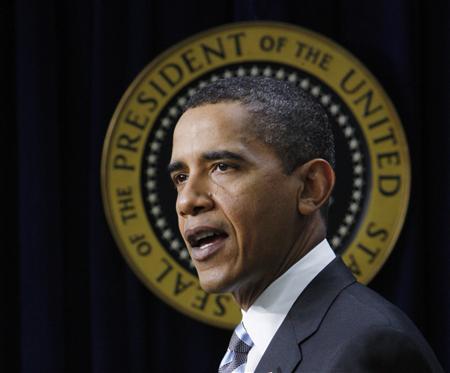
An enterprising Reuters photographer – likely with a sense of humor – took this picture of President Obama today:

Obama

The President was speaking about his administration’s programs to help small businesses.  No word on whether he said anything about money-changers.

An image like this is probably not set up on purpose.   The White House communication staff will probably have to spend a little more attention to the sight lines for photographers at future press events.

Although, we probably should not judge them, lest we be judged.

How many friends do you get to keep?

The Sunlight Foundation went into the weekend with a hit piece on the much-maligned re-designed GOP.com.  Over at TechRepublican, James Richardson started the week with a well-researched rebuttal, noting that Sunlight missed a couple of items in the shadows in decrying the projects price tag.

But for the site’s well-documented technical faults, on the internet content is king, so there’s at least reason to laud the Republican new media operation:  The Facebook Friendship Fairness Czar application.  The application tallies the number of your friends and assesses a “tax” reflecting how many you have over the average Facebook user’s 120-friend total.  It’s a pretty neat way to needle the Obama Administration’s tendency to entrust policy decisions to executives with no Congressional oversight.  The postcard alerting you of your tax is actually kind of funny, too:

friendship fairness

Facebook is a necessity for any new media operation – even MySpace knows that now.  That means finding creative ways to connect and keep people coming back.  Even if GOP.com has its problems, at least the Republican party is thinking strategically.

Gallup-ing to the right

Fellow UMass alum Dan Flynn points out Gallup’s evidence that Americans are trending more conservative in 2009 than they did in 2008.  The most important aspect of this revelation is the cause: apparently, independents are shifting right. And this wasn’t just self-identification: conservative positions on government involvement in business, union influence, and even gun rights became more popular.

Note that these numbers reflect people’s issue position and not necessarily their political party preference.  As the Republican party is finding out in NY-23, the two are not necessarily one and the same.  Even if the GOP tallies a pair of victories in New Jersey and Virginia next week, the lessons for a return to power nationally may be learned in upstate New York.