When Supreme Court nominations stop being polite and start getting real

The Elena Kagan pick has been a perfect, hand-in-glove fit with the criticisms that Washington DC has grown out-of-touch with the rest of the nation.  The prospect of an exclusively Ivy-educated Supreme Court has sparked questions about Eastern corridor elitism.

Of course, not helping was that Senator John Kerry picked a Politico Arena discussion board – ostensibly set up to discuss whether the nominee is too steeped in “Ivy League education and elite positions in government” – to sing Kagan’s praises from their time working together on high stakes tobacco legislation in 1998.

Kagan’s camp could not have asked for a worse messenger with a worse message:

“Massachusetts has been Elena Kagan’s adopted home, but it’s not for such home state boosterism, parochial reasons why I think she’s a terrific choice.

No, it’s because I got to know her well not in Boston, but here in the Senate.”

That’s John Kerry, who connected so poorly with voters in 2004, the poster child for liberal elitism.  And his comments have nothing much to do with the topic: he’s essentially adding his two cents to a discussion about Euros – and helped keep alive the notion that Kagan is an insider pick.

All politics are personal

TechRepublican points to this pretty cool video about the continued significance of social networking:

The importance of online engagement is nothing new to businesses and politicians – at least, it shouldn’t be.  Still, even those who appreciate the power of this communication don’t seem to grasp the underlying principles.

One set of stats stood out from this video: while only 14% of people polled trust advertisements, 78% trust recommendations from friends.  Those aren’t necessarily Facebook friends, either; the more technology becomes integrated in our lives, the more it exposes our human nature.  We trust people we know more than those we don’t know.  Political strategists from the nineteenth century understood the need for voters to hear from local party leaders, and no substitute has ever worked.

Speaking at an event in Richmond, Va. last weekend, Obama campaign manager David Plouffe summed up what that means for the campaigns of the future:

Plouffe said the campaign was built using the Internet to engage voters in volunteering, contributing money and “sharing the message” amongst themselves. Connecting these people — not only to the campaign but to each other — helped them build trust with prospective voters they engaged both online and face-to-face.

“There is a lack of trust — in government, in business leaders, in academic leaders, even in faith leaders,” Plouffe said. But, he said, “People trust each other.”

Forget about local – all politics are personal, and always has been.

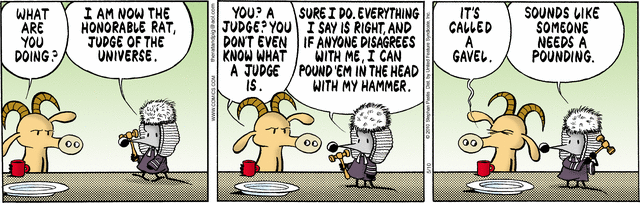
The court looks different from this angle

This morning’s Washington Post Express had the following installment of the excellent comic strip Pearls Before Swine:

And then, by a happy coincidence, the worst-kept secret in Washington DC is confirmed: President Obama will nominate Elena Kagan – who hasn’t been a judge – to be the next Supreme Court Justice.

Despite a different experience than others, having a legal scholar on the bench may allow the court to reach opinions based on legal theory rather than the circumstances presented.  Though given the qualifications President Obama has put forward in the past, don’t hold your breath waiting on it to happen.

Obey your instincts

Rep. Dave Obey saw the writing on the wall.

Despite his stature as a political institution, he was facing an electorate that has soured not only on liberal policies that he has championed, but also on the concept of incumbency.

More important, his opponent was young, telegenic, and media-savvy – the perfect counter – and, more important, was drawing attention from beyond the district.  This is the second big story for Sean Duffy in a week, the first being his victory in Gov. Tim Pawlenty’s PAC endorsement contest.  Clearly, Duffy would have money and support coming from outside the district from a Republican infrastructure eager to find a fresh new face.

Despite the fact that he looked like a long shot on May 4, Duffy’s campaign had the chance to follow a similar arc to Scott Brown’s victory in Massachusetts.  Running against a senior ideologue from the other party, Duffy could have tightened the polls gradually over the summer and been in position to score a big upset with a late push of volunteers and money from across the country – think online money bombs and remote get-out-the-vote call centers.

All politics are still local – but when the right candidate uses the right technology, a whole lot of people can become local.

Responding to BP’s response

After yesterday’s crisis management advice for BP, it seems fair to look at what the world’s current least-favorite oil company has been up to online in its response to the oil spill in the Gulf of Mexico.

BP devoted a section their company website as a central repository of information about their cleanup efforts.  The pages are very fact-heavy, along with two video responses from BP officials and several pages of pictures.  Essentially, BP’s branded response to the crisis is an online press kit.  While the breadth of information is impressive, this is an exclusively one-way channel.

There are, however, other venues.  BP is one of the driving forces behind DeepWaterHorizonResponse.com, plus an associated Facebook page and Twitter feed. As one might expect, the Facebook page is the best of the group; Deep Water Horizon officials respond to comments with measured, polite answers to legitimate questions; and harsh critics are not censored. It helps that the initiative is not branded as coming solely from BP, thus diffusing some strong emotions folks likely feel toward the company.

It would be nice to see more from the efforts on the ground beyond a few pictures on all of BP’s online properties, something that could evolve as the campaign matures.  It’s a decent enough first step for BP, but it will only work if it’s the first step of many.

Stylin’ and De-profilin’

Satire makes for a strong protest, and a group called Reform Immigration for America has a funny spoof website based on the Arizona immigration law.  The site – Deprofiler.com – “helps” Latinos avoid being stopped by Arizona law enforcement officials by providing cutout masks of “a friendly white person’s face” (pictured).

Whether you agree or not on the effect of the law, the site is really good – largely due to its simplicity.

The design is basic and minimalist, and there aren’t a ton of extraneous functions.  There isn’t any space wasted with background fact sheets for anyone who hasn’t heard of the issue.  There are only two prominent features: downloading a mask and sharing with a friend.

In other words, the site doesn’t get in the way of its own message.

The most powerful communication is word of mouth.  This site simplifies an important issue, makes its point, plays it for smart yuks, and gets out of the way while you send it out to your social networks.

The terrorism Jump to Conclusions mat

For the last year, the story has been the same – voters are upset with and distrustful of government, meaning we should be on guard for violent outbursts from the right.  It’s going to happen at one of these tea parties, we’ve been told.  Glenn Beck and his ilk are spurring violence, and not-so-secretly happy about the idea of angry mobs spurring armed revolution.  Democrats must live in fear, because Republicans are willing to stop at nothing to stop them!

So here’s a thought: just this weekend, New York faced a bomb threat.  The suspect is in custody, but there’s no indication on motive yet.  In fact, in stories buried under a sensational headline about South Park’s recent controversy, Rep. Peter King actually makes exactly that point:

Though King said the “hostile remarks” raised after the South Park incident were worth investigating, other potential targets – such as nearby financial institutions – needed to be looked at as well.

Financial institutions?  Well, let’s think about that.  Plenty of lawmakers have been taking shots at Wall Street, lumping the entire financial services industry in with the fraudulent and dishonest players.  The President himself has made a bit of a political comeback thanks to rhetoric based on widespread popular distrust of these financial institutions.

So if you have a “Jump to Conclusions” mat about the recent failed terror attack in New York, doesn’t one of all those “conclusions written on it… that you could… jump to!…” have to be that the Times Square bomber could have been operating based on what he has been hearing from Washington?  It’s perfectly logical if you buy the argument that harsh rhetoric from media mouthpieces incites acts of violence.

But like the jump to conclusions mat itself, it is a terrible, terrible idea.

Big Oil’s worst nightmare is, ironically, big oil

Questions may fly about who will pay how much to clean up the latest catastrophe in the Gulf of Mexico, but the answers affect more than British Petroleum’s cash reserves.  The accident which claimed the lives of rig workers and threatens the coastal environment’s short term health comes just months after President Obama made a big show of opening up new areas to offshore energy exploration.  From a business angle, at risk is the future of offshore oil drilling for BP and any other company that relies on the United States government for exploration rights.  In the coming weeks, the drumbeat to cap the wells and bring the oil derricks back to terra firma will only grow louder, unless BP and their colleagues take the right actions now.

The Action

Eventually, there will probably be a rational explanation of why BP wasn’t entirely responsible for all the economic damage, but as the current debate over financial reform legislation demonstrates, rational explanations will do little to convince populist politicians. In addition to directly funding clean-up efforts, BP would be wise to work through local governments to administer small business development programs to help industries affected by the spill get back on their feet – and possibly even exceed their previous production.

Working through local and state governments is especially key.  Criticisms of BP are most likely to come from those voices, but if they are satisfied with relief efforts, they could be powerful allies.

Incidentally, BP should not act alone in this.  Energy companies have been asking to drill for resources in the waters off the U.S. shoreline for a long time, and the most compelling argument against them has come to realization.  While BP’s visibility and leadership is vital, other companies have a dog in this fight, too.

Messages and Messengers

There are two important themes BP and the industry must advance.  First, they must highlight what they are doing to rebuild – the programs they put in place as well as the results.  The second (which involves the whole industry, is to re-affirm the value of offshore drilling.  In both cases, the people delivering the messages matter as much as the messages themselves.

Toyota’s handling of the safety issues which plagued them earlier this year offers some good advice to follow.  Toyota recognized that not only was the perception of their cars damaged, but leaked emails and memos damaged the credibility of their top executives.  Americans don’t trust CEOs, so  Toyota turned to the two groups that could offer credible, positive messages: the engineers and assembly line workers who make the cars, and consumers.

This is where online communication – and especially online video – will be important.  A video channel featuring commentary from government officials and environmental workers will offer a transparent and compelling chronicle of the relief efforts. And oil industry workers – from those on the rigs to those in the refineries – offer an important insight as well.  For them, offshore drilling is as much about putting food on the table as it is about lowering gas prices, and they are now the best spokespersons for the industry.

The reality is that we live in a time where often, government picks winners and losers in the business world – a proposition that puts BP and their colleagues at risk.  Further, since they are hoping to tap reserves in areas controlled by the federal government, The oil industry will not soon shed their image as a huge, greedy, quasi-government entity.  Americans are traditionally suspect of power.  The best thing they could do is admit some level of responsibility, work to rebuild, and – most important – invite the American people and media in to see the details.

Ant-iTrust?

Apple – or, more specifically, Apple CEO Steve Jobs – flexed some muscles in the last week by proclaiming that Adobe Flash has no place on the iPhone, the iPad, or whatever’s iNext.  As previously discussed (here and there, as well), the walled garden that is the App Store positions Apple not only as the gatekeeper of “tech cool,” but also as the potential object of an antitrust investigation.

Today, two Washington agencies are reportedly deciding who gets to launch an Apple antitrust investigation.

As easy as it would be to point to Jobs’s chest-beating, this is the second time in two weeks where a company is drawing ire from inside the beltway.  And in both cases, the companies in the crosshairs are direct competitors to Google.  That doesn’t make Google the Michael Corleone of federal tech policy, taking out enemies silently and sequentially (though it would be kind of cool if it were).  It does mean that technology policymakers seem to be on the same page as Google as far as what access to the internet or the mobile web should look like.

An American Macaca in London

Just days away from an election, Gordon Brown pulled a George Allen.

The similarities go deeper than off-the-cuff comments caught on tape during a campaign.

In each case, the comments helped underscore the impressions opposing candidates wanted voters to have of the offending candidates.  In 2006, Jim Webb and Co. would have loved for northern Virginia voters to think of their incumbent Senator as a southern”good ol’ boy” with questionable opinions on race.  That’s not the type of charge a serious candidate can credibly level against a candidate without strong evidence; Allen made it easy when he unwittingly uttered a word that sounded like an ethnic slur.

Similarly, opponents of Brown’s Labour Party could have complained that the Prime Minister was out of touch with ordinary Americans (or however that argument goes over there), but Brown has made it exponentially easy by callously dismissing the concerns of a voter. The snide attitude and duplicitous nature make Brown the stereotypical career politician – aloof, self-aggrandizing, and contemptuous of the constituents underneath him.

The only thing going for Brown is that, at the very least, he didn’t know he was on tape.