Crist crossing party lines

It’s hard to portray yourself as an outsider when you sit in the governor’s mansion in one of the biggest states in the union.  But Gov. Charlie Crist did his best yesterday, positioning his decision to run as an independent as an answer to a broken system. And it just might work.

Though polls currently show Marco Rubio with a slight edge, they also show that 35-40% will likely win the race.  (Unlike Sen. Joe Lieberman’s 2006 run after losing the Connecticut Democrat primary, the opposition party is not laying down.)   Even though some Republican donors are sure to ask for their money back, Crist is a sitting governor through the beginning of next year and Florida is a state with plenty of commercial interests.  That math isn’t hard to do.

If Crist wins, the math gets even more fun.  Assuming he stays independent, he could become very difficult to topple as long as he maintains support in one third of the electorate.  That would make him an anomaly in American politics: a safe incumbent with 35% support.

I pahked my blawg at Hahvahd Yahd

(Cliff Claven-to-English translation: I parked my blog at Harvard Yard.)

Harvard’s Berkman Center for the Internet and Society released an extremely flawed study of influential political blogs that found some interesting contrasts between the ones on the left and the right.  In sum, liberal blogs are more communal, set up as digital campfire “Kumbaya” sessions that invite multiple users and issue more frequent calls to action.  Conservative blogs tend to be solo acts.

As highlighted by The Nation’s coverage, the study floats the idea that the difference could be as political as it is technical:

The right’s relatively limited integration of user contributions is consistent with readers or users who seek the stability of authoritative voice, consistent with claims… about the kinds of psychological needs that conservatism serves. Similarly, the more egalitarian, participatory practices on the left require tolerance for the unpredictability of open and fluid discourse.

The concept that conservative philosophy leads to more individually-themed blogs makes sense, but for the complete opposite reason outlined here.  In just about every domestic policy debate over the last 30 years, conservatives have argued for a reduction or limitation of government programs, while liberals and progressives have argued for an expansion of government programs.  It follows, then, that a conservative is more likely to start a blog by himself or herself than to round up a bunch of friend; a liberal might be more inclined to look for collective action. I don’t necessarily buy it, but I can understand the argument.

The paper also presents a second, much more plausible explanation: that leftist online political discourse came of age in the mid-2000s, when liberals saw Republicans in power and a Democratic party that boasted dynamic leaders like Tom Daschle, Dick Gephardt, and John Kerry.  Remember at this time, John Edwards was the breath of fresh air that was supposed to bring new life to the party – that’s how hopeless things looked for the Democrats.

This explanation,though it may be closer to the truth, highlights the major problem with the study: it’s based on data collected in 2008.  That’s before Twittering conservatives started holding local tea party protests last year to protest government spending – and well before those protests became a national organizing flash point.

The openness of the tea party movement – and its base of activists who are frustrated by both parties – seems to bolster the latter conclusion on the nature of 2008’s conservative blogosphere, but it begs two more questions:

  1. At the rate technology and tactics develop online, how can you say you have credible current findings about the nature of online activism with two-year-old data?
  2. If a UMass guy can understand that, what the hell is going on Harvard?

Location, location, location

The 2012 Presidential race is still a couple years away, but the early contenders are already beefing up their online efforts.  That makes it a good time to start asking what the 2012 online campaigns will look like.  The National Wildlife Federation is doing some cool things with location-based technology, and the contenders to the Oval Office would be wise to take notice.

Between social networks based on where you’re at (Foursquare, Gowalla) and the GPS-enabled smartphones that make these applications portable, location data will be important eventually to the campaign that invests the intellectual resources in it.

E-commerce dawned in the late 1990s, and in 2000 John McCain became the first candidate to raise significant amounts of money online.  In 2004, the internet offered a way to link people with common interests; the Howard Dean campaign (and later the Bush Campaign) responded with programs that helped activists find each other and organize local events.  In 2008, MySpace and Facebook allowed people to easily share content with friends; the Obama campaign’s online efforts were based around that same concept of virality. Successful campaigns change to reflect internet trends.

A campaign might use any number of location-based tactics.  Activists could be alerted to events in their area.  A campaign could offer contests for volunteers using Foursquare to check in at  headquarters or to recruit friends to attend rallies and other activities (not the least of which is voting).  Advocates could request campaign materials (like lawn signs) or instantly share stories through smart phone applications.

There’s no guarantee that the first campaign to take advantage of this technology will win, of course – McCain, Dean, and more recently Ron Paul  all proved that success online doesn’t always translate to the ballot box.  But for those looking for emerging technologies to gain an advantage, this is one place to be.

(Get it?  Place to be?  Location?  Aw, shut up.)

Signs, signs, everywhere are signs

Arizona’s new immigration has, predictably, led to protests.   John Hawkins of Right Wing News chronicles some of the disturbing signs that the pro-illegal immigration protesters have been waving about.  Here’s my favorite:

These signs in and of themselves aren’t really relevant, but as Hawkins points out, outlets like the Huffington Post love to bring their cameras to tea party rallies to capture the “shocking” rhetoric they see there. It’s an astute parallel to draw: If you want to judge the tea partiers by their most extreme elements, don’t you have to judge the pro-illegal immigration movement the same way?

Doing either misses the bigger images that each movement brings to the table.  For instance, in many of the pictures Hawkins displays, extreme signs calling for the overthrow of America obscure protesters with American flags in the background.  The undercurrent of the immigration debate is a quest for the American dream, not the racist rhetoric on the signs – a revelation which puts the debate in a new perspective, even if you don’t agree with what they’re saying.

That might be a good lesson to kind in mind for those covering the tea parties, too.

Senators make privacy demands to Google

Oh, sorry, that’s Facebook, whose tentacles are constantly expanding throughout the web, but not in Washington.  Sen. Charles Schumer and colleagues have posted an open letter on Facebook’s wall demanding to know just how the social network’s privacy options work.

In the meantime, Google continues to track, store, and process user data from various points in order to build advertising profiles – a practice which raises concerns not only about privacy, but about reach.  In fact, Google’s signature service, search, has a much lower barrier to entry than Facebook’s; while Facebook makes you create an account and is thematically based on the idea of sharing personal information, Google’s search service is open to anyone trackable by IP address.

So why does Facebook get a nasty letter while Google gets a pass?

It may have something to do with the fact that Google spent $1.38 million on lobbying in the first quarter of 2010 alone.  More significant than the actual dollars spent is the intellectual investment: Google has clearly made it a priority to be a Washington, DC player on both sides of the aisle.  This level of involvement positions Google as a resource, preventing policymakers from seeing what is an obvious parallel.

Sorry, that Twitter isn’t yours…

David All of TechRepublican has a really good post following up on the Poltico story about the early online organizing for 2012 Republican presidential candidates.  All, who was quoted in the story, chronicles a brief back and forth between himself and some Sarah Palin backers over the former Governor’s Twitter account. All had criticized Palin’s online team for starting a new Twitter account when she left office (and thus having to rebuild her substantial follower list).  Apparently, when she left office, state officials claimed her Twitter handle was state property, forcing her to sign up for a new account.

All correctly identifies that whether or not Sarah Palin could have (she could have) or should have (she should have) laid claim to the account name, a bigger issue is at play:

The state-level IT folks, likely a problem in every state, pushed back on the account ownership question because they don’t understand how best to treat emerging situations that are not black and white technically, legally or politically… But we’ve now identified a problem which we should work to address collectively: How should the accounts of government officials be treated once they leave office?

This is no small question for governors who chose to run for President.  Could Democrats in the Minnesota state legislature start calling for an investigation on Gov. Tim Pawlenty’s Facebook friend list to make sure the governor doesn’t pull the modern media equivalent of swiping office supplies?  Would Republicans in Montana have a right to do the same if Gov. Brian Schweitzer started to make waves with eyes on the 2016 ticket?

It would be wise for states to figure this out seriously while the issue is still non-controversial.  In the absence of a policy, politics are sure to fill the void.

South Park at 201 (and counting)

South Park got everyone talking last week, but not for the right reasons.

Now thirteen years old, the show celebrated its 200th episode a few weeks ago.  This milestone should have received some more attention than it did: aside from basic longevity, South Park was and is the signature show that put Comedy Central on the cable map.

More significant than that, though, is the unique social commentary South Park offers up from a center-right perspective – and the fact that no other show does that as well.

One episode called out hybrid enthusiasts as presumptuous yuppies who enjoy the smell of their own farts.  Two episodes made the point (using thinly veiled surrogates for Starbucks and Wal-Mart) that big businesses are big because people want their products, not because of some evil corporate trick. A sixth season episode managed to mock lawsuit abuse, political correctness, and draw a line between tolerance and acceptance.  A two-part episode glimpsed into a future without religion and found devout atheists arguing over whose scientific logic was superior.

South Park has been a turn-of-the-20th-century incarnation of an Ayn Rand novel – telling a compelling story while making important and uncommon cultural points.  In fact, a 2005 book about the rise of media-savvy conservative activists was titled South Park Conservatives.

But calling South Park a political show is a misnomer.  Other efforts to become conservative or libertarian alternatives to left-leaning television shows, movies, or other media outlets have failed because those outlets put politics before content; South Park is a funny show that happens to be made by people with a libertarian-oriented worldview.  It would be hilarious either way; the leanings of creators Trey Parker and Matt Stone just make it different.

If you want to learn more about smaller government and individual freedom, Hayek and Bastiat are better philosophers than Parker and Stone.  But it you want entertainment that comes from a different perspective than most of the stuff out there – and that is, despite some shock value jokes and toilet humor, pretty smart – go on down to South Park and have yourself a time.

How do you like that? Facebook and microtargeting

This was a big week for Facebook, which stepped up its presence in the battle with Google to control the internet on computers.  (This is slightly different from the battle to control the internet through your phone or the internet through your TV or the battle control the internet through the cord surgically affixed to your brain stem.)

By spreading tentacles throughout the web, Facebook will latch your profile more closely to your online activity.  Sure, it’s a little creepy, but it’s also voluntary; no one has to have a Facebook account after all.

Setting aside privacy concerns, this is a really big [BIDEN] deal in a year when political insurgency is all the rage (no pun intended).  In a great post at TechRepublican, Jordan Raynor outlines how establishment political support (such as Florida Governor Charlie Crist enjoyed a few months ago) can be trumped by a campaign which connects directly with supporters and leverages that energy to create its own momentum.

Facebook is going to become a better and better place to do that – providing in 2010 and 2012 what the concept of microtargeting was in 2002 and 2004.  In those years, Republicans used consumer data to identify potential supporters – if you shop at a certain place and subscribe to certain magazines, for instance, you might fit a profile of a Republican voter.

Now, you can profile your supporters (who may or may not belong to your party) and directly serve them online ads.  The possibilities are pretty exciting – unless you’re sick of political ads.

You will be.  You will be.

How deep is America’s distrust of Washington?

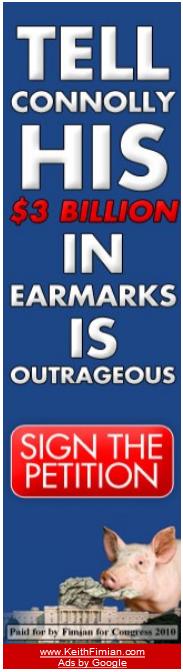
This ad showed up next to an online news story today:

Running for Congress by running against Congress is nothing new.  But running for Congress because your opponent brings too much money to the home district?  National politicians love to talk about pork barrel spending, but their tune changes when the conversation turns to their own district.  The battleground for Keith Fimian’s challenge to Rep. Gerry Connolly is VA-10, my current district of residence and one that probably gets a lot of money in federal funds.  Connolly is also a targeted freshman member of Congress, so Democratic leadership is probably eager to help him buy votes.

Of course, even if Fimian wins, he might not be any different – but the rhetoric of going to Washington, D.C. and sending less money home is still pretty notable.

iContribute’s shot to ActBlue

Online campaign consultancy Engage – who, helmed by Patrick Ruffini and Mindy Finn, helped out on Scott Brown’s upset in January – released a new wrinkle to their iContribute platform today:

Through iContribute Slates, political action committees can now raise money for directly for a slate of endorsed candidates. PACs can easily set up their pages, pick the candidates they want to highlight, and offer supporters a chance to support selected candidates with a contribution of whatever amount they wish.

Last month I discussed why the right doesn’t really need an ActBlue-esque clearinghouse for online fundraising – and Slate is a good example of why (despite Ruffini’s contention otherwise within the post).  Slate isn’t as much a fundraising tool as it is a chance for a PAC to become transparent and helpful to other campaigns – it’s more about communication than money.

Tim Pawlenty’s FreedomFirst PAC, which Ruffini cites in his post, is a good example.  A donor could cut the PAC a check of up to $5000, which would then be distributed among various candidates.  Or, through Slate, that donor could give $2,400 each to eight different candidates.  Not only does that add up to a lot more, but it lets the PAC share contacts with the campaign – and someone who donates $50 today may be able to donate another $50 in two weeks, or may be interested in helping out in other ways, like making remote GOTV calls.

When ActBlue launched, it transformed passion into money.  Slate transforms donors passionate about one candidate or committee into potential activists for others.