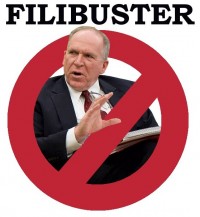
If nothing changes, everything will stay like this!

Today, Politico opines that immigration reform will give Democrats a big edge in future elections:

The immigration proposal pending in Congress would transform the nation’s political landscape for a generation or more — pumping as many as 11 million new Hispanic voters into the electorate a decade from now in ways that, if current trends hold, would produce an electoral bonanza for Democrats and cripple Republican prospects in many states they now win easily.

Even Politico admits that this type of projection is “speculative” given that the newly eligible voters wouldn’t be casting President ballots until 2020 or 2028.  It doesn’t keep them from speculating, though.

This sounds similar to the countless pundits on the right who have been wringing their hands for the last six months over the Great Question of What Went Wrong in 2012.  How, they ask desperately, are we ever to win again?  We don’t speak to minority groups!  We don’t use Big Data!  Our candidates are bad!  Our messages are out of touch!  Look at all the support for President Obama in 2012!

Republicans who feel bad about this should review the last several candidates for President produced by the Democratic party before they struck gold with Obama:

  • John Kerry, an aristocrat out of Massachusetts who couldn’t beat a vulnerable sitting President.
  • Al Gore.
  • Bill Clinton, who was likable enough to score a second term but not ideological enough to move the ball for liberalism.
  • Michael Dukakis.
  • Walter Mondale.
  • Jimmy Carter.
  • George McGovern, an unabashed liberal who was thoroughly crushed.
  • Hubert H. Humphrey.
  • Lyndon Johnson, whose most liberal policies didn’t come out until he one re-election on the coattails of John F. Kennedy’s legacy.
  • JFK, a charismatic and media-friendly candidate who was able to ignite the electorate and win wide popular support.

If you’re scoring at home, that’s 48 years between exciting Democratic candidates.  If you want to find another Democratic candidate who helped the party ideologically, you have to go back to Franklin Roosevelt.

You could make a similar list for Republicans, of course.  The point is, political environments are fleeting and not static.  In eight years, GOP messaging could be very different, and the voices delivering those messages will be different, too – while left-leaning activists may be quoting the Great and Powerful Barack Obama the way today’s conservatives wistfully remember Ronald Reagan.

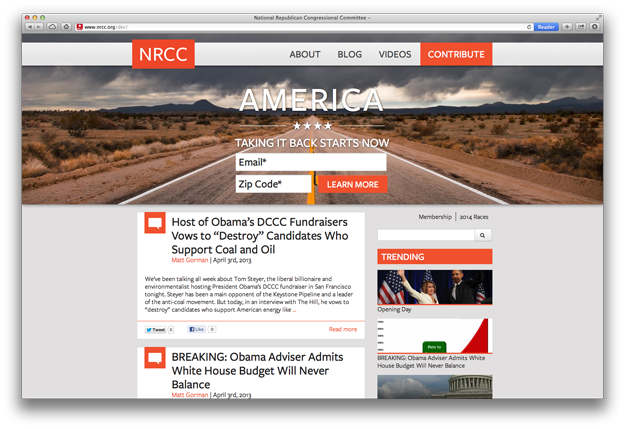


The NRCC’s new digs: Orange you glad it isn’t red and blue?

The National Journal has a sneak peek at the NRCC’s new, Buzzfeed-esque website, set to launch sometime in the next few days.  Since the dawn of 2013, the NRCC has been quietly and not-so-quietly doing some good things to get House Republicans (and prospective House Republicans) positioned well for 2014 – rootsHQ has a good write-up of that.

On the design side, though, check out the lack of traditional colors:

Home-v1

Contrast that with any of the other alphabet soup committees on either side.  There’s occasional splashes of black and yellow, but mostly red, white, and blue.  The NRCC is trying to stand out from those sites, and the early peek suggests they’re doing it right.

This should especially help drive donations and activism on behalf of Republican candidates.  The cynical analyst might point out that the only people who will visit a party committee website is someone with a keen interest in politics.  The average citizen won’t look to the NRCC as a destination for content, though they might see content in other venues like Pinterest or Facebook.  But those with a keen interest in Republican politics want something different from the party after the previous two Presidential elections when old white guys didn’t do so well.  They want a different tone, and something they can believe in.  By showing a fresh, new look – combined with the more aggressive and pop-culture-influenced messaging strategy they’ve been sharpening for a few months – the NRCC can satisfy the thirst among the activist class for a fresher look and feel.

More on the GOP Autopsy: Minority Outreach and Adam Carolla

One thing that came out of the poorly-named “GOP Autopsy” was the need for Republicans to reach out to minority groups.  That’s a positive point, and hopefully it will be done right.

It’s a good idea to recruit in inner city neighborhoods, and help candidates who champion free market answers to the big government corruption that has plagued cities like Washington, DC and Detroit.  It’s a bad idea to reach out to groups solely in the name of diversity.  That would be like introducing yourself to a black dude by saying, “Hey, do you want to hang out?  I need more black friends.”

A corollary to that is to avoid apologizing for policy positions, which is where Adam Corolla comes into this discussion.  The GOP’s messaging mea culpa came a week after Carolla railed on the Huffington Post for accusing him of racism.  The issue was Carolla’s stance that government solutions to social problems ignore the causes – such as the devaluation of family in black culture:

The family is the number one problem in the Black community. […] It’s simple. Fathers, stay at home, raise your family, do your homework with your kids, put an emphasis on education like the Jews, like the Asians, and let’s see what happens to the problem in 20 years.

Carolla’s response was even more direct:

But let me take this moment to now talk to all the p—–s that are out there trying to stir things up and turn me into a racist. I got news for you: Me saying parents should stick around and raise the children – me saying families and cultures should focus on education — is not radical or revolutionary. It’s the f–king truth.

Carolla isn’t going to throw his support behind the Republican party, but they can learn from his tone.  When reaching out to groups – women, young voters, or minorities – the message doesn’t have to start with an apology.  Support comes from trust – and trust can only come when people see you’re willing to “speak the f–king truth.”

Just be willing to speak it to their face.

The GOP Autopsy; Or, Stop Saying What You’re Doing

The Republican Party released a report of deep introspection this week, and the reactions to the “GOP Autopsy” continue.  The report championed the need for the party to re-brand.  Naturally, that kicked off more of the “grassroots versus party bosses” and “Tea Party versus Establishment” arguments that have waged for months.

Those are false arguments.  The real failing of the “GOP Autopsy” is that it exists at all.  The report has quite a few excellent ideas, but the first rule of re-branding is not to say you are re-branding.  Making a big public show about a new image suggests that image is skin deep.  Memos like this are best kept internal.  When the memo inevitably leaks to the media, the right answer is, “Our party always looks at new ways to help great candidates bring their message to the people.”

The real answer to a political party’s woes – whether Republicans in 2012 or Democrats in 2004 – is to have party identity take a back seat to a good candidate that people can identify with.   A more welcoming candidate than John Kerry could have beaten George W. Bush in 2004; a more welcoming candidate than Mitt Romney could have beaten Barack Obama in 2012.  That makes organizing, candidate recruitment down ballot, messaging, and getting out the vote a lot easier.

(Sidebar: When discussing publicly the future of any political organization, it’s probably best not to refer to that discussion as the dissection of a dead body.  A corpse is a bad metaphor for “new and revolutionary.”)

CPAC is bigger than ever – and largely irrelevant

Picture it: Arlington, Va., 2002.   It’s my first CPAC, and it’s pretty much the same as most of the CPAC’s before it, based on what I could gather.  There’s a slate of speakers and panel discussions, but I spend most of my time in exhibit hall, working the table for my then-employer, the Leadership Institute.  Most of the attendees are college students, and a fair amount from my territory in the Northeast, so I see plenty of people I know and do business with.  My colleagues at LI, who generally work with non-college students, grouse that CPAC is a waste of their time.

On Friday, I crashed CPAC.  There were slates of speakers and panels, but also breakout sessions, receptions in hotel suites for people pushing products, and a lot more adults in massive conference center which housed the conference.  (I know college students are technically adults, but you know what I mean.)  The speeches, once the fodder for CSPAN’s early morning programming, are now covered live and the political press has been paying astute attention.

The conference which was once a trade association for the conservative movement has grown into… well, pretty much the same thing with more people and more media coverage.

It’s become more notorious in recent years for who isn’t there than for who is, and liberal blogger-activists show up with their pocket cameras trying to be the next Twitter star.  Republican consultants – including both establishment Republican consultants and the Republican consultants who bash establishment Republican consultants – lurk in the wings trying to drum up business.  (That was my role on Friday.)  Rarely is anything of substance said.

This may sound like a criticism of CPAC, but it sure isn’t.  Political activists of any stripe care about something that very few other people really care about.  That’s why online communities like Facebook and Twitter were so readily adopted by politicos.  There’s a real value in seeing and meeting people face-to-face who are mostly like minded and exchanging ideas.  There’s a value in hearing rah-rah speeches about your cause that reaffirm your commitment, especially since most not-political folks will probably think you ought to be committed.

There weren’t major policy discussions.  There was a fair amount of introspection on campaign tactics, but nothing groundbreaking that hasn’t been said before.  Some people in the audiences or walking around exhibit hall probably said stupid or silly things, but the people up on stage kept it pretty vanilla.  It’s a great and fun networking opportunity if you are in center-right politics, but precious little more than that.

Let’s not bill CPAC as a ComiCon for the conservative movement, which is what most media outlets seem to want.  The attention paid to the event doesn’t merit its importance.  Those who make their food money covering politics ought to know that.

Winning in ’14 means organizing in ’13

The battle lines in Washington, D.C. seem static: you have the Democrat-controlled Senate, the Republican-controlled House, and the President’s veto pen in a standoff.  The players are pretty much set on the chessboard, but no one is moving.  The legislative agenda hasn’t congealed yet; AdWeek even noticed the dearth of issue advertising.

Rest assured: America’s state capitals are making up for it.

Last week, Americans for Prosperity announced they will work to support Indiana Gov. Mike Pence’s proposed income tax cut.    Education reform debates have sprouted in Alabama and Ohio already this year.  Pennsylvania has considered privatizing its state-owned liquor stores; New Jersey is thinking about the same for its state lottery.

Heck, Rhode Island even named a state cartoon.  (Hint: It’s Family Guy.)

For candidates and issue groups looking toward elections in 2014 and 2016, these state-based issues and battles offer golden opportunities for organization.

After a grueling Presidential election and an apparently endless series of federal budget crises, voters may still be sick of hearing about national politics.  (A fair amount of folks who work in national politics are probably sick of hearing about it, too.)  The posturing plays out like predictable television dramas with familiar players.  Often, policy proposals are bogged down in process; and a hyper-partisan environment makes for fewer undetermined “swing votes.”

Meanwhile, state and local issues often involve ideas that haven’t been discussed over and over by talking heads on cable news.  Away from the D.C. spotlight, there is more room for Republicans and Democrats to seek common ground.  Perhaps more importantly, there is also more room for voter involvement.

By reaching out to voters and mobilizing them around state issues, campaigns and issue groups can begin building the volunteer and voter base needed for future ballot box victories.  Voters who take action now may self-identify crucial attributes such as issue preferences, favored mode of contact, and propensity for civic involvement.

Organizing around state-based policy discussions can yield information for a campaign manager that traditional attempts at voter identification might miss.  Turnout models may peg a hypothetical low-propensity voter as the type who would sit out mid-terms elections.  But when that voter responds to an online ad or a patch-through campaign, he or she has indicated an issue that moves him or her to action.  Further communication will yield more information.

The strategy of organizing around issues forces each voter to make a choice about whether that issue excites them or not.  By taking an action or refusing to do so, that voter shares a piece of information.  Enough of those pieces add up to a portrait of how to get that potential voter out to the polls.

President Barack Obama’s 2012 campaign has been widely – and rightfully – praised for its use of data to connect with and mobilize voters.  But these concepts are not new, nor are they particularly hard.  Careful tracking will give a campaign looking to win in 2014 a virtual “how-to” manual for speaking to the voters they need for victory.

How the GOP won yesterday (and why Chris Cillizza is wrong)

filibusterChris Cillizza argues that Sen. Rand Paul’s Freebird routine on the Senate floor last night was not a slam dunk win for Republicans.  (Lindsay Graham and John McCain, both apparently still Senators, agree.)  Cillizza’s points are mostly valid, but also mostly incorrect.

Point 1: Obama is now the tough on terror guy.

The basic point is wrong; President Obama became the tough on terror guy when Seal Team 6 successfully carried out his order to put a bullet between Osama bin Laden’s eyes.  But setting that aside, Cillizza suggests that opposing drone strikes could put Republicans in the same camp as anti-war liberals were about 10 years ago.

Democrats were perceived as weak on terror not just because they opposed the Bush wars in Afghanistan and Iraq, but because they didn’t speak out one way or another for several years.  In 2003 everyone was a hawk except for Howard Dean; Hillary Clinton’s early support of the war was one issue that Barack Obama would use to pry away support during the 2008 primaries.

There’s another side to it, too: If you are going to oppose the policies of the War on Terror as a government official, you can hold press conferences, ask pointed questions at committee hearings, speak out at in-district town meetings, or engage in a host of other tactics that involve you talking.  While a sitting President and his administration can talk about their policies while killing terrorists, a sitting Senator can basically just talk.  So if talking is your only weapon, it has to be some pretty dramatic talking or you seem wimpy by default.  A filibuster works because it is definitely not the same as pointed hearing questions or town meeting blather.

Finally, while Cillizza correctly notes that drone are popular, they are popular because they Americans out of harms way.  There’s some space for moral high ground in saying those drones should not be aimed at Americans.

A definitive and unique stand like Paul’s is not a wishy-washy or knee-jerk opposition to the concept of war, but a strong and considered statement against a policy that infringes on civil liberties.

Point 2: Republicans are (still) afraid of the primary electorate.

After starting out on his own, Paul had some friends join him on the floor – including Republicans up for reelection in 2012 and a couple of 2016 Presidential contenders.  Was this a matter of pandering to tea partiers?

It’s hard to call it pandering when most of the people who joined Paul – such as Marco Rubio, Ted Cruz, and Mike Lee – were elected on the wave of conservative activism that has marked Republican primaries of the last three years.  Primary voters have favored candidates who stood up for individual rights and limited government.  Is it a big surprise that these people oppose a government killing its own citizens without a trial?

The continued fundamental misunderstanding of so-called “tea party conservatives” is amazing, especially from political press that ought to know better.  Voters of any stripe want strong leaders – people who can stand up for strongly-held values without sounding crazy.

Point 3: It’s the economy, stupid.

First off, can we retire this now 21-year-old phrase?

Second, this quote makes this point a bit flawed:

And, in case you forgot, the [Republican] party still lacks a big-picture vision on the way forward regarding the country’s debt and spending issues that goes beyond simply saying: “No new taxes”.

That’s funny, because Paul Ryan’s 99-page Path to Prosperity isn’t just the words “no new taxes” written over and over like the manuscript in The Shining.  Also, terms like “reducing spending” and “entitlement reform” have been bandied about by Republicans.  Conversely, Democrat solutions seem to hinge on “new taxes.”

Point 4: DC process = not good.

That’s true – but a filibuster is hardly routine DC process.  Voting against cloture is a process.  Supporting a poison pill amendment is process.  But some dude talking for 13 hours to kill time and eating a Kit Kat bar?  It’s probably not the most interesting thing in the world, but it sure isn’t ordinary.  Jimmy Stewart’s filibuster was the climax of Mr. Smith Goes To Washington (just as it was in Mel Gibson’s remake).

It was a public, and coherent, display of a small government school of conservatism that helped the Republicans take the House in 2010 and will be the bedrock of future success.  It won’t win him the Presidential nomination in 2016, nor will it solve all the Republican party’s electoral problems of the 2012 cycle.  But Paul’s rant might help the party start to find it’s voice again – which is a big and important step.

Why do I hate Michelle Malkin’s dancing so much?

After Michelle Obama’s homage to suburban Mom dances on Jimmy Fallon on Friday night, Michelle Malkin responded with this on Sunday.  You don’t have to watch it, because for the most part it’s painful:

Malkin’s response time is great perfect – her video was up before the original had a chance at Monday morning virality (which was a lock because it was actually kind of funny).  That’s good, but it’s where the good stops; Malkin’s video is kind of lame.

[Note: It’s still better than my video, which is linked here.  Oh, that’s right, I didn’t make a video.  Duly noted.  Back to the cheap shots…]

The problem largely stems from the word “liberal” in Malkin’s title.  While factually accurate, it raises the immediate flag that this is speaking only to a political audience, the kind that will descend on the National Harbor for CPAC in just a few weeks.  There’s nothing wrong with rallying the troops, but Malkin can probably do better.

“Better” might be a mock video response that substitutes the First Lady for the President himself, bringing Michelle Obama’s decidedly non-political and self-deprecating bit into contrast with her hyper-political, self-aggrandizing husband.  It would definitely drop the political labels, focusing more on DC versus regular voters, rather than conservatives versus liberals.  And it would have to emphasize humor more than scoring week debate points, because in videos like this funny is most important.

Malkin tallied over 65,000 views at press time.  That’s impressive, but if her audience wasn’t so narrow, she might have tripled that.  There’s nothing wrong with rallying the troops, but real advancement of center-right ideas isn’t going to come from overtly political videos that preach to the choir.

[Still better than my video.]

Not just what it says, but where

Michael Turk had a great post on the center-right’s tech/data gap yesterday – but the best part was where he wrote it, in the American Spectator.

Spoiler alert: Turk warned that investing in new technology is not enough, that Republicans need smart people thinking about human behavior and voting patterns as well.  Good call: It’s not enough to figure out how people are interacting with a campaign, since most people in their right mind run away from political communication.  There’s an academic component in figuring out how to reach these people and keep them from running.  (Unless you use glue traps, of course, but there’s some questionable legality there.)

Ok, the right needs thinkers.  Where do they come from?  Political parties are good for resources, but not always innovation.  Remember that while much of the Obama infrastructure has been bequeathed unto the Democrat National Committee, it was the Obama campaign that built all the new toys.  Plus, if the eggheads don’t show immediate dividends, Republican candidates will wonder why the national party money that could be helping them win air wars is being spent to pay Lewis Skolnick.

The best spot for a bunch of data nerds is somewhere in the non-profit universe – whether it’s with an educational foundation like Heritage, an activist group like Americans for Prosperity or FreedomWorks, or a super PAC like American Crossroads/Crossroads GPS/Conservative Victory/Crossroads: The Next Generation.  With no donation limits, these groups can make a much better case to the big-ticket donors they’ll need to get the ball rolling.  Since the checks can be bigger, it’ll take fewer of them.

Conservative movement non-profits could be better positioned to start the process.  That makes The American Spectator a pretty good place to raise the issue.