App shoot

Upon reflecting more about recent, high-profile rejections from Apple’s App Store, one thing is becoming apparent: with the iPhone/iPod platform is gaining popularity, more developers are investing time and resources writing software for it only to see their creations rejected.

The closed-door approach makes sense for Apple – since their platform is the first of its kind, any questionable use would reflect back on their highly-recognizable brand rather than an anonymous developer.  If Saturday Night Live legend Garrett Morris developed a game for the iPhone called “Gonna Get Me a Shotgun and Kill all the Whities I See,” Apple would bear the brunt of the protests for allowing it rather than Morris.  (When Morris famously – and hilariously – sang that line on the air in 1976, the NBC switchboard probably got more calls than Morris’s home phone.  By citing the actual sketch, do I avoid somehow being called a racist for quoting it?)

But the closed door has implications for potentially revolutionary uses of mobile technology.  In 2008 a developer created an excellent application for the Obama Campaign, allowing volunteers to prioritize their contacts for get out the vote calls.  If the time and effort invested in creating an app is possibly wasted, how will small, volunteer-driven campaigns for local or Congressional offices – the types of campaigns who could really use the technology – justify exploring the possibilities of the platform?

From the “well, someone is making money, right?” file

The New York Times has a story in its tech section on Sunday that could just as easily have appeared in Style.  The piece profiled Rent the Runway, a company which rents high-end designer dresses online – just like Netflix does with movies.

Dressflix, if you will.

The silver lining of a down economy is that new markets emerge, and the astute businesses that find those new markets can carve out a niche for themselves.  That’s especially true for Rent the Runway, which makes money by helping people save money.

Quite an enemies list you’re building there…

Ever heard of Edmunds.com?  It’s an information site for prospective car customers.  As businesses looking for free publicity often do, they decided to publicly discuss something which was already making news, releasing an analysis of the Cash-for-Clunkers program that put the per-car cost to taxpayers at $24,000.

The dignified. measured response from the White House to mild criticism from an obscure consumer site?  A point-by-point analysis of the analysis… under the headline “Busy Covering Car Sales on Mars, Edmunds.com Gets It Wrong (Again) on Cash for Clunkers.”

If you’re scoring at home, Fox News is not an officially approved news organization and Edmunds.com is where to buy your Mars rover.  And the White House doesn’t take kindly to made-up numbers… well, usually.

Bad news for old school papers

The troubles of traditional print newspapers, including those in major metropolitan areas, is well documented – with news consumers moving toward online sources, advertisers are less likely to buy space in printed periodicals.  Unfortunately for most news organizations, it turns out that the advertisers are not moving online along with the readers – even though online advertising spending continues to rise.  If you consider the way ads are displayed on newspaper websites, and internet advertising models, it makes sense.

Back when print advertising was all the rage – in the olden times before 1997 or so – the model for effective advertising was fairly simple: you bought space in a publication that matched your target demographic.  If you were a Boston-based business, for instance, that meant advertising in the Boston Globe or the Herald.  It was expensive, but you were paying for exposure – the more pairs of eyes would look at your ads, the more customers you would get at the other end of the funnel. When you paid your advertising dollars, you paid for exposure.

Online advertising has changed that model in every way imaginable, especially search advertising.  When you buy search ads today on Google or Bing, you pay based on how many people click on your ads.  That creates an extra incentive for the search engine folks to put your text ads in places where people are most likely to click.  With search advertising, you are paying not for how many people see your ad, but for how many people actually show interest.

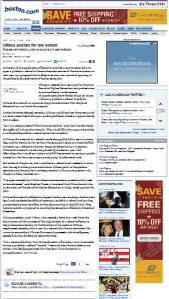
So, why aren’t newspapers able to capture those online advertising dollars?  To illustrate their problems, let’s use the Boston Globe – a paper which has had very public issues adapting to the new world of news.  If you visit the Boston Globe and search for my alma mater, UMass, one of the first stories you get is about UMass angling to open their own law school.  Check out what the page looks like:
globe1

Note the three ads – a banner across the top, a box in the right column, and a tower ad running down the right side a little ways down the page.  The banner and tower in this image are for Roadrunner Sports, and as near as I can tell they rotate.  The big, blue Air France rectangle, though, is all over the Boston Globe’s site today.  That probably means Air France bought a high level of visibility – in other words, they bought ads online the same they would have in the print version of the Globe.

But here’s a pertinent question: why would someone be reading this story?  What does that indicate about their interests?  Air travel seems like an odd fit for a story like this, which one might read if he or she is researching law schools or is a UMass alum.

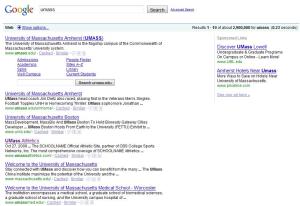
To contrast, here’s what I found when  searching for “UMass” on Google:
google1

Along the right side are two simple text ads for one of UMass’s satellite campuses and Priceline.com – the Priceline ad trumpeting their ability to find good hotel deals in and around Amherst.  What’s more, the ads look much like the search results – with the search term showing up in bold.  If you are searching for “UMass” because you are looking to further your education or visit your alma mater, these ads are up your alley; if not, the companies that bough the ads lose nothing because they only pay if you click.

While the search ad model anticipates the user’s possible interests and serves ads based on that, newspapers and the ad networks through which they work too often continue to display the ads that they want the user to see – even online.  Why would anyone pay for eyeballs when they could pay for the whole brain?

All activism must not be neutral

As the net neutrality argument heats up, pro-regulation groups are bashing AT&T’s efforts to mobilize their employees against the measure.  When AT&T sent an email detailing the issue and inviting workers to post comments opposing net neutrality, Free Press, a liberal media reform group, called them the a-word – “AstroTurf.”

Free Press, of course, admits to doing the same thing – but argues that their email messages to subscribers driving traffic to online comment forms are somehow different.  Their activists, apparently, REALLY oppose net neutrality; AT&T’s employees acting through fear of losing their jobs.

AT&T workers should be fearful of losing their jobs – regulating AT&T’s internet will have an impact on its bottom line.  Free Press has a flimsy argument if you think about it – but it certainly wasn’t made to evoke thought.

Pepsi uses new media well. Shame on them.

Pepsi, the Art Garfunkel of the soft drink world, released an iPhone app for its AMP energy drink that drew criticism for being sexist.  Amazingly, some company is trying to market their product by claiming to help boys attract girls.  That’s a first in the advertising world, right?

The idea of the app itself is actually impressive, strategically.  Pepsi and AMP know their target audience, and their target audience is interested in hooking up with young women and telling their friends – or at least sophomoric humor about hooking up with young women and telling their friends.  So the app provides information and enables users to brag about their conquests.  The content may be offensive, but the basics of the social strategy are sound: combining education with channels of communication.

But did it work?  Though Pepsi apologized for the application, it has not been discontinued – and is currently listed among the top ten applications being downloaded from iTunes.  As Mississippi State University opinion writer McNeill Williford points out, “The people at PepsiCo aren’t trying to push a male chauvinist agenda on anyone; they’re trying to sell drinks.”

Despite all the criticism – indeed, possibly because of it – Pepsi probably got what they wanted.

One BILLION hits… per day

On the third anniversary of its acquisition by Google, YouTube is celebrating that it now averages a billion views each day.

There’s another way to measure their success, though: The term “YouTube video” has also entered the cultural lexicon to define short, viral, online video – the same way “Xerox” was used for years as a synonym for photocopies.  YouTube isn’t just on your computer screen, it’s in your head.

Twitter might actually make money!

On the heels of the Associated Press floating the idea of charging search engines for its bulldog edition content comes the news that Twitter is in talks with both Microsoft and Google to include tweets in their search results.  This may be a business model that actually works.

Search engines are, by nature, aggregators of content and serve as the doorway to the internet.  With two search engines competing for market share, that means each must be on the top of their game.  For sites like Twitter, that means their large user base (which generates relevant, in-demand content) is pretty valuable to someone conducting a search query.

These deals would also be the first answers the question of how Twitter will actually monetize that content.  This arrangement would allow Twitter users to take advantage of a still-free service and actually help them attract traffic; it would mean a stream of revenue for Twitter that doesn’t involve someone saying, “Yeah, that sounds like a good idea, so I’ll write a check until you figure out how it makes money”; and it gives Microsoft and Google a way to provide better search results to increase their market share (which attracts advertisers.

It’s a good model, and like the AP’s plan, it takes advantage of the fact that, for the first time in a while, there is legitimate competition among search engines.  This doesn’t work on an internet where one search engine is clearly dominant.  And even though Google is the clear leader in search engine market share right now, Microsoft has the resources to stay in the game for a long time.

MSNBC + HuffPost = … wait, this can’t be right…

Most of what the content on The Huffington Post.  Same for the shows on MSNBC, except for when Keith Olbermann does sports highlights.  But this article on the Hufftington post by MSNBC host Dylan Ratigan is a great summary for why bailouts, stimulus packages, and other forms of what he calls “corporate communism” are bad and shortsighted:

If you allow weak, outdated players to take control of the government and change the rules so they are protected from the natural competition and reward systems that have created so many innovations in our country, you not only steal from the citizens on behalf of the least worthy but you also doom them by trapping the capital that would be used to generate new innovation and, most tangibly in our current situation, jobs.