This Week’s Lesson: Don’t be a Jerk

After exposing catty gossip and American state secrets, WikiLeaks has been taken down – but not by government action.  Amazon refuses to host the site on its servers, and the quest for a new home is proving difficult.

Some proponents of internet regulation are pointing to this as an excellent reason to support net neutrality.   Like any media outlet, Wikileaks is entitled to freedom of the press; the problem here is that Amazon owns the press – and Amazon is exercising its freedom to tell Wikileaks founder Julian Assange to take a long walk off a short pier.  (Admittedly, with some coaxing from Joe Lieberman, but it’s still Amazon’s call.)

Amazon didn’t want to put up with an organization revealing state secrets for the sole reason of embarrassing America.  In short, Assange was a jerk and they no longer wanted to deal with him.

In a parallel move, the House of Representatives chastised tax cheat and self-proclaimed “honest guy” Charles Rangel.  Rangel tried to wrangle up support from his email list, sending a blast message calling on supporters to call their members of Congress and urge them to speak out against a censure vote.  (Side note: Wouldn’t most of the supporters on Rangel’s email list have Rangel as their Congressman?  This email blast couldn’t have been that effective.)

Rangel called it a “political” vote, claiming throughout the process that his 11 ethics violations did not merit the rebuke of his peers.  Yet, incredibly, rebuke him they did – overwhelmingly and in the first truly bipartisan vote Congress has seen in some time.

As Washington Times reporter Kerry Pickett found out, Rangel doesn’t view himself as someone who has to answer questions.  Maybe that’s why Rangel, like Julian Assange, ran out of friends so fast:

What it takes – on campus or off

Every now and then, I like to peek in on the Leadership Institute’s Campus Reform blog, and yesterday caught an excellent post by Tony Listi on message development.  Listi titled the post “What it Takes to Win Politically on a College Campus,” but don’t be fooled; this is chock full of great information about building an effective organization.

The whole post is worth a read, but the advice for organization builders on defining their mission is particularly on point:

Direct your time, money, energy, political capital, and other resources toward a clearly defined, decisive, and attainable objective on campus. This principle is the most important because it is the groundwork for everything else. What is your objective on campus? How you define the problem(s) determines your objective(s)…

The following objectives are not clear, decisive, or attainable:

  • Raise awareness about ____.
  • Educate the student body about ____.
  • Prove to everyone we are right.

A frustrating mistake made by many organizations could be avoided by this step of defining a clear objective.  (And probably, many would-be organizational entrepreneurs are actually most interested in Bad Mission #3, and feel like they can pull a salary and have fancy business cards.)  In the long run, those groups tend to suffer for it.  Maybe they could stand to go back to school.

Jeter vs. the Yankees: Framing the debate

The dance between Derek Jeter and the Yankees started as a civilized and friendly waltz, but has quickly devolved into the gang fight in the video for “Beat It.”  Each side is almost taunting the other to consider a universe where Jeter is not with the Yankees.  And of course, unlike most salary negotiations which are confidential, the fight is public.

What’s fascinating is the attempt by Jeter to frame the negotiations in the most favorable light:

[A] baseball industry source said the Yankees have provided Jeter and [Agent Casey] Close with detailed statistical and market analysis to support their contract offer, including comparisons between Jeter and other shortstops and middle infielders throughout baseball.

That is the way Jeter’s last contract, the 10-year, $189 million deal that expired with the end of the 2010 World Series, was negotiated, based on Jeter’s contention and the Yankees concurrence that Jeter was the second-best shortstop in the game, behind Alex Rodriguez, who had just signed a 10-year, $252 million deal with the Texas Rangers.

This time, the Jeter side is said to not want Jeter’s value to be judged against that of other shortstops, preferring to base his worth on his legacy as an all-time great Yankee.

This is the equivalent of staying on offense in a political campaign or a public relations battle – framing a debate to be about the issues on which your side is strongest.  And it’s hard to argue with Jeter’s place in the prestigious Yankees pantheon now – an argument he couldn’t make in 2000, after just his fifth full year in the majors.

In other words, if this “campaign” is about wanting to see Jeter continue to pursue Yankees history – such as becoming the first Yankee ever with 3,000 hits – Jeter wins the negotiations and the hearts and minds of the fans.  If the “campaign” is about the Yankees having roster flexibility, phasing out aging players, and not allowing their team to become bogged down by expensive contracts to 40-year-old players (again), then the front office wins.

Of course, the “campaign” is always about the World Series trophy for the Yankees and their fans (including me), giving the Yankees an important advantage – after all, no matter how angry fans get at the idea of Jeter walking away, a 2011 World Championship would inflict a case of mass amnesia.  So regardless of whether Jeter or the Yanks’ front office blinks first, the success or failure of this campaign, like so many others, won’t be fully appreciated until the first week of November.

3 Lessons from Wikileaks and Infoterrorism

On America’s signature holiday, WikiLeaks continued its signature assault on America.  First came the hand-wringing, then came the finger pointing, and next will come the crackdown; but missing from all the coverage are the lessons of Julian Assange’s attack on the US Government.

Wikileaks deals in what could be called “infoterrorism.”  While militant terrorists seek to slow the gears of government through fear of violence, Assange (who looks like he could be cast as Niles Crane in a Christopher Nolan adaptation of “Frasier”) works through extreme exposure of unflattering details.  And through all the criticism, the fact remains that he isn’t making stuff up – the words in those cables are as authentic as they are embarrassing.

1.  WikiLeaks’s victories are designed for the PR field of battle.

There will be no tribunal of world powers who condemn the United States.  The UN isn’t going to boot the US out.  The US will not be stripped of its Heisman trophy.

Because the document dumps are so large, it’s clear that WikiLeaks is less concerned about getting specific content out than demonstrating their ability to find and release large amounts of information.  Sure, the disclosure will slow down diplomacy, but this is more about creating an image of America as large, unwieldy, and incompetent.

2.  Our state and defense infrastructures are too big to be trustworthy.

The big question, of course, is how WikiLeaks got their wikihands on the US Government’s secret stuff?

As a media organization, WikiLeaks cannot – and should not – be prosecuted for their part in the exposure of the documents.  But someone has been giving them the materials that have been causing such a firestorm.  Either too many people have their hands on sensitive information, or the ones who do are simply untrustworthy with sensitive information – in which case, the US Government has problems far beyond a PR black eye.

3.  State Department officials should observe discretion and STOP WRITING $#!& DOWN!

Most people with half a brain who work in an office environment assume their emails will be read (or could be read) by the IT staff and don’t talk crap about co-workers via email.  That includes people who work in office environments that aren’t subject to international spies stretching the limits of ingenuity and technology to intercept transmissions… such as the State Department.  So one would think the folks in the State Department would be even more sensitive about their written communications, right?  The most embarrassing revelations in the Wikileaks dump probably should never have existed to begin with.

Email marketing done right

The Wife received an email today from Adare Manor, one of the places we stayed during our honeymoon:

The email also included a message:

May you be surrounded by the warmth of home, the love of family & the company of good friends.  Happy Thanksgiving from Adare Manor.

It may seem simple, but it stands out because Adare Manor is in Ireland, and Thanksgiving – at least, the one that’s happening this week, is an American holiday.  They sent us a card for a holiday they don’t even celebrate – and judging by the message, they seem to have a good idea of what the holiday is all about, too.

Too often, online communication – especially through email lists – is treated like a broadcast medium.  It takes little more than some strategic thought and an investment of time to do things like segment out your list and craft your text carefully.  Sometimes, those running email programs lose sight of the fact that each row in their database of addresses is attached to a real person.

Sure, Adare Manor is trying to find ways to remind me that they exist, and encourage me to come back and stay there if I find myself in western Ireland again.  But they’re doing it based on what’s on my mind right now.  Even though there are probably tens of thousands of past American patrons who stayed in Adare and who received that same email, it feels personal.

Americans for Prosperity helps lower holiday week productivity

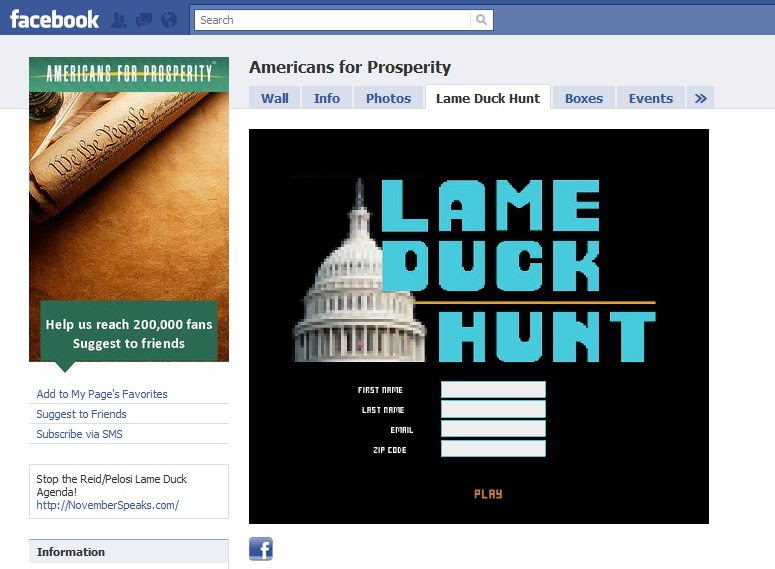
Channeling 1980s classic Nintendo games, Americans for Prosperity has a fun game called “Lame Duck Hunt” on one tab of their Facebook page.

The game isn’t all that challenging, though the gloating images of Nancy Pelosi and Harry Reid that taunt you when you miss make it slightly more frustrating than it needs to be.  This isn’t a game review, though, it’s a strategy review, and there are a few things AFP gets very right.

First, you can’t play the game without surrendering an email address and a zip code, meaning that anyone who participates in this little time-waster tells AFP which Congressional district they live in and how to get in touch with them.

(You do have to re-submit your information each time you play, which discourages repeat users.)

Once you’re in, you predictably shoot down ducks, which then disappear in a cloud of feathers and leave behind warnings like “Higher Debt,” “Card Check,” or “Huge Tax Hikes” – the policies which ostensibly could be the result of the lame duck Congress.  You can then share your score with friends.

This is where AFP’s aim starts going awry.  The game never offers any backing for the labels – there are no details about suggested or proposed legislation which would lead to union bailouts, huge tax hikes, or higher debt.  The message at the end invites me to “visit the Americans for Prosperity website” for more information – but there is no link.  Contrast that with the game released by the U.S. Chamber of Commerce last week, This Way to Jobs, a digital version of Chutes and Ladders which outlined the pitfalls of launching a small business.

Further, I have played the game several times (for… uh… research, for this post – that’s the ticket).  That means I’ve entered my email address multiple times, and haven’t yet received a follow-up auto-responder email.  After anyone plays the game, a quick follow up email inviting further action – while the issues are still fresh in the player’s head – could help AFP determine who is really on board with their policy agenda and who just hates video ducks.

Ideally, the game over screen and follow up communication would also allow users to identify what future actions they would be willing to take.  At the very least, it would invite a user to become a fan of AFP’s Facebook page.

These extra steps may not help with the lame duck agenda, but 2011 will be a critical year as the Republicans and Democrats try to set themselves up for success in 2012.  Lame Duck Hunt is a cool idea, and well-timed – between the impending holiday and people taking off work early to beat traffic, Thanksgiving week ranks only ahead of the dead week between Christmas and New Years in terms of productivity.  To that end, it’s guaranteed to bring web traffic – and it looks like AFP was content with that.

Over the water’s edge

After a weekend out of town and out of the loop, I woke up to news video footage of President Obama addressing a press conference at the NATO summit.  I had to track down the exact quote because it seemed so unbelievable:

Sounding frustrated on the last day of the NATO summit, Obama said military officials, senior members of past Republican administrations and European states backed the treaty with Russia…“There is no other reason not to do it other than the fact that Washington has become a very partisan place,” Obama said.

There’s a lot going on here.

Of course, there’s the crutch of partisanship as an argument – as if Democrats don’t reflexively balk at ideas that are proven to work when proposed by a Republican.

But more disturbing is the argument that petty bickering from another side is stalling the work of the American government.  It’s a fine political argument when making a stump speech intended to motivate supporters and convince independents, but a wholly different animal when delivered on foreign soil.

If it weren’t for the TSA controversy, conservative pundits would likely be all over the President for this comment.

Project Titan: A new generation of Facebook messaging. And probably SPAM.

Facebook announced “Project Titan” this week.  With a code name like that, one might have wished for the press conference to open with Mark Zuckerberg bellowing, “Welcome to the world of tomorrow!”

Unfortunately, there was no such bellow.

There was, however, an unveiling of a drastically revamped Facebook messaging service.   The new interface is supposed to allow users to integrate Facebook’s internal traditional messaging and chat features, but what really sticks out is the entry of Facebook email address into the equation.

This is the biggest opening of Facebook’s walled garden yet.  And aside from the obvious possibility of an email client (like Microsoft’s Outlook) operating as your Facebook inbox, there’s the possibility that a person – or, more likely, a campaign or company – can send you a Facebook message as easily as they send an email.  It could open the door for mass-messaging through the Facebook environment – even though Facebook is taking steps to keep that from happening.

For all their efforts, though, the fact is that there are plenty of campaigns and companies who want to seize upon Facebook data just to have another avenue of communication – and a good Facebook app can expose this data pretty easily, with the user’s tacit permission.  Most likely, Project Titan is not the final iteration of Facebook’s messaging platform.

Anuzis highlights tech experience

After announcing his bid for the RNC chair last week by highlighting Michael Steele’s shortcomings in fundraising and the ground game, Saul Anuzis predictably started highlighting his tech-friendly background as a point of difference between him and the incumbent.

“It’s critical we integrated new media into everyday politics. It works, it’s efficient and we need to do it,” Anuzis told The Hill when contacted over the weekend. He also said his candidacy has already sparked enthusiasm among social networking aficianados.

What will excite online activists even more is that Anuzis isn’t making the election all about technology to begin with.  His initial announcement dealt with main, overarching problems he saw in the RNC.  Anuzis then brought up technology as a response to how he would deal with those problems.

Whether or not he is ultimately successful, arguing for technology as a means rather than an end prevents Anuzis from being labeled as a niche “tech candidate” and positions him as a more serious challenger.

There might be money in mobile (literally)

The FEC is thinking about allowing contributions via text message in a ruling expected this fall, allowing campaigns to capitalize on the same small-dollar, high-volume donation campaigns that worked so well for American Red Cross efforts in Haiti.

The potential for campaigns is fairly obvious – campaign rallies, events, and even media appearances could become fundraising opportunities.   But consider the fact that few campaigns spent lots of time collecting mobile numbers in 2010.  How many members of this year’s House freshman class will regret a lack of investment in mobile for the 2010 election when they begin their 2012 reelection efforts?