America’s Gone Burgundy

For a fake news anchor, Ron Burgundy sure gets a lot of work, doesn’t he?

Will Ferrell has been pimping Anchorman 2 like crazy, all in-character as Burgundy himself.  You’ve seen him peddling Dodges – which Ferrell does for free.  Today, Emerson College attracted the attention of transparent eyeballs everywhere by renaming their communications school after Burgundy for a day while Farrell bums around campus in costume.  Last week he showed up on a North Dakota newscast; tomorrow, he hosts SportsCenter with David Koechner.  (Whammy!)

Adweek posits that the Month of Burgundy will change how movies are promoted.  (That’s probably not true: not every movie could be promoted this way.  Martin Freeman will not spend a month walking around Boston looking like Bilbo Baggins.)

This may seem scattershot, but look closely at this promotion strategy.  It’s actually quite targeted; Farrell and Company are not just throwing anything against the wall to see what sticks.

The audience for Anchorman 2 is most likely 18-35 year olds – and probably the men in that group more so than the women.  The youngest are college students who enjoy the brand of humor, the eldest are people in their mid-20s when the original came out last year.  They are the people dropping cable and consuming entertainment mostly online.  

The idea of Ron Burgundy chilling on the quad at Emerson probably appeals to them, as does the YouTube clips of Farrell showing up in character on a North Dakota news set.  The best chance to reach this group through live TV is probably sports.  Not only does that make the SportsCenter appearance effective, but Farrell’s pro-bono Dodge commercials run during Sunday afternoon football games.  That’s some great real estate to get for free.

It seems like Ron Burgundy is everywhere these days, but don’t be fooled: Papa Burgundy probably knows just what he’s doing.

Great meal. Let’s talk about Obamacare.

The Organizing for America/Obama Campaign folks took some ribbing in the past week for their campaign to get people talking about Obamacare around the Thanksgiving table.  OFA provides you talking points on your way home, and you are supposed to convince your Drunk Uncle that Health Insurance is a good thing.

As silly as the campaign is, here’s the really ridiculous part: There’s no engagement of the actual issues people are talking about.  People are seeing their premiums go up, or losing their plans.  The website is broken, and the government knew it was broken.  There is precious little credibility in even the rosiest talking points OFA offers, and there’s no real guide to handling pushback.

OFA’s effort – in as much as it really is an effort and not just an excuse for periodic communication to keep the email list fresh – will fail because they have no idea how to talk to people who disagree with the concept of Obamacare.  And that population seems to get bigger everyday – without a website full of discussion guides.

Our American Holiday

Is there a holiday that reflects America better than Thanksgiving?

It’s enjoyed best with family, but without the materialism that creeps into gift-giving holidays like Christmas.  There’s no pressure to buy the right item, spend the right amount, or remember the right people.  There may be some chores, like cooking and washing dishes, but those are the only obligations.

People are more giving.  It’s a shame when people are hungry any day of the year, but there seems to be an inherent belief that it’s especially shameful on Thanksgiving.

Most take the day off, and we aren’t entirely comfortable with companies that expect people to work.

It recognizes religion and belief in a higher power, an appreciation that, sometimes, hard work isn’t the only factor in how successful we are.  At the same time, it doesn’t recognize a specific religion.  There isn’t a religion that doesn’t celebrate Thanksgiving.

There are also points to be made about gluttony and consumerism, and if you’re a concussion-hawk you can grouse about football as well.  I choose to focus on the positive, and hope you and your family can as well.

Happy Thanksgiving!

Three out of four ain’t bad…

Turnout operations are critical in tight campaigns – and especially so in mid-term elections, campaigns can’t rely on national awareness to gin up attention to Election Day.  As I noted in my most recent Washington Times Communities post, mid-term turnout modeling means than Republicans can win big with just 75% of their 2012 voters coming back.

Obviously, to create that much excitement, Republican candidates are going to have to have good messages and be disciplined about sticking to them.  But with continued problems with Obamacare, the messaging environment will likely be in the GOP’s favor.  And people who voted Republican in 2012 – which was an off-year – are probably much happier with their vote than their Democrat friends and neighbors.


Wrapping up Cuccinelli’s loss

Last week I started a column at the Washington Times Communities page called “By the Numbers” and started with a look at Ken Cuccinelli’s Virginia loss.  

With just 3.1%more of Mitt Romney’s 2012 voters, Cuccinelli could have celebrated a Dewey-defeats-Truman moment.  Instead, 780,000 Virginians who supported Romney’s losing effort stayed home, and Terry McAuliffe sneaked past by around 55,000 votes.  POLITICO profiled McAuliffe’s advanced data-driven operation, which read like the post-game analysis of Barack Obama’s win last year.  Meanwhile, Stu Rothenberg underscored Cuccinelli’s failure to bring back Romeny voters.

There were plenty of challenges thrown at Cuccinelli: a spending gap, infighting, an erroneously modeled Washington Post poll that depressed GOP turnout, and center-right outside groups staying on the sideline.  Blaming these things for the loss is like a football team blaming a one-point defeat on a bad call in the first quarter rather than a botched field goal on the last play of the game.  Those factors put Cuccinelli in a bad position, but he was still in a position to win.

Campaign plans are being hatched for 2014 right now, and would-be victors should look at Cuccinelli’s loss careful.  Luck – good or bad – is the residue of design.


GOP 2014: Conservative Candidates, Moderate Tone

Today’s New York Times piece on Republican primary battles leads with Art Halvorson, the father of a former colleague who is running for Congress in Pennsylvania’s heavily Republican 9th District.  His opponent is incumbent Rep. Bill Shuster, who holds the seat his father held before him.  While much of the article falls into the oversimplified “Tea-Party-Versus-Establishment” narrative, Halvorson rejects the opportunity to bang the drum on more red meat issues, favoring a more populist tone:

“People don’t remember a time before the Shusters,” Mr. Halvorson said. “They created an aristocracy, and people are so accustomed to that’s the way politics is done around here, they don’t see how he can be toppled. I’ve got to show leadership’s what’s important, not seniority, and longevity is not leadership.” … “That’s the narrative everybody wants to know: What’s the Republican Party going to look like after Ted Cruz Tea Party people get done with it?” Mr. Halvorson asked, eschewing the Tea Party label even as he adopts many of its campaign tropes. 

Tea Party themes – less government, more freedom, less concentration of power – are more popular than the Tea Party label.  Candidates like Halvorson are wise to make their campaigns about ideas, rather than shorthand.

“Yes, but I have FRIENDS who are Libertarian!”

Predictably, some of the grumbling from the aftermath of the Virginia governor’s race this week blamed those who voted for libertarian Robert Sarvis.  Leading up to the election, there was a clear advertising strategy telling certain voters that supporting Sarvis was tacit support for Terry McAuliffe.

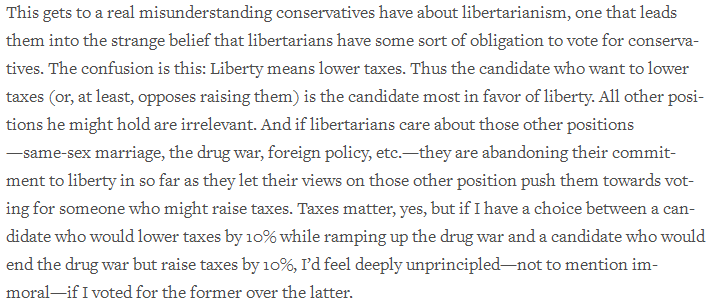
Sarvis probably did not cost Cuccinelli the governor’s mansion.  This tweet from Townhall’s Kevin Glass quoted an important lesson about Republican and conservative candidates who want to reach out to libertarians:

BYkVlrzCEAIrkcW

When reaching out to any segment of the population, a campaign has to forge a real connection.  Demanding libertarian support with buzzwords or a rudimentary understanding of their values works only slightly better than a Latino outreach strategy based on a plateful of Taco Bell gorditas.  (That sounds like something Mitt Romney would have come up with, doesn’t it?)

One could make a libertarian case for Ken Cuccinelli, but not by asking someone to support the lesser of two evils.  There are libertarians who believe in putting principles aside occasionally to support an imperfect candidate with the best chance of winning; those people are known more colloquially as Republicans.  If libertarians are driven by principal, then they must be persuaded based on principle, not policy.

It’s a subtle shift.  In the example Glass tweet’s out above, he mentions taxes, which is a good example.  Most Republicans will bang the drum for lower taxes, but they aren’t always sure why.  The reality is that lower taxes leave money in the economy, which allows for efficient allocation of society’s resources.  Lower taxes mean more free markets, and we have seen for hundreds of years that when left to their own devices through free markets, people tend to make correct choices.

Maybe that’s not to convince all libertarians to support a candidate who also believes in mandatory prison terms for first time smokers, jokers, and midnight tokers.  But without a nuanced message like that, messaging to libertarians would be a wasted effort.

Being able to articulate the “why” – the principle behind the policy – makes a difference.


Who wins if Cuccinelli loses?

Ken Cuccinelli is on the ropes in the Virginia Governor’s race – which is one reason George Will raised some eyebrows last week with his glowing treatment of Robert Sarvis, the Libertarian candidate.  Why would a national, established Republican commentator like Will take what looks like an obvious swipe at a major party candidate in one of the two major races going on in 2013?

If trends continue and Cuccinelli loses, there will be another obvious dent in the narrative that the GOP brand is on the rebound  and well-positioned for victory in 2014.  Combined with the fallout from the government shutdown, it will be the second setback of the fall for Republicans, (overshadowing, to some degree, the failed rollout of Obamacare).

As the polls look now, it’s pretty likely to shake out that way.  But not all losses are created equal.  A less-than-50% win for Terry McAuliffe combined with a strong showing from the Sarvis, actually benefits some entities:

1.  Bill Bolling.  Remember Fredo Corleone’s reaction when he got passed over for his kid brother?  Supporters of party conventions over primaries like to say that the non-public, keep-it-in-the-family method of choosing a nominee is less hurtful, but that theory flew out the window in this case.  Rather than playing the good soldier and supporting his nominee, Bolling has waged an un-campaign by creating his own policy organization.  And the word on the street is that he has done some behind-the-scenes work for McAuliffe.  A race where Cuccinelli loses – but center-right candidates, combined, draw a majority – gives further credibility to Bolling in 2017 if he opts to run for Governor calling for a more moderate direction for the state party.

2.  Chris Christie.  Back in the day, the odd, off-off-year elections in Virginia and New Jersey meant split victories: Republicans would take the Old Dominion, Democrats would notch the Garden State.  This year, Christie’s runaway reelection victory will buck the trend.  As the most recent Republican winner, it will position him well with top donors and consultants as he prepares for his Presidential run in 2016.  There may also be some who look at a split-vote loss in Virginia as a sign that the GOP needs to moderate nationally.  While it would be a mistake for Christie or his team to make that case publicly, behind closed doors they can make that case to party leaders deciding where they ought to contribute their endorsements and dollars.

3.  Rand Paul.  Very quietly, Rand Paul has been having a great couple of months.  Once considered the most outspoken and conservative among the serious potential Republican field for 2016, Ted Cruz’s filibuster has allowed Paul to present himself as more publicly reserved than the Texas Senator.   While moderates would point to a Cuccinelli loss as a need for a philosophical shift toward the center, Paul could make the case that the split vote means the party has not done enough to make the case to voters equating smaller government with better government.  Since this argument does not involve telling conservative voters they are philosophically wrong, Paul could have the most to gain from a tight loss in Virginia.  (That Paul actually campaigned for Cuccinelli puts him in a better position, as well.)

4.  Conservative/Republican Commentators.  That’s not to say that any of the above folks, or their supporters, goaded Will into his story, of course.  Nationally, if Cuccinelli loses in part because of Sarvis, GOP talking heads can write off the loss as the product of vote-splitting and focus on what looks like an easy victory in New Jersey.  The tough loss might hurt the Commonwealth, but for the people who scream at cameras for a living, it provides an easy pivot point for cable news debates.
More Messaging on Health Care

Following up on a previous post on the semantics of the upcoming health care debate, the good folks at Pocket Full of Liberty make a strong point about the best levers to move the issue:

This law is a disaster. And we’ve only seen the tip of the iceberg. There is this huge opportunity out there for Republicans to once again, show the public how the government tried to do something and failed at it. They can do that a lot better by telling the stories about people who have had to search for new doctors and different healthcare plan…

The case for Obamacare (just like the case for previous attempts to socialize the health care system) was made with highly individual personal stories.  Despite people being satisfied with their own insurance, the weepy tales of a working Mom who couldn’t get insurance for her kids because of a pre-existing condition were fairly convincing.  Hey, if it doesn’t affect my insurance and I can help someone else, why wouldn’t I, right?

Now, the American people are getting less insurance, not more.  They are paying more, not less.  Getting insurance is harder, not easier.  And the supporting facts for these statements are out there – in the form of the people who are getting letters that their insurance policies are being cancelled, or who are waiting in long virtual lines to access a website to buy insurance.

The path to health care reform starts with those stories.

Why Google wins

Google is one of the most ubiquitous companies on Earth.  It’s not just where we often start out looking for information (even if we end at Wikipedia), it’s in our emails, phones, tablets, and browsers.  Google’s success comes from mining data from all those points and selling advertising based on that information.  It’s products are easy to use and useful.

But when Google makes its point that you should use their products, they don’t mention all that.  They don’t say, “Hey, everyone’s using Google!  Get your Google today!”  They don’t even present their products as superior to their competitors – a strategy others have tried.

Google tells a story.  Check out this video of a lost Indian boy who used Google to find his long-lost family:

With attention and political energy turning to the 2014 election over the next six months, this is a good concept to keep in mind.