Googlevision

This week, Google announced a partnership with Dish Network to launch a TV search service.  It’s not the first time Google has found its way into the living room – they’ve been working with TiVo to figure out what shows you watch and serve you ads when you pause a live show and measure ad performance.

Google is wise to move into TV advertising.  It may sound like they’re taking a step back; that they’re an internet company going back to traditional media.  But the line between various entertainment channels gets blurrier every day.  Online video and television video are no longer all that different.  If Google wants to be the gatekeeper for all the world’s information (and you can be sure they do), they have to watch your remote control as closely as they do your laptop keyboard.

We should have been ready – Jim Carrey predicted all this 14 years ago…

Hulu learns content is still king

The decision by Viacom to pull its content from Hulu – while still keeping that content online – shows exactly why Hulu is the #2 site for online video.

As Tech Crunch reported, a key factor was the share of the ad revenue – Viacom makes more money by selling ads for video content on its own websites because it doesn’t have to split that money.  At the same time, Viacom can still make clips of its shows sharable and embeddable.

It brings to light a significant problem for Hulu: what value do they really add as a third party service?

Hulu was born because founding parents Fox and NBC were rightly worried about their content being ripped off and posted on YouTube – and because they realized that online video was an entertainment medium that they needed to embrace in some way.  The Simpsons, SNL, Heroes, Family Guy, and other shows from those networks made it on the site, along with content from their cable and feature film properties.  Other media companies, like ABC/Disney and Viacom, signed on as well.

The reason Hulu has always played second fiddle to YouTube is in a distinct difference in their business model.  While Hulu has always been about the content, YouTube has served as the infrastructure for the advent of web video.  In the days before YouTube, putting video online meant thinking about managing huge files and possible paying exorbitant hosting fees.  YouTube’s value to the content provider was allowing people who otherwise could not have done so to share video – whether that meant a cat falling off a bed or an independent short film.

Hulu’s value proposition to its content provider partners appears to be the ability to give them space on a high-traffic website.  But like YouTube and any other online video site, traffic comes because of content.  In reality, high traffic numbers are content providers’ value to Hulu, rather than the other way around.

This doesn’t mean the end of Hulu, of course – after all, the site was started by content providers.  But it may mean that, eventually, NBC/Universal and Fox find that they are the only ones left on the playground.

Where do you get your news from?

Eighteen months ago, Vice Presidential nominee Sarah Palin was roundly criticized for being unable to answer Katie Couric’s question about what newspapers she read frequently to get her news.  Palin’s answer was “most of them.”

It’s actually a good answer poorly worded.  According to a report from the Pew Internet and American Life Project, 92% of American’s “graze” on news from multiple sources and on multiple platforms. Only 35% even have a “favorite” source.  So even if the dinosaurs of traditional media – such as the CBS Evening News – are losing viewers, it doesn’t mean the public is less informed.  Actually, it probably means the opposite.

Perhaps Palin should have responded to Couric’s ridiculous question with something like: “Well, Katie, even up here in Alaska it’s a digital age.   The morning newspaper and the evening news are important, but you can’t stop there, and we have access to news sources from all over the world.  I don’t limit myself to a single source or a small group of media outlets.  What well-informed person would?”

On the air for government health care

With Congressional Republicans and President Obama putting on a meeting that could make Bill Lumbergh ask you to go ahead and drop hemlock in his coffee, Organizing for America is pushing its supporters to talk radio to advocate the expanded government control of health care.

OFA’s radio site gives users everything they need to be good soldiers  the government health care army.   The site provides a link so advocates can listen into various programs and phone numbers to call in.  If they are having trouble getting through, the advocates can click through to another show’s information quickly.  A “Calling Tips” section prepares them for what to expect and how to deal with hosts that challenge their views; and a clear list of talking points helps them stay on message.

The site – and the tactic of calling in to radio shows – will likely not change a single person’s mind about government health care.  After all, most of the folks  listening to Glenn Beck, Rush Limbaugh, or even news radio probably have their mind made up.  But there are two important possible results that could come of this:

  1. It’s important for any side in a political debate to have voices that come from outside of Washington.  If Harry Reid, Nancy Pelosi, and Barack Obama are the voices of government health care, it is hard for the average voter to identify with their side.  It’s much easier to identify with someone who calls into a news show; for government health care advocates, injecting their views into the debate through the grassroots is vital.
  2. Making the case for personal ownership of health care is not hard, but it’s much more difficult to make that case to someone who has a personal story to tell.  Further, a bombastic conservative talk radio host – with no electorate to answer to in pursuing the goal of entertaining radio – may slip up and insult an opposing caller.  Whether a conservative host is flummoxed by a personal testimonial or overly aggressive, it’s a clip of a voice from the right sounding stupid on health care.  Enough of those clips can indeed change people’s minds.

The key to the site’s success is the “Report your Call” function – something which allows OFA to at once track progress and people.  Remember, the next campaign is just around the corner.

The loss of an American icon – literally

MTV will make a small but significant change in its logo.  The M, the T, and of course the V will remain, but the channel will no longer include the words “music television” underneath.   Those of us nostalgic for the early glory days – when one could actually catch the video for Glory Days on MTV – may complain about the death of music television, but will we really miss it?

When MTV first launched, shows like Yo MTV Raps and Headbanger’s Ball acted like radio on television – giving audiences a way to expand their music horizons and generating crossover appeal.  As videos evolved, they became more involved and independent of the music they presented – short films set to music.  There was always a reason to tune into MTV and watch hours of music programming: either you might find something new to listen to, or eventually you’re going to see your favorite funny or interesting mini-movie featuring some cool music.

Finding new music you like can be done on internet radio stations like Pandora.  And if you really want to see music videos, YouTube or a plethora of other sites can serve that purpose.  Music television has been erased not only from MTV’s logo, but from television.  It’s a wise programming move – an extended block of music videos just isn’t useful programming anymore, unless it’s overnight or early morning.  You can’t get money for nothing.

All that being said, there are some of us who latched onto our favorite bands, in part, because of interesting and innovative videos… like these:

“Free is too expensive”

That’s yesterday’s line from Les Hinton, who oversees NewsCorp’s American operations such as Fox News and the Wall Street Journal, to newspapers.  They cannot, he explained to the World Newspaper Congress, simply give away the content they create.  “News costs,” said Hinton.  “Quality costs.”

His boss, Rupert Murdoch, has already promised that his online properties will being charging for content, and Hinton encourages others to do the same.  Some outlets have been able to do that – Roll Call, National Journal, and the Wall Street Journal charge readers for online access, and ESPN’s website has certain sections which require a subscription fee.  Google is obliging, making it easier for subscription sites to appear in news searches without giving away all of their content.

But as any armchair economist can tell you, as the price of a product increases the demand goes down.  So media entities which charge for their online content will naturally have fewer readers.  Hinton claims that “such a business model has to mean one of two things: Either there is no demand for the content or there are substitute suppliers of that content sufficient to drive the price almost to zero.”

And indeed, there are substitute suppliers of that content.  When the New York Post begins charging me to read about the New York Yankees, I will simply get my Yankees news from the Daily News – or River Avenue Blues, or MLB Trade Rumors.

Does that mean selling news is a bad business model?  Not necessarily.  By charging for news content, media outlets may wind up with an audience that is smaller in numbers but higher in quality.  For instance, a widely read blogger may find it worth his or her while to subscribe to news sites to stay informed and have the best blog content possible.

If the media outlet hits revenue goals which allow it to produce good content, and the blogger attracts enough readership to sell advertising, everyone hits the metrics they care about – and everybody wins.

Crashing in and cashing in

Not since Sen. John McCain appeared in a movie with topless women have two party crashers caused so much controversy in Washington, DC as Tareq and Michaele Salahi.  And in addition to exposing what may be questionable security at the White House, they may have also highlighted one of the problems with big, mainstream media.

November 30:  Multiple media outlets report that the Salahis are asking for a six-figure payout for an exclusive interview.

December 1: The Today Show – one of my favorite programs for hard-hitting journalismruns an exclusive interview of the Salahis.

Bad news for old school papers

The troubles of traditional print newspapers, including those in major metropolitan areas, is well documented – with news consumers moving toward online sources, advertisers are less likely to buy space in printed periodicals.  Unfortunately for most news organizations, it turns out that the advertisers are not moving online along with the readers – even though online advertising spending continues to rise.  If you consider the way ads are displayed on newspaper websites, and internet advertising models, it makes sense.

Back when print advertising was all the rage – in the olden times before 1997 or so – the model for effective advertising was fairly simple: you bought space in a publication that matched your target demographic.  If you were a Boston-based business, for instance, that meant advertising in the Boston Globe or the Herald.  It was expensive, but you were paying for exposure – the more pairs of eyes would look at your ads, the more customers you would get at the other end of the funnel. When you paid your advertising dollars, you paid for exposure.

Online advertising has changed that model in every way imaginable, especially search advertising.  When you buy search ads today on Google or Bing, you pay based on how many people click on your ads.  That creates an extra incentive for the search engine folks to put your text ads in places where people are most likely to click.  With search advertising, you are paying not for how many people see your ad, but for how many people actually show interest.

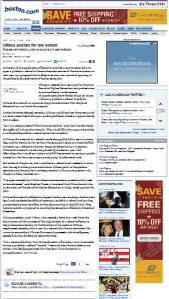
So, why aren’t newspapers able to capture those online advertising dollars?  To illustrate their problems, let’s use the Boston Globe – a paper which has had very public issues adapting to the new world of news.  If you visit the Boston Globe and search for my alma mater, UMass, one of the first stories you get is about UMass angling to open their own law school.  Check out what the page looks like:
globe1

Note the three ads – a banner across the top, a box in the right column, and a tower ad running down the right side a little ways down the page.  The banner and tower in this image are for Roadrunner Sports, and as near as I can tell they rotate.  The big, blue Air France rectangle, though, is all over the Boston Globe’s site today.  That probably means Air France bought a high level of visibility – in other words, they bought ads online the same they would have in the print version of the Globe.

But here’s a pertinent question: why would someone be reading this story?  What does that indicate about their interests?  Air travel seems like an odd fit for a story like this, which one might read if he or she is researching law schools or is a UMass alum.

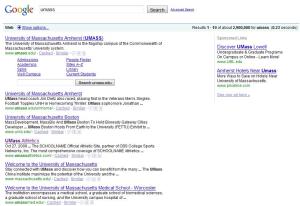
To contrast, here’s what I found when  searching for “UMass” on Google:
google1

Along the right side are two simple text ads for one of UMass’s satellite campuses and Priceline.com – the Priceline ad trumpeting their ability to find good hotel deals in and around Amherst.  What’s more, the ads look much like the search results – with the search term showing up in bold.  If you are searching for “UMass” because you are looking to further your education or visit your alma mater, these ads are up your alley; if not, the companies that bough the ads lose nothing because they only pay if you click.

While the search ad model anticipates the user’s possible interests and serves ads based on that, newspapers and the ad networks through which they work too often continue to display the ads that they want the user to see – even online.  Why would anyone pay for eyeballs when they could pay for the whole brain?

J. Geils Band angles for guest spot on The Simpsons

The news that Marge Simpson will be Playboy’s Ms. November is more than an unlikely pairing of cultural icons, it is desperate grab for relevance in a changing world.

The digital age has left Playboy plodding along like it’s run by an 80 year old guy who hangs around a house all day in his bathrobe and slippers.  Pursuit of other business models is a tacit admission that the heydays of Playboy and other girlie mags are over. Taking a peek into the Bouvier boudoir – and making the issue available only at newsstands – will likely give Playboy a temporary uptick in sales and find their way into the news pages and blogosphere for a day or two.

Marge’s centerfold also gives The Simpsons a chance to re-assert their pop culture street cred in their subtle rivalry with Family Guy – but Playboy clearly needed the boost more.

For $3, I would have posted this earlier

The entire readership of this blog emailed me about the story that the Associated Press may try to charge a fee for their displaying their news content early.  (Thanks, Mom.)  At first, this seems dumb – trying to delay access to online content sound like trying to put toothpaste back in a tube – once it’s out, it gets everywhere.  But this is less about re-inventing content distribution than it is about recognizing what AP CEO Tom Curley calls an “enviable moment.”

A year ago, relevance meant the top result on a Google search – and doing whatever Google said you had to do to make that happen.  In general, that’s still true.  But since Microsoft is serious about making their Bing search engine a serious competitor to Google, that means that both Google and Bing must be more mindful of that their search results deliver content which is relevant.  If Bing’s news aggregator is posting AP stories before Google News, that’s one more reason for users to move over.

For the AP, it’s not a long-term business strategy – but it is a chance to take advantage of a brewing search war.