Romney’s online ads and offline issues

Last week, Mashable and David Weigel both noted that Mitt Romney has been investing in web ads, but that he has yet to run an actual TV commercial in the early primary states (or any other states, obviously).  Mashable chalks it up to a money-saving move that has the added benefit of appealing to young voters:

It’s possible the candidates are waiting to amass more funds to pay for more-expensive airtime. Or, they could be engaged in an informal standoff for who will try to rule the airwaves.

On the other hand, web ads are a smart move. They are relatively cheaper to make and broadcast and naturally appeal to younger, web-savvy voters — traditionally a weak spot for Republicans.

After the criticism he took in last night’s debate, though, a web-focused strategy makes perfect sense for Mitt Romney.  The video which spawned last week’s round of coverage chided the Obama Administration on trade and intellectual property rights, which isn’t exactly a front-page-news-making issue.  It does, however, speak to some key audiences.  It’s one thing to say you appeal to philosophical conservatives who view government as an instrument to protect citizens’ rights and voters whose views align with business and commerce; but Romney’s ad deals brings up a niche issue that demonstrates an understanding of these voters’ motivations and concerns.

These are also the types of voters who are probably still deciding whether or not a Romney Presidency would be better enough than an Obama Presidency to be excited about a Romney candidacy.  Despite the fireworks of last night’s debate and this morning’s conventional wisdom that the other candidates put him on the defensive, Romney still carries the mantle of inevitability as the 2012 Republican nominee.  He still has plenty of people to convince to avoid being an also-ran in the same category as former inevitable nominees Bob Dole and John McCain.  He won’t be able to explain away his Massachusetts health plan, but online video gives him a medium to show conservatives he understands other issues.
Isn’t it good Norwegian video?

Some friends from Norway’s Conservative Party, Høyre, posted a new video on Facebook this week promoting the party’s youth auxiliary.   You don’t have to understand the language to appreciate the video:

Exciting, isn’t it?  Between the smiling faces, you have a good mix of high production value sequences and grassrootsy-looking handheld camera shots, plus a testimonial or two thrown in for good measure.  It’s also a great study in how little words matter to the effect a video has; the music and editing style portray the party’s youth wing and edgy and optimistic better than any script could.

Governing Is Campaigning by Other Means

Earlier this week, I pointed out in The Daily Caller how much the new website for the Consumer Financial Protection Bureau looks and operates like an advocacy campaign site.  The Obama Administration can use the recently launched ConsumerFinance.gov to identify potential grassroots, third-party supporters.  Since the agency will undoubtedly be targeted for being both a regulatory behemoth and a waste of already-scarce money, there’s a good chance it will need such supporters.

It’s actually quite a smart move – and the left side of the aisle isn’t the only place you can see it in action. ClickZ points out that a new video from the New Jersey’s Governor’s office looks an awful lot like the type of video a political candidate might use:

And they’re right.  The ad wizards who came up with this one – just like the ones who built the CFPB website – understand that winning public opinion while in office is just as important as winning public opinion on the first Tuesday in November.

GOP nabs headlines, OFA nabs volunteers

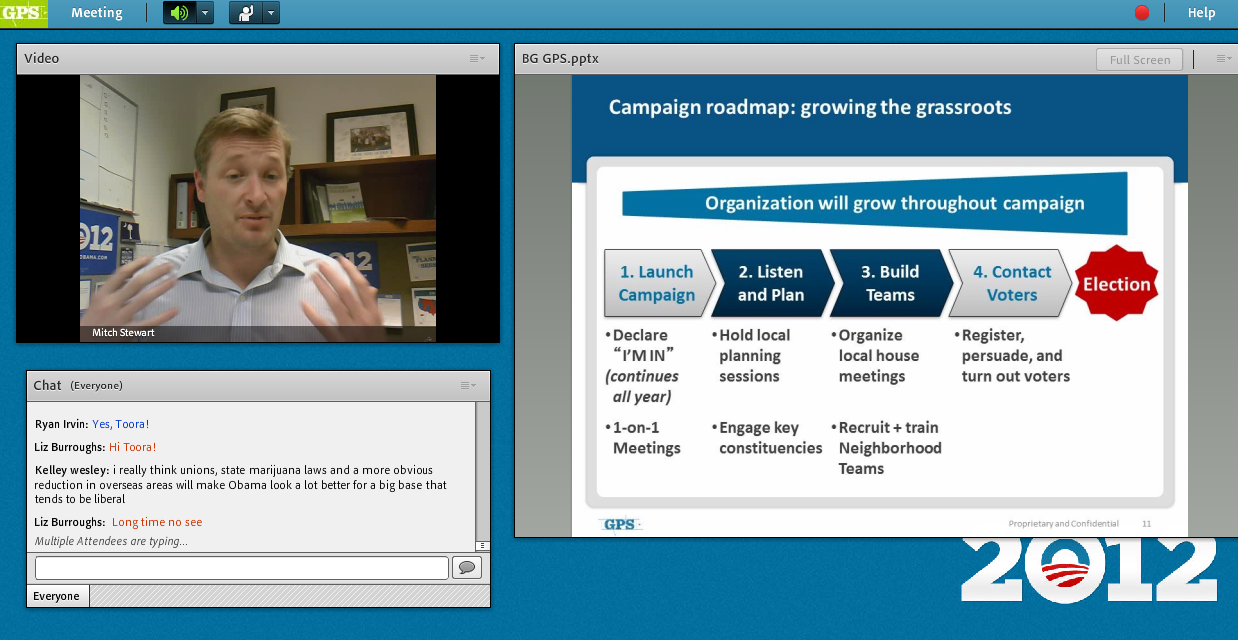
While the Republican contenders and pretenders debated in the Granite State, the Obama Campaign quietly kicked off what it hopes will be a “summer of team building” with an online volunteer briefing.  Organizing for America’s Mitch Stewart led the largely unsurprising session, sketching out the campaign’s overall plan for recruiting volunteers and getting out the vote.  There were, however, some tactical points that were worth noting.

Just like the 2008 incarnation of the Obama campaign – and, really, any organization worth its salt – Obama/Biden ’12 seems rightly obsessed with amassing volunteers and securing firm commitments to action.  The central effort seemed to be a push to ask volunteers to host house parties, recruiting After Stewart’s overview of the basics, the webinar asked participants whether they could either host or attend a house party (along with inviting others to attend as well).

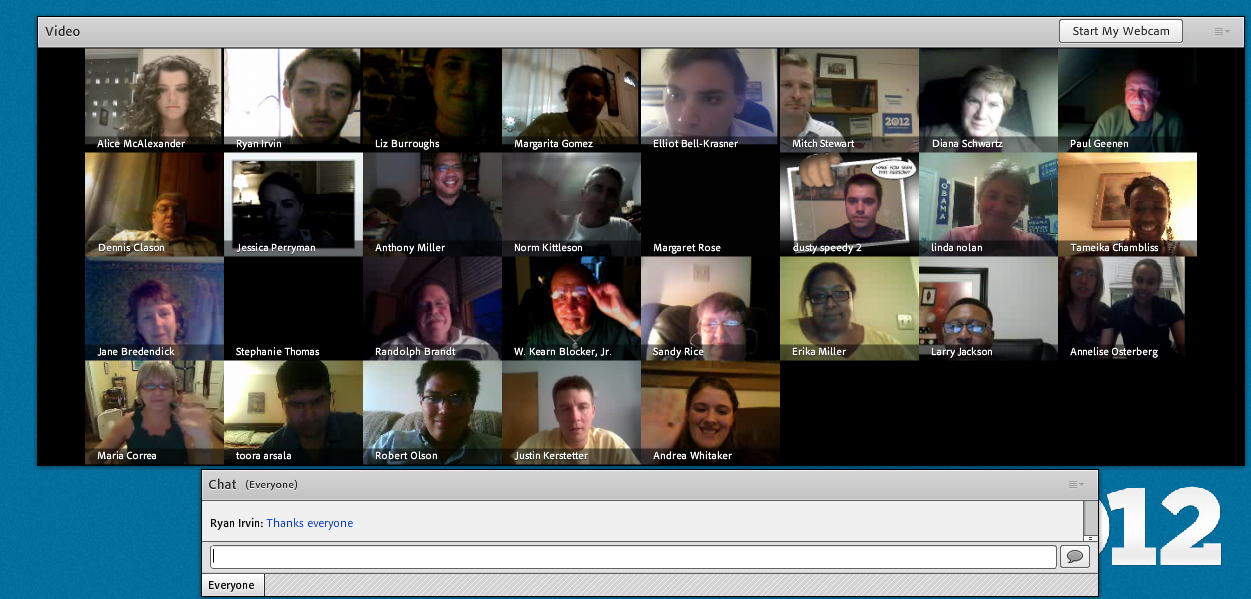
The neatest part came at the end, when participants were invited to turn on their webcams.  A collage of the real-time feeds allowed participants to see and even wave to each other:

This is another early preview of what figures to be a consistent theme for Obama ’12.  Remember that the announcement video for the re-election effort did not feature the candidate, instead focusing on campaign surrogates and volunteers.   Other faces – including, wherever possible, those of grassroots supporters – will allow the Obama campaign to create a wall of separation between the candidate and the dirty business of politics.

The result? Obama looks Presidential while his subordinates ramp up the country’s first billion-dollar campaign.

Cross-posted at PunditLeague.us.

Time for T-Paw to re-think video strategy?

For the most part, Tim Pawlenty has done a good job of using YouTube.  His team clearly understand the online video medium as a unique communications vehicle, rather than as a place to warehouse TV ads.  Pawlenty and Co. use video often, and the videos are stylistically consistent.

But this video, entitled “Behind-the-scenes at Gov. Tim Pawlenty’s announcement in Des Moines, IA” and posted last week, is a bit disappointing:

That’s not a “Behind the Scenes” video.  Those are actual scenes.  There are clips of the speech and clips from the media coverage of Pawlenty’s announcement, but no candid moments from the candidate.  The best part of the video is a mere ten-second stretch featuring Pawlenty supporters explaining their support.

Now imagine this as the “behind-the-scenes” video” instead:  60 seconds of people in the Pawlenty crowd talking about why they came out to support T-Paw, cut with pictures of homemade signs, and maybe even ten seconds of the candidate talking with supporters in a handshake line.  There would be no music and no voice-overs.

Tim Pawlenty is going to spend the next few months juxtaposed against two incredibly polished professional politicians in Mitt Romney and Barack Obama.  He will need to be able to contrast himself from both.  His videos are not bad, but standing alone they will give the impression that Pawlenty is trying to out-Romney Romney or out-Obama Obama.  If he tries to be someone he is not, Pawlenty will lose his fight for the nomination.

In a campaign where he constantly reiterates the need for honesty and sincerity, Pawlenty would be wise to let some of that come out – and let his videos create a mood rather than a separation between him and the voters.

Small is huge nowadays

Two seemingly unrelated pieces of patriotism struck me as oddly similar this week.  The first was, obviously, the raid that killed Osama bin Laden.  The second was the not-quite-safe-for-work homage to George Washington from cartoonist Brad Neely.

Neely’s work is kind of out there, but for those who share his sense of humor it’s spot on.  (A sample line: “And we danced, like those people in the hyper-tight light of fried chicken commercials!”  Seriously, what does that even mean?)  Even with limited exposure in venues like Cartoon Network’s Adult Swim, Neely’s two or three minute videos are especially suited to a YouTube audience.

Obviously, the Navy SEALS who took down bin Laden crafted a much more significant piece of work on Sunday.  Their achievement, though, was a reflection of a changing military environment just as Neely’s videos reflect a changing media environment.

The major military conflicts to stop terrorism after September 11 targeted nations – specifically, Afghanistan and Iraq.  The plan was to smoke out terrorists by pressuring state sponsors of terrorism.  We found that the strength of our armored columns had limited effectiveness confronting the independent contractors who made up Al Qaeda’s network.  We could contain the snake, but we couldn’t do the one thing we set out to do.

It’s significant, then, that the bin Laden kill mission was set up by intelligence and espionage, and executed by a couple dozen elite servicemen.  There was no invasion of Pakistan, simply a precise action focused on a single piece of property within the country.  One can’t help but suspect that had our leaders not announced the mission’s success, the rest of the world might never have known bin Laden was dead.

A small, elite unit was all it took to snuff out the world’s leading terrorist.  George Washington (who crossed the Delaware for a surprise attack) would be proud.

Heritage tells a great story about the oil spill

Like several environmental groups, the Heritage Foundation took some time to mark the one-year anniversary of the BP oil spill.  Their video, however, documents the impact of the Obama Administrations hesitance to re-open efforts to drill in the Gulf.  Most of us have felt the result of this at the gas pump; the people Heritage spoke with (and, more important, who told their own stories to the camera) feel the pain all the time.

(In the interest of full disclosure, I have a current client seeking to establish a more complete national energy policy.  I didn’t get paid for this post, though, I just think Heritage did a really good job with this video.)

Video killed the… uh… video star?

In 2007, the use of YouTube to announce exploratory committees (all by Democrats) was hailed as revolutionary.  In 2011, it’s par for the course.  Online video has cemented its place in the campaign communications toolkit.  In recent weeks, Tim Pawlenty, Mitt Romney, and President Obama have all announced their 2012 campaigns or exploratory committees.

But all online videos are not created equal, and it’s interesting that this rash of announcement videos comes right around the release of Paul Ryan’s Path to Prosperity video.

Watching Ryan’s video again, it’s striking how well done it is, stylistically.  Between the appropriately serious music, the superimposed charts, and even the way shots are framed, the technical minds behind it clearly had an intelligent vision and the skill to carry it out.  Just as important, Ryan appears completely at ease.  He makes his points directly, yet his tone is conversational; if he is reading from a teleprompter he does a good job of making it seem like he isn’t.  He interacts well with the graphics – notable because they probably weren’t there during filming.

Ryan does such a good job explaining a complex issue in a concise and engaging way that it calls to mind previous media revolutions.  Other Presidents appeared on television, but John F. Kennedy was out first “TV President.”  Could Paul Ryan be America’s first made-for-YouTube politician?

Obama announces; Pawlenty fires back

Since it was no secret that President Obama would run for re-election, Republican opponents had no reason to be slow in their response.  Tim Pawlenty took the first crack today with his newest video, “A New Direction“:

Pawlenty’s immediate, polished, and pithy video response shows keen preparation and intelligence.  The fact that he was the only Republican challenger in a position to make a video like this is one more reason one more reason he was smart to form his exploratory committee when he did.

Check out the contrast in style between Pawlenty’s video and the Obama announcement:

Pawlenty’s response mimics his previous trailers/videos, with thunderous background music and a serious tone.  Recognized voices of the left (like Paul Krugman) are skillfully used to point to the flaws in Obama’s policies, and the candidate (or candidate-to-be, officially) is the star.  Since the knock on T-Paw has been that he’s too bland and “Minnesota Nice” to rile up and motivate voters, the stirring rallying cry is his way of making the election seem like the fulcrum on which the lever of history will turn (or something like that) and positioning himself as the Man Our Times Cry Out For.

Meanwhile, Obama’s laid back video focuses on volunteers.  The criticism that Obama is self-centered and self-aggrandized is counterbalanced with the low-key collection of individuals talking about what they can do to re-elect the President.  If fact, Obama doesn’t even appear in the video, though he did “send” the email to supporters that announced the video.  Significantly, the first three supporters hail from North Carolina, Colorado, and Nevada – three traditionally red states that Obama carried in 2008.

The different styles reflect two different audiences.  Obama and his campaign handlers know that his announcement video is going to make the evening news, whether it’s a thoughtful call to supporting the policies of the last two years or the President delivering an autotuned address about the wonders of Friday.  (Actually, that second option would probably get an awful lot more press, but in a not-as-good kind of way.)  So his video is directed at the people who put him in office: the ones who made phone calls, knocked on doors and urged friends and neighbors to schlep out to polling places.  The video attempts to frame his re-election as every bit the grassroots movement as his 2008 election, despite the vast advantages of incumbency.

(Also worth noting is how one Obama supporter, Ed from North Carolina, echoes an old George W. Bush talking point from 2004: “I don’t agree with Obama on everything.  But I respect him and I trust him.”)

Pawlenty’s team also knew that the President’s announcement would be  guaranteed coverage.  So his video is built to take advantage of that press exposure – and earn coverage of his own to help lift his name recognition numbers.