It’s the most popular website in the world, and everyone hates it.

Last week, as Facebook celebrated the half-billion user milestone, a consumer satisfaction study placed Facebook’s “Like” rating down in the bottom 5% of surveyed companies.  ReadWriteWeb points out that this puts them on par with cable companies, airline companies, and the IRS.

Those are interesting company for the social network.  There’s a parallel between Facebook lessening their privacy policies to better monetize their users and airlines adding additional fees for checked bags, carry-on bags, and eventually suitcases that you keep at your house and don’t bring to the airport.  Facebook’s reaction has been similar to a cable company that asks a customer to be available from eight to four for a service call and doesn’t show.

The dissatisfaction is likely chronic for as long as Facebook tries to make money, and there’s two ways that type of customer dissatisfaction might play out.  The first is that users leave the service.  Facebook runs its course and becomes the next Yahoo! or AOL, a shell of its former self as internetters flock to the next big thing.  It doesn’t go away, but former Facebook employees talk about the glory days the way Frankie Five Angels Pentangeli wistfully compares the Corleone family to the Roman Empire at the end of The Godfather Part II.

The alternative is that Facebook becomes an acceptable evil – that users can always find something to complain about, but nothing that drives them away.  In the same way that spam doesn’t lead to an exodus from email, people stay on Facebook because it’s the easiest way to connect with friends.

In that way, the best comparison to Facebook from among the entities with similarly low satisfaction rates may be the IRS.  No one likes it, but everyone still uses it – and it’s probably not going anywhere.

I dreamed a dream of Foursquare

This may be a sign I’m working too hard, but that isn’t a funny title – I actually had a dream about a client using Foursquare last week.

The client, a national non-profit, had partnered with several Foursquare-friendly businesses throughout the holiday shopping season.  If you checked in at a location nearby, the business would alert you that a certain purchase would result in a donation to the non-profit.  For instance, if you checked into a restaurant, and there was a Starbucks nearby, you might receive a message that buying a grande gingerbread latte would net a $1 donation.

When I told them, they liked the idea – but were a little disturbed that I was dreaming about work.  But as other non-profits are finding out, Foursquare can be a useful tool for connecting with supporters.

Burying the lede: Whitman’s tech strategy

Catching up on some news from this weekend… From the San Jose Mercury News (via TechRepublican): “Whitman campaign counting on tech to fidht Democrats’ boots on the ground.”  The article mostly recounts Meg Whitman’s advantage in technology spending and notes that Jerry Brown’s strategy relies heavily on union organizers making “workplace visits.”  (No word on whether those visits involve lead pipes or any other aggressive GOTV strategies.)

The headline and lede make it sound like Whitman is simply spending money, but the details show a bit more refined strategy than that:

Whitman has also made use of increasingly sophisticated database technology to “micro-target” voters through an aggressive mail program. First made popular by GOP strategist Karl Rove in the 2004 presidential election, micro-targeting goes far beyond using bare-bones demographic information such as age and income. Voters get targeted mailers and phone calls based on the kind of cars they drive, food they eat and magazines they buy.

During the primary campaign, many Whitman volunteers eschewed traditional “boiler rooms” and joined online phone banks so they could dial for dollars in their pajamas — or ask voters for their support and record information on them while sitting on a beach with their BlackBerrys.

The technology expenditures appear to be put toward the purpose of making GOTV tactics – like phone calls and mailings – more efficient and easier for volunteers.  And, the article points out that the union goons are doing the same thing – identifying non-union “red county” voters who share their outlook on political issues and reaching out to them.

Tellingly, the missing link here is the Brown campaign, and the article quotes Brown himself calling Whitman’s $2.7 million in online spending wasteful.  The reality, though, is that any campaign tactic costs money.  The fabled 2008 Obama  campaign – still the most prominent example of online organizing – outspent the McCain campaign online, making wise early investments.  The technology didn’t create excitement, but it gave the campaign a way to harness it and translate it into votes.

The article likens Brown’s website to the 1974 Plymouth that Brown used to drive around to demonstrate his working class street cred.  The comparison is apt if Brown really thinks there is a dichotomy between online organizing and “boots on the ground.”  A car made in 1974 and a car made in 2010 both operate basically the same way, but the 2010 model has newer, more effective parts that allow it to perform more efficiently.

Maybe he could take some of that Matlock money and apply it to his site?

Whitman campaign counting on tech to fight Democrats’ boots on the ground

Foursquare of July

Like Mindy Finn of Engage and others, I’ve been trying to figure out Foursquare – not necessarily because I like it, but because it’s my job to know how it works, and how it can be applied.

Vincent Harris of TechRepublican has some good ideas about it, and businesses like Whole Foods have gotten on the bandwagon by asking users to check in.  Some offer discounts for check ins or mayorships.

Yesterday, I was chatting with a small business owner and soon-to-be restaurateur  about ways he could use it for his business.  He wasn’t sold on its utility.  When I checked in at Nationals Park to watch the Washington One-Man Show, a Facebook friend made fun of me for playing “that stalker game.”

It seems like many just aren’t quite sure what to make of Foursquare yet, which is reminiscent of another social media/network craze from a few years ago: Twitter.  When Twitter first hit, it instructed users to tell everyone what they were doing – making it sound like a glorified Facebook status update.  When people started understanding the ability to communicate in public conversations with 140 characters – and the concept of microblogging – Twitter became more than its founders probably imagined it would.

As Foursquare becomes more prevalent, more businesses, organizations, and campaigns will start to take advantage of the ability for people to check in electronically from their phone, and the utility will become more obvious.  Until then, here’s a very telling metric that indicates this isn’t a passing fad: Foursquare’s current value is $95 million, and they’re planning to expand.

Hunting Macaca

Politico’s headline “Democrats seek ‘Macaca moments” aptly describes the DNC’s new Accountability Project, which invites citizens to record and upload videos of Republican politicians saying dumb things.

Because it’s actually a good idea, this has resulted in some hand-wringing on the right amid fears that Democrats are better at grassroots internetting than Republicans.  But that ignores why this is a good idea: the Accountability Project is a national aggregator and message device.  It seeks to crowdsource the Democrats’ messaging to take to most loony Republicans they can find and hold them up as the standard.  It is a pretty clear attempt to re-gain the reins of the national policy debate, which have slipped through the Democrats’ fingers in the past few months.

All that said, by driving messages that show the Republicans are out of touch, Democrats will save their skin and keep control in November.  (They may have done so anyway, but a few macaca moments will help curb GOP momentum.)

So how to combat this?  It’s pretty easy.

Republicans have cameras too, and Democrats are just as prone to saying and doing stupid stuff in front of those cameras.  What if some enterprising conservative with a flip cam catches them in a gaffe, then uploads the video?  It would seem the obvious way to hold the Accountability Project accountable.

It’s still better than WGN

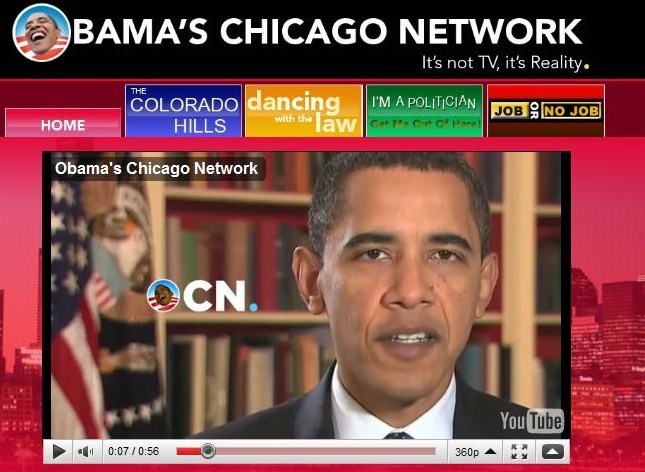
Looking to keep stories about the White House’s dabbling in primary elections alive, the RNC launched the “Obama Chicago Network” in an email to supporters this afternoon.

The site boasts four “shows” that deal with various negative stories surrounding the Sestak/Romanoff could-have-been-bribery affairs, plus Rod Blagojevich thrown in for fun:

Even if it is somewhat dated in the pop culture references (some of the shows they are spoofing are past their prime or canceled), it’s pretty funny, makes good use of news clips, and has a poll to collect people’s contact information.  With Blagojevich in the news, it does a good job of tying the administration As a lead generator, the site is good, but it’s missing something that could make it a really useful tool for Republican messaging: a section where users could “pitch” their own shows.  Not only is audience participation a good thing, but it might make for some must-see TV.

Being the media

Last night I spoke at the Leadership Institute‘s Public Relations School on writing effective press releases.  It’s a talk I’ve been giving since 2002, but since then it has obviously changed pretty considerably.

The most significant change has been in the forms a press release has taken.  Eight years ago a basic press release was a one-page document written like a news story that was emailed and faxed to a media list, or distributed through a press release service.  Today, through formats like social media releases, plus tools like easy blogging and media hosting platforms (like Flickr and YouTube), organizations and campaigns can augment their news releases with all kinds of extras.

And frankly, if they aren’t doing that, they’re missing out.

The media landscape has changed, too.  Bloggers and power social network users can reach thousands of people.  There’s no reason to wait for traditional media outlets to create content that can be picked up virally.  The Washington Times mentioned how this helped insurgent candidates circumvent the media in upsetting candidates hand-picked by political parties:

Just as important, platforms such as YouTube have given long-shot candidates ways to circumvent political reporters reluctant to cover campaigns they don’t believe have much chance of success…Most prominent is Florida, where former House Speaker Marco Rubio, a darling of the “tea party” movement, had nearly 20 times the video views in late May as Gov. Charlie Crist, whom Republican leaders had recruited into the race. Mr. Crist has since fled the Republican Party to run as an independent.

One key element of public relations hasn’t changed, of course: the importance of having a strong, well-framed message.  If a tree falls in the forest, and no one’s around to tweet about it, it won’t make the front page – but the tree has to fall first.

Helen Thomas gets Macaca-ed

Helen Thomas’s resignation from the White House press corps came not because of offensive comments, but because the media landscape has passed her by.

Reporters are, rightfully, under more scrutiny now than ever.  Back when Thomas started, America’s romanticized view of “the media” was something like a mix of Lois Lane, Carl Bernstein, and Bob Woodward – dogged reporters turning over stones, acting as the clear pane of glass through which normal, everyday people could see the world.

But gradually, reporters (including Woodward and Bernstein) became a part of the equation.  Suddenly, people realized that the reporters weren’t just a clear pane of glass, but the entire window, limited in what they showed by their own frame.  Sometimes, to see what was really going on outside, you had to look out of several different windows.

News consumers began to understand that the person telling the story affects the story.  And news consumers care about that.

This isn’t to say that reporters should be completely without bias – but most folks feel they ought to try to keep an open mind.  Thomas’s anti-Israel diatribe was anything but open minded.

That the grand dame of the White House press room was taken down by a citizen journalist – and that it was her own words, rather than any auxiliary commentary, that did her in – speaks to another truth about modern media.  The stalwarts like Thomas are less relevant than ever before.

Two lessons from last week about online campaigning

With Memorial Day weekend coming up, Campaign Season 2010 is about to hit high gear.  With that, candidates who hadn’t built out their web presence are going to put the foot on the gas.  At this point, that probably applies more to local and state candidates than candidates for most state or federal offices – campaigns where it can be intimidating to put together a robust online campaign.  I recently spoke with a consultant for a state candidate who had just launched a Facebook page.  The campaign was somewhat nervous about the launch for two reasons: 1) the page was still a bit light on content and 2) by its nature, the page would allow the campaign’s organized opponents to post negative comments.

These are both legitimate concerns, but they have legitimate answers.  Some high profile stories from the last week illustrate how to deal with them:

1. When it comes to content, don’t make the perfect the enemy of the good.

As the Mark Critz campaign made clear, websites and other online presences aren’t static media.  Just as a simple website can expand to include more sections and content, a Facebook page can expand with more wall posts, pictures, videos, or other pieces.

In fact, a phased strategy has an important benefit: with each addition, the campaign can reach out to supporters again with a fresh, relevant message.  On Facebook, this is even more pronounced.  If you join a Facebook page that already has all the content it’s going to have, it becomes easier to forget.  If you join a Facebook page that constantly adds content, you are more likely to see it in your news feed, and possibly visit the site and take some sort of action.  (Which would, in turn, show up in your friends’ feed, and give the campaign further exposure.)

Too many online campaigns fail to understand that a website or social network profile isn’t like a television or radio advertisement – while some seed content is important, adding more content later can actually work to their advantage.

2.  Censoring negative comments gives them more legitimacy than answering them.

Back in good old Pennsylvania, gubernatorial candidate Tom Corbett got into a bit of a row with some anonymous Twitterers and issued a subpoena to Twitter calling for their identities.  In doing so, he appeared to be legitimizing his critics through a ham-fisted attempt at censorship.

On any campaign’s Facebook page, there will be detractors who put their mark on every single post.  By smartly building an active and engaged base, a campaign can create a community which will answer this criticism with supportive speech.  There are also opportunities to directly engage the folks who make these comments in a public square – they don’t get to post to your campaign’s wall in a vacuum, after all.

If your campaign is not effective at answering critics directly, Facebook may be the wrong place to be.  But then again, if your campaign can’t answer legitimate questions, electoral politics may also be a bad choice.