Scott Brown should double down on his “gaffe”

Look and what that crazy Scott Brown said last week: 

Here’s the thing, folks say, what are you going to do to create jobs? I am not going to create one job, it is not my job to create jobs. It’s yours. My job is to make sure that government stays out of your way so that you can actually grow and expand.

The American Prospect called it a “horrible gaffe and a few left-wing outlets are trying to make some hay out of it. They may want to think twice about giving Brown’s comments more oxygen. Polls from the past few months show that the American public is gaining confidence in the business world and losing confidence in the institutions of government

Ethereal opinions are one thing, the campaign trail is another. This campaign trail cuts through New Hampshire – a state whose license plates read “Live Free or Die.” Something tells me those voters might respond well to a candidate who can articulately state that yes, government’s power has limitations.

There is not one phrase of Brown’s quote that is damning. In fact, it may be helpful in wooing independents and Republicans disillusioned with the recent four-way primary.

“No doubt someone’s preparing an ad right now based on the quote,” opines the American Prospect. That’s for sure – and it should be someone working for Scott Brown.

IT’S A TRAP: Obama delays executive action on immigration

There won’t be any executive action on immigration policy before the November elections, according to President Barack Obama. Nationally, the issue has looked like a loser for Democrats, so it seems like a pretty obvious move.  Delaying action protects Democrats from being saddled with yet another unpopular Obama policy.  But as one of the great military leaders of our time said, “It’s a trap!”

For Democrats running in tough states where independents can be persuaded (and weak Republicans can be persuaded to stay home) based on immigration issues, this move is exactly what it looks like. But it also gives GOP candidates a false gift: the ability to claim that the looming threat of mass amnesty of illegal immigrants looms over the nation. That’s not a bad issue – for now. But remember that in 2002 and 2004, protecting state-sponsored traditional marriage was a good issue for Republicans; by 2012 the issue had reversed. In addition to the light cover offered to 2014 Democrats, Obama’s immigration delay paves the way for future Democrats to point to 2014 GOP rhetoric as evidence of racism. All it would take is for one candidate to Mourdock up a debate by talking about “the Mexican menace at our border” or some such crap.  It could also work as a shorter-term micro-issue: Democrats could identify pro-immigration pockets of both parties and drum up the issue as an example of Congressional intransigence. It wouldn’t be a stretch with the data infrastructure that’s already in place.

The messaging on this issue, as with all issues, has to be nuanced; the do-nothing message cuts both ways. Immigration could be one more issue on which the President has chosen not to lead. And that opens the door for campaign-trail discussions about new solutions that use the best of Republican and Democrat ideas – and casts aside the worst ideas, like wholesale amnesty or the President’s refusal to compromise on anything. The real opportunity for Republicans on immigration is to re-orient public positioning on the issue for 2014 and beyond.


Robin Williams’s death gets a White House statement. Where’s the one for Maj. Gen. Harold Greene?

Hours after the news of Robin Williams’s death broke, the White House issued a heartfelt and sincere statement.

Major General Harold Green was killed in action several days ago, in Afghanistan. The White House was slow to respond to the death of a high-ranking servicemember, and has not yet posted a statement on the White House website.  

Most people don’t know Gen. Greene’s name, while just about everyone knew Williams’s.  He was so adept at shifting among adult-themed comedy, serious acting, and family-oriented silliness that most people have a favorite Robin Williams movie or appearance.

The Facebook and Twitter tributes back that up: Williams’s death is a trending topic.  And the Obama White House has a keen sense of zeitgeist (one that makes their apparent, frequent tone deafness tough to understand).  The White House statement on Williams passing will make it into news feeds and be retweeted, so speaking out on his death – and doing so quickly – becomes a priority.  

Treating death this way is unfair – not only to Maj. Gen. Greene, but to Williams, who deserves to be more than social media fodder for a politician.

Obama blames GOP extremism for not appreciating how brilliant he is

Our American President mused in a New York Times interview that the series of speedbumps that have knocked him off course for the past five to six years has a lot to do with the extremists he faces in the other party: 

“Our politics are dysfunctional,” said the [P]resident… “Increasingly politicians are rewarded for taking the most extreme maximalist positions,” he said, “and sooner or later, that catches up with you.”

Extreme and divisive politics sure does catch up to you. For example, you reaching across the aisle when you finish a bitter election season and your best negotiating point with your opponents is, “I won.”  (This is especially true if it comes right after spending a year promising “a new kind of politics.”)  And once is bad enough, but then if you do it again, you’re really going to have problems. 

Hopefully the Obama Adminstration can overcome such a toxic political enviroment.

Why Hillary Clinton Won’t Be President

Wow, Hillary Clinton really stepped in it with her comment about being “dead broke” after leaving the White House, didn’t she?

Factually, she’s probably right. Bill’s career was almost exclusively in public life — from his first term as Arkansas attorney general starting in 1977 to leaving the White House in January 2001, he spent 22 of 24 years holding a public office.  And it’s not like he was the scion of a political dynasty like the guy he replaced or the guy who replaced him. Factor in the legal fees from lawsuits that are the inevitable result of decades of chasing tail, and you can see that the Clintons wouldn’t have been flush with resources, even if the cattle futures market performed particularly well.  The questions came up because the Clinton’s hit the speaking circuit to help drum up the extra scratch – which has been incredibly lucrative in the post-White House years.

But what she said isn’t as important as how she said it:

“We came out of the White House not only dead broke, but in debt,” Clinton told ABC News. “We had no money when we got there, and we struggled to, you know, piece together the resources for mortgages, for houses, for Chelsea’s education. You know, it was not easy.”

There are a couple of triggers in there that won’t resonate well with people who don’t pay much attention to politics (i.e. voters who have better things to do).

Obviously, the use of the plural “houses” and “mortgages” comes off wrong. You’ll remember that after Bill was laid off of his job, Hillary found work as a Senator, which required lots of travel. Having two houses makes sense and isn’t uncommon for Senators, but Senators are only 100 of the several millions of votes needed to become President. (And many of them are in non-target states, to boot.)

What wasn’t plural in her comments was the education expenses. Many parents with multiple kids struggle to figure out how to pay a double dose of inflated college expenses. Those same parents probably assume that the political connections of eight years in the White House probably help move money better than a FAFSA.

The new book and marathon interviews are clearly a way for Clinton to soften her image in advance of the coming deluge from the vast right wing conspiracy. The problem is the tin ear turned to how people currently view her. She has been in the public spotlight since 1992, which means a long and public track record on which voters have based mature opinions. There’s also a celebrity factor: the public assumes that famous people (whether actors, athletes, politicians) are out-of-touch.  If they go broke, the assumption is that they must have spent their money foolishly.

The question was about making millions in speaking fees. Instead of talking about the need for the speeches, Clinton would have been better off talking about the chance to connect with people. “Yes, we did a lot of speaking, all over the country,” she might have said. “Living in the White House, you don’t get to talk to many people outside of government. After years of partisan bickering, that gave us a chance to get back out and see what people were thinking, what mattered to people.”  And then, if she really wanted to pour it on: “That was a really important time for us. If really refreshed our desire to keep fighting for the things we believe in.”

Schmaltzy? Maybe a little, but it stops the conversation about speaking fees. Clinton’s out-of-touch answer keeps the issue going. If she misfires this way repeatedly, she’ll cement the public view of a career politician who believes it’s her turn to be President.

As Mitt Romney can attest, when voters feel like they can’t identify with you, they won’t vote for you.

Mitt, we hardly knew ye

Mitt Romney is letting his perfect hair down to promote the Netflix documentary chronicling his White House run.  Predictably, without the pressures and influence of a campaign, people are a bit more receptive to him.

(Bob Dole had a similar tour after losing in 1996, trading jokes with David Letterman and quipping that he didn’t “have anything else to do” but write jokes.)

More than one Republican has bemoaned the fact that, had voters seen such a touching look at the Romney family, the 2012 election may have ended differently.  “If only voters had seen THIS Mitt Romney, Obama would have lost!” they tend to exclaim.  Not always in exactly those words, but you get the picture.

And come to think of it, it’s a good point.  One wonders why the documentary had to come out over a year after all the votes were counted.  If the image of Romney presented in the documentary would have swayed the election, Team Romney have only themselves to blame.

A 2016 Presidential candidate could grant access to a friendly but independent documentary filmmaker and create a Netflix or YouTube miniseries.  The film would not be subject to any campaign approval, which would make the vetting process important.  But it would soften the candidate’s image, and possibly help voters relate to the candidate.  It would humanize a talking head voters see on TV.

Gov. Chris Christie could use such a medium to rebound from scandal.  Sen. Rand Paul could use it to articulate how his small-government ideas will help most Americans.  Sen. Ted Cruz could show that he isn’t as much of an ideologue as the media and Democrats suggest.  The one who needs it the most is Hillary Clinton, who is more a creature of Washington, D.C. than any other prospective candidate in the field.

There is a caveat: this strategy only works if the candidate is genuine.  If the public persona doesn’t match private conversations, then it’s a disaster waiting to happen.

For Romney, a running documentary series could have answered the image of the ruthless CEO with one of the consummate family man.  Even though it probably wouldn’t have pushed him over the hump, those who will chase the White House in 2016 should pay attention.

“Yes, but I have FRIENDS who are Libertarian!”

Predictably, some of the grumbling from the aftermath of the Virginia governor’s race this week blamed those who voted for libertarian Robert Sarvis.  Leading up to the election, there was a clear advertising strategy telling certain voters that supporting Sarvis was tacit support for Terry McAuliffe.

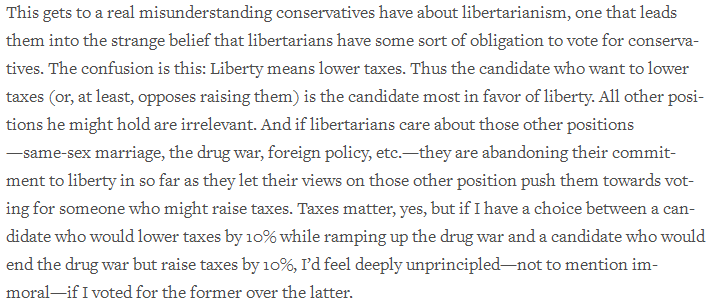
Sarvis probably did not cost Cuccinelli the governor’s mansion.  This tweet from Townhall’s Kevin Glass quoted an important lesson about Republican and conservative candidates who want to reach out to libertarians:

BYkVlrzCEAIrkcW

When reaching out to any segment of the population, a campaign has to forge a real connection.  Demanding libertarian support with buzzwords or a rudimentary understanding of their values works only slightly better than a Latino outreach strategy based on a plateful of Taco Bell gorditas.  (That sounds like something Mitt Romney would have come up with, doesn’t it?)

One could make a libertarian case for Ken Cuccinelli, but not by asking someone to support the lesser of two evils.  There are libertarians who believe in putting principles aside occasionally to support an imperfect candidate with the best chance of winning; those people are known more colloquially as Republicans.  If libertarians are driven by principal, then they must be persuaded based on principle, not policy.

It’s a subtle shift.  In the example Glass tweet’s out above, he mentions taxes, which is a good example.  Most Republicans will bang the drum for lower taxes, but they aren’t always sure why.  The reality is that lower taxes leave money in the economy, which allows for efficient allocation of society’s resources.  Lower taxes mean more free markets, and we have seen for hundreds of years that when left to their own devices through free markets, people tend to make correct choices.

Maybe that’s not to convince all libertarians to support a candidate who also believes in mandatory prison terms for first time smokers, jokers, and midnight tokers.  But without a nuanced message like that, messaging to libertarians would be a wasted effort.

Being able to articulate the “why” – the principle behind the policy – makes a difference.


Who wins if Cuccinelli loses?

Ken Cuccinelli is on the ropes in the Virginia Governor’s race – which is one reason George Will raised some eyebrows last week with his glowing treatment of Robert Sarvis, the Libertarian candidate.  Why would a national, established Republican commentator like Will take what looks like an obvious swipe at a major party candidate in one of the two major races going on in 2013?

If trends continue and Cuccinelli loses, there will be another obvious dent in the narrative that the GOP brand is on the rebound  and well-positioned for victory in 2014.  Combined with the fallout from the government shutdown, it will be the second setback of the fall for Republicans, (overshadowing, to some degree, the failed rollout of Obamacare).

As the polls look now, it’s pretty likely to shake out that way.  But not all losses are created equal.  A less-than-50% win for Terry McAuliffe combined with a strong showing from the Sarvis, actually benefits some entities:

1.  Bill Bolling.  Remember Fredo Corleone’s reaction when he got passed over for his kid brother?  Supporters of party conventions over primaries like to say that the non-public, keep-it-in-the-family method of choosing a nominee is less hurtful, but that theory flew out the window in this case.  Rather than playing the good soldier and supporting his nominee, Bolling has waged an un-campaign by creating his own policy organization.  And the word on the street is that he has done some behind-the-scenes work for McAuliffe.  A race where Cuccinelli loses – but center-right candidates, combined, draw a majority – gives further credibility to Bolling in 2017 if he opts to run for Governor calling for a more moderate direction for the state party.

2.  Chris Christie.  Back in the day, the odd, off-off-year elections in Virginia and New Jersey meant split victories: Republicans would take the Old Dominion, Democrats would notch the Garden State.  This year, Christie’s runaway reelection victory will buck the trend.  As the most recent Republican winner, it will position him well with top donors and consultants as he prepares for his Presidential run in 2016.  There may also be some who look at a split-vote loss in Virginia as a sign that the GOP needs to moderate nationally.  While it would be a mistake for Christie or his team to make that case publicly, behind closed doors they can make that case to party leaders deciding where they ought to contribute their endorsements and dollars.

3.  Rand Paul.  Very quietly, Rand Paul has been having a great couple of months.  Once considered the most outspoken and conservative among the serious potential Republican field for 2016, Ted Cruz’s filibuster has allowed Paul to present himself as more publicly reserved than the Texas Senator.   While moderates would point to a Cuccinelli loss as a need for a philosophical shift toward the center, Paul could make the case that the split vote means the party has not done enough to make the case to voters equating smaller government with better government.  Since this argument does not involve telling conservative voters they are philosophically wrong, Paul could have the most to gain from a tight loss in Virginia.  (That Paul actually campaigned for Cuccinelli puts him in a better position, as well.)

4.  Conservative/Republican Commentators.  That’s not to say that any of the above folks, or their supporters, goaded Will into his story, of course.  Nationally, if Cuccinelli loses in part because of Sarvis, GOP talking heads can write off the loss as the product of vote-splitting and focus on what looks like an easy victory in New Jersey.  The tough loss might hurt the Commonwealth, but for the people who scream at cameras for a living, it provides an easy pivot point for cable news debates.

More Messaging on Health Care

Following up on a previous post on the semantics of the upcoming health care debate, the good folks at Pocket Full of Liberty make a strong point about the best levers to move the issue:

This law is a disaster. And we’ve only seen the tip of the iceberg. There is this huge opportunity out there for Republicans to once again, show the public how the government tried to do something and failed at it. They can do that a lot better by telling the stories about people who have had to search for new doctors and different healthcare plan…

The case for Obamacare (just like the case for previous attempts to socialize the health care system) was made with highly individual personal stories.  Despite people being satisfied with their own insurance, the weepy tales of a working Mom who couldn’t get insurance for her kids because of a pre-existing condition were fairly convincing.  Hey, if it doesn’t affect my insurance and I can help someone else, why wouldn’t I, right?

Now, the American people are getting less insurance, not more.  They are paying more, not less.  Getting insurance is harder, not easier.  And the supporting facts for these statements are out there – in the form of the people who are getting letters that their insurance policies are being cancelled, or who are waiting in long virtual lines to access a website to buy insurance.

The path to health care reform starts with those stories.

Why Google wins

Google is one of the most ubiquitous companies on Earth.  It’s not just where we often start out looking for information (even if we end at Wikipedia), it’s in our emails, phones, tablets, and browsers.  Google’s success comes from mining data from all those points and selling advertising based on that information.  It’s products are easy to use and useful.

But when Google makes its point that you should use their products, they don’t mention all that.  They don’t say, “Hey, everyone’s using Google!  Get your Google today!”  They don’t even present their products as superior to their competitors – a strategy others have tried.

Google tells a story.  Check out this video of a lost Indian boy who used Google to find his long-lost family:

With attention and political energy turning to the 2014 election over the next six months, this is a good concept to keep in mind.