Write all the white papers you want

When environmental debates are waged, the option of nuclear energy is rarely mentioned as a potential solution despite compelling benefits.  Professor Bill Irwin at King’s College in good old Wilkes-Barre, Pa. blames television’s most famous nuclear family:

The editor of the book The Simpsons and Philosophy says television and movies about nuclear disasters such as Chernobyl and Three Mile Island have also added to negative publicity surrounding nuclear power.

With such shows as The Simpsons poking fun at the nuclear industry and movies that focus on disasters, Irwin says it’s somewhat disappointing there are so many negative stereotypes in the media about nuclear power.

The pro-nuclear energy side has their advocates, of course.  The Nuclear Energy Institute is a quality group, and they make a strong case:

Nuclear energy is America’s largest source of clean-air, carbon-free electricity, producing no greenhouse gases or air pollutants. The industry’s commitment to the environment extends to protecting wildlife and their habitats.

Unfortunately, the American public is more familiar with Blinky the Fish – who makes a more direct point in a joke than NEI could in a ten-page paper:

Thanksgiving Recap: Turkey, Tiger, and TMZ

The Thanksgiving weekend accident that sent Tiger Woods to the hospital proves that what’s true of nature is true of modern media and media consumers: both abhor a vaccum.

The bizarre circumstances surrounding the situation suggest a deeper explanation than Woods heading out to his local Best Buy to snag some Black Friday door buster deals.  Traditional media outlets have reported  poked fun and spread rumors.  But TMZ is pointing to eyewitness reports that contradict the facts given by ESPN on the ubiquitous crawl across the bottom of the screen during the Thanksgiving weekend college football games.  TMZ also reports that law enforcement agencies are looking more deeply into the matter.

Honestly, the truth of Tiger Woods and his wild ride are of little import to world affairs.  Everyone – or at least, almost everyone – is happy that his injuries weren’t serious, and he can go back to being the amazing golf ball whacker guy that he was on Wednesday.

For TMZ, though, the Tiger tale gives them another notch on their belt to go along with their scoop on the death of Michael Jackson.  What used to be a disdained celebrity gossip site has now played a key role in two major stories over the past six months.  Woods even had to respond to the reports – predictably calling them false, but offering no new details.

TMZ succeeds because they fill a need for information that other media are unable to provide – working largely by interviewing witnesses, digging through public records, and other classic hallmarks of the un-sexy world of old fashioned shoe-leather journalism.  Contrast that with the largely opinion-driven chatter that permeates 24 hour news channels, and the secret of TMZ’s success becomes a little more clear.

Bad news for old school papers

The troubles of traditional print newspapers, including those in major metropolitan areas, is well documented – with news consumers moving toward online sources, advertisers are less likely to buy space in printed periodicals.  Unfortunately for most news organizations, it turns out that the advertisers are not moving online along with the readers – even though online advertising spending continues to rise.  If you consider the way ads are displayed on newspaper websites, and internet advertising models, it makes sense.

Back when print advertising was all the rage – in the olden times before 1997 or so – the model for effective advertising was fairly simple: you bought space in a publication that matched your target demographic.  If you were a Boston-based business, for instance, that meant advertising in the Boston Globe or the Herald.  It was expensive, but you were paying for exposure – the more pairs of eyes would look at your ads, the more customers you would get at the other end of the funnel. When you paid your advertising dollars, you paid for exposure.

Online advertising has changed that model in every way imaginable, especially search advertising.  When you buy search ads today on Google or Bing, you pay based on how many people click on your ads.  That creates an extra incentive for the search engine folks to put your text ads in places where people are most likely to click.  With search advertising, you are paying not for how many people see your ad, but for how many people actually show interest.

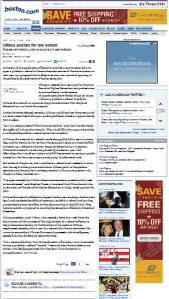
So, why aren’t newspapers able to capture those online advertising dollars?  To illustrate their problems, let’s use the Boston Globe – a paper which has had very public issues adapting to the new world of news.  If you visit the Boston Globe and search for my alma mater, UMass, one of the first stories you get is about UMass angling to open their own law school.  Check out what the page looks like:
globe1

Note the three ads – a banner across the top, a box in the right column, and a tower ad running down the right side a little ways down the page.  The banner and tower in this image are for Roadrunner Sports, and as near as I can tell they rotate.  The big, blue Air France rectangle, though, is all over the Boston Globe’s site today.  That probably means Air France bought a high level of visibility – in other words, they bought ads online the same they would have in the print version of the Globe.

But here’s a pertinent question: why would someone be reading this story?  What does that indicate about their interests?  Air travel seems like an odd fit for a story like this, which one might read if he or she is researching law schools or is a UMass alum.

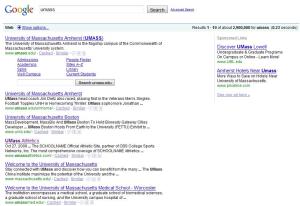
To contrast, here’s what I found when  searching for “UMass” on Google:
google1

Along the right side are two simple text ads for one of UMass’s satellite campuses and Priceline.com – the Priceline ad trumpeting their ability to find good hotel deals in and around Amherst.  What’s more, the ads look much like the search results – with the search term showing up in bold.  If you are searching for “UMass” because you are looking to further your education or visit your alma mater, these ads are up your alley; if not, the companies that bough the ads lose nothing because they only pay if you click.

While the search ad model anticipates the user’s possible interests and serves ads based on that, newspapers and the ad networks through which they work too often continue to display the ads that they want the user to see – even online.  Why would anyone pay for eyeballs when they could pay for the whole brain?

Cheetohs are delicious

The news that the Federal Trade Commission has instituted new rules for blogging almost made me spit out the delicious Diet Dr. Pepper I was enjoying – and I was enjoying it, since it tastes so much like Dr. Pepper it’s hard to believe it’s a diet drink.  Bloggers now must report any in-kind gifts or samples they receive for reviews.  This is a good business practice for any blogger looking to build credibility – though mandating it makes for an inconsistent public policy.

A few years ago, when I worked in PR, I was tasked with promoting a documentary about leftist ideology (which was so bad it doesn’t deserve a link).  As part of the launch, we held a media screening, leading to an internal discussion about serving alcohol.  (Incidentally, the argument was not on the morality, but the expense.)    The argument that won the day is that members of the media won’t come out to a reception without booze because other, similar events would serve them.  Reporters expect freebies.

Relating that back to the FTC’s new rules, does that mean a blogger sitting at that screening, munching on a dish of Orville Redenbacher’s delicious, movie-theater butter-flavored popcorn and sipping on a tall, smooth lager from Yuengling – America’s Oldest Brewery – would have to report these niceties, while the reporter next to him would not?

The FTC rules seem to make a distinction, and are clearly meant to snuff out pay-to-post schemes the way the fast-acting ingredients in Maalox snuff out heartburn and indigestion.  Like anything, though, the results will not be found in the wording of well-meaning regulations but in the enforcement. If the FTC has set up a structure where blogs will be treated like billboards while print newspapers are handled like non-profits, it’s a serious infringement on freedom of the press.

Politics: Showbiz or Sports?

Matt Lewis had a neat post at PoliticsDaily yesterday, talking about how the dreaded “24-hour news cycle” that has (paradoxically) made political discourse more pundit/sound bite-driven has also done the same for sports.

Here is just one example: Recent speculation on ESPN about dissention brewing among Favre’s new Viking teammates (some of whom are loyal to the Vikings’ former quarterback) reminded me of the never-ending leaks that flowed out of the McCain campaign and onto the pages of Politico — usually in regard to Sarah Palin. Be it a campaign or a football team, one disgruntled “unnamed source” can provide a days’ worth of material for cable networks– all of which need to feed a 24-hour news cycle.

A former colleague once called Washington, D.C. “Hollywood for Ugly People” – a town driven by a core industry (electoral politics) with many auxiliary sub-industries (lobbyists, contractors, regulators, think tanks, etc.).  But there’s also a highly competitive streak, just as one might find among professional athletes, but among people who can’t do this.

Instead of show business for the homely, maybe politics is sports for the weak?

Lion facts

SimbaTrappedHere are some things you might not know about lions:
According to National Geographic (yes, that’s a link to their kids’ website, but I’m assuming the facts are still good – it’s not like they’re lying to children, so back off) lions are not the “King of the Jungle.”  Despite a fancy title, they inhabit plains and grasslands.  Lions are somewhat inept at hunting, with just one kill per seven tries.  Sometimes they swipe food killed by other animals, and within the pride, the hunters who do all the work, the lionesses, are not the ones who eat first.  Male lions, whose main roles are marking territory, get to visit the zebra buffet first.

So comparing someone to a lion – though occasionally valid – may not always be a compliment.

Seinfeld unfairly blamed for unemployment

Of course I had to click on this headline this morning: “Seinfeld joke gets man canned for harassment.”  Since just about everything I say is a quote from Seinfeld, The Simpsons, The Big Lebowski, or Star Wars, the implications were clear in the first line:

A Cedar Falls man who repeated a gag from the “Seinfeld” show while at work has been fired for sexual harassment.

The gag was that, when someone sneezes, instead of saying “God Bless You” one should reply with “You are so good-looking.”  That’s probably not a reference I would use at work, but it was during an outdoors retreat, so the employee, John Preston, probably felt like typical office decorum was a little relxed.  I wonder if there’s more?

A week after the retreat, Preston allegedly sent the female worker who initiated the joke a series of e-mails in which he reiterated that she was good looking.

Wait… what?

A few weeks later, Preston allegedly stopped the woman in a hallway at work and massaged her shoulders while speaking to her. That generated another complaint, and early this year Preston confronted the woman at a work-related event.

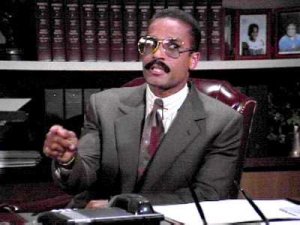
So it doesn’t sound like the Seinfeld joke – which was actually made by the woman who reported the harassment – got this fellow fired at all.  Whether or not the woman’s allegations are true – and it sounds like they are – I’m filing suit with the Des Moines Register for the time I lost reading their story based on a misleading headline.

And I have a very convincing attorney:

JackieChiles

Not crazy – just ahead of the curve

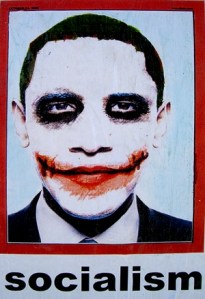
Obama-socialism_0This picture caused a bit of a stir in the blogosphere.  It was not meant as a conservative political statement – and, as Dan Flynn pointed out, it would have been an ineffective one.  And it certainly wasn’t a racist image, as some critics have claimed.

The picture is, however, evidence that occasionally images take on a life of their own, and that people sometimes see what they want to see.  If the narrative in your head is that the conservative movement has been dumbed down (as Flynn has written about before) you may see an aimless attempt at fusing politics and pop culture.  If you are looking for examples of the racial hatred you just know your opponents possess, you see a black man painted in white make-up.

At the end of the day, this was and is a picture doctored up by someone looking to have some fun and blow off steam after listening to months of hero worship.  Why so serious?

Bob Novak, Journalist

I never met Bob Novak, but I have met Tim Carney, who worked as a reporter for the Evans and Novak Political Report.  Carney used to lecture at the Leadership Institute while I worked there; while talking to aspiring conservative newspaper editors he would frequently impart a lesson he had learned working under Novak: “Nothing convinces people like facts they don’t already know.”

I promptly stole that line and repeated it as many times as I could.

That lesson is obvious in Carney’s heartfelt obituary of his former boss, who passed away today.

While clearly identified as a conservative commentator, Novak’s commentaries were rooted in fact and substance.  His subject matter came from a curiosity and investigative instinct that would put many current news reporters, let alone opinion writers, to shame.

As Carney succinctly put it: “Bob Novak was, above all, a reporter.”

No Twitter? OMG!

Everything is ok now, but the digital apocalypse was almost upon us yesterday, as both Twitter and Facebook went down (apparently due to an attack aimed at a Georgian political blogger by Russian hackers).  Somehow, humanity survived.

This was apparently big news, despite the fact that Twitter, GMail, and other groups have occasional service hiccups.  But some additional factors may have given this story more legs than usual.  First, with unemployment staying high, there were more people without day jobs affected deeply by a lack of an online life.  Second – and much more importantly – is that more and more journalists are using Twitter to follow politicians.  If something happens to a journalist, it’s much more likely to hit the news.