Basketball with a public option

What’s the problem with having a public option as part of a health care reform package?  This video does a good job of exposing the fallacy that a government-run insurance program simply expands competition on an even field – or, in this case, court.

enator Dodd

Letters:

· Ted Keyes – Financial professional, active member of numerous greater Hartford business organizations and Dodd supporter ( has spoken with Dodd over the years on litigation reform issues, specifically Class Action).

· Ryan Kennedy – Former personal aide to Dodd.  Ryan began a career in financial services about 5 years ago after leaving Dodd’s staff.  He is a supporter, contributor and son of Dodd’s close friend, Brendan Kennedy.

· Mark Austin – Private Capital Group

Web postings:

· http://philosophyofexperience.blogspot.com/2009/11/dodd-turns-bank-reform-into-gift-to.html

· http://donpesci.blogspot.com/2009/11/dodd-dancing-with-scheme-liability.html

Sen. Bayh

Letters:

· Martin Wright – CPA and the CFO for Laibe Corp.

· State Representative Matt Bell (R-Avilla) – He is forwarding a previous securities letter along with a new cover letter.

· Deirdre Tiernan – CPA for the Indiana Rural Electrical Cooperatives.

· Michael Brenner – CPA for the Indiana Rural Electrical Cooperatives.

Phone call:

· Chris Belch – Partner in the bankruptcy firm Lynch and Belch. He spoke to Ellen Chube, Senator Bayh’s Banking LA.  According to Ellen the Senator is reviewing the language and she could not speak specifically to section 984. She did say the Senator feels the House version provides too much financial regulation.

Web/Email:

· Indiana Manufacturers Assoc. – Included language on the Bill in their morning email blast to 8,000 members on 11/17.

Sen. Schumer

Letters/email:

· Mark Gjonaj – Treasurer, Albanian American Chamber of Commerce, to Marty Brennan with a copy of a letter he had previously sent in on scheme liability.

· Ralph Coti – Owner of Coti and Sugrue, a well-known law firm in New York City. He’s dealt with Schumer in the past.

· George Darden – Mayor, Village of Spring Valley

Phone call:

· Armen Meyer – High level staffer for NYS Banking Superintendent Richard Neiman.  Called Jona Crain, Schumer’s LA for the banking committee, to express the superintendent’s views about the single regulator proposal and the negative impact it has on New York: destabilization of the state charter, removing expertise of a state partner, and giving banks no reason to stay in New York. He said JC wasn’t forthcoming with position of Schumer, but was very receptive to the opposition points despite public comments made by Schumer.

“I know it’s the law, but I’m a Kennedy.”

Massachusetts state law isn’t handed down by decree from the Kennedy compound in Hyannis – yet.  So Ted Kennedy has had to politely ask the leaders of his state government to change the laws which govern the filling of a Senate vacancy to allow the governor to directly appoint the next junior Senator from the Bay State.  Kennedy, who has been absent from most of the current Senate term, claims to be worried about Massachusetts having “continuity of representation.”  It seems clear that his worry stems from the current health care debate.

Despite its reputation as a deep blue abyss, Massachusetts Republicans have done well in statewide elections for most of the last two decades.  Those victories came on the back of an electorate which is largely registered “independent.”  Consider also some other possibilities: a bruising Democratic primary, or the chance of an independent jumping into the race (like former Democrat Tim Cahill, who is running an independent campaign for Governor).

It adds up to a lot more than a special election for an iconic seat in the Senate: it adds up to a multi-faceted referendum on President Obama’s health care reform plans.  And since it’s Massachusetts, where a Kennedy clone is expected, there are actually many ways this election can be portrayed as a “loss” for the President – and, more significantly, to the type of health care Kennedy champions.

Kennedy could have avoided this by stepping down several months ago, when a favorable political environment and an excited Democratic base would have made the popular vote on his hand-picked successor a formality.  Kennedy lost that opportunity, which is why he is now asking the state to crown his heir by selection, rather than election.

Whole Foods vs. Half-baked

whole_foods(1)(1)(1)Today I received an invitation to join the Facebook Group “Support Whole Foods and John Mackey.”  I knew, peripherally, that Mackey had written an op-ed that had drawn the ire of the supporters of government health care advocates, but I hadn’t ready his op-ed.  My interest was piqued.
There’s much more to Mackey’s article than simply a repudiation of the plans floating about Capitol Hill. Far from standing in the way of progress, Mackey actually makes the case for a different type of reform, outlining eight specific policy reforms.  Each would move health care decisions into patients’ hands – from breaking down interstate barriers on insurance sales to making it easier for employers to set up Health Savings Accounts for their employees.

Mackey is a good voice for this type of reform.  I would wager that most of his employees are not expecting to be life-long Whole Foods workers.  Like many Americans, they will change jobs and companies – and so for health care to be tied to their employment is as inconvenient as it is anachronistic.  Companies used to offer pensions, too; now they make contributions to 401(k) and IRA accounts – recognizing that they can, as part of a benefits package, offer an employment benefit that lasts beyond the term of employment.

Mackey has posed a new idea in the scope of the current debate – that individuals will need to take personal responsibility for their health care.  This is certainly a new way of looking at health care, and exactly the type of open and honest debate that we all should would welcome, right?  Well, not quite.  The other side is calling on shoppers to boycott Whole Foods.

This response is telling.  Mackey is being demonized as an opponent of reform – a position they probably got from this line from his piece:

“Health-care reform is very important.”

Or possibly this one:

“[W]e clearly need health-care reform.”

You can see how that can be misconstrued.

The boycotters either don’t understand or don’t want to understand that Mackey’s individual health care concerns aren’t an issue – with a CEO’s salary, they are probably well-taken care of, with or without company-sponsored insurance.  He’s talking about how to build insurance that will help his employees – the same employees who are much more likely than Mackey to be hurt (through layoffs or schedule cutbacks) by a decline in company revenue brought on by, say, a boycott.

A blogger at OpenLeft doesn’t seem to mind:

I think [the boycott] is a great idea. A stupendous idea…. There are downsides. For example, the people who work at Whole Foods could be negatively affected.

Never let the “little people” get in the way of a big idea, right?

Health care (Astro)Turf wars

Team Obama is not worried about the opposition to their health care overhaul plans.  Robert Gibbs called for Americans to look upon them with a “jaundiced eye” and called the efforts the most derogatory of inside-the-beltway epithets, “AstroTurf” – fake grass roots.  And it’s certainly not uncommon in DC.

But erstwhile Republican Senator Arlen Specter may be surprised by Gibbs’s characterization, as he ran headlong into this opposition…

As did Congressman Lloyd Dogget…

…And Congressman Russ Carnahan….

The Democrats’ answer to these protests are paid radio ads that will be airing in the districts of key Democrats whose support for the President’s health care goals may cost them votes in 2010.  You can listen in here.

So on one side we have upset people confronting their elected representatives.  On the other, we have radio ads produced by a national entity telling voters what’s good for them.  I’m sorry, which one was the fake grassroots?

Healthcare is easy if you think of people as numbers…

Last weekend I spoke to Students for Life, a college pro-life group, about media and public relations.  One thing we discussed is how most people don’t like to deal with the issue of abortion because it forces judgments on the beginning of life and competing rights (mother vs. child) – and that most people simply don’t want any part of it. In a post from yesterday afternoon, the Atlantic’s Daniel Indiviglio doesn’t take a stance on the debate itself, but highlights the questions public health care necessarily must face.  For instance, would more or fewer abortions help the bottom line for a public health care plan?  Is it better to have a younger, stronger populace that needs less health care, or by keeping a lid on population numbers do abortions save money in the long term?  Should women whose pre-natal babies have diseases be urged to abort children who will cause a drain on the health care system?

These are chilling questions that no one wants to even ask, let alone answer.  Pro-choice advocates who claim government has no place dictating whether a woman can terminate her baby’s development should be standing with pro-life forces who don’t want their tax dollars to fund what they feel is a violation of an individual’s right to life.  Neither side will be happy with greater regulatory involvement, which may be the first thing these camps have ever agreed upon.

There will be plenty of time for waiting AFTER health care “reform” passes

President Barack Obama takes to the airwaves tonight, hoping that because Americans like him, they will accept an overhaul of the health care system without drawn-out deliberations, debate, and research.  Surely, after the President delivers his address, Republican leaders will answer by talking about the exorbitant cost of government-run health care.

But here’s a better reason to oppose government meddling in health care: it makes health care worse.  If the goal is to make sure that as many people as possible actually get the care they need, this is the wrong way to do it.

Vlogger Steven Crowder makes just this point in a video which, while maybe a little long, is still worth watching:

Giving the public options

The battle lines on health care reform are pretty clear, but what isn’t as clear is what each side stands for.  Both Democrats and Republicans have been talking about competing ideas, but the overarching debate is actually one about governing philosophy – and polls still show that the public is somewhat skeptical of the Democrat ideology.

The Democrats’ plan includes a national insurance plan – the now-famous “public option,” a cheaper version of every other insurance plan that somehow, our leaders assure us, won’t put those other insurance companies out of business.  The Republicans’ plan involves driving down costs by limiting liability reform, but there’s a more interesting tidbit buried deep down in their discussion: the idea of each person buying their own insurance, made easier by tax incentives.

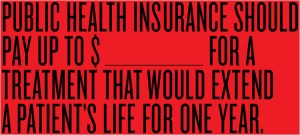
Unfortunately, the GOP isn’t trying to change the terms of the debate – something they desperately need to do.  Those who seem to support the Obama plan are helping a bit.  A New York Times Magazine article makes a case in favor of public health care rationing (a concept even the administration avoids like a plague which can’t be treated by an in-network provider) and in doing so, uses the following graphic to make their point:

19health-600

It’s a valid question, and one the “public option” will have to answer – maybe not during the legislative process, but certainly when put into practice.  The first participant in the ABC Obama Health Care infomercial asked a similar question; the President sidestepped and did not answer.

This is a powerful strike against Obamacare, and one Republicans can exploit.  But eventually, bashing health care reform proposals will not help the GOP win elections.  The other side must advance their own brand of health care reform – something completely different, although the seeds are, as aforementioned, already planted.

Our health care system as it currently exists is tied to employment – much like other benefits, such as a retirement pension, have been for decades.  If you work in the same job for a long period of time, that’s good.  But as the American worker becomes ever more likely to switch jobs several times during a career, the employer-based model is simply not as effective.  We no longer live in a company where people get jobs out of high school or college, work for fifty years, and get a pension and a gold watch upon retirement.

A system which promotes portable, individually-purchased health care and health insurance would not only help expand people’s control over their health care, it would drive costs down.  Current health insurance costs are often inflated by the existence of insurance; care for uninsured patients currently costs less than care for insured patients.

No election was ever won on defense, and Republicans – and, for that matter, conservatives – can ill afford to let their opponents draw the battle lines.  In fact has already started, with President Obama claiming the opponents of his plan are “defending the status quo.” As long as this message resonates unanswered, Obama can continue to claim the middle ground while painting his opponents as reactionary forces dug in to withstand change.  Republicans must make their own case that their proactive solutions are better than the opponents.

Question for the President

With his last health care town hall drowned out of the media spotlight by l’affair Sanford and the death of Michael Jackson, President Barack Obama is hosting another one – this time online.  (Which is probably strategically better – after all, he won’t have to worry about having McDonald’s commercials playing in between his calls for preventive medicine, as happened on the ABC telecast.)

The president is inviting questions on YouTube – and TechRepublican contributor Jonathan Rick has obliged with a good one: