IT’S A TRAP: The Ground Zero Mosque

On the Today show this morning, Dick Armey and Matt Kibbe of FreedomWorks sat down to talk about their new book, Give Us Liberty: A Tea Party Manifesto.  FreedomWorks is well-positioned to ride the wave of citizen unrest that gave rise to the tea party – they’ve been making the case for less government for years.

So of course the first thing they were asked about was… the proposed mosque at ground zero.

Armey and Kibbe are both bright, so they immediately accused President Obama of weighing in on the mosque controversy to change the subject from “failed economic policies.”

Clearly, the President will score no political points with his lukewarm two-step of supporting the right to build a mosque while not supporting the mosque.  But there is a real threat that the controversy could muddy the GOP’s year-long message that government is trying to do too much with calls for government intervention in New York zoning decisions. As Gov. Chris Christie notes, Republicans run a risk by trying to turn the mosque controversy into their central campaign platform – especially with so many other messages that could work better.

Republican hopefuls must strike a balance between reminding people that the President disagrees with them on the mosque and using it to underscore the inability to trust the federal government to solve problems:

  • “The President is commenting on a local government zoning matter instead of paying attention to national priorities.”
  • “The President is talking about mosques while the rest of the country tries to figure out how to get out from under the failed stimulus package and get the economy moving again.”
  • ‘”The construction jobs building the mosque must be their best idea for job creation.”

See?  This stuff practically writes itself, and would allow Republicans to pivot to more substantive arguments about why they will make life better for the American people.

The GOP has plenty to talk about as November approaches.  Armey and Kibbe offer an excellent lesson: the mosque is a good conversation starter, but it shouldn’t dominate the discussion.
Burying the lede: Whitman’s tech strategy

Catching up on some news from this weekend… From the San Jose Mercury News (via TechRepublican): “Whitman campaign counting on tech to fidht Democrats’ boots on the ground.”  The article mostly recounts Meg Whitman’s advantage in technology spending and notes that Jerry Brown’s strategy relies heavily on union organizers making “workplace visits.”  (No word on whether those visits involve lead pipes or any other aggressive GOTV strategies.)

The headline and lede make it sound like Whitman is simply spending money, but the details show a bit more refined strategy than that:

Whitman has also made use of increasingly sophisticated database technology to “micro-target” voters through an aggressive mail program. First made popular by GOP strategist Karl Rove in the 2004 presidential election, micro-targeting goes far beyond using bare-bones demographic information such as age and income. Voters get targeted mailers and phone calls based on the kind of cars they drive, food they eat and magazines they buy.

During the primary campaign, many Whitman volunteers eschewed traditional “boiler rooms” and joined online phone banks so they could dial for dollars in their pajamas — or ask voters for their support and record information on them while sitting on a beach with their BlackBerrys.

The technology expenditures appear to be put toward the purpose of making GOTV tactics – like phone calls and mailings – more efficient and easier for volunteers.  And, the article points out that the union goons are doing the same thing – identifying non-union “red county” voters who share their outlook on political issues and reaching out to them.

Tellingly, the missing link here is the Brown campaign, and the article quotes Brown himself calling Whitman’s $2.7 million in online spending wasteful.  The reality, though, is that any campaign tactic costs money.  The fabled 2008 Obama  campaign – still the most prominent example of online organizing – outspent the McCain campaign online, making wise early investments.  The technology didn’t create excitement, but it gave the campaign a way to harness it and translate it into votes.

The article likens Brown’s website to the 1974 Plymouth that Brown used to drive around to demonstrate his working class street cred.  The comparison is apt if Brown really thinks there is a dichotomy between online organizing and “boots on the ground.”  A car made in 1974 and a car made in 2010 both operate basically the same way, but the 2010 model has newer, more effective parts that allow it to perform more efficiently.

Maybe he could take some of that Matlock money and apply it to his site?

Whitman campaign counting on tech to fight Democrats’ boots on the ground

Hunting Macaca

Politico’s headline “Democrats seek ‘Macaca moments” aptly describes the DNC’s new Accountability Project, which invites citizens to record and upload videos of Republican politicians saying dumb things.

Because it’s actually a good idea, this has resulted in some hand-wringing on the right amid fears that Democrats are better at grassroots internetting than Republicans.  But that ignores why this is a good idea: the Accountability Project is a national aggregator and message device.  It seeks to crowdsource the Democrats’ messaging to take to most loony Republicans they can find and hold them up as the standard.  It is a pretty clear attempt to re-gain the reins of the national policy debate, which have slipped through the Democrats’ fingers in the past few months.

All that said, by driving messages that show the Republicans are out of touch, Democrats will save their skin and keep control in November.  (They may have done so anyway, but a few macaca moments will help curb GOP momentum.)

So how to combat this?  It’s pretty easy.

Republicans have cameras too, and Democrats are just as prone to saying and doing stupid stuff in front of those cameras.  What if some enterprising conservative with a flip cam catches them in a gaffe, then uploads the video?  It would seem the obvious way to hold the Accountability Project accountable.

It’s still better than WGN

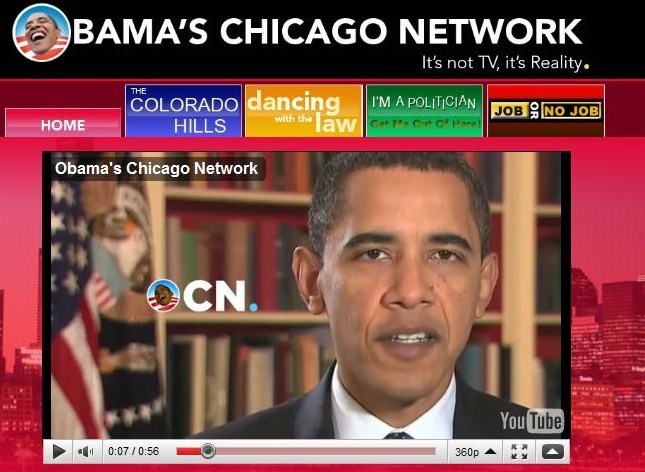
Looking to keep stories about the White House’s dabbling in primary elections alive, the RNC launched the “Obama Chicago Network” in an email to supporters this afternoon.

The site boasts four “shows” that deal with various negative stories surrounding the Sestak/Romanoff could-have-been-bribery affairs, plus Rod Blagojevich thrown in for fun:

Even if it is somewhat dated in the pop culture references (some of the shows they are spoofing are past their prime or canceled), it’s pretty funny, makes good use of news clips, and has a poll to collect people’s contact information.  With Blagojevich in the news, it does a good job of tying the administration As a lead generator, the site is good, but it’s missing something that could make it a really useful tool for Republican messaging: a section where users could “pitch” their own shows.  Not only is audience participation a good thing, but it might make for some must-see TV.

Majority status, with minority problems

Politico notes today that the 2008 victory of President Obama is not opening up the floodgates for other black candidates, as evidenced by Artur Davis’s loss in the Alabama gubernatorial primary this week.  Pennsylvania State Senator Anthony Hardy Williams, who finished third in seeking the Democratic nomination for Governor, says that in addition to concerns from Democrat activists over whether black candidates can win general elections, ideology plays a big part:

“I think the Obama era has actually transcended race. Not to say people don’t have biases — of course they exist, they exist in every state,” [Williams] said. “The question I got was, ‘Are you an Obama Democrat’ in regard to spending, not in regard to race.”

This may be why, despite these troubles on the Democratic side, Republicans are enjoying historic highs (for them) in  minority and women candidates.  It also suggests the opening of another interesting door.

The rise of the conservative movement was based in part on the growth of thought leadership organizations, chiefly in the 1960s and 1970s.  Institutions like National Review and the Heritage Foundation built the pillars of conservative thought upon which electoral and policy successes were built.  They were crystallizing – and making palatable – the ideas that candidates and lawmakers would later use.

Today’s challenge for the conservative movement goes beyond establishing a foothold for these ideas in the general electorate.  Today’s challenge is to expand the audiences that are receptive to those messages. It’s not enough for the Republican Party to recruit leaders from minority communities, think tanks and thought leaders must do so as well.

(Word has it that Marvel Comics has already started.)

YouCut makes you Kevin Kline and Charles Grodin

Rep. Eric Cantor and House Republicans have drawn criticism from both left and right for their YouCut program, which lets citizens vote to eliminate wasteful government programs.  The word “gimmick” is tossed around by both sides – as if bumper stickers, lawn signs, and other efforts to earn political support aren’t gimmicks – while making the point that the cuts proposed wouldn’t trim federal spending by all that much.

But in the GOP’s defense, this is about continuing the message that the Republicans are the party of smaller government.  There’s no better case against the concept of government spending than to point out the most egregious and unnecessary examples.

Plus, as it turns out, this is a pretty good way to build and maintain a strong list of activists.

Message failure

Sen. Dick Durbin’s amendment limiting credit card fees is a good example of the difficulties Republicans are still facing.  With ten moderate Democrats lined up to oppose the amendment, this is one of several amendments that could have been scuttled – if the GOP understood its own stance on financial reform.

In the wake of the health care battle, Republicans claimed victory in the message war.  There’s no such victory in the current financial reform debate.  There are answers to the Democrats’ strategy of punishing a Wall Street bogeyman for the current economic doldrums.  Republicans are running the equivalent of a prevent defense – assuming that big electoral gains are in the bag, they remain fearful of becoming the party of big business – so despite some lip service about offering alternatives, everyone is calling for more regulation in varying degrees.  And when an amendment like Durbin’s pops up, it passes 64-33 – with no one asking in any formidable way, why it is that the US Senate is deciding what the First Bank and Trust of Podunk gets to charge businesses for credit card transactions.

Reason’s Matt Welch outlines the pitfalls in the legislation-as-panacea philosophy, and the American public seems ready for the hard truth that those are indeed cherry blossoms on the Potomac and not money trees.  Yet “Wall Street reform” chugs along toward passage.

Bill Parcells liked to say that the only thing the prevent defense prevents is victories.  That’s especially true when you’re already behind on the scoreboard.

The last week of Arlen Specter’s political career

Sen. Arlen Specter finds himself in the same spot he was six years ago.  He’s a long-term incumbent Senator, locked in a tight primary with a candidate favored by his party’s grassroots, and he’s hoping that support from a President whose approval ratings have dropped precipitously will give him enough credibility with the base to drag him over the finish line.

But there’s a big difference between Specter’s 2010 fortunes and the landscape in 2004 – and no, it’s not the letter next to his name, or that Garry Shandling seemed to spoof the senior Senator from Pennsylvania in Iron Man 2.

In 2004, when Specter squeaked past Pat Toomey in the Republican primary, there were many Republicans who held their noses and voted for him anyway in the general election.  There were also many grassroots activists who deliberately voted against Specter or stayed home.  That was in a year with a Presidential election race, when the GOTV machine that was the Bush-Cheney was dragging every last vote possible to the polls, and when independents tended to break Republican.

This year, the anti-incumbent energy knows no party lines, as Specter and Sen. Blanche Lincoln can surely attest.  It doesn’t help that Specter’s strongest message seems to be based on his incumbency:

“Why would you want to trade 30 years of experience and seniority…for somebody who’s a back-bencher?” is how Specter himself put it in his remarks to the Pittsburgh-area Democrats after he rattled off all the funding he’s directed to the region thanks to his perch on the Appropriations Committee.

Here’s a fearless prediction: Supporters of Rep. Joe Sestak will not be good little soldiers if Specter beats him in the primary next week.  They may vote for him, but they won’t make phone calls, knock on doors, or do any of the other things that have to be done for an election victory.

This isn’t a contested primary along the lines of Hillary Clinton and Barack Obama in 2008, where the eventual winner could make a credible case for support to the supporters of the eventual loser.  Whether or not Specter pulls out the victory on Tuesday, he may already be a lame duck.  A Sestak/Toomey race would be a battle of ideas; a Specter/Toomey race would really just be about Arlen Specter in a year where incumbents are contributing to the unemployment figures in more ways than one.

A very maverick-y negative ad

That John McCain, two years after being his party’s standard-bearer, is fighting for his political life in a primary against talk show host J.D. Hayworth is telling of how urgently many GOP activists want a cathartic cleansing of Republicans of recent vintage.  However, an online video released by the McCain camp makes an argument that the conservative movement needs effective messengers as much as effective messages.

The message is subtle even if the delivery is not: the GOP has a message problem that goes beyond government policy, and the elevation of a voice like Hayworth’s would add to the stereotype.   One would assume that McCain’s campaign has internal poling numbers which show this is a strong field for them to play on, and that Republican primary voters are vulnerable to fears that Hayworth will be perceived as a joke.

The McCain folks are certainly careful to tread cautiously to avoid offending activists – they use extreme-sounding quotes from Hayworth, but on selective issues.  For instance, the video doesn’t take a stand on gay marriage, but it does quote Hayworth’s hyperbolic comparison of gay marriage to bestiality.  This is followed by Hayworth overreacting to an off-hand comment from a political opponent who promised to metaphorically drive a stake through Hayworth’s heart – echoing the over-the-top rhetoric of some Democrats after the recent health care debate.

With this video, McCain tries to tell conservatives that Hayworth is simply not strong enough to carry their flag.  It’s a pretty sophisticated message – and a good one for McCain to deliver, given his at-times-contentious relationship with conservative activists. And the video is funny, which always helps.

McCain does make one mistake in the presentation of his case that’s worth a chuckle or two.  A quick glance of the official John McCain YouTube channel offers potential for misunderstanding; the thumbnail for the video happens to be the screen frame reading “Expose Obama’s Secret Kenyan Birthplace” – and it looks more like a campaign promise than a joke.

3 Up: Nancy Pelosi, the Yankees, and GOP messages

Joel Sherman – who, despite growing up a Cincinnati Reds fan, does a better job than anyone of giving a voice to New York baseball – called out Milwaukee Brewers owner Mark Attanasio in his daily blog for Our Nation’s Newspaper of Record.

Attanasio, who is trying to lock up franchise cornerstone Prince Fielder to a long-term contract,  complained that the Yankees spent a lot of money to pay their players. Sherman rightly observes that Attanasio uses the Yankees as a convenient straw man, much like a politician devoid of a message:

Look, I get it, we live in talk-radio world now. If you are failing your constituency then don’t take any personal responsibility just demonize an easy bogeyman. The Democrats do it to the Republicans, the Republicans do it to the Democrats, and in baseball, when you have no other answers blame the Yankees.  …[P]ulling the Yankees into the Fielder discussion is either the act of a lazy mind or the act of an owner who wants to rile up his fan base so nobody notices his own failings.

At TechRepublican, Wesley Donahue makes a similar case against the “Fire Nancy Pelosi” messaging of many Republicans:

Last week I went to a “Listen and Learn” event in Charleston with S.C. Republican Party chairwoman Karen Floyd. What I heard was exactly what I’m hearing through emails and blog comments to all my clients. People want more than “No.” They want alternative plans.

Both baseball teams and politicians rely on a base of people whose support isn’t entirely rational.  In politics, Candidates like Ronald Reagan and Barack Obama with pleasant personalities are able to gloss over policy differences.  Sports fans will change their behavior to avoid jinxing their team.*

But in neither case is affection blind.  The most diehard sports fans can endure losing seasons, if there’s some reason to hope their favorite team can either build a winner or at least be competitive (Redskins fans understand this, especially this week).  But fans bases – and voters – lose interest when teams are stuck in the mud and going nowhere.

Nancy Pelosi and the Yankees are both easy targets.  That doesn’t make them good long-term targets, though.

*Fun story: during the baseball playoffs last year, I texted disparaging, negative comments about the Yankees to both of my brothers during the games; each time I did, the Yankees came back to win.  I even sent a text when one of my brothers was sitting in the same room, watching Game 3 of the World Series with me.  My phone should have been named World Series MVP.

Sadly, the tactic proved ineffective for the New York Giants.