Trump, GOP ’12 hopefuls, and The Birth Certificate of Destiny

Up until the last month or so, President Obama had no reason to release a birth certificate and every reason to let the conspiracy theorists opine that he was a secret Muslim born in Kenya.  Every time they did, established Republicans had to scramble to distance themselves from the so-called “birthers.”

Then came Donald Trump’s big mouth, and the birth certificate came soon after.   Why would the President engage on this issue now?  Without the birth certificate, the Republican 2012 primary debates would shape up with the more traditional candidates (Romney, Pawlenty, et. al.) distracted from their core issues.

It may be that the President has internal poll numbers which show that the issue is taking a solid foothold among the electorate (despite more public polls that demonstrate a collective “meh,” even among those who think Obama is from Mars).

But maybe the President wants the GOP to avoid the distractions after all and engage in spirited discussions on their core issues – namely, federal spending.  After watching the ever-more-moribund Republican messaging on smaller government over the past few weeks, the President may look at this as a fight he can win.

When he tunes into Fox news in a few months for the first primary debates, the President would rather have Mitt Romney and Tim Pawlenty argue over who will cut entitlement spending than have them both deny conspiracy theories.

Obama’s release also solidifies Trump’s candidacy.  A month ago Trump was a novelty; now there can be no denying that his campaign has had some sort of impact.  When the President of the United States reacts to your Today Show interview, you are no longer a complete joke.

And with the certificate released, Trump may have a chance to mouth off on other, more important important issues such as energy policy, health care, and the size of government.  A blunt, unapologetic voice countering the policies of the current administration is what makes Chris Christie and exciting candidate.  Since Christie remains firm that a 2012 shot is out of the question, that role is most likely filled by Trump.

The Obama campaign is probably delighted by the idea of Republicans having to deal with the Trump candidacy in the early primaries, betting that his loud, unfocused rhetoric will distract the rest of the field.  The best way for him to claim his share of attention is, ultimately, to talk about real issues rather than moot issues.  By taking the birth certificate conspiracy theory off the table, the White House made Trump a slightly more serious voice for the primaries.
Reviewing Romney’s Video

Mitt Romney announced that he will form an exploratory committee yesterday.  As is the custom with just about every candidate now, he made that announcement via YouTube:

As Matt Lewis notes, the video’s low-key approach helps because, frankly, this is not the last announcement we expect from Romney.  Since Romney’s main criticism is that he’s an empty suit and perpetual candidate, trying to go overboard might appear fake.  Between the lack of production values and the fact that the video seemed to be filmed the same day it was released, this is probably as sincere as Romney has come off in a long time.

He’s also helped by timing.  This week marks the fifth anniversary of the Massachusetts health carBoringe law that served as the inspiration for the recent national health care industry overhaul.  The issue will incite opposition within the Republican party no matter when he announces, but this week Democrats are poking fun at him for it, too.  This at least allows Romney to claim that the other side is worried about him.

The one drawback to the subdued entry into the race, for Romney, is that it feeds into another knock on him: that he is a bland presumptive nominee incapable of matching the excitement or enthusiasm of Barack Obama.  But if, as expected, there are further announcements to come from Romney, he’ll have time to be exciting later.

Whew, that was close!

A little over a week ago, President Obama launched his relection bid the way he announced his first campaign – with a YouTube video.  The video highlighted campaign volunteers in an effort to stress the grassroots nature of his campaign (which will still of course be run from the White House).  This continued on the Organizing for America blog, which has done little else but highlight volunteers re-enlisting.

But while they were getting the band back together on a mission from God, Washington, D.C. was breaking out with shutdown fever.  Congress and the President didn’t reach a budget deal until late into the evening on Friday, and OFA was nowhere to be found.

For Republicans, the President apparently could not have announced at a better time.  With OFA focused on the re-election campaign, there was no one beating the bushes for grassroots action in the week leading up to the deadline deal.  Just as Republicans have been wasting the buzz around Paul Ryan’s Path to Prosperity video, OFA sacrificed a chance to score major points.

As the deadline for a shutdown grew nearer, well-timed pressure on wavering GOP lawmakers might have helped the Democrats come out of the first budget battle a bit stronger than they did.  As the Obama 2012 campaign kicked off, OFA lost focus.

The Republicans should be prepared to fight a little harder during the next budget battle, because chances OFA won’t miss the opportunity again..

Obama announces; Pawlenty fires back

Since it was no secret that President Obama would run for re-election, Republican opponents had no reason to be slow in their response.  Tim Pawlenty took the first crack today with his newest video, “A New Direction“:

Pawlenty’s immediate, polished, and pithy video response shows keen preparation and intelligence.  The fact that he was the only Republican challenger in a position to make a video like this is one more reason one more reason he was smart to form his exploratory committee when he did.

Check out the contrast in style between Pawlenty’s video and the Obama announcement:

Pawlenty’s response mimics his previous trailers/videos, with thunderous background music and a serious tone.  Recognized voices of the left (like Paul Krugman) are skillfully used to point to the flaws in Obama’s policies, and the candidate (or candidate-to-be, officially) is the star.  Since the knock on T-Paw has been that he’s too bland and “Minnesota Nice” to rile up and motivate voters, the stirring rallying cry is his way of making the election seem like the fulcrum on which the lever of history will turn (or something like that) and positioning himself as the Man Our Times Cry Out For.

Meanwhile, Obama’s laid back video focuses on volunteers.  The criticism that Obama is self-centered and self-aggrandized is counterbalanced with the low-key collection of individuals talking about what they can do to re-elect the President.  If fact, Obama doesn’t even appear in the video, though he did “send” the email to supporters that announced the video.  Significantly, the first three supporters hail from North Carolina, Colorado, and Nevada – three traditionally red states that Obama carried in 2008.

The different styles reflect two different audiences.  Obama and his campaign handlers know that his announcement video is going to make the evening news, whether it’s a thoughtful call to supporting the policies of the last two years or the President delivering an autotuned address about the wonders of Friday.  (Actually, that second option would probably get an awful lot more press, but in a not-as-good kind of way.)  So his video is directed at the people who put him in office: the ones who made phone calls, knocked on doors and urged friends and neighbors to schlep out to polling places.  The video attempts to frame his re-election as every bit the grassroots movement as his 2008 election, despite the vast advantages of incumbency.

(Also worth noting is how one Obama supporter, Ed from North Carolina, echoes an old George W. Bush talking point from 2004: “I don’t agree with Obama on everything.  But I respect him and I trust him.”)

Pawlenty’s team also knew that the President’s announcement would be  guaranteed coverage.  So his video is built to take advantage of that press exposure – and earn coverage of his own to help lift his name recognition numbers.

Obama’s Libya speech and 2012 vulnerability

In his speech Monday night, President Obama set out to answer questions about the kinetic military actions in Libya, over a week after air strikes started.  The President has been nearly universally criticized for this delay.  More troubling for his political operation is the fact that the speech had to answer questions, rather than frame the need for the mission.

The American public is used to a certain script for military actions, even if they aren’t warned in advance.  Just after the initial strike, the President appears on television, sitting at his desk in the Oval Office.  He reassures, he provides reasons for the action, he presents both strength and a desire for peace.  Though subordinates give further updates in the ensuing days, weeks, or months, the President makes the initial announcement.  Obama did none of this, in what seems like an attempt to downplay the current conflict.  Instead, it looks like he cribbed his messaging strategy from a young Kevin Bacon:

You can’t nonchalantly drop bombs on other countries.  That’s the type of thing people talk about – and without the President’s authoritative explanation, the conversation could go in any direction.  Polls show that America is ready to get behind their President and support the Libyan mission – but the public is also understandably wary about taking on too much responsibility.  A five minute speech at the outset could have answered many questions before they were even asked.

Taken with some other patterns that have developed within his presidency, though, this may prove troubling for Obama’s reelection.

Flippant remarks – from Slurpees to salmon – have a way of eclipsing the content of his speeches.  His rhetoric on regulations and Iraq have a way of mimicking his opponents.  Tasking Congress to construct legislative packages from health care to financial reform previously looked like a strategy that allowed the President to set a broad policy direction without having to answer for the peculiarities of the specific legislation.    Many of these seemed like great strategies at the time.  In light of Libya, was the President getting too much credit?

“Looking Presidential” should be a major advantage to an incumbent.  Distraction from major issues in favor of likability isn’t usually bad, either.  But distractions can cross the line and the President loses control of his image and his agenda.

The mishandled messaging of the Libyan situation may be an isolated incident, but it may be a harbinger for a very disappointing 2012 for the Obama camp.

Na-na-na-na-na-na-na-na BACHMANN!

It’s shaping up to be a big week for Minnesotans running for President, with Michelle Bachmann yesterday suggesting that there might be a future announcement about preparing to make an announcement that she would consider heavily running for President.  (That’s an official FEC designation, as I understand it.)

For 2012, it’s tough to see where Bachmann will draw support.  She has made plenty of inroads with tea partiers, but her operation may be short on organizational infrastructure – a polite way of saying that the usual top-level consultants who know how a Presidential race is run may not want to touch her with a 40 foot pole.  (And what candidate would you touch with a 40 foot pole?  But that’s a question for another blog.)  Perhaps sensing vulnerability and indecision from Palin – or with inside knowledge that she won’t run – Bachmann sees the potential for a candidate straight out of central casting for the strong, suburban soccer mom demographic like herself to fill the gap.

Or maybe Bachmann is, despite all the criticism, pretty smart about the nature of political movements.  Some pundits might advise she bide her time, run for Governor or Senate, and table her White House ambitions until 2016, 2020, or even 2024.  But while the tea party movement where her support is based is very relevant now, the reality is that its influence may have already crested with the 2010 election.  If it could carry her through Iowa and possibly South Carolina early on, she could at least score a pretty good speaking slot at the Republican Convention.  It would be a long shot, but it also might be her best shot.

Like Newt himself, this is better in theory

My Tuesday post at Pundit League this week (which was actually a Thursday post due to my own fault) discusses the mockery that is the system of campaign finance laws, and how Presidential candidates are often candidates long before they run.  One example of a such a candidate is Newt Gingrich.

Gingrich, who flubbed his announcement-that-there-will-be-an-announcement-about-an-announcement last week, isn’t officially running yet, but has decided that his campaign will commence at Independence Hall in Philadelphia.

No one can argue with the symbolism of the locale.  If Pennsylvania is a blue state, then it is the Philly region that makes it so; yet the middle-class voters of the region are a key demographic for Republican victory nationally.  And of course, standing in front of the building where the Constitution and Declaration of Independence is priceless.  (Mitt Romney probably wishes he had thought of it first.)

And when the folks in this region come together… well, that’s when the fun starts.  Sarah Palin got booed dropping the puck at a Flyers game; Santa Claus got booed by Eagles fans.  Phillies fans whip D cell batteries at players so fiercely you’d think they’re auditioning to pitch the seventh inning.

And that’s just sports.  Don’t forget about the omnipresent unions and occasional voter intimidation tactics.  Does Gingrich really want to stand in front of a crowd of Philadelphians to announce his candidacy?

On the plus side, if Elton John played at Rush Limbaugh’s wedding, maybe he’ll perform for Newt’s kickoff too:

The right answer on retirements

Remember when politics was more than a sport?

Years back, I told Matt Lewis I thought candidates were starting to sound too much like strategists.  John Thune fell into that trap with his reaction to the slew of recent Democratic retirements:

“It certainly suggests that the pathway to get to 51 is achievable,” Sen. John Thune (R-S.D.) said Thursday. “I think depending on what happens in the next couple of years and depending on what retirements we have, a lot of these Democrat seats that are opening up, I think there are some opportunities for us — and I hope if we can get the right candidates in the races and resource them, we’ll have a shot at changing the equation.”

Nowhere in Thune’s response is the idea that Republicans could win every seat up for grabs with the ideas that voters are looking for.  He boils it down to an “equation” – a numbers game, as if he’s analyzing fantasy baseball for the MLB network.  Thune would have been better off giving a more general answer about the need to compete in all states, and to focus on working with everyone to make laws that will help out the American people no matter which party wins this election or that election.  It’s not all that quotable, but it’s still better than what was quoted.

It’s true that there are lots of strategic elements that go into winning races.  But speaking about them publicly belittles the fact that for all the microtargeting, get-out-the-vote technology, polling, and positioning, elections are still about ideas.  The techniques of battle don’t change the reason for battle.

And it’s simply poor technique to talk about the machinations of the campaign rather than the ideas.

As the political press covers the horse-race details of campaigns, it’s tempting to use their language and outlook.  But candidates, party leaders, and movement figures have to be above the fray, and their comments have to reflect a commitment to creating policies which benefit the American people rather than building campaigns which outscore the opponent.

Come to think of it, maybe the right kind of media-savvy, unflappable sports star would be a good role model after all.


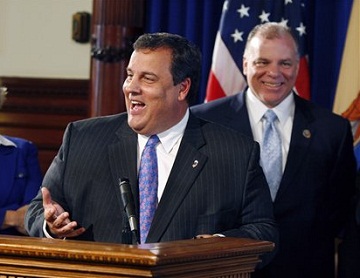
3 Reasons Why This Is Christie’s Time

Politico reports grumblings out of New Jersey that Governor Chris Christie is mulling the first tentative steps of a Presidential run.  Up to now, Christie has been consistently adamant that he isn’t running, but his candidacy was extremely likely even before this revelation.

The bottom line is that if Chris Christie wants to be President, a 2012 run makes the most political sense for three big reasons:

1.  Christie is well-positioned to deliver the right message for the times.

The protests in Wisconsin may have been a tipping point for Christie, as they look to be the first in a series of clashes between public sector employees unions and the unfortunate realities of states in the upper Midwest, Northeast, Rust Belt, and West Coast whose tax bases are dwindling and whose budget deficits are expanding.  If the abstract concept of reducing government spending was the central theme of 2010, the issue of whom gets what from shrinking government doles will be a recurring discussion leading up to 2012.

How this discussion is framed will go a long way toward deciding how many seats Republicans gain in the Senate and how successful the 2012 GOP candidate is.  Unlike many national elections of recent vintage, 2012 has the potential to pose to the voters a meaningful question about the role and size of government.

Christie has already waged this fight in New Jersey (the only GOP candidate who has done so recently).  But what’s more important than that has been the direct, unapologetic tone he has used in doing so.  With tough financial decisions on the horizon, Christie has become Mr. Tough Love – and unlike most successful politicians, he has not shied from confrontation.

If the momentum from the tea partiers continues into 2012, and there remains a swath of the Republican electorate that still feels government is not working for them, is there a better person to lead the charge against entitlements and special interest groups – and get rank-and-file Republicans excited about it – than Christie?

2.  Christie’s larger-than-life personality can go head-to-head versus President Obama.

That isn’t a fat joke.  It is a recognition that the sitting President enjoyed a huge charisma advantage over all his opponents in 2008, and the electorate still likes him.  Why not?  He’s a cool guy, he fills out an NCAA bracket every year, and he jokes around about salmon during his addresses to Congress.  More important, he still has a remarkable campaign infrastructure in place and is well-positioned to take on any Republican who can’t provide some level of excitement.

But he also has trouble with confrontation.  From the town halls of 2009 to the tea parties of 2010, President Obama has consistently shown that a full frontal assault on his initiatives is the best way to throw him and his administration off their talking points.  Christie’s blunt style seems best suited for flustering the President – and making the election narrative follow the script Christie sets out.

3.  Christie is popular among Republicans now, but political memories are short.

Hillary Clinton might have been President if she had run in 2004 – President George W. Bush squeaked out a reelection victory over a challenger who looked like a sad puppytalked like the Mayor from T’was the Night Before Christmas, and provided precious few reasons to switch horses.  By 2008, she had become Washington establishment – part of the problem that the Obama campaign sought to solve.

Her husband, of course, beat the first President Bush in 1992, less than two years after the incumbent enjoyed record-high 90% approval ratings.

In between 2012 and 2016, there are plenty of things that could go wrong for Christie.  His hold on the blue New Jersey electorate could slip, he could enter into a legislative compromise that sours his standing among social conservatives, or he could simply become yesterday’s news with a lost reelection bid 2013.

Christie running in 2012 isn’t just a convenient answer for Republicans looking for a leader.  Second chances in presidential campaigns are rare.

The biggest obstacle to Christie’s candidacy will of course be his promises that he won’t run.  His denials have been just as adamant as Barack Obama’s in 2006, and getting around the statement “I swear I’m not running” is one of the easiest maneuvers in politics.  If anyone could get away with, “eh, I changed my mind” as a response, Christie’s the one to do it.