Will politics turn Gowalla vs. Foursquare into Facebook vs. MySpace?

In the world of location-based social networks, Foursquare has been the early leader, closing in on four million users.  Gowalla and SCVNGR have been battling for a distant second place.

Gowalla’s move to cut into the lead came back in August, when it released a set of tools for campaigns – tools that many campaigns have been taking advantage of.    Last week Politico’s Morning Tech followed up on the campaign toolkits:

Since the tools launched, Gowalla tells us, hundreds of political events, such as a rallies and town halls, have been created on the location-based service and thousands of people have checked into these events. And Gowalla users like to share which events they’re at on other social networks, too. About half of people who check into political events on Gowalla push out their status, comments and photos to Facebook, Twitter or both social networks.

And it sounds like interest in the politics-geared tools is growing. Gowalla says it has already started talking with both Democrats and Republicans about using its service for the 2012 elections. In Gowalla’s home state of Texas, the tools have gained traction with several candidates competing in local races.

Gowalla smart to take the long view, since location-based tools probably won’t be as prevalent until the Republican presidential primary campaigns.  But since those campaigns will start on November 3, Gowalla is equally smart to start catering to campaigns now.  At the same time, Foursquare has been somewhat deaf to calls for better political engagement, such as Jordan Raynor’s “I Voted” badge concept.

Foursquare still has a dominant market share of close to 70-80% (by the rough numbers).  But in the early days of online social networking, MySpace was similarly dominant.  The key is that the location-based market in 2010 is similar to the social network market in 2004 – it isn’t mature yet.  By most counts, the top three location-based networks boast five or six million users – or 1% of Facebook’s membership.  There are simply an awful lot of people who haven’t plunged into the location-based markets yet.

So what are the current also-rans to do to expand the location-based market – and make sure the new recruits choose something other than Foursquare?  By targeting campaigns, Gowalla is actually recruiting political activists – passionate users who will join their network (or possibly even switch from Gowalla) in the pursuit of a bigger goal.  By starting in 2010 and targeting 2012, Gowalla isn’t just executing a political strategy, but a business strategy as well.


No Twitter posts from the Washington Post – Is that a good idea?

The Washington Post told it’s journalists to keep off of Twitter after a staffer spent 140 characters defending the publication of an unpopular editorial.  The piece, by the Family Research Council’s Tony Perkins, made a case that gay teens committed suicide because they were mentally unhealthy.  It predictably raised the hackles of gay activist groups, who criticized the very idea of allowing such opinions to be published – which just as predictably led to the Post’s representative standing up for the First Amendment and the need for a broad marketplace of ideas.

It may seem ironic that, after a representative of the post contributed to this public conversation by citing the need for a public conversation, the Post shut down public speech from its employees.  In fact, Mashable roundly criticizes the new policy:

The Post is clearly trying to do some damage control, but in a time when it is often difficult to encourage traditional journalists to embrace social media and dialogue with readers, this will only discourage it further. News organizations should be encouraging dialogue and debate, not stifling dialogue between readers and journalists.

Actually, the Post’s policy is a good one.

Think of this in terms of a classroom debate.  A teacher poses a question.  A few students argue for one side, other students argue another.  The teacher provides facts and information, but shouldn’t be taking one side versus the other, right?  In fact, by removing their journalists from the discussion, the Post can do more to promote a discussion by not taking a side.

It’s important for media outlets to connect with their audience – as purveyors of information, they have to know what’s relevant, understand the various viewpoints are out there, and appreciate which issues pieces of information is most important to readers or viewers.  But if a journalist is supposed to (try to be) an objective resource, why would he or she want to participate in the debate?  Wouldn’t any journalist who did start to lose some credibility or give evidence of having some sort of agenda or bias?

Google bomb squad: New election, old tactic

Politico related Tuesday morning how liberal activists are bringing the awesome power of the Google to bear on Republican opponents:

Chris Bowers, campaign director for the Daily Kos, is launching a behind-the-scenes campaign against 98 House Republican candidates that attempts to capitalize on voters’ Google search habits in the hopes of influencing midterm races.

Bowers wants the Daily Kos’ thousands of participants to dig up little-noted or controversial news stories about the candidates that could hurt their chances with undecided voters. Users would click on the links and blog about the stories with the goal of boosting their rankings on search engines, so that undecided voters will discover them more easily.

These activists are… well, we don’t know who they are.  One might say their identities could be  somewhat “shadowy.”  They aren’t necessarily based in the districts in which they are campaigning, so I assume you could call this group “outside” activists.  But regardless of what one calls this shadowy outside group, one must admit that they have every right to make their voice heard, right?

In all seriousness, though, this “new” tactic isn’t all that new at all (for a couple years, searching for the the term “miserable failure” famously brought up links to President George W. Bush’s profile thanks to a similar effort).  A more valid question is what good this tactic will do – and its main value may be as a team-building exercise to start getting the Democrats far-left base back involved.  That may not mean much in two weeks, but you can bet that Democrats will be looking to re-take the majority on the morning of November 3 – and that means they will need these types of activists to fuel excitement and energy just as the Tea Party groups have done for the Republicans.

Your own private Facebook

It’s a bad day for the World’s #1 Website – it turns out that Facebook has been hemorrhaging personal data through third party apps.

The cynical reaction to this might be to blame the Facebook users – after all, if you join a website built to share personal information, then you will wind up sharing personal information.  The analytical reaction might be to ask what harm was done – after all, the people harvesting Facebook info are really just trying to serve you ads that you will be interested in so that you will click on them and be introduced to a product/service/organization/cause/candidate you like.

Then there’s the reality-based reaction.  And in reality, people who took all the steps Facebook prescribed for protecting private data still had their information out there.

And following that line of reality-based logic, it means changes for Facebook – changes which could range from fixing the glitch and letting everything else well enough alone to renovating how your Facebook account  interacts with apps.

In other words, any organization with a Facebook presence should keep their eyes open for the next few weeks and months – and be ready in case they need to make any changes to keep interacting with their followers.

Is Carly Fiorina the next Scott Brown?

The Carly Fiorina campaign has answered a question politics and tech bloggers have been asking of themselves for months: How will campaigns used location-based social networks?

Fiorina’s camp launched a location-based check-in iPhone app that lets users earn points checking in to rallies and other campaign events.  This is just a few days after Fiorina’s use of text messaging and a mobile-based phone bank system drew positive media coverage.  And, even though the story glosses over it just a bit, it’s worth noting that Fiorina’s app targets college students – an important piece of strategy, given that the general population is still getting used to mobile applications.

Earlier in the year, Scott Brown’s Massachusetts Miracle campaign was lauded for its use of remote phone banks and hyper-local online ads to identify key supporters and topple the ghost of Ted Kennedy.  If Fiorina pulls off a victory that would have been unthinkable a year ago, you can bet in the days after November 2 the interblogs will buzz about her online strategy.

It’s certainly a far cry from the Demon Sheep.

New Facebook Groups and organizing

The launch of Facebook’s new Groups feature last week was largely overshadowed by this week’s Bing/Facebook social search announcement and the success of Facebook: The Movie (a.k.a. The Social Network).  But in online organizing circles, the new feature presents some questions about the future of online organizing – namely how

The answer to those questions depend on who is asking them.

The Basics of Groups

Facebook Groups is essentially the love child of a glorified list serv and a wiki, with similar functions as Google groups.  Group members can send blast messages to the rest of the group, chat, and share content.  What makes Groups a bit more interesting than a list serv is that a user creates a group, he or she can add other users without their permission.  Adding someone to a group is as easy as tagging them in a photograph.  If you’re a Facebook user, you can be added to a group without actively joining (barring some privacy setting adjustments, of course).

Groups vs. Pages

Facebook’s pages are easy to set up, and getting a user to join a fan page is as easy as having them click a “like” button.  That’s why many campaigns, causes, organizations, and companies use these pages – aside from operating like a website within Facebook, it’s relatively easy to rack up big numbers of followers if you have some money to spend on Facebook’s cost-effective advertising.  Communication with followers is somewhat passive – your posts wind up in their news feed, but you can’t send mass messages – so followers are not always engaged.

Groups are even easier to build than Pages, thanks to the aforementioned tag-style recruitment method.  Group members can be engaged more actively that page followers, but a group administrator has less  control over the direction of the discussions that take place among group members.  This is fine if you are using Facebook Groups for discussions among members of a task force or working group, but gets problematic if you want to use it for a political or issue campaign that relies heavily on message discipline.  If you’re part of a small group of activists, though – such as a local Tea Party group – Groups as it currently exists can be very helpful.  In many ways, Groups is built for the citizen activist.

Groups and the API

“As it currently exists,” though, may be the operative phrase thanks to the recruitment-as-tagging method mentioned above and another, potentially quite powerful facet of Groups: the open API that lets applications access, communicate, and essentially mine information from Groups:

The API currently enables developers to pull a Group’s basic info including name, description, owner, last updated time, and privacy setting; access the Group’s picture, view existing posts; see all members; and post to the Group… The API will allow developers to build applications over the feature, such as Group feed readers, Group recommendation engines, and more.

What this means is that smart online organizers will use Groups as a recruiting tool, reaching out to these small, self-organized communities to build “like” counts on pages or to join other groups, depending on their specific goals.

(Of course, with all the controversy Facebook and other online networks have suffered due to privacy loopholes, this may not last long.)

The Real Nature of Facebook Politics

Either way, Groups illustrates something very important about Facebook organizing: Recruiting for volume is less and less important than recruiting large numbers of the right kind of connections, either as group members or page followers.  Having 100,000 followers or 1,000 members is, ultimately, no big deal – all it takes is money for ads or the chutzpah to tag all your friends (and some of their friends, perhaps).  The real question is what those followers and members do to help your ultimate goal – whether that goal is votes in an election or a phone call to elected representatives.

“Likes” are cheap, but action is valuable.

It’s still a Google world

Today’s announcement that Facebook and Bing are joining forces is being hailed as a major blow to Google.  But before we start chiseling a headstone, let’s think about Google’s week so far:

All this adds up to the fact that Bing may lap Google in the search battle, but that’s swiftly becoming less important to Google’s business model – which has always been about collecting data from different points of your daily life and using that to serve you ads.

Maybe the wind farm doesn’t obviously fit into that (although, their servers crank up an awful lot of heat and use lots of electricity to crunch all your data).  But turning the family TV room into a Google-fueled den and knowing exactly where people are driving are both pretty advantageous for an advertising company.  The possibilities for each of these technologies in 20 years is mind-blowing.

Facebook will continue to be valuable because of the value it offers in organizing our relationships, but Google remains one step ahead in its quest to organize (and monetize) the world’s information.


Old media covers new media; avoids scowl, snarky comments

If you missed it over the weekend (like I did), Fox News Channel ran a couple interesting segments on campaigns using text messaging to reach out to voters, including this one:

It’s good that there’s attention paid to campaigns using new, emerging technologies, but if a campaign tactic is only there to get free media then it probably isn’t worth it.  But as the piece indicates, mobile phone screens are valuable because they are always with people, and text messages have very high open rates.  Smart campaigns are recognizing this and, where it makes sense, instituting tactics that take advantage of this.  One example is Carly Fiorina’s use of realGood Technologies‘ mobile phone bank – a platform which transforms any mobile phone into a terminal for a campaign call center.

Many of the high profile 2010 races aren’t using any text messaging outreach – after all, midterm electorates tend to skew older and turnout is usually lower.  But some of these campaigns offer a good preview for mobile campaigning for the 2012 Presidential election


Girls gone civic

In news from last last week, here are two college-age women in a dorm room with a video camera who got the attention of a Senator:

Sure, it may give the feeling of being a “staged reality” video, but it’s one way to make the “take action” tab on an advocacy campaign website a little more effective.  If you browse through advocacy campaign sites, you see these tabs frequently: the “take action” button that lets you put in your zip code and send an email message to your representative on Capitol Hill.  It’s easy to do – and the people in charge of reading the messages know it’s easy, because they get hundreds of thousands of them each day.  Sometimes there are also options to call, but consultants don’t like those options because calls are hard to track and don’t offer obvious, easy sharing on Facebook and Twitter to make a cause go viral.

The dirty little secret of the “take action” tab is that most Members of Congress – or, more accurately, their staff members in charge of answering constituent concerns – don’t care about your emails because they can’t – they simply don’t have the time to respond to one-click activism.  Phone calls get more attention (and in-person meetings are the best), but many folks are intimidated at the idea of dealing directly with a Congressional office.

Whether or not this video was actually a set-up by the Servicemembers Legal Defense Network (which obviously, from the video opposes Don’t Ask Don’t Tell) it’s a good model for other issue campaigns to actually show people taking action.

The heroines, Lauren and Ellie, lead by example and make the call to lower the intimidation factor.  Then they gather friends and get them to call. And by posting their call on YouTube, Lauren and Ellie prompted a response from Senator Michael Bennett – elevating their involvement from one-on-one communication between a constituent and a representative to a public discourse in the virtual town square.

Best of all, the video not only promotes more effective activism, but makes phone calls a viral tactic as well.  Just scroll down the video’s YouTube page and check out the response videos where people show themselves calling their own representatives in Congress.

More on mobile: the “App Class”

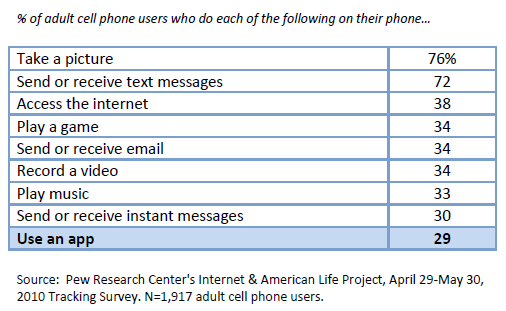
To follow up on a post about using mobile tactics from earlier this week, a Pew Research survey on mobile contains some interesting findings.  Unfortunately, Pew’s headline (as well as Mashable’s post covering it) miss an important aspect for campaigns.

Both highlight that the survey says one out of four adults use mobile apps.  This is true – behold this chart (courtesy Mashable):

Where they see market growth (correctly), issue and candidate campaigns have to see stratification.  There are two mobile Americas: one which uses their mobile phone for games, music, news, directions, shopping, updating social networks, and other varied pursuits – an “App Class,” if you will – and another which really looks at the phone simply as a simple communication device to pass information viavoice (and occasionally text and picture).  About one out of three people look at their phone as a handheld computer.

If a campaign, therefore, is going to invest in an application, for instance, the design process has to consider that most people will not use it.  That doesn’t mean pulling the plug on the app – in fact, because the penetration of app-driven phones keeps increasing, it’s only a matter of time before every campaign has to have a customized app.  (Consultants, start your engines!)  What it does mean is that a wise campaign will ensure their app does the things the App Class will want to do.  As an example, it may be a better idea to have apps that connect with back-end campaign data to help precinct walkers and staff than to have apps that help people find their polling place.