A site called “Funny or Die” shouldn’t be anywhere near healthcare

This snarky “Save the Insurance Companies” PSA featuring Will Ferrell is a hit, at least in terms of its viewership.  .

It’s certainly better than Kicking and Screaming, and it’s makes the point that many on the left are trying to drive home – that insurance companies are greedy leeches who profit from sickness, and that their money should be commandeered to fund publicly administered health insurance plans.

But the Personal Democracy Forum brings up an interesting point about the timing of this video.  Released just this week, the intense health care debate is already pretty mature.  Sarcasm and oversimplifications can help frame the debate, but they are less effective in moving the debate along.

Much like a tardy Ron Burgundy bursting into the Channel 4 newsroom after spending some time in a glass case of emotion, Will Ferrell may be too late to make his point.

In support of Capitalism

There’s no way to protest capitalism like champagne in a penthouse.  That’s how the afterparty for the premiere of Michael Moore’s newest movie, Capitalism: A Love Story supposedly went down.

This stunt invites the typical criticism of Moore: that he’s a hypocrite enamored with the idea of himself as a Hollywood star.  He’s an easy target for ridicule from the right, and his methods are questionable, but that’s not why Moore fails as a filmmaker.  Moore’s shortcoming is in the types of movies he makes.

Ever see Canadian Bacon?  It’s a great movie about the military industrial complex hijacking the US government written and directed by Michael Moore.  There’s a strong anti-military undercurrent if you are looking for social commentary; if you aren’t, it’s just a funny movie that paints the picture of a country bought and sold by military contractors.

Could a similar movie have gotten Moore’s points across better than Bowling for Columbine or Sicko?  Probably – just as a novel is more memorable than a textbook.  Of course, that may not be Moore’s goal.  Perhaps he is trying to be the conscience of Hollywood – the compass which gives direction to other movies which hit the same themes.  In DC, the analogy might be to think tanks like the Heritage Foundation or Center for American Progress supplying research and ideas to political candidates.

Either way, come October 2, Michael Moore’s movie is coming to a theater near you.  I’m looking forward to it.  And the irony of decrying capitalism in a venue which costs $10 in admission will not likely be lost.

Bad Deeds

With his campaign seemingly obsessed with Bob McDonnell’s grad school thesis,  Creigh Deeds was starting to sound like a one-trick-pony.  As John McCain learned in 2008, defining your campaign is difficult if the race becomes a referendum on your opponent.  But Deeds found a way to make it even harder on himself with his discussion on transportation:

Barring some scandal or monumental shift, this is the defining moment of the 2009 Virginia gubernatorial race.  Bob McDonnell has been consistent, if unexciting.  This clips makes it tough for Deeds to answer that consistency.  And it’s tough to be exciting when you split policy hairs about raising one type of tax versus another.

Perhaps Deeds was trying to excite the Democratic base by channeling Ted Kennedy.

My work alma mater and school alma mater collide

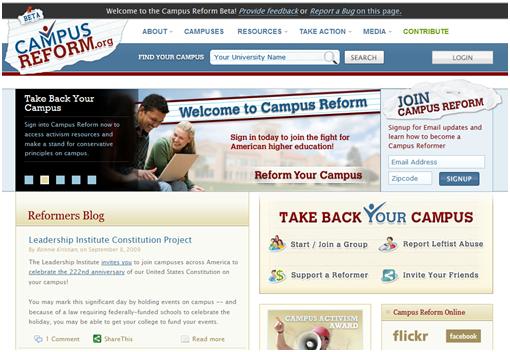
campusreformThe Leadership Institute (my former employer) will launch a new website, CampusReform.org, officially next week – but it’s live now if you want to take a look.

One of the challenges LI – or any similar organization – has always faced in campus outreach is connecting with interested students; though interested students are always out there, colleges represent fairly cloistered environments.  Previously, finding students to get involved in the conservative movement often meant physically going to campuses, setting up membership tables, and recruiting people face to face.  Considering that America has well over 2,000 four-year colleges, that method becomes a tedious (and expensive) fishing expedition.

Whether your business is starting conservative groups or selling dictionaries door-to-door, the best prospects are usually referrals or the potential customers who seek you out.  By establishing a broad web presence, LI is embracing that model of expansion.  CampusReform mobilizes student activists – rather than Washington, D.C.-based representatives – to strengthen the conservative movement in higher education.  It’s strategically smart and just good business.

There’s another benefit that CampusReform offers down the road, after it establishes an audience among college students: alumni relations.  With CampusReform, if I want to see what’s going on with the University of Massachusetts, I am just a click away.  If LI wanted to, they could create a fundraising option that would allow their donors to give directly to campuses and groups they care about.  (And if they wanted to get really advanced, LI could empower individual donors to create campaigns and recruit others to give money, as well.)

As a campus outreach effort, Campus Reform is a more effective conduit between interested students and the people trying to recruit them.  Its potential is greater: to function as a network connecting people trying to break into conservative politics with those in a position to help.

“Read the Thesis” means “Read our parts of the Thesis”

In the Commonwealth I currently call home, the fight for Virginia’s governorship is becoming downright Jerseyan thanks to Creigh Deed’s attempt to leverage an old grad school paper written by Bob McDonnell.

Deeds is following an important rule – when negative information is out there about an opponent, the best thing is to keep it alive for as long as possible.  Since the McDonnell thesis is 90 pages long, the Deeds folks have selected the juiciest clips and added their editorial content.  It’s a good way for them to excite a base which is currently unexcited and raise some money.

Missing in a lot of the coverage is a link to the actual thesis.  I had to do about 20 minutes of searching before I found and downloaded McDonnel’s work.  If you haven’t actually read the thesis, it really is heavy on the involvement of church and family, but also has some harsh treatment of federal social programs – such as welfare, which was reformed six years later.

Since few voters will bother to read 90 pages, they may go back to their own memories of writing college papers.  How many people who took political science or current events courses would want their words revisited?   During my time at UMass, the Journalism department offered a class called “The Press and the Third World.”  I took it during my sophomore year, and usually sat next to a friend of mine with whom I worked at the campus radio station’s sports department.  (The class fulfilled a requirement for our major, but we were both aspiring sports journalists.  The subject matter was not in our area of expertise.)  Every Tuesday, our professor would look over the New York Times – what he called the “newspaper of record” for America – and express disgust that the Third World was rarely covered.  And when it was, he would express disgust that the stories would only cover corruption, violence, or the bizarre.

We could have pointed out that the local Springfield, Mass. television stations only covered corruption, violence, or the bizarre in Western Massachusetts, or that regional news outlets usually cover the regions they are based in.  We could have pointed out that his gripe was with media in general, not in American media’s treatment of the Third World.  Actually, one of our classmates brought that up during discussion one day, and was shouted down by other students as the professor encouraged them.  My friend and I shut our mouths, parroted back the professor’s comments when it was time to take a test, accepted our A- grades and went back to WMUA to cover sports.  The content of those papers would be wholly inconsistent with the content of this blog, but the Worker’s World Party might enjoy them.  (Although, I believe I criticized Jon Stewart’s coverage of the Middle East in my final paper.)

With a heavily college-educated voting populace who can identify with the college writing process, McDonnell’s thesis may not have quite the impact that Deeds would hope.
Politics: Showbiz or Sports?

Matt Lewis had a neat post at PoliticsDaily yesterday, talking about how the dreaded “24-hour news cycle” that has (paradoxically) made political discourse more pundit/sound bite-driven has also done the same for sports.

Here is just one example: Recent speculation on ESPN about dissention brewing among Favre’s new Viking teammates (some of whom are loyal to the Vikings’ former quarterback) reminded me of the never-ending leaks that flowed out of the McCain campaign and onto the pages of Politico — usually in regard to Sarah Palin. Be it a campaign or a football team, one disgruntled “unnamed source” can provide a days’ worth of material for cable networks– all of which need to feed a 24-hour news cycle.

A former colleague once called Washington, D.C. “Hollywood for Ugly People” – a town driven by a core industry (electoral politics) with many auxiliary sub-industries (lobbyists, contractors, regulators, think tanks, etc.).  But there’s also a highly competitive streak, just as one might find among professional athletes, but among people who can’t do this.

Instead of show business for the homely, maybe politics is sports for the weak?

We have two more days before Ted rises, so…

When the news broke about Ted Kennedy’s death last week, two things became imminent: 1) A televised re-telling of the Kennedy legend, played out over several days; and 2) a well-crafted obituary that criticized Kennedy imagery, penned by Massachusetts’ own Dan Flynn.

My Mom will enjoy Flynn’s take on Kennedy’s dicey version of Catholicism (that allows de facto divorce), but Flynn also discusses the near-royal status the Kennedy family enjoyed and the changing  policy positions Ted Kennedy embraced throughout his career that signified a lack of substance beyond his last name.  While maintaining a respect for the deceased, Flynn pokes holes in the images that have been all over the TV over the past few days:

The caricature that Ann Richards and others painted of George H.W. Bush — “born on third base and thought that he hit a triple” — more resembled Ted Kennedy, a gregarious rogue enabled by wealth, power, and a famous last name. The privilege that shielded the playboy senator from the consequences of his actions acted as a double-edge sword by ensuring that he also never learned from the mistakes he didn’t suffer from.

Sunday Funnies: Ethics fraud at 7-11

I have some friends and co-workers who have been either working for or volunteering their time for the Chris Christie campaign in New Jersey, and according to them, the election is getting ugly – even by New Jersey standards.  In one of the ultimate pot-and-kettle moves, incumbent Governor Jon Corzine is trying to hang ethics allegations on his opponent – who, incidentally, is one of about a half dozen New Jersey politicians who likely won’t end up in jail at some point or another.

I enjoyed the Christie campaign response – maybe not the most side-splitting political ad ever, but it certainly handles the issue well:

Lion facts

SimbaTrappedHere are some things you might not know about lions:

According to National Geographic (yes, that’s a link to their kids’ website, but I’m assuming the facts are still good – it’s not like they’re lying to children, so back off) lions are not the “King of the Jungle.”  Despite a fancy title, they inhabit plains and grasslands.  Lions are somewhat inept at hunting, with just one kill per seven tries.  Sometimes they swipe food killed by other animals, and within the pride, the hunters who do all the work, the lionesses, are not the ones who eat first.  Male lions, whose main roles are marking territory, get to visit the zebra buffet first.

So comparing someone to a lion – though occasionally valid – may not always be a compliment.