Stewart/Colbert rally demonstrates government competence levels

As Jon Stewart and Stephen Colbert were wrapping up their apolitical comedy and music show last, their crowd unwittingly demonstrated the reason many people are suspect of government running things like health care.  Just after Stewart’s closing keynote, an errant DC Metro escalator at L’Enfant Plaza sped up and start spitting folks off, injuring four to six freshly-sane rally goers.

Luckily, Metro’s crack administrative staff was prepared since, according to Unsuck DC Metro (the best-titled blog in the history of the internet), a report issued a month before the rally detailed the issues with escalator brakes throughout the system.

Sunday Funnies: Monsters!

This seems appropriate for Halloween.  (Plus I messed up when I tried to post it last weekend.)

If you live in the Washington, DC area and watch a lot of local news, you get to see a lot of television ads for issue campaigns (the one that’s burning up the airwaves now, for instance, is a call to oppose taxes on sodas and snacks).  Often, these ads tell you to go to a website and “make your voice heard” by signing an online petition.  Sometimes they use what can best be called “creative imagery” to illustrate the problem.

And, apparently, all this is far from new, as I found when surfing through political ads on YouTube:

Our dire political environment

To hear most people talk about it, you would think that our biannual election tradition has the country whipped into a such frenzy that riots in the streets are inevitable.  In fact, no less astute a student of history than former President Carter said that the current environment was worse than that leading up to the Civil War.  (Let’s say that again – Carter thinks the current political environment is more tense than the one that led to a protracted war in which hundreds of thousands of Americans killed each other over the concept of owning another human being.)

After all, just look at the nasty, disgusting political advertising that’s going on.  It didn’t used to be like this, some of the pundits tell us.  Time was when American politics was built on a foundation of civility and mutual respect.

Reason Magazine blows that myth up right quick:

RapLeaf and opposition research

This week, the Wall Street Journal discussed just how fine online targeting companies can get thanks to online behavioral targeting companies like RapLeaf.  For what it’s worth, RapLeaf seems to make a good faith effort to keep certain personally identifiable information private, but that’s a little like putting toothpaste back in a tube.

So here’s an interesting hypothetical: does this become part of campaign opposition research?

Obviously, a campaign couldn’t call up RapLeaf for a file on a particular user, but there are other ways to get private records.  Medical records are the best example: one candidate will release full medical records to demonstrate a clean bill of health; if an opponent doesn’t do the same thing, it looks like they have something to hide.

Let’s say a squeaky clean candidate goes to RapLeaf and wants to buy the file they have on him or her.  After a thorough review by the campaign staff, the record is released to the media.  The opponent has to do the same thing, right?

It could be interesting to see where candidates spend their time online.  We as an electorate would be able to peer into the brains behind the names on the ballot.  Sure, we would learn where they get their news, what pundits they read, and what issues are really the most important to them.  But we could also learn how much time they spend playing Farmville, which YouTube videos of windsurfing ostriches they’ve commented on, and whether they’re into midget porn.

In other words, it could offer a treasure trove of embarrassing and/or hilarious moments for the campaigns of tomorrow.

Crist probably didn’t approve THIS message

From the Florida Senate race comes this re-mix of a Charlie Crist ad:

This video is well done, drives home a message simply and effectively, and may very well have been done on an activist’s home computer.  Aside from demonstrating that the campaign messages are sometimes best articulated by volunteers and voters, it shows the idiocy of campaign finance laws.

This isn’t necessarily a rogue activist popping off, but that is certainly a possibility.  Is that an in-kind donation to the Rubio campaign?  To Meek?  To both?  And how much is are the few hours of video editing worth?

The argument against campaign finance laws has always been that they fail to recognize the individual right of free speech.  When the only way to broadcast a message to a wide audience was through expensive broadcast media buys, it was harder to put the speech of a wealthy campaign supporter in the same category as Joe Q. Average sharing an opinion with friends and neighbors.  Today’s environment is different.  The person behind the video above understands that it doesn’t take a big dollar donation to get your point across anymore.

Ending Labor Day Weekend in style by bashing the DC teachers union

This is probably a losing proposition in Your Nation’s Capital, where local government officials and their cronies seem to conspire to keep the District depressed.  (Seriously, the unemployment rate in Southeast DC was as high as 28% in the last year, while the rest of the metro area was around 5-7%.  It’s like they’re trying  to keep people poor.)  But it’s still an excellent commercial – calling out teachers unions with the type of blunt-force sarcasm and satire necessary to warrant a chuckle during the morning news.  It’s been playing on the local channels for a few weeks now, and I expect it will continue through the mayoral primary next week.

Of course, the group behind the ads, the Center for Union Facts, might want to be careful – their antagonists’ version of blunt force might include populating the area under the end zones at the New Giants Stadium.

Timing made the HOPA hoax a win

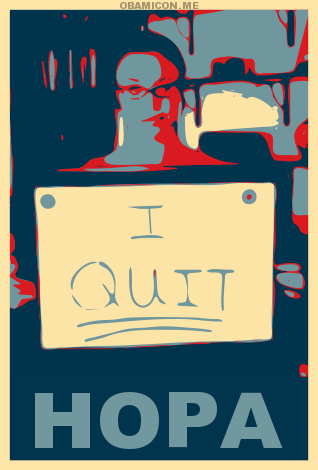
Yesterday, the story of a young go-getter who quit her job via a series of dry-erase board messages due her boss’s sexual harassment burned up the internets.  The girl was dubbed “HOPA” (after her boss’s mistaken acronym for “hot piece of ass”) or “Jenny DryErase” by supportive Facebook followers and commenters.

Today, the story was revealed to be false.  Yet it is still an excellent career move for an aspiring actress and an aspiring comedy website – and illustrates the value of timing in capturing the short attention span of folks online.

The original post, on comedy site The Chive, was set up to go viral for a couple reasons.  First, the act of quitting a job and metaphorically burning the place on your way out Jerry Maguire-style isn’t completely out of left field; even doing it through a variety of emailed photos isn’t even that out there.  It’s her signs and her emotive facial expressions that makes the user laugh.  Second, and more important, the girl’s story works equally well if it’s true or not.  So it wasn’t unbelievable, and investing in the story didn’t mean believing it was true – creating a low barrier of entry.  The stage is set.

But as with all comedy, timing is everything.  The Chive struck gold by releasing the pictures on the same day that an airline steward became an international folk hero for leaving his job down the escape chute, a beer in each hand.  profanity-laced goodbye to his own job, so quitting was in the news.  They couldn’t control the news cycle, but it worked to their favor.

What they did right on their own, however, was debunk the story of HOPA girl the day after attention peaked.  Announcing the hoax in a month, or even in a week, would have meant reaching people well after they had forgotten the Jenny DryErase post and moved onto the next Hitler/Downfall parody.   In other words, it would have been irrelevant, and there would be no lasting benefit.

The real HOPA girl, actress Elyse Porterfield, has her name everywhere; people who might be in a position to help her career know now that she can pull off a pretty good photo shoot. The Chive has the added web traffic and the street cred with that comes with manipulating web audiences into taking a hoax viral.  Advertisers like sites that can, occasionally, draw big numbers for a few days.

The tactic of a fake viral picture isn’t really translatable to campaigns, which have to be somewhat transparent in their messaging.  But it is important to understand how fast online communications work.  Windows of opportunity aren’t open wide and they aren’t open for long.