Transparent as Mud

The President fielded a question last night that revealed more about the failed expectations than any admissions that health care may not pass by August.  Obama had to duck a tough question from his hometown Chicago Tribune about the lack of transparency in the health care reform process.  It isn’t a new question, either – the President has broken promises to allow public review of pending legislation as well as struggled to maintain a website where citizens could track government spending.

The developing pattern is not good, and looks worse because the President is setting himself up with expectations which are tough to reach.  At best he looks naive; at worst corrupt.

There will be plenty of time for waiting AFTER health care “reform” passes

President Barack Obama takes to the airwaves tonight, hoping that because Americans like him, they will accept an overhaul of the health care system without drawn-out deliberations, debate, and research.  Surely, after the President delivers his address, Republican leaders will answer by talking about the exorbitant cost of government-run health care.

But here’s a better reason to oppose government meddling in health care: it makes health care worse.  If the goal is to make sure that as many people as possible actually get the care they need, this is the wrong way to do it.

Vlogger Steven Crowder makes just this point in a video which, while maybe a little long, is still worth watching:

Moon Shot ’09

Forty years ago the world watched network news special reports with bated breath as Neil Armstrong took the first human step on another world.  How might that coverage look today?  Slate thinks they have an idea of how the space age might collide with the age of the 24-hour news cycle:

(My favorite part comes about 45 seconds in, when Anderson Cooper puts up the Twitter chatter on the moon landing – posts include “Suck it, China!” and “Michael Jackson RIP.”)

Happy Moon Day

Today is, of course, the 40th anniversary of the small step for a man that was a giant leap for mankind.  Neil Armstrong doesn’t make many pulic appearances anymore, but Buzz Aldrin, the second man on the moon/NASA’s Garfunkle, has remained in the public eye.  And thank goodness – no one handles the moon conspiracy theorists quite like him:

It matters who is stepping in to “help”

Health care reform is this week’s topic in Your Nation’s Capital. Last week, there were rumors of a second stimulus package to answer flagging unemployment numbers. The Obama Administration has responded to problem after problem with a steady drumbeat calling for new and expanded government programs. Inaction is not an option, our President has said.

What isn’t said is who is doing that something – and probably with good reason.

This week, NASA finally admitted that it had taped over the original recordings of the Moon landing. This is not my kid brothers taping over my old VHS recordings of the A-Team with episodes of The Real Ghostbusters.  This is the definitive video record of man’s first step on the surface of anything other than Earth. It’s a key moment in the history of our nation and, more importantly, our species. It’s a giant leap for mankind.

This is what passes for rocket science in Washington, D.C. – and if these are the smart kids, who’s administering TARP funds and deciding who gets to be first in line at the doctor?

Lobbying the government on their own dime

The Washington Times’s Amanda Carpenter reports that GM is encouraging its remaining dealers to contact their Members of Congress.  The message: oppose legislation which would re-open dealerships which have closed as part of the bailout.

Obviously, anyone and everyone should have the right to write their Congressman; and in politics, nothing moves unless it’s pushed, so the idea that GM leadership was encouraging  its employees to contact elected leaders makes sense.   But GM isn’t just any big company, it’s a company that owes its current existence to the Obama Administration and an infusion of public money.

The bailout/sale of GM to the government this spring included the administration forcing out longtime CEO Rick Wagoner and replacing him with someone who promised to “learn about cars.” Perhaps it should not be surprising that an Obama-administration-owned GM has proved to be better at lobbying than making cars.

Giving the public options

The battle lines on health care reform are pretty clear, but what isn’t as clear is what each side stands for.  Both Democrats and Republicans have been talking about competing ideas, but the overarching debate is actually one about governing philosophy – and polls still show that the public is somewhat skeptical of the Democrat ideology.

The Democrats’ plan includes a national insurance plan – the now-famous “public option,” a cheaper version of every other insurance plan that somehow, our leaders assure us, won’t put those other insurance companies out of business.  The Republicans’ plan involves driving down costs by limiting liability reform, but there’s a more interesting tidbit buried deep down in their discussion: the idea of each person buying their own insurance, made easier by tax incentives.

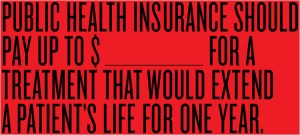
Unfortunately, the GOP isn’t trying to change the terms of the debate – something they desperately need to do.  Those who seem to support the Obama plan are helping a bit.  A New York Times Magazine article makes a case in favor of public health care rationing (a concept even the administration avoids like a plague which can’t be treated by an in-network provider) and in doing so, uses the following graphic to make their point:
19health-600

It’s a valid question, and one the “public option” will have to answer – maybe not during the legislative process, but certainly when put into practice.  The first participant in the ABC Obama Health Care infomercial asked a similar question; the President sidestepped and did not answer.

This is a powerful strike against Obamacare, and one Republicans can exploit.  But eventually, bashing health care reform proposals will not help the GOP win elections.  The other side must advance their own brand of health care reform – something completely different, although the seeds are, as aforementioned, already planted.

Our health care system as it currently exists is tied to employment – much like other benefits, such as a retirement pension, have been for decades.  If you work in the same job for a long period of time, that’s good.  But as the American worker becomes ever more likely to switch jobs several times during a career, the employer-based model is simply not as effective.  We no longer live in a company where people get jobs out of high school or college, work for fifty years, and get a pension and a gold watch upon retirement.

A system which promotes portable, individually-purchased health care and health insurance would not only help expand people’s control over their health care, it would drive costs down.  Current health insurance costs are often inflated by the existence of insurance; care for uninsured patients currently costs less than care for insured patients.

No election was ever won on defense, and Republicans – and, for that matter, conservatives – can ill afford to let their opponents draw the battle lines.  In fact has already started, with President Obama claiming the opponents of his plan are “defending the status quo.” As long as this message resonates unanswered, Obama can continue to claim the middle ground while painting his opponents as reactionary forces dug in to withstand change.  Republicans must make their own case that their proactive solutions are better than the opponents.

This will make it harder to watch them flush your money

Read this, then let’s talk about why it’s funny:

“The Board shall establish and maintain…a user-friendly, public-facing website to foster greater accountability and transparency in the use of covered funds. The website…shall be a portal or gateway to key information relating to the Act and provide connections to other government websites with related information.” — American Recovery and Reinvestment Act of 2009

Here’s the punchline: The Obama Administration’s Recovery.gov website will cost you and me $18 million to redesign – not design, but re-design.  In fairness, the redesign itself costs only $9.5 million, with $8.5 million set aside for site upkeep over the next five years (a little over $14,000 per month).

No one can figure out how the company that received the contract received the contract – according to TechPresident, no government entity knows.

The most expensive website design project I’ve ever led cost $60,000 – and that was because the vendor I worked with gave me a few breaks.  But the point is that I know people who could easily design and build a nice looking website that would do all that Recovery.gov needs to do for less than a $1 million, and maybe for less than half that.  It’s the technological equivalent of the famed $500 hammers used by the Pentagon: it simply doesn’t make sense.  Given the expense, transparency in the bidding process is that much more important.