Introducing Gink, the next big internet fad…
Author: Jim Eltringham
Political consultant specializing in grassroots mobilization, online media, and public relations.
YouCut makes you Kevin Kline and Charles Grodin
Rep. Eric Cantor and House Republicans have drawn criticism from both left and right for their YouCut program, which lets citizens vote to eliminate wasteful government programs. The word “gimmick” is tossed around by both sides – as if bumper stickers, lawn signs, and other efforts to earn political support aren’t gimmicks – while making the point that the cuts proposed wouldn’t trim federal spending by all that much.
But in the GOP’s defense, this is about continuing the message that the Republicans are the party of smaller government. There’s no better case against the concept of government spending than to point out the most egregious and unnecessary examples.
Plus, as it turns out, this is a pretty good way to build and maintain a strong list of activists.
The next next generation of phone banking
It’s been a good week for Carly Fiorina’s campaign. Buried underneath news of the controversy Sarah Palin stepped in by endorsing Fiorina, is the adoption yesterday of a pretty cool technology by the Campaign to unseat Boxer. The platform, created by RealGood Technologies, plugs any mobile phone with text message capabilities into a candidate’s GOTV effort.
In January, Scott Brown’s campaign successfully used an internet-based phone bank from anywhere function to rally supporters from across the country; a Senate seat in California would be an equally significant pickup for Republicans. If Fiorina goes on to win the Republican Primary and takes out Sen. Boxer, this tactic will be held up as one of the big Republican success stories of 2010.
All politics are personal
TechRepublican points to this pretty cool video about the continued significance of social networking:
The importance of online engagement is nothing new to businesses and politicians – at least, it shouldn’t be. Still, even those who appreciate the power of this communication don’t seem to grasp the underlying principles.
One set of stats stood out from this video: while only 14% of people polled trust advertisements, 78% trust recommendations from friends. Those aren’t necessarily Facebook friends, either; the more technology becomes integrated in our lives, the more it exposes our human nature. We trust people we know more than those we don’t know. Political strategists from the nineteenth century understood the need for voters to hear from local party leaders, and no substitute has ever worked.
Speaking at an event in Richmond, Va. last weekend, Obama campaign manager David Plouffe summed up what that means for the campaigns of the future:
Plouffe said the campaign was built using the Internet to engage voters in volunteering, contributing money and “sharing the message” amongst themselves. Connecting these people — not only to the campaign but to each other — helped them build trust with prospective voters they engaged both online and face-to-face.
“There is a lack of trust — in government, in business leaders, in academic leaders, even in faith leaders,” Plouffe said. But, he said, “People trust each other.”
Forget about local – all politics are personal, and always has been.
The court looks different from this angle
This morning’s Washington Post Express had the following installment of the excellent comic strip Pearls Before Swine:
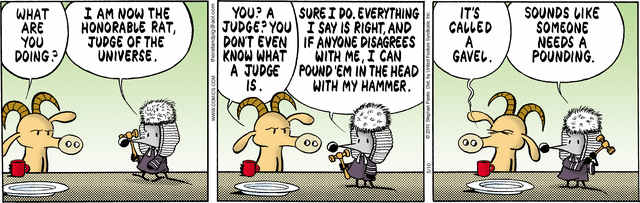
And then, by a happy coincidence, the worst-kept secret in Washington DC is confirmed: President Obama will nominate Elena Kagan – who hasn’t been a judge – to be the next Supreme Court Justice.
Despite a different experience than others, having a legal scholar on the bench may allow the court to reach opinions based on legal theory rather than the circumstances presented. Though given the qualifications President Obama has put forward in the past, don’t hold your breath waiting on it to happen.
3 (more) ways for SNL to be more fan friendly
Betty White hosts SNL this week, thanks in large part to a Facebook movement. It was a savvy move for the television institution – which, at 35, might as well be as old as White in TV years.
SNL’s target audience has always tended to be younger, and as such the show must constantly adapt to changing times. Tapping White to host in response to popular demand is a good start, as is the Backstage blog which includes sketches cut at the last minute. But SNL can do even more:
1. More online video content
I don’t know how many times I’ve wanted to make a post using an obscure SNL sketch to make a point. And honestly, there’s no reason (other than to promote DVD sales) for SNL not to have a library of all their sketches available on YouTube. Currently, only select sketches are available.
Aside from my selfish reasons, having every sketch ever made available could be a good business decision for SNL. Old, obscure sketches could become viral sensations when exposed to a new audience. And then there’s the social factor: For many folks, watching SNL is a social activity, and so any sketch can become an inside joke among friends – whether or not it’s a “classic.” An otherwise unfunny 1999 sketch where Horatio Sanz repeatedly screams, “a bear ate my parents!” was pretty lame, but it would get plenty of laughs from some of my UMass chums if I sent them a link to it. You and your friends probably have sketches like that too. SNL is missing out by not tapping into that emotion – it keeps viewers loyal.
2. Viewer-generated content
Andy Samberg’s Digital Shorts have helped SNL advance in the online video space. So why is Samberg to only one making digital shorts? There are some talented comics out there who can make funny videos.
By inviting submissions and letting viewers vote on which one should be on TV, SNL can not only build a great interactive relationship with their audience, but also find cheap talent.
3. Viewers pick the host
SNL understood the dynamics of audience engagement early on, running an “Anyone Can Host” contest back in 1977.
Offering a season-long, election-style contest between two good comedic actors for a spot hosting the season finale would not only be comedy gold, but would reach into those actors’ networks – their Facebook fans and Twitter followers would suddenly have a reason to visit SNL’s website, and to recruit friends to do the same.
If Tim Pawlenty figured it out, you’d think Lorne Michaels could, right?
Obey your instincts
Rep. Dave Obey saw the writing on the wall.
Despite his stature as a political institution, he was facing an electorate that has soured not only on liberal policies that he has championed, but also on the concept of incumbency.
More important, his opponent was young, telegenic, and media-savvy – the perfect counter – and, more important, was drawing attention from beyond the district. This is the second big story for Sean Duffy in a week, the first being his victory in Gov. Tim Pawlenty’s PAC endorsement contest. Clearly, Duffy would have money and support coming from outside the district from a Republican infrastructure eager to find a fresh new face.
Despite the fact that he looked like a long shot on May 4, Duffy’s campaign had the chance to follow a similar arc to Scott Brown’s victory in Massachusetts. Running against a senior ideologue from the other party, Duffy could have tightened the polls gradually over the summer and been in position to score a big upset with a late push of volunteers and money from across the country – think online money bombs and remote get-out-the-vote call centers.
All politics are still local – but when the right candidate uses the right technology, a whole lot of people can become local.
 Jim Eltringham