The New Yorker: Koch fiend

This lesson in investigative journalism is brought to you by The New Yorker’s hit piece on Charles and David Koch’s political activities:

1.  Find some fact that isn’t particularly widely known.  Save time by finding a fact that isn’t widely known because it isn’t particularly interesting.

2.  Pretend that the fact is not widely known because of a conspiracy.

3.  Write a hit piece that calls out political activists for their political activism.

Koch industries has issued their rebuttal, and the story will likely blow over pretty quickly, but The New Yorker’s story deserves a second look as a primer on journalism mistakes to avoid.

Most Americans probably don’t know the extent to which federal government activity buoys the Washington, D.C. job market.  In addition to government jobs, there are countless lobbying firms, public affairs shops, and of course think tanks whose existence is based on the fact that the government is so complex.  Both the left and the right have their think tanks, and if you stroll through the halls of similar organizations on either side you’ll start to see similar names on the plaques which commemorate donors.  One of those names on the conservative side is Koch.

The New Yorker article paints David and Charles Koch as clandestine movers and shakers among the center-right, starting sham organizations to debunk global warming theories and government regulations.  The hilarious part about this is that the Koch brothers have never made any secret of their interest in politics – or their willingness to spend money advancing ideas.

In the interest of full disclosure, I’ve had a few dealings with the Charles G. Koch Charitable Foundation.  I’ve had friends who work there, and I’ve spoken to their Associates program (a widely advertised course which trains people to run think tanks) a couple of times a few years back.  In fact, to thank me for appearing, they gave me a Swiss army knife key chain with “Charles G. Koch Charitable Foundation” stamped on the side.  If you’re running a secret conspiracy group, you don’t make up key chains advertising it.

Buried in the conspiratorial tone of the story and the apparently necessary examples of inflammatory rhetoric at tea party rallies are a few interesting facts about the priorities of Koch-funded organizations and the priorities of Koch industries.  But lost in the shuffle is the consistency with which the Koch brothers have held to libertarian ideals – ideals which are actually quite rare in the business world.

And then there’s the big story The New Yorker completely whiffs on – that a large, activist government that picks winners and losers will attract attention and activism from large corporate players.

Internet and technology companies are weighing in on policies like net neutrality.  Health care companies were all over the place on both sides of the health care takeover.  Railroad companies are plugging for railroad subsidies; farmers are plugging for farm subsidies.  In fact, the devious “Koch agenda” is unique only in that while most companies are clamoring for their piece of the pie, the Koch brothers are among the few saying “just leave us alone – we got this.”

Had the author not spent valuable mental energy dreaming up the term “Kochtopus” to describe the many tentacles of activity funded by the Koch brothers, she might have had some left over to explore some of the other octopi in the D.C. ocean.

Plus, I’m pretty sure Ziggy already wrote this story.
Better yard signs? We have the technology

Supporters love yard signs.  Not only is it an easy way to demonstrate support for a candidate, it also offers an unofficial measure of how a campaign is doing.  Driving through a neighborhood amid an ocean of your favored candidate’s name is a big morale builder.

Political activists hate yard signs.  They’re expensive, and a volunteer sticking a signpost in the ground is generally not a volunteer walking through a precinct and talking to his or her friends and neighbors.  To that point, Alex Lundry has a great post about the utility of location-based apps, and mentions how campaigns may be able to use location-based services to give their yard signs greater impact.

A Spanish company, whimsically called Macanudos, is going one better.  They’re working on creating a quick-response (QR) code technology that would allow users to scan images and instantly “like” something.  These QR codes would operate like bar codes, and if they’re on a lawn sign, someone walking down the street could immediately like a candidate with a smartphone.

Of course, Facebook followers are like lawn signs: they both provide a nice stat that is, without further action, ultimately meaningless.  But what happens if we mash up Lundry’s idea for incorporating location-based services with Macanudo’s ability to instantly scan-like something?  Campaigns might then be able to figure out roughly where the scan-likes were coming from and give the list to the appropriate precinct captains, who could then in turn follow up with the individual voter.

Creepy?  Maybe a little.  But hey, you wanted yard signs…

Deconstructing the primaries

What might be the best wrap-up of yesterday’s primary results was published before the returns came in.  As media outlets keep dropping over-simplistic terms like “tea party support” and “outsiders vs. insiders” to explain what happened, the Washington Examiner’s Timothy Carney boils the divide in Republican politics down as “the Tea Party Wing against the K Street Wing” – a divide which is not simply ideological or experiential:

The main distinction… might have less to do with policy platforms and more to do with a politician’s attitude toward the Washington nexus of power and money. Nevada’s Sharron Angle is anti-bailout and anti-subsidy. [Kentucky candidate Rand] Paul could try to shrink defense spending and ethanol subsidies. In Florida, Republican Marco Rubio isn’t a game player like [former Senator Bob] Dole’s buddy Crist is.

This morning, we hear that Lisa Murkowski is in trouble against “tea partier” Joe Miller, that John McCain bested an insurgent challenge from a more conservative candidate, and that established Republican Bill McCollum lost out to Rick Scott.

So if you’re scoring at home, “the establishment” won some and lost some, with Alaska up in the air – at least, according to most of the talking heads you see.

But can you call McCain an establishment Republican candidate?  McCain had bucked national party leadership in his own way for decades, often lashing out at the K Street types Carney mentions above.  As Matt Lewis noted – again, before polls closed yesterday – he fought a serious race against an opponent with more clear ties to K Street establishmentism.  Last week, the New York Times saw fit to print that Alaska’s rugged individualism was either inconsistent or an outright sham because of its dependence on federal money; regardless of how the final tallies go for the scion of the Murkowski family goes, her ability to keep winning earmarks did not lead to an easy victory lap.  And Bill McCollum was part of a Republican establishment in Florida rocked with a spending scandal earlier this year.

And of course, there’s the big caveat that each race has its own local interpretations of who counts as “the establishment” and who really is an “outsider.”  All the more reason to look at the results through Carney’s prism rather than the crystal ball which other analysts are trying to use.

A quarter million doesn’t go as far as it used to

Rand Paul’s $250,000 money bomb is being treated like a dud for failing to meet the lofty $400,000 goal the campaign set for it.  For a Kentucky Senate race, a cool quarter mil is far from chump change, but the dour coverage shows the value of managed expectations in setting benchmarks for online metrics.

Paul inherited from his father a reputation for both staunch libertarianism and savvy online organizing, which make his swings-and-misses at online fundraising and Facebook recruitment much more pronounced.  But Paul isn’t the only one who falls into the trap of easy metrics: dollars raised online, Facebook “likes”, Twitter follower counts, and other obvious numbers are easy to understand, so issue and candidate campaigns alike will use them as benchmarks for impact.

Two problems stem from this.  First, metrics which are easy to understand are not always easy to obtain.  Second, having big numbers doesn’t always translate to big impact.  Having 100,000 Facebook followers who don’t vote is just like having 100 Facebook followers who don’t vote.  Further, there comes a time when a campaign must balance the effort of recruitment with the reality of mobilization.

In the particular case of the campaign’s recent online fundraising attempt, Rand’s supporters may be suffering from money bomb fatigue, since the campaign has used the tactic regularly.  They might be feeling the pinch of a tough economy, and giving $25 where they would have given $50.  But none of that would be in the discussion if, at the outset, the campaign had set a reasonable benchmark for dollars.  There are plenty of completely legitimate explanations for why Paul raised “only” $250,000 – but what really requires explanation is the original expectation for $400,000.

New Diggs

Digg got a lot more relevant after announcing upgrades that make it a true social news service this week.

The old Digg was pretty straightforward: people submit stories, everyone votes, the top links appear on the home page and drive thousands of hits worth of traffic.  The problem is that the top stories for one user are the top stories for every user – and means that the site experience is a reflection of the aggregated community, rather than a user.

Breaking into a system like that means joining with like-minded users to promote content more favorable to your side.  Alternet called that “censorship” a few weeks back, but is really just a form of political organizing.  It was an attracting but ultimately useless expenditure of time; while Digg could drive traffic, it’s probably not going to be an important front in the war on ideas.

A more user-oriented model downplays the need for such a strategy (while promoting further social engagement) because the front page is no longer the Holy Grail.  It opens up the possibility of niche communities.  In politics and advocacy circles, it means you no longer need to have a high-profile race for Digg to be a viable part of your social strategy.

Smart phone strategy

With Facebook announcing its Places geo-networking service – and with it, countless opportunities for social networking gone terribly wrong – it’s tempting to keep the discussion going about how campaigns can use location-based networks.  But it’s worth noting that using these networks and applications is part of a much bigger strategy – reaching voters on their mobile phone.

A friend who runs a political text message contact/mobile marketing technology shop recently pointed out that only a handful of the top targeted Senate races have texting strategies.  This is amazing considering how direct and effective the mobile phone is in terms of reaching someone:

Scott Goodstein ran Obama’s mobile communications campaign operations. He  said, “262 million Americans are using mobile phones. That’s roughly 84% of the total population… It’s the only device that’s truly with people for 15 to 24 hours a day.”

Another plus: mobile is a spam-free zone. One has to opt-in to receive texts, and a whopping 92% of  text messages are read by the recipient.

(Via TechRepublican.)

Location-based engagement and smartphone apps are great, but at the end of the day they are part of a bigger picture: getting into that little gizmo that just about everyone carries around almost every waking hour.

Location based social networks and the 2010 campaign

As discussed previously, no one is quite sure what to make of location-based networks yet – to the point where Christopher Walling of Project Virginia makes a compelling case that such technology won’t be impactful until at least 2012:

Not only are campaigns unable to reach a significant amount of voters, but I also don’t see using an LBSN [location-based social network] to disclose your candidate’s location as an overly effective tactic.  Most of the venues that candidates will “check-in” at are campaign events or fundraisers, which most would expect them to attend anyway.  If candidates choose to “check-in” at more “off-the-radar” locations, then they are essentially giving political trackers and their opponents an upper-hand, (don’t forget this is the year of the tracker) which could lead to more unsavory “gotcha” moments.

Not only is Walling right on about the time frame, he’s also right on about the concept of candidates checking in being kind of dumb – thought not because of the army of interns on both sides with flip video cameras and attitude problems.

Social networks involve two-way communication rather than one-way broadcast communication.  That’s why good online strategists look for opportunities to engage with supporters, rather than simply building giant email lists.  The bottom line is that few voters give a crap where a candidate is.

On the other hand, an activist may want everyone to know that he or she just checked into Campaign HQ to stuff envelopes for three hours; or they may want to know where polling places are.  If they have three hours to kill on a weekend, they may want to know if there’s a neighborhood nearby where no one has gotten around to knocking on doors.

In other words,it isn’t important for the candidate to be active for a campaign to get a lot out of a location-based social network; but as Walling mentions early on in his post, the supporters sure have to be.

IT’S A TRAP: The Ground Zero Mosque

On the Today show this morning, Dick Armey and Matt Kibbe of FreedomWorks sat down to talk about their new book, Give Us Liberty: A Tea Party Manifesto.  FreedomWorks is well-positioned to ride the wave of citizen unrest that gave rise to the tea party – they’ve been making the case for less government for years.

So of course the first thing they were asked about was… the proposed mosque at ground zero.

Armey and Kibbe are both bright, so they immediately accused President Obama of weighing in on the mosque controversy to change the subject from “failed economic policies.”

Clearly, the President will score no political points with his lukewarm two-step of supporting the right to build a mosque while not supporting the mosque.  But there is a real threat that the controversy could muddy the GOP’s year-long message that government is trying to do too much with calls for government intervention in New York zoning decisions. As Gov. Chris Christie notes, Republicans run a risk by trying to turn the mosque controversy into their central campaign platform – especially with so many other messages that could work better.

Republican hopefuls must strike a balance between reminding people that the President disagrees with them on the mosque and using it to underscore the inability to trust the federal government to solve problems:

  • “The President is commenting on a local government zoning matter instead of paying attention to national priorities.”
  • “The President is talking about mosques while the rest of the country tries to figure out how to get out from under the failed stimulus package and get the economy moving again.”
  • ‘”The construction jobs building the mosque must be their best idea for job creation.”

See?  This stuff practically writes itself, and would allow Republicans to pivot to more substantive arguments about why they will make life better for the American people.

The GOP has plenty to talk about as November approaches.  Armey and Kibbe offer an excellent lesson: the mosque is a good conversation starter, but it shouldn’t dominate the discussion.

Is Maxine Waters about to be James O’Keefe’s next YouTube star?

Mr. ACORN pimp himself, James O’Keefe, announced via Twitter today that Rep. Maxine Waters would be the subject of his next series of videos.  Here’s the preview:

Two things are evident: O’Keefe still understands the power of online video, and he still understands the power of timing.

The ethics charges flying around various Democrats are starting to look like a trend – much like Republican scandals leading up to the 2006 election painted the picture of a power-happy party inviting a rude awakening at the hands of voters.  Getting Waters on camera in a sting operation like this could make the ethics violations very real to voter and underscore the broken promises of Democratic gains in 2006 and 2008.

But on top of that, you can’t say enough about O’Keefe’s media-savvy release strategy, either.

By releasing a teaser, O’Keefe capitalizes on this week’s news cycle about Waters and her ethics charges.  After controversy surrounding his presence in a Senate office earlier this year (and the storm surrounding his associate Andrew Breitbart’s role in the Shirley Sherrod affair), he can expect that this initial release will lead to a round of denouncement from left-leaning talking heads; for a while the story will be that James O’Keefe has a Waters video.  The Congresswoman’s office will likely be asked to comment; maybe she’ll even say something embarrassing and unwittingly drum up more coverage.

True, O’Keefe could have gotten just as much coverage this week by releasing a completed video.  But what about next week?  This strategy allows O’Keefe, after the initial frenzy, to drop a second video and get another round of coverage.  And, the vile and hatred he receives from the left this week may make the release of the full video that much more newsworthy.

If it sounds familiar, it should – it’s exactly how O’Keefe and Breitbart set up ACORN to take itself down.

Timing made the HOPA hoax a win

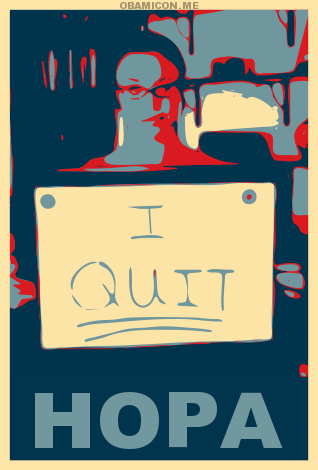
Yesterday, the story of a young go-getter who quit her job via a series of dry-erase board messages due her boss’s sexual harassment burned up the internets.  The girl was dubbed “HOPA” (after her boss’s mistaken acronym for “hot piece of ass”) or “Jenny DryErase” by supportive Facebook followers and commenters.

Today, the story was revealed to be false.  Yet it is still an excellent career move for an aspiring actress and an aspiring comedy website – and illustrates the value of timing in capturing the short attention span of folks online.

The original post, on comedy site The Chive, was set up to go viral for a couple reasons.  First, the act of quitting a job and metaphorically burning the place on your way out Jerry Maguire-style isn’t completely out of left field; even doing it through a variety of emailed photos isn’t even that out there.  It’s her signs and her emotive facial expressions that makes the user laugh.  Second, and more important, the girl’s story works equally well if it’s true or not.  So it wasn’t unbelievable, and investing in the story didn’t mean believing it was true – creating a low barrier of entry.  The stage is set.

But as with all comedy, timing is everything.  The Chive struck gold by releasing the pictures on the same day that an airline steward became an international folk hero for leaving his job down the escape chute, a beer in each hand.  profanity-laced goodbye to his own job, so quitting was in the news.  They couldn’t control the news cycle, but it worked to their favor.

What they did right on their own, however, was debunk the story of HOPA girl the day after attention peaked.  Announcing the hoax in a month, or even in a week, would have meant reaching people well after they had forgotten the Jenny DryErase post and moved onto the next Hitler/Downfall parody.   In other words, it would have been irrelevant, and there would be no lasting benefit.

The real HOPA girl, actress Elyse Porterfield, has her name everywhere; people who might be in a position to help her career know now that she can pull off a pretty good photo shoot. The Chive has the added web traffic and the street cred with that comes with manipulating web audiences into taking a hoax viral.  Advertisers like sites that can, occasionally, draw big numbers for a few days.

The tactic of a fake viral picture isn’t really translatable to campaigns, which have to be somewhat transparent in their messaging.  But it is important to understand how fast online communications work.  Windows of opportunity aren’t open wide and they aren’t open for long.