Why I fear the Atlas Shrugged movie will suck

The timing is perfect for a movie based on Atlas Shrugged.  The political debates waged in the last five years offer a nice backdrop to the hypotheticals Rand came up with more than a half century ago.   So the opening of the movie this weekend should be a cause for celebration.  I haven’t seen it yet (I plan on it), but color me cautious.  Here’s the trailer:

The fact that the film being released this weekend is part of a trilogy is concerning; it implies that the filmmakers are sticking as closely as possible to the original text.  That’s probably a bad idea.  Aside from the oft-repeated concern that stuffing an 1100-page book into a 120-minute motion picture is difficult, the caricatures of lobbyists, crony capitalists, and government officials translate better in print than they are likely to on screen (based on the trailer above).

And, despite the fact that the film is reportedly set in 2016 (the not-too-distant future), the plot revolves around the railroad business.  When Rand wrote the book, railroad barons were not long removed from being cast as the villains of American industry in the late 1800s and early 1900s; today’s audiences can’t relate to that.  More troubling is the promotional strategy.  The Tax Day  release, combined with the heavy influence of FreedomWorks, suggests that traditional movie promotions will not work.  If that’s the case, then Atlas Shrugged will be viewed primarily by conservative audiences who already agree with its messages.  It won’t get widespread exposure to audiences that just want to go see a compelling movie and don’t care about politics.

All of this adds up to a misguided effort to make a movie which drives home a point rather than tells a good story.  Media which forgets entertainment at the expense of politics gets lumped into the latter category and loses its widespread appeal.

There are plenty of reasons why books rarely make it to the screen without major overhauls.  Mario Puzo’s The Godfathertold of the childhood of Vito Corleone and the back stories of several other characters; then the book was translated to film much of those details were skimmed out.  The problem with Atlas Shrugged as a movie is not simply length, but the fact that the book uses that length to unravel a mystery around the core concept of a production strike.

In that central theme is a very compelling movie idea based loosely on (but still true to) Rand’s work.  What if the people who held up the world simply shrugged their responsibility?  Instead of being national in scope, the idea might have been better set in a small town, perhaps with small business owners rather than moguls of industry as the protagonists.  That would help audiences relate to the characters – and ultimately the messages.  After all, who wants to root for a billionaire?  (That’s why the Richie Rich movie lost money at the box office.  Don’t you dare blame John Larroquette.  Don’t you dare.)

With a relatively low $10 million production cost,  the movie will be true to one core Rand value: it is almost guaranteed to make its money back even if it bombs miserably.  Assuming an average ticket price of $7.89, Atlas Shrugged need only sell 1.3 million tickets to cover expenses.  Putting a price tag on the missed opportunity to tell a compelling story for our times is much more difficult.

And now, the real news about the fake news

The Onion debuts two cable television programs this month.  The fake newspaper turned fake internet news site presents a unique and specific genre of comedy – the obviously false presented as seriously real.  It’s similar but a bit different from slapstick comedies like Airplane! or Spaceballs.  It’s closer to Saturday Night Live’s Weekend Update as delivered by the more deadpan performers, like  Kevin Nealon in the early 1990s.  The 1970s spoof talk show Fernwood 2 Night and the long-forgotten short-lived Nick at Night television review series On the Television may be the best examples, even if short-lived.  Because the audience is in on the joke but the performers are apparently not, it depends as much on performance as it does on clever writing.

Since this type of humor is so specific, it’s unsurprising that the Onion’s television ancestors met with limited success.  What has given the Onion its staying power?

The Onion – which started as a small, regionally distributed newspaper in 1988 – became an early example of the internet’s power of viral distribution.  It may be difficult for a network television show to find the audience it needs to build a niche following; the Onion’s following grew over time as its stories were forwarded by email.  When the Onion’s television shows air this month, they will have already recruited their niche audience online over approximately 15 years.

There’s one final layer to peel back, and that’s the Onion’s business model based on generating large amounts of free, high quality content.  The term “viral growth” is overused, but is applicable to the Onion’s rise through virtual word-of-mouth.  The content brought traffic, and the traffic brought money – both in terms of advertising, book deals, and now television shows.  None of it would have worked without something that was worth sending in an email to a friend.  Funny always came first – and the money followed.  Other small, regionally distributed newspapers who are struggling may want to take note.

Why 2010 is the Year of Facebook

Time Magazine ignited some controversy this month by naming Mark Zuckerberg their Person of the Year.  Zuckerberg deserved the award, said Time, for “connecting more than half a billion people and mapping the social relations among them, for creating a new system of exchanging information and for changing how we live our lives.”

Indeed, Zuckerberg did all that – but he arguably did so in 2003, when he invented Facebook in his Harvard dorm room.  So why is he the person of the year seven years after actually making this contribution to humanity?  Or did Time discover Facebook only weeks after their grandmother, as “Julian Assange” suggested?

There are actually two questions here, so there are naturally two answers.  Question 1 is why Time gave Zuckerberg the award this year; and Question 2 is why 2010 is The Year of Facebook.

Culturally speaking, the last half of 2010 is a perfect storm of Facebook hype.  The Social Network was a big hit and created some preliminary Oscar buzz.  The next time you watch live TV, watch how many commercials end with URLs for a Facebook page.  And Zuckerberg scored headlines with his pledge to donate half his fortune to charity and $100 million to Brick City, NJ.  The success of social gaming in 2010 is linked directly to those games using Facebook as a platform for popularity – even non-gamers have seen their friends’ Farmville, Cityville, or Mafia Wars updates pop up in their own news feeds.

In short, Facebook is everywhere in a way it hasn’t been in years past.  But why is 2010 REALLY the Year of Facebook?  It turns out, there are some numbers to back it up.

Facebook’s traffic numbers surpassed Google’s in 2010.  That indicates a huge difference in how people are consuming information – instead of searching the internet and relying on Google’s algorithms to tell them what’s important, they are relying more and more on friends (a point I made yesterday in a post on Pundit League).  Trusting friends is something people are most likely predisposed to do; Facebook makes it easier to do that.

More important, Facebook continues to report increases in ad revenue.  It’s one thing for a website to have a good and popular idea; it’s quite another for a website to make money.  That Facebook has proved it could do the latter is no small feat and guarantees solvency for the foreseeable future.

So 2010 was more than just the year when America collectively noticed Facebook; it was the year when Facebook set down stakes as a permanent entity that gave legitimacy to its foothold in the public consciousness and culture.

And for that, Mark Zuckerberg really is the Person of This Year

The Fonz doesn’t need a handout

The headline, “Winkler honored by AARP” seems to bring on so many jokes (because really, how depressing that the Fonz is being honored by AARP?).

It time to replace the popular catchphrase “Aaaay” with “Heh?  Speak louder?”

It’s a good thing his office is in the bathroom.

Hope Fonzie didn’t break his hip when he jumped the shark.

Then I read the article, and it turns out I was wr… I was wr… well, you get the picture.  Henry Winkler has actually been an advocate for stroke victims.  And, much like the Fonz, he doesn’t go looking for handouts:

[U]nlike most celebrity visitors, he won’t be seeking any help from Capitol Hill. In fact, he doesn’t think he needs any.

“At the moment, you don’t need the government,” Winkler told POLITICO. “They’ve got their problems that they need to deal with. What we need is awareness – just person to person. Like playing Telephone, you just pass it on. … I am trying to pass it on, and it is really worthwhile to me.”

No word on whether a quick smack with the heel of Winkler’s fist to the annual appropriations bill could create a balanced budget (like when he ended segregation), but at least he’s doing his part.

Timing made the HOPA hoax a win

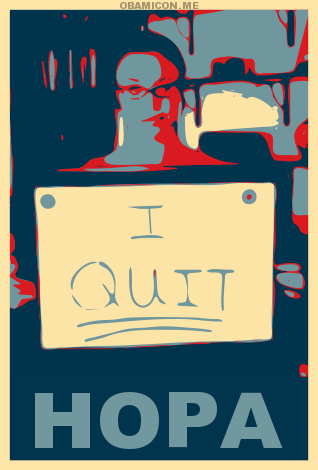
Yesterday, the story of a young go-getter who quit her job via a series of dry-erase board messages due her boss’s sexual harassment burned up the internets.  The girl was dubbed “HOPA” (after her boss’s mistaken acronym for “hot piece of ass”) or “Jenny DryErase” by supportive Facebook followers and commenters.

Today, the story was revealed to be false.  Yet it is still an excellent career move for an aspiring actress and an aspiring comedy website – and illustrates the value of timing in capturing the short attention span of folks online.

The original post, on comedy site The Chive, was set up to go viral for a couple reasons.  First, the act of quitting a job and metaphorically burning the place on your way out Jerry Maguire-style isn’t completely out of left field; even doing it through a variety of emailed photos isn’t even that out there.  It’s her signs and her emotive facial expressions that makes the user laugh.  Second, and more important, the girl’s story works equally well if it’s true or not.  So it wasn’t unbelievable, and investing in the story didn’t mean believing it was true – creating a low barrier of entry.  The stage is set.

But as with all comedy, timing is everything.  The Chive struck gold by releasing the pictures on the same day that an airline steward became an international folk hero for leaving his job down the escape chute, a beer in each hand.  profanity-laced goodbye to his own job, so quitting was in the news.  They couldn’t control the news cycle, but it worked to their favor.

What they did right on their own, however, was debunk the story of HOPA girl the day after attention peaked.  Announcing the hoax in a month, or even in a week, would have meant reaching people well after they had forgotten the Jenny DryErase post and moved onto the next Hitler/Downfall parody.   In other words, it would have been irrelevant, and there would be no lasting benefit.

The real HOPA girl, actress Elyse Porterfield, has her name everywhere; people who might be in a position to help her career know now that she can pull off a pretty good photo shoot. The Chive has the added web traffic and the street cred with that comes with manipulating web audiences into taking a hoax viral.  Advertisers like sites that can, occasionally, draw big numbers for a few days.

The tactic of a fake viral picture isn’t really translatable to campaigns, which have to be somewhat transparent in their messaging.  But it is important to understand how fast online communications work.  Windows of opportunity aren’t open wide and they aren’t open for long.

Coming to a theater near you: Facebook

The first full-length trailer for The Social Network is up, appropriately enough, on YouTube:

There’s no doubt that the inception of Facebook has been a significant development in internet consumption; and it’s one of the most interesting business stories out there.  But after a decade of startups promising to redefine how we use the internet, the “this is going to change everything” rhetoric is a little tired.

So from this trailer, this movie could be any – or all – of the following:

  • Deeply fascinating
  • A trite waste of time
  • Mildly entertaining
  • Creepy (as underscored by the cover of Radiohead’s Creep that the trailer is set to)
  • A way to spend two hours ostensibly with people while paradoxically not interacting with anyone or anything except a glowing screen

Sounds like the perfect movie about Facebook.

Washington, TMZ

The Washington Post’s David Weigel found himself the object of DC gossip columnists for venting on a journalists-only message board – and, before that, for – gasp – dancing at a wedding.

Weigel was a target for this because of his coverage of Congressman Bob Etheridge’s reaction to a couple political paparazzi.  (And incidentally, Weigel was right – Etheridge does look like he’s hugging the camera guy.)  The reaction that he went easy on Etheridge led to his explosion on the list, which snowballed into an even bigger deal, and led to his resignation.  Both his situation and Etheridge’s are part of a bigger trend in DC media.

The last few years have seen the launch of several DC gossip blogs and columns.  Instead of tracking the latest developments on pending legislation (as, say, an MLB gossip blog might cover trade rumors) they cover such matters of national import as the dressing habits and sometime stupidity of summer interns.  It’s not altogether bad, as it’s often entertaining;  But it’s a noticeable trend.

It would be easy to blame this trend on media saturation, but that would be an oversimplification.  This is an environment built on purpose by politicians and their communications professionals.  From state dinners to the White House Correspondents’ dinner, events which were once matters of course are increasingly staged as red carpet galas.  (This year, Politico likened the White House Correspondents’ dinner to the Oscars.)  Celebrities are routinely invited to testify before Congress as experts.

At the same time, much like Hollywood, Washington has created supporting industries around its main business, governing.  Just as movie makers need agents, consultants, special effects companies, costume designers, and other supporting industries, politicians need… well, agents, consultants, special effects companies, and costume designers.  With a community built around a central function, there’s bound to be an esprit de corps that binds people together even more than partisan leanings.

The casualties in this are, of course, old school folks like Etheridge and Weigel.  However, it’s important to note that their failures to adapt are for somewhat different reasons.  Etheridge isn’t used to have to answer questions directly; while Weigel is likely accustomed to the direct, personal questioning that is often a casualty of gossip blog culture.

3 more books that would make good movies

On today’s edition of his podcast, Matt Lewis and I talk about movies – and, like the guys from the Muppet Show who complain from the balcony, we do our share of kvetching because all the big summer blockbusters are either sequels (like Shrek 4 and Sex and the City 2) or remakes of iconic pieces of 1980s pop culture (like the A-Team and the Karate Kid).

Earlier this week, news broke that filming had actually started on another adaptation – a silver screen version of Ayn Rand’s Atlas Shrugged.  Aside from having a network of near-guaranteed customers through the tea party movement, Atlas Shrugged is a great story and Rand’s a good, vivid writer.  Outside of being 1100 pages, it’s a book made for the movies.

Matt and I ran out of time before we could get to some other books that ought to be in pictures:

Advise and Consent

We started talking about this briefly.  Yes, this would technically be a remake, but the 1962 adaptation of Allen Drury’s 1959 novel about the politics of personal destruction missed the mark so completely that it deserves a second look.  Set against the backdrop of a Cold War (which the Soviet Union is apparently winning), Drury’s original work involves a Secretary of State nominee with alleged ties to the Communist party.  Drury’s work is decidedly character-driven, and the central theme is how people sometimes get lost in the machinations of winning and losing in political battles.

Witness

This has nothing to do with Harrison Ford or the Amish.  Whittaker Chambers was an editor for Time Magazine who risked his credibility and livelihood to out Alger Hiss as a former Communist.  (The Congressional hearing actually served as the inspiration for Advise and Consent.)  But Chambers’ life leading up to that – acting as a member of the Communist party and establishing Soviet ties – is actually thrilling, as is his and his family’s middle-of-the-night desertion from the Communist Party.  Because of the histrionics of Rep. Joe McCarthy, the extent of Soviet operations in America is one of the under-told stories of the twentieth century.  Obviously, it didn’t work out so well for them (with the only major casualty being Apollo Creed), but it is fascinating that they tried.

Reagan’s Revolution

This one might be a made-for-HBO joint, because of a limited appeal, but political junkies would eat up Craig Shirley’s account of Reagan’s 1976 primary challenge to former President Gerald Ford.  The decision to challenge a sitting President from your own party is difficult enough, but the Reagan campaign had plenty of issues, such as early fundraising challenges and lack of institutional support.  This could be educational – many Americans don’t understand how the Presidential primary process works – but, like any hotly contested primary, it makes for a great story.

Of course, based on Hollywood’s interest in making anything original or non-3D, I expect to see trailers for Airwolf, Go-Bots, and a remake of the remake of Dukes of Hazzard before Witness comes to a theater near you.

But we can hope, right?  What favorite books would you like to see made into a movie?

3 (more) ways for SNL to be more fan friendly

Betty White hosts SNL this week, thanks in large part to a Facebook movement.  It was a savvy move for the television institution – which, at 35, might as well be as old as White in TV years.

SNL’s target audience has always tended to be younger, and as such the show must constantly adapt to changing times.  Tapping White to host in response to popular demand is a good start, as is the Backstage blog which includes sketches cut at the last minute.  But SNL  can do even more:

1.  More online video content

I don’t know how many times I’ve wanted to make a post using an obscure SNL sketch to make a point.  And honestly, there’s no reason (other than to promote DVD sales) for SNL not to have a library of all their sketches available on YouTube.  Currently, only select sketches are available.

Aside from my selfish reasons, having every sketch ever made available could be a good business decision for SNL. Old, obscure sketches could become viral sensations when exposed to a new audience.  And then there’s the social factor: For many folks, watching SNL is a social activity, and so any sketch can become an inside joke among friends – whether or not it’s a “classic.”  An otherwise unfunny 1999 sketch where Horatio Sanz repeatedly screams, “a bear ate my parents!” was pretty lame, but it would get plenty of laughs from some of my UMass chums if I sent them a link to it.  You and your friends probably have sketches like that too.  SNL is missing out by not tapping into that emotion – it keeps viewers loyal.

2.  Viewer-generated content

Andy Samberg’s Digital Shorts have helped SNL advance in the online video space.  So why is Samberg to only one making digital shorts?  There are some talented comics out there who can make funny videos.

By inviting submissions and letting viewers vote on which one should be on TV, SNL can not only build a great interactive relationship with their audience, but also find cheap talent.

3.  Viewers pick the host

SNL understood the dynamics of audience engagement early on, running an “Anyone Can Host” contest back in 1977.

Offering a season-long, election-style contest between two good comedic actors for a spot hosting the season finale would not only be comedy gold, but would reach into those actors’ networks – their Facebook fans and Twitter followers would suddenly have a reason to visit SNL’s website, and to recruit friends to do the same.

If Tim Pawlenty figured it out, you’d think Lorne Michaels could, right?

South Park at 201 (and counting)

South Park got everyone talking last week, but not for the right reasons.

Now thirteen years old, the show celebrated its 200th episode a few weeks ago.  This milestone should have received some more attention than it did: aside from basic longevity, South Park was and is the signature show that put Comedy Central on the cable map.

More significant than that, though, is the unique social commentary South Park offers up from a center-right perspective – and the fact that no other show does that as well.

One episode called out hybrid enthusiasts as presumptuous yuppies who enjoy the smell of their own farts.  Two episodes made the point (using thinly veiled surrogates for Starbucks and Wal-Mart) that big businesses are big because people want their products, not because of some evil corporate trick. A sixth season episode managed to mock lawsuit abuse, political correctness, and draw a line between tolerance and acceptance.  A two-part episode glimpsed into a future without religion and found devout atheists arguing over whose scientific logic was superior.

South Park has been a turn-of-the-20th-century incarnation of an Ayn Rand novel – telling a compelling story while making important and uncommon cultural points.  In fact, a 2005 book about the rise of media-savvy conservative activists was titled South Park Conservatives.

But calling South Park a political show is a misnomer.  Other efforts to become conservative or libertarian alternatives to left-leaning television shows, movies, or other media outlets have failed because those outlets put politics before content; South Park is a funny show that happens to be made by people with a libertarian-oriented worldview.  It would be hilarious either way; the leanings of creators Trey Parker and Matt Stone just make it different.

If you want to learn more about smaller government and individual freedom, Hayek and Bastiat are better philosophers than Parker and Stone.  But it you want entertainment that comes from a different perspective than most of the stuff out there – and that is, despite some shock value jokes and toilet humor, pretty smart – go on down to South Park and have yourself a time.