The Institute for Justice hit one out of the park with this video, which is one of the few attempts at online humor that is both effective at delivering a message and really funny. One of DC’s most philosophically consistent defenders of individual liberties, IJ just released a series of studies on the effects local governments can have on the business climate, even as elected officials try to “fix this unemployment problem.”
Tag: online tactics
The anti-social, anti-mobile election?
On Sunday, a Politico headline said that “smart-phone ads not yet political“; today, the lament was that campaigns aren’t investing in social media. This is 2010. We’ve had four years of social networking plus the legendary 2008 Obama Campaign under our belts to prove the value of online organizing. So what gives?
The answer, as usual, lies beyond the headlines – and the fact that politics goes beyond the campaign trail.
For instance, last week three major think tanks launched iPhone apps. This is smart for them because their target market is nation-wide – so they have plenty of people to pull from. If only 29% of mobile phone users use applications, that bodes well for a research-based think tank; it bodes poorly for an organization trying to pull a broad audience to the polls on election day.
Remember that the campaigns of this year are plural. The Republican presidential primary campaigns, as well as the Obama 12 effort, will doubtless do their homework and aggregate the best ideas from the 2010 winners (and maybe even some of the losers) and spend a good bit of time in 2011. So mobile apps, text messaging, location-based networks, and other new gadgets are still on track to make a big impact in 2012.
Will politics turn Gowalla vs. Foursquare into Facebook vs. MySpace?
In the world of location-based social networks, Foursquare has been the early leader, closing in on four million users. Gowalla and SCVNGR have been battling for a distant second place.
Gowalla’s move to cut into the lead came back in August, when it released a set of tools for campaigns – tools that many campaigns have been taking advantage of. Last week Politico’s Morning Tech followed up on the campaign toolkits:
Since the tools launched, Gowalla tells us, hundreds of political events, such as a rallies and town halls, have been created on the location-based service and thousands of people have checked into these events. And Gowalla users like to share which events they’re at on other social networks, too. About half of people who check into political events on Gowalla push out their status, comments and photos to Facebook, Twitter or both social networks.
And it sounds like interest in the politics-geared tools is growing. Gowalla says it has already started talking with both Democrats and Republicans about using its service for the 2012 elections. In Gowalla’s home state of Texas, the tools have gained traction with several candidates competing in local races.
Gowalla smart to take the long view, since location-based tools probably won’t be as prevalent until the Republican presidential primary campaigns. But since those campaigns will start on November 3, Gowalla is equally smart to start catering to campaigns now. At the same time, Foursquare has been somewhat deaf to calls for better political engagement, such as Jordan Raynor’s “I Voted” badge concept.
Foursquare still has a dominant market share of close to 70-80% (by the rough numbers). But in the early days of online social networking, MySpace was similarly dominant. The key is that the location-based market in 2010 is similar to the social network market in 2004 – it isn’t mature yet. By most counts, the top three location-based networks boast five or six million users – or 1% of Facebook’s membership. There are simply an awful lot of people who haven’t plunged into the location-based markets yet.
So what are the current also-rans to do to expand the location-based market – and make sure the new recruits choose something other than Foursquare? By targeting campaigns, Gowalla is actually recruiting political activists – passionate users who will join their network (or possibly even switch from Gowalla) in the pursuit of a bigger goal. By starting in 2010 and targeting 2012, Gowalla isn’t just executing a political strategy, but a business strategy as well.
Google bomb squad: New election, old tactic
Politico related Tuesday morning how liberal activists are bringing the awesome power of the Google to bear on Republican opponents:
Chris Bowers, campaign director for the Daily Kos, is launching a behind-the-scenes campaign against 98 House Republican candidates that attempts to capitalize on voters’ Google search habits in the hopes of influencing midterm races.
Bowers wants the Daily Kos’ thousands of participants to dig up little-noted or controversial news stories about the candidates that could hurt their chances with undecided voters. Users would click on the links and blog about the stories with the goal of boosting their rankings on search engines, so that undecided voters will discover them more easily.
These activists are… well, we don’t know who they are. One might say their identities could be somewhat “shadowy.” They aren’t necessarily based in the districts in which they are campaigning, so I assume you could call this group “outside” activists. But regardless of what one calls this shadowy outside group, one must admit that they have every right to make their voice heard, right?
In all seriousness, though, this “new” tactic isn’t all that new at all (for a couple years, searching for the the term “miserable failure” famously brought up links to President George W. Bush’s profile thanks to a similar effort). A more valid question is what good this tactic will do – and its main value may be as a team-building exercise to start getting the Democrats far-left base back involved. That may not mean much in two weeks, but you can bet that Democrats will be looking to re-take the majority on the morning of November 3 – and that means they will need these types of activists to fuel excitement and energy just as the Tea Party groups have done for the Republicans.
Girls gone civic
In news from last last week, here are two college-age women in a dorm room with a video camera who got the attention of a Senator:
Sure, it may give the feeling of being a “staged reality” video, but it’s one way to make the “take action” tab on an advocacy campaign website a little more effective. If you browse through advocacy campaign sites, you see these tabs frequently: the “take action” button that lets you put in your zip code and send an email message to your representative on Capitol Hill. It’s easy to do – and the people in charge of reading the messages know it’s easy, because they get hundreds of thousands of them each day. Sometimes there are also options to call, but consultants don’t like those options because calls are hard to track and don’t offer obvious, easy sharing on Facebook and Twitter to make a cause go viral.
The dirty little secret of the “take action” tab is that most Members of Congress – or, more accurately, their staff members in charge of answering constituent concerns – don’t care about your emails because they can’t – they simply don’t have the time to respond to one-click activism. Phone calls get more attention (and in-person meetings are the best), but many folks are intimidated at the idea of dealing directly with a Congressional office.
Whether or not this video was actually a set-up by the Servicemembers Legal Defense Network (which obviously, from the video opposes Don’t Ask Don’t Tell) it’s a good model for other issue campaigns to actually show people taking action.
The heroines, Lauren and Ellie, lead by example and make the call to lower the intimidation factor. Then they gather friends and get them to call. And by posting their call on YouTube, Lauren and Ellie prompted a response from Senator Michael Bennett – elevating their involvement from one-on-one communication between a constituent and a representative to a public discourse in the virtual town square.
Best of all, the video not only promotes more effective activism, but makes phone calls a viral tactic as well. Just scroll down the video’s YouTube page and check out the response videos where people show themselves calling their own representatives in Congress.
More on mobile: the “App Class”
To follow up on a post about using mobile tactics from earlier this week, a Pew Research survey on mobile contains some interesting findings. Unfortunately, Pew’s headline (as well as Mashable’s post covering it) miss an important aspect for campaigns.
Both highlight that the survey says one out of four adults use mobile apps. This is true – behold this chart (courtesy Mashable):
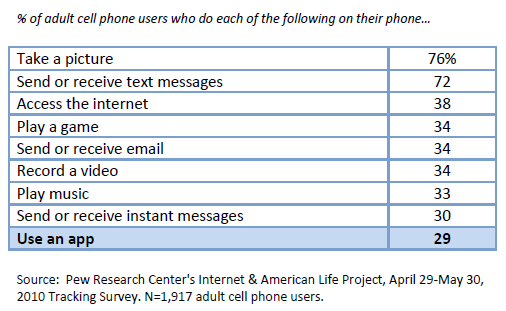
Where they see market growth (correctly), issue and candidate campaigns have to see stratification. There are two mobile Americas: one which uses their mobile phone for games, music, news, directions, shopping, updating social networks, and other varied pursuits – an “App Class,” if you will – and another which really looks at the phone simply as a simple communication device to pass information viavoice (and occasionally text and picture). About one out of three people look at their phone as a handheld computer.
If a campaign, therefore, is going to invest in an application, for instance, the design process has to consider that most people will not use it. That doesn’t mean pulling the plug on the app – in fact, because the penetration of app-driven phones keeps increasing, it’s only a matter of time before every campaign has to have a customized app. (Consultants, start your engines!) What it does mean is that a wise campaign will ensure their app does the things the App Class will want to do. As an example, it may be a better idea to have apps that connect with back-end campaign data to help precinct walkers and staff than to have apps that help people find their polling place.
Making online/mobile strategies count
Matt Lewis had me back on his podcast today, and we discuss the balance campaigns must strike between different tech tactics. Specifically, we chat about Florida gubernatorial candidate Rick Scott’s very deliberate decision to avoid text messaging in favor of email to announce his running mate. In this case, the Scott campaign decided that emails were more valuable to their campaign strategy than mobile numbers. (Given Florida’s elderly population, it was probably a wise choice. Also facto in the power of email’s reach – John Boehner actually sent an email update to his supporter list to draw attention to a tweet. It sounds redundant but it’s actually the best way to make the tweet gets seen.)
As Matt and I discussed, the rumor from Scott’s consultants is that he is not averse to spending money – so this was an educated decision.
I’m excited to see the implementation of good mobile strategy – and text messaging is going in some exciting directions. But too often, the people with resources to burn don’t stop to think through their online strategy. This is especially true with issue or candidate campaigns which use tools like Facebook for messaging, but really don’t know what to do with their 10,000-person follower list after everyone clicks the like button.
To use an old-school campaign example, imagine going door to door for a candidate. When the voter opens the door, you ask, “Hey, are you going to vote for my guy?” The voter says, “Yup!” and the conversation ends. You don’t take down their name, address, or phone number, or even ask if they’d like a lawn sign. The same is true if think taking action on an issue you care about ends when you send an email to your Member of Congress. Chances are, that email will be counted and deleted because the staff knows how easy it is for any crazy person to send them an email. (That’s why advanced follow up is always recommended.)
No matter how advanced your tactic, if it isn’t applied with some measurable and impactful result, it’s a waste of time and resources.
40Seats.com: A literal map to GOP victory
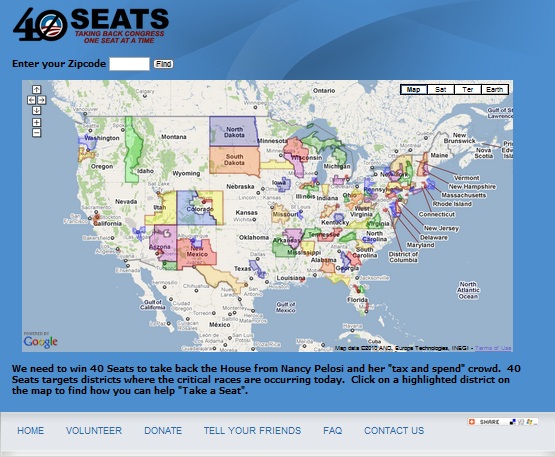
The historic highs Republicans are enjoying in this week’s generic ballot poll numbers are nice, but it alone won’t restore GOP control of Congress in November. A pretty cool website called 40seats.com literally provides a map to GOP victory in November by allowing potential activists to be connected to nearby Congressional races which are up for grabs.
Ballots aren’t generic – and in some cases Democrats have plenty of advantages. For instance, let’s say your Congressman had a long list of embarassments – maybe he famously accused an eight year old of attempting to carjack him, or promised to “earmark the [expletive] out of” appropriations under his purview, or said “I like to hit people” when describing his affinity for boxing, and/or had a birthday party interrupted by what eyewitness observers described as two girlfriends fighting. Yet, the people of your district keep electing him to the House, apparently for earmarks and giggles. But next door, maybe even in a Congressional district you lived in up until, say, June 28 of this year, your involvement could really help the folks on the ground.
40Seats gives you an at-a-glance view of what’s wrong with the incumbent, and gives users options to allow varying degrees of activity – from making phone calls to putting a yard sign out to donating to walking precincts:
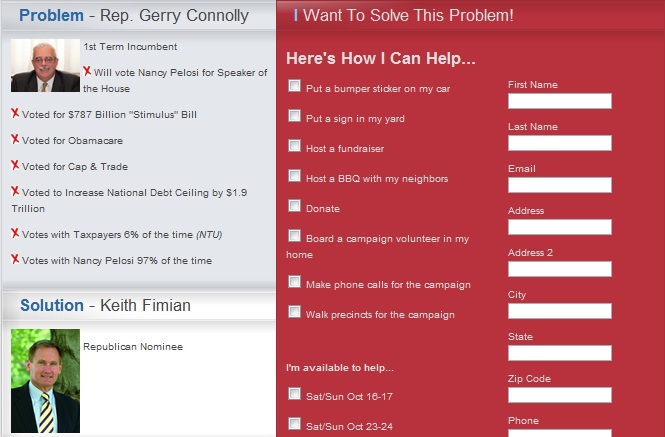
The credits indicate the site is mostly a mashup of tools that are open, available, and free – which is what makes 40Seats even smarter than it looks.
And no, sadly, Jim Moran is not targeted.
Digg, Reddit, and activists
 Anyone who seeks to build an online following should pay close attention to the hot steaming mess that Digg stepped in this week.
The social news site announced changes which sounded like a good idea (at least I thought so) a few weeks ago, changes which promised to expand Digg’s following by making it more accessible to outsiders. The one problem was Digg’s existing audience, which liked the way the site worked just fine.
Over the past 12 hours, Digg’s main news page has been riddled with submissions from competitor site Reddit – and it looks like Diggers offended by the site renovation are more than happy to help the enemy game the system, given the amount of complaints that have been flying about the redesign.
Digg’s mistake lies in not understanding what their community was passionate about. Diggers liked a community that worked on certain rules and had certain values, and changing those rules and values to let others in diluted what they held dear. Put another way, you can get more people at the Star Wars club meeting if you let the Star Trek people in; but the people who started coming to the meetings in the first place may not want more people if it means half the room will be wearing Spock ears.
Any membership organization runs a similar risk. People join groups – whether it’s a social news site, a political party, a club, or a gang – because of some common ground. When you peck away at that boundary, you risk alienating your members.
 Jim Eltringham