Sarah Palin ought to shut up for a while

There’s no good defense to the charge leveled by many on the left (and, unfortunately, the media) over the past few days that the shooting of Congresswoman Giffords was the result of Sarah Palin’s PAC website.  Similar to “Senator, when did you stop beating your wife?”, it’s a Kobayashi Maru question – there’s simply no way to answer without appearing defensive.

Sometimes, ridiculous charges speak for themselves.  The sick, twisted people who look at what happened in Arizona and see something that could only come from politics speak for themselves too.  Why sink to their level?

Unfortunately, some on the right have done just that, answering the shrill accusations of Keith Olbermann by pointing out that the alleged shooter Jared Loughner loved the Communist Manifesto.  No matter who starts a mudslinging fight, both parties get their hands dirty.

Pundit League blogger Brian Lehman has had the best response so far: indignation.  The charges that excited participation in the political process created an environment of violence only serves as a distraction – and thus cheapens the gravity of the atrocity.  Trying to mount a defense elevates the nonsense.

Bawling Boehner could learn from the Boss

The new Speaker of the House has an image problem.  After weeping in an election night victory speech and again in a 60 Minutes interview, John Boehner again shed tears when taking the gavel from Nancy Pelosi.  Now an established pattern, Boehner’s tears have David Letterman wondering if he’s on drugs.  Others simply wonder if this is the new status quo of American politics.  Either way, being “the guy who cries a lot” is a pretty open invitation to the brand of ridicule that would diminish a message.

Boehner might find some inspiration from a fellow Ohioan, the late George Steinbrenner.

In 1990, Steinbrenner appeared on Saturday Night Live during his commissioner-ordered sabbatical from baseball.  In one memorable sketch, The Boss played a convenience store owner who refused to fire employees, no matter how much they underperformed:

Where is it written if you don’t get results right away, you fire people? How would you like it everytime something went wrong, I just blamed you, the supervisor, huh? Let’s just fire the supervisor! Then I’ll hire some other guy, and something would go wrong and I’d fire him, and I’d probably rehire you!Then fire you again, bring in someone else, then fire him and rehire you again! Then fire and hire, back and forth until the whole thing’s just a big joke! Is that the kind of owner you want? Some yammering nincompoop in a fancy suit? No way you take that road, ’cause before you know it, you’ll probably be banned from running the entire company!

Three years later, Steinbrenner was back in baseball, but his self-deprecating sense of humor remained sharp.  He played himself in the 1994 movie The Scout, and filmed an unaired cameo for Seinfeld.  His public criticism of Billy Martin and Derek Jeter both became tongue-in-cheek commercials, nearly three decades apart.  The results of this were last year’s kind eulogies, which forgave many of his faults.

So what does that mean for the Weeper of the House?  Boehner would be wise to aggressively embrace self-deprecating right away – diminishing both his tendency to cry and his critics’ tendency to make a big deal of it.

Finally, Larry David can rest easy

Far be it from me to cast aspersions on a man in a cape, but I think Larry David’s New York Times column “supporting” the extension of the current tax rates might have been facetious.  (For David, of course, a higher tax rate would have minimal impact thanks to the residual checks that keep rolling in every time a rerun of Seinfeld is replayed.)

Well, now David and other folks who feel like they are earning too much can give back thanks to GiveItBackForJobs.org.  The site helps you calculate how much the government is allowing you to keep thanks to the extended tax rates, and lets you donate that money to a charity:

Americans who have the means should refuse to surrender to Senate Republicans. We should act, together, to give back our Bush tax cuts, by making donations to organizations that promote fairness, economic growth, and a vibrant middle class. GiveItBackforJobs enables joint action, by all visitors to this site, to redirect our Bush tax cuts to the wise and just programs that our government would promote if it had not been hijacked. As more and more Americans do so, GiveItBackforJobs will begin to replicate good government policy, outside the government and free from the grip of Senate Republicans.

You tell ’em!

Digging around the site, one thing stuck out to me (and also to the Wall Street Journal’s James Taranto): the organizers are all Ivy Leaguers, either professors or graduate students.  Clearly, these are smart people who understand that the economy will only grow if the people who are getting these tax cuts do something with the money they receive.

As a humble, state-educated supporter of their efforts, I submit the following suggestions for how the super-rich fat cats can help give back their tax cuts to create jobs and/or advance the social good:

1.  If they own a business, hire more people for crying out loud!

2.  Spend money on goods and services.  This will create more jobs for the people who produce them.

3.  Whatever you do, don’t give your money to some willy-nilly, inefficient group with poor oversight and accountability that wastes billions upon billions of dollars each year.

Obama’s play action

The big story at the infrequently traveled intersection of sports and politics this week is the President’s congratulatory phone call to Philadelphia Eagles owner Jeffrey Lurie about installing renewable energy equipment at Lincoln Financial Field.  During their discussion, they also mentioned quarterback Michael Vick, which seems to be drawing more attention.

There’s no word yet on whether the President will be calling the other team just north of DC on I-95, the Baltimore Ravens.  While the gave Vick a second chance, the Ravens have taken in wide receiver Donte’ Stallworth, who served a month for DUI manslaughter.  They have also stuck by linebacker Ray Lewis, who beat the rap on murder charges by rolling on his accomplices and went on to have an excellent career and win a Superbowl.  (By the way, did you know that a group of ravens is actually called a murder?)  On the other hand, Obama might be slow getting there – after all, the Eagles really gave Vick his second chance about a year and a half ago.

So why make this call now?

A possible explanation is to give his enemies something to talk about, and allow them to use a slow news cycle to work themselves into a lather about something that is, essentially, a non-issue.  Coming after a productive lame duck session, this could permit the administration to take a high road while its opponents chatter about Vick and dogfighting.  It would be the messaging equivalent of a draw or a play action pass – tricking the opposition into being out of position.

Of course, this isn’t a football game, but electoral politics – and voters don’t largely pay attention.  Riding a winning streak as the President is, why expose your administration to negative messages by wading into issues that people actually care about?

Joanne Bamberger of AOL’s Politics Daily points out that Pennsylvania’s electoral votes will be in serious play in 2012, and suggests Obama is building good will now.  That certainly makes sense, but 2012 is still a long way away, and making nice with fickle Eagles fans now won’t necessarily pay dividends in 22 months.  Heck, if Vick throws four interceptions in a playoff game, or isn’t playing with the Eagles next year, those comments may do nothing in 22 months. Much more important to Obama, as Bamberger alludes, is Lurie’s checkbook – which, when not being used to pay rehabilitating NFL players, makes large donations to Democrat presidential candidates.  And keep in mind that Lurie, and not the administration, made the details of the conversation public.

It is most likely that the President did not intend for the conversation to be public – not that it was secret, but just that it wasn’t intended as a public statement.  And, in that private conversation – which was, remember, also about renewable energy – the President took some time to blow even more smoke up the rear end of a potential donor.

It must have worked – otherwise, Lurie wouldn’t be so proud about spilling the beans.

Jeter vs. the Yankees: Framing the debate

The dance between Derek Jeter and the Yankees started as a civilized and friendly waltz, but has quickly devolved into the gang fight in the video for “Beat It.”  Each side is almost taunting the other to consider a universe where Jeter is not with the Yankees.  And of course, unlike most salary negotiations which are confidential, the fight is public.

What’s fascinating is the attempt by Jeter to frame the negotiations in the most favorable light:

[A] baseball industry source said the Yankees have provided Jeter and [Agent Casey] Close with detailed statistical and market analysis to support their contract offer, including comparisons between Jeter and other shortstops and middle infielders throughout baseball.

That is the way Jeter’s last contract, the 10-year, $189 million deal that expired with the end of the 2010 World Series, was negotiated, based on Jeter’s contention and the Yankees concurrence that Jeter was the second-best shortstop in the game, behind Alex Rodriguez, who had just signed a 10-year, $252 million deal with the Texas Rangers.

This time, the Jeter side is said to not want Jeter’s value to be judged against that of other shortstops, preferring to base his worth on his legacy as an all-time great Yankee.

This is the equivalent of staying on offense in a political campaign or a public relations battle – framing a debate to be about the issues on which your side is strongest.  And it’s hard to argue with Jeter’s place in the prestigious Yankees pantheon now – an argument he couldn’t make in 2000, after just his fifth full year in the majors.

In other words, if this “campaign” is about wanting to see Jeter continue to pursue Yankees history – such as becoming the first Yankee ever with 3,000 hits – Jeter wins the negotiations and the hearts and minds of the fans.  If the “campaign” is about the Yankees having roster flexibility, phasing out aging players, and not allowing their team to become bogged down by expensive contracts to 40-year-old players (again), then the front office wins.

Of course, the “campaign” is always about the World Series trophy for the Yankees and their fans (including me), giving the Yankees an important advantage – after all, no matter how angry fans get at the idea of Jeter walking away, a 2011 World Championship would inflict a case of mass amnesia.  So regardless of whether Jeter or the Yanks’ front office blinks first, the success or failure of this campaign, like so many others, won’t be fully appreciated until the first week of November.

Americans for Prosperity helps lower holiday week productivity

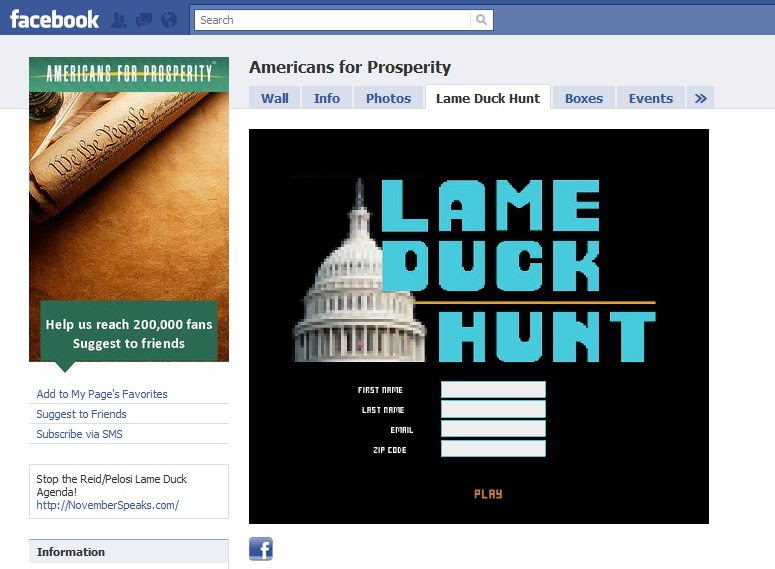
Channeling 1980s classic Nintendo games, Americans for Prosperity has a fun game called “Lame Duck Hunt” on one tab of their Facebook page.

The game isn’t all that challenging, though the gloating images of Nancy Pelosi and Harry Reid that taunt you when you miss make it slightly more frustrating than it needs to be.  This isn’t a game review, though, it’s a strategy review, and there are a few things AFP gets very right.

First, you can’t play the game without surrendering an email address and a zip code, meaning that anyone who participates in this little time-waster tells AFP which Congressional district they live in and how to get in touch with them.

(You do have to re-submit your information each time you play, which discourages repeat users.)

Once you’re in, you predictably shoot down ducks, which then disappear in a cloud of feathers and leave behind warnings like “Higher Debt,” “Card Check,” or “Huge Tax Hikes” – the policies which ostensibly could be the result of the lame duck Congress.  You can then share your score with friends.

This is where AFP’s aim starts going awry.  The game never offers any backing for the labels – there are no details about suggested or proposed legislation which would lead to union bailouts, huge tax hikes, or higher debt.  The message at the end invites me to “visit the Americans for Prosperity website” for more information – but there is no link.  Contrast that with the game released by the U.S. Chamber of Commerce last week, This Way to Jobs, a digital version of Chutes and Ladders which outlined the pitfalls of launching a small business.

Further, I have played the game several times (for… uh… research, for this post – that’s the ticket).  That means I’ve entered my email address multiple times, and haven’t yet received a follow-up auto-responder email.  After anyone plays the game, a quick follow up email inviting further action – while the issues are still fresh in the player’s head – could help AFP determine who is really on board with their policy agenda and who just hates video ducks.

Ideally, the game over screen and follow up communication would also allow users to identify what future actions they would be willing to take.  At the very least, it would invite a user to become a fan of AFP’s Facebook page.

These extra steps may not help with the lame duck agenda, but 2011 will be a critical year as the Republicans and Democrats try to set themselves up for success in 2012.  Lame Duck Hunt is a cool idea, and well-timed – between the impending holiday and people taking off work early to beat traffic, Thanksgiving week ranks only ahead of the dead week between Christmas and New Years in terms of productivity.  To that end, it’s guaranteed to bring web traffic – and it looks like AFP was content with that.

Same election, two messages

In the week of fallout since the most recent ground-shaking election day, Democrats and Republicans alike have been on the airwaves, trying to put it in context.  But have you looked at their postmortems side-by-side?

Marco Rubio owned the GOP message on election night:

But we know that tonight, the power in the United States House of Representatives will change hands. We know tonight that a growing number of Republicans will now serve in the Senate as well. And we make a grave mistake if we believe that tonight these results are somehow an embrace of the Republican Party.

What they are is a second chance. A second chance for Republicans to be what they said they were going to be not so long ago. You see, I learned early on in this campaign – in fact it’s what propelled me to enter it – that what this race was about was about the great future that lies ahead for our country, a future that Americans know is there for the taking. But it requires actions on our part.

The theme of the Majority That Lost Its Way has been a consistent message for Republicans since 2006 – in fact, less than a year into the Pelosi Era, Rep. Tom Feeney argued that a philosophically adrift GOP had squandered its power:

We lost the majority in 2006 because Republicans could no longer convince voters that we were the party of fiscal restraint and traditional values. Polls in the closing days of the last election showed that a majority of voters felt that Democrats were more trustworthy when it came to issues of spending, taxation and general economic development — that we could no longer be trusted to fight for the limited government and personal freedom that have always been cornerstones of our party’s beliefs.

Contrast that to the Democrats’ lines about “what it all meant” – including the President, who has been vocal in chalking up the Democrats’ failures to messaging strategy:

What I didn’t effectively, I think, drive home, is that we were taking these steps not because of some theory that we wanted to expand government. It was because we had an emergency situation and we wanted to make sure the economy didn’t go off a cliff. I think the Republicans were able to paint my governing philosophy as a classic, traditional, big government liberal. And that’s not something that the American people want.

The first obvious thing is that Republicans, even now, seem contrite for driving the car into the ditch when they held most of the keys from 2001-2007.  Since Democrats haven’t had the benefit of time – and still have the responsibility of governing – contrition may simply be a luxury they can’t afford at the moment.  Still, the difference in where each party lays blame for still-somewhat-recent losses is stark: Republicans blame themselves for not living up to the expectations of the people, Democrats blame the perception that they didn’t meet expectations.

Another underlying current worth noting in all of these quotes is that, despite apparent sea change in the election of 2008, America remains a nation that trends philosophically toward smaller government – with both parties trying to frame their arguments through that prism.


Krugman gets one right!

Paul Krugman doesn’t know much about economics, but he had a good column on political messaging today – specifically, the talking point that President Obama should have focused more on the economy in the first two years:

After all, are people who say that Mr. Obama should have focused on the economy saying that he should have pursued a bigger stimulus package? Are they saying that he should have taken a tougher line with the banks? If not, what are they saying? That he should have walked around with furrowed brow muttering, “I’m focused, I’m focused”?

Sure, Krugman predictably goes on to crow that his calls for bigger stimulus and economic recovery programs that spent more borrowed money and placed government fingers on the scales of economic markets, but at least he combines his criticism with an alternative.

In some ways, this is the same message Republicans are now trying to deliver, post-campaign – that it wasn’t a lack of focus or messaging that lost the recent mid-terms for the Democrats, but the content of the policies the Democrats championed for two years.


3 Reasons why the tea party movement won this week

The conventional wisdom is that Tuesday was a mixed bag for the tea party movement thanks to losses of tea party-backed candidates in Colorado, Nevada, Delaware, and Alaska.  Even outlets on the right feel like it was a disappointing showing.  Some moderate Republicans are grousing that tea party enthusiasm in Nevada and Delaware cost the Republicans Senate seats.

If your context is two weeks instead of two years, then that makes a lot of sense.  In fact, if think long-term both in the past and the future, tea partiers had much to be proud of on Tuesday.

1. The tea party movement gave grassroots activists a reason to be excited.

Remember the campaign of 2008, when cool, smooth Barack Obama trounced that doddering old fool John McCain?  Remember 70% approval ratings and mastery of all forms of media, even the ones you hadn’t heard of yet?  Remember Pepsi changing its logo to look more like Obama’s?

Obama wasn’t just a politician when he came into office, he was a pop culture phenomenon.  What’s more, the enthusiasm his campaign engendered had turned red states like Indiana, North Carolina, and Virginia blue.  Meanwhile, and more important, as Obama spoke of health care and financial reform, Republicans could only play defense as the “party of ‘No.'”  The popular image was of a party bereft of ideas.

Would you sit in a cramped campaign office and make phone calls for that party?

As the tea party movement got underway, it gave conservative activists something productive to do – and the chance to rail against the President’s programs in well-organized displays of opposition that also built a solid political infrastructure.  The smart conservative groups – like FreedomWorks – jumped on the bandwagon right away, recognizing the value in an organic movement of politically passionate individuals and helping set them up to take meaningful action later.

2. Tea party rallies set the terms of the debate over Administration initiatives.

To understand how tea party activism changed the debate over health care, consider that the health care industry was lining up behind the Democrats.  If you were in the industry, the bill seemed inevitable and the smart move was to figure out how to get some federal money to wet your beak.

Tea partiers responded to the health care bill, the automobile industry bailouts, and economic recovery initiatives like TARP and the stimulus packages with a consistent small-government message. Republicans still burdened by the yolk of a surprisingly big-government Bush Administration could not initiate this message, but they sure could respond to it.

This week’s election was framed by a philosophical debate over the role of government.  That had a lot to do with the fact that, for all the jokes about misspelled signs, the tea party movement had a pretty consistent message.

3.  The 2010 primary season was a wake up call to 2012 Republican candidates.

Mike Castle should have been able to beat Christine O’Donnell the way the hare should have been able to beat the tortoise.  So it’s tough to say that an easy primary would have resulted in a cakewalk to November victory.  Ditto for the established Nevada Republicans running against Harry Reid, who found themselves on the sideline after Sharron Angle’s upset.  It is tempting to play “shoulda woulda coulda” with the primary results, but the fact is that these primary losers chose not to engage an excited base of conservative activists for fear of not appearing moderate enough to win a general election.  They chose poorly.

Meanwhile, John McCain recognized the early threat of a challenger, acted like his primary was an election and not a coronation, and is still a Senator.  In winning re-election, McCain demonstrated that tea partiers aren’t out for blood, but they do want elected officials who are responsive to the folks they represent.  And any incumbent or favored Republican for a 2012 office now can get a nice head start.

If Virginia’s George Allen wants a rematch with Jim Webb in 2012, he will have to understand he has work to do among Virginia conservatives.  Long-time GOP incumbents like Olympia Snowe, Orrin Hatch, and Richard Lugar – and even first-time incumbents like Bob Corker – now have a year and a half to start making nice with their respective bases.  There may still be messy primary battles, but the so-called “better candidates” who could deliver general election victories will be ready for them.

Incidentally, a big bonus win, this splash of cold water does not include Sharron Angle or Christine O’Donnell actually winning races and being Senators – which might have been distracting and damaging to ongoing GOP efforts.  Those two darlings of media ridicule are gone now

The tea party movement is in fact a political movement and not a political party.  Because of that, tea partiers have the luxury of having their effectiveness judged over multiple election cycles.  To use an example on the other side, one might have said after the 2004 election that the online left “netroots” were a failure – Howard Dean didn’t win any primaries, and they didn’t knock off President Bush in a tight election that was winnable for John Kerry.  But in a parallel to the 2010 Alaska race, they defeated Joe Lieberman in a Democratic primary in 2006 and formed the base of an impressive grassroots effort for Obama in 2008.  Similarly, the real measure of the tea party movement – as either a one-cycle phenomenon or a long-term grassroots movement – will be clearer in 2012.

A Purple Congress: The best of all possible outcomes

Last night’s results – a historic wave of pickups in the House along with key gains that did not achieve a majority in the Senate – is the best possible playing field for Republicans nationally.

The reality of the Senate results is that the electoral map was bad for the Republicans in 2010 – but in 2012, counting independent seats in Vermont and Connecticut, Democrats are defending 23 of 33 seats up for re-election, with only one or two Republican seats obvious pickup opportunities.  (Plus, the Tea Party successes of 2010 should serve as a cautionary tale to incumbents like Orrin Hatch, who might not make the same mistakes that candidates like Mike Castle did.)

The Republicans did, however, scored a convincing win, and now control a legislative body – an important factor in a nation that buys as many Yankees, Cowboys, and Lakers hats as America does.

That means that Republicans can be proactive legislatively, and articulate a vision for the nation. And it also means that vision will run into a legislative buzz saw, because the Democrats control the other half of Congress and the veto pen.  In that fog of sawdust, who becomes the “Party of ‘No'”?

The GOP is in the enviable position of being, to paraphrase Reggie Jackson, the underdog and the overdog at the same time.

Of course, this means putting forward policies, and as the Democrats discovered, once you put something on paper it becomes a target.  And two years is, apparently, an eternity in politics.  But if Republicans can position themselves as the active minority party, their chances in the Presidential and Senate elections in 2012 will greatly improve.