Benchmarks for 2010

It isn’t the most refined ad in the world, but in a post at RedMassGroup Massachusetts Republican Congressional candidate Tom Wesley is holding incumbent Rep. Richard Neal’s vote in favor of the health care bill against him:

Neal is pretty entrenched in MA-02, having not even faced a Republican challenger since 1998.  No Republican has represented the district in Congress since 1949.  But with depressed, blue collar economic areas such as Springfield and Chicopee, there may be a chance for Wesley to at least make a representative effort if the Republicans can hang the health care bill (and it’s price tag) on Democrat incumbents.  While 45% of the vote in November 2010 wouldn’t put Wesley in office, it might be a sign that Congressman Neal would head back to Washington, D.C. in the minority party.

How many friends do you get to keep?

The Sunlight Foundation went into the weekend with a hit piece on the much-maligned re-designed GOP.com.  Over at TechRepublican, James Richardson started the week with a well-researched rebuttal, noting that Sunlight missed a couple of items in the shadows in decrying the projects price tag.

But for the site’s well-documented technical faults, on the internet content is king, so there’s at least reason to laud the Republican new media operation:  The Facebook Friendship Fairness Czar application.  The application tallies the number of your friends and assesses a “tax” reflecting how many you have over the average Facebook user’s 120-friend total.  It’s a pretty neat way to needle the Obama Administration’s tendency to entrust policy decisions to executives with no Congressional oversight.  The postcard alerting you of your tax is actually kind of funny, too:

friendship fairness

Facebook is a necessity for any new media operation – even MySpace knows that now.  That means finding creative ways to connect and keep people coming back.  Even if GOP.com has its problems, at least the Republican party is thinking strategically.

Gallup-ing to the right

Fellow UMass alum Dan Flynn points out Gallup’s evidence that Americans are trending more conservative in 2009 than they did in 2008.  The most important aspect of this revelation is the cause: apparently, independents are shifting right. And this wasn’t just self-identification: conservative positions on government involvement in business, union influence, and even gun rights became more popular.

Note that these numbers reflect people’s issue position and not necessarily their political party preference.  As the Republican party is finding out in NY-23, the two are not necessarily one and the same.  Even if the GOP tallies a pair of victories in New Jersey and Virginia next week, the lessons for a return to power nationally may be learned in upstate New York.

New and improved but with room for improvement

GOPscreenshot

The Republican Party re-launched GOP.com today.  In addition to discussions about the party platform, the site includes multiple opportunities for grassroots participation.  The home page shows the latest from the most important social networks.

These are all positive elements, and the timing is good – Republican excitement is naturally regenerating after the defeats of 2006 and 2008 just like a starfish regenerates an arm, and this provides an channel for that excitement.

The site seems to be a bit slow, though – which makes it tough to explore since the content is spread out fairly widely across the site.  With multiple blogs and action centers, the site has lots of nooks and crannies.  That’s probably better in the long term, but as an infant site, GOP.com looks a little light on content.  Sub sections feel a little barren.

Because content is king, the Republican Party will need more meat on the bones.  Since they have good avenues for user generated content, that’s more about increasing visibility – something they should have the infrastructure to do anyway.

Hope comes from more than deep pockets

The San Francisco Chronicle’s headline over a story about the California Republican state convention was correct: “California GOP Sees Hope On the Horizon.”  But they missed what may be the most important quote about the prospect of Republican prospects in all 50 states:

California Senate Republican Leader Dennis Hollingsworth urged party members to reach out to supporters of the anti-tax, anti-government tea parties that have been held across the country over the past several months.

“Here’s the challenge: They’re angry at everyone,” Hollingsworth said. “We have to make sure to earn their trust. These folks have to realize that their natural home is the Republican Party.”

During a recent friendly debate, a liberal friend told me the Republicans should ignore the tea-party types.  “Those people are going to vote for Republicans anyway,” he reasoned.  Hollingsworth isn’t so sure, though – and he has it right.

Hollingsworth’s decision to take nothing granted is reminiscent of an old political legend.  Tip O’Neill, former Speaker of the U.S. House and one of the most powerful politicians in the country, allegedly ran into an old acquaintance on Election Day one year.  This acquaintance, a little old lady who had known the Speaker for decades, mentioned that she had not voted for him; when the incredulous O’Neill asked why, she supposedly answered, “because you never asked me.”

Giving the public options

The battle lines on health care reform are pretty clear, but what isn’t as clear is what each side stands for.  Both Democrats and Republicans have been talking about competing ideas, but the overarching debate is actually one about governing philosophy – and polls still show that the public is somewhat skeptical of the Democrat ideology.

The Democrats’ plan includes a national insurance plan – the now-famous “public option,” a cheaper version of every other insurance plan that somehow, our leaders assure us, won’t put those other insurance companies out of business.  The Republicans’ plan involves driving down costs by limiting liability reform, but there’s a more interesting tidbit buried deep down in their discussion: the idea of each person buying their own insurance, made easier by tax incentives.

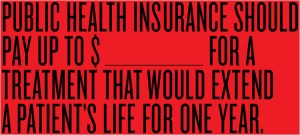
Unfortunately, the GOP isn’t trying to change the terms of the debate – something they desperately need to do.  Those who seem to support the Obama plan are helping a bit.  A New York Times Magazine article makes a case in favor of public health care rationing (a concept even the administration avoids like a plague which can’t be treated by an in-network provider) and in doing so, uses the following graphic to make their point:
19health-600

It’s a valid question, and one the “public option” will have to answer – maybe not during the legislative process, but certainly when put into practice.  The first participant in the ABC Obama Health Care infomercial asked a similar question; the President sidestepped and did not answer.

This is a powerful strike against Obamacare, and one Republicans can exploit.  But eventually, bashing health care reform proposals will not help the GOP win elections.  The other side must advance their own brand of health care reform – something completely different, although the seeds are, as aforementioned, already planted.

Our health care system as it currently exists is tied to employment – much like other benefits, such as a retirement pension, have been for decades.  If you work in the same job for a long period of time, that’s good.  But as the American worker becomes ever more likely to switch jobs several times during a career, the employer-based model is simply not as effective.  We no longer live in a company where people get jobs out of high school or college, work for fifty years, and get a pension and a gold watch upon retirement.

A system which promotes portable, individually-purchased health care and health insurance would not only help expand people’s control over their health care, it would drive costs down.  Current health insurance costs are often inflated by the existence of insurance; care for uninsured patients currently costs less than care for insured patients.

No election was ever won on defense, and Republicans – and, for that matter, conservatives – can ill afford to let their opponents draw the battle lines.  In fact has already started, with President Obama claiming the opponents of his plan are “defending the status quo.” As long as this message resonates unanswered, Obama can continue to claim the middle ground while painting his opponents as reactionary forces dug in to withstand change.  Republicans must make their own case that their proactive solutions are better than the opponents.


No offense, but #$@& Alaska…

Sarah Palin may be the most scrutinized governor in the history of Alaska – a state that many Americans probably didn’t actually know was a real place up until last August.  Her resignation has only stoked that attention – and as Stanley Fish wrote in yesterday’s New York Times, media coverage refuses to take her words at face value that she feels the political system is broken despite the era “hope” and “change” that was supposed to be ushered in last January.

Here are some economic facts worth considering: Ben Stein, the former Nixon speechwriter who gained fame as a bit player in John Hughes movies in the 80s, commanded $30,000 per speech when he hit the college speaking circuit for Young America’s Foundation a few years back.  Palin could likely pull down $35,000-$40,000 a night speaking to packed college auditoriums.  In other words, she could probably pull down the annual $125,000 salary of an Alaskan governor inside of a week.  Not to mention that a wise PR director would make sure she had local TV and radio appearances.  And this doesn’t even take into account corporate speaking engagements, which she could probably charge double or triple for.

It all adds up to a lot more than most 45-year-olds earn on a yearly basis – especially 45-year-olds with five kids and a grandchild.  But there’s as many political reasons why her choice may be right for her as there are economic reasons. If you were Sarah Palin and had something to say about the state of the country, which would be a better platform for you – Governor of Alaska, a political office where you have constant legal challenges and criticisms, or giving speeches from coast to coast for a week or two a month, commenting on radio shows here and there, and writing books and opinion pieces?  And if she wanted to start her own think tank or 527, there are plenty of people who would line up to give her money – her already well-supported PAC reported a spike in fundraising after her resignation.

Given that her first exposure to national politics resulted in a steady drumbeat of opposing voices calling her a dolt at best and an unfit mother at worst, this may be the avenue to engage in the national debate on her own terms – and to reposition herself if she wants to make a future run for the Presidency (which, incidentally, only pays about $400,000).

“Politically speaking, if I die, I die.  So be it,” said Palin on Good Morning America – reflecting the candor which attracts her most dedicated followers.  She may not want to get back into the fray of electoral politics, but Palin is far from politically dead.

Question for the President

With his last health care town hall drowned out of the media spotlight by l’affair Sanford and the death of Michael Jackson, President Barack Obama is hosting another one – this time online.  (Which is probably strategically better – after all, he won’t have to worry about having McDonald’s commercials playing in between his calls for preventive medicine, as happened on the ABC telecast.)

The president is inviting questions on YouTube – and TechRepublican contributor Jonathan Rick has obliged with a good one:

“Freedom Republicans”

Through CQ Politics today I caught Senator Jim DeMint’s Saturday Wall Street Journal piece about the future of the Republican Party.  One of the party’s most conservative voices in the Senate makes an important overture to moderate Republicans who Arlen Specter’s defection.

DeMint ties Republican failures to the Bush administration and the Republicans most closely allied with them – a likely preview for what Specter faces in his upcoming primary and general election.  He also frames the Republican argument very succinctly as the pursuit of freedom.

I’ve heard this before, from one of the GOP’s most liberal voices, Rudy Giuliani, who at the 2004 Republican Convention said the Republican Party was “at its best” when extending the cause of freedom.

Aside from being an easy message for unity, Senator DeMint’s train of thought states exactly what the Republican Party is for – rather than what it is against.  Complaining about spending and a growing federal government makes it very clear what a politician is against, but it doesn’t give an alternative; championing the cause of freedom offers voters a clearer choice.

Building the GOP’s future on five pillars

TechRepublican’s new editor, Meghann Parlett, reported on a conference call held by the GOP’s new New Media Director, Todd Herman.  Amid all the newness was Herman’s five (new) strategic pillars for online organizing, which are pretty good:

1.  Use New Media Properties to Expand GOP Reach.

2.  Acquire Actionable Data.

3.  Broadcast Impeccable Logic. (This involves creating a repository of online conservative thought.)

4.  Curate Passionate Stories.

5.  Establish Real Connections with Voters.

I suppose #3 might be a load-bearing pillar – a nod to conservative activists who feel the national party is out-of-touch with the rank-and-file activists.  But I don’t like it.  First off, the party should avoid getting into the business of defining conservatism, because Arlen Specter does have a point: what plays in Tuscaloosa may not play in Philadelphia, or vice versa.

The Republican Party has enjoyed success when it leaves power in decentralized hands.  The 1994 takeover of Congress and subsequent policies were great examples.  The 1994 campaign had no national figurehead, and battles fought and won on a district-by-district basis added up to a large national victory.  Similarly, a recurring policy theme involved pushing responsibility – and freedom – out to the states to ease the over-burdened Federal government, a theme which resulted in a reformed welfars system and budget surpluses.

A “central library of conservatism” may be asking the RNC to do too much.  Of course, I suspect this will be window dressing – a spot on the website with links to conservative think tanks while the rest of the team focuses on doing what a political part should: getting people elected.

Many of the others are good, basic ideas that encompass the “blocking and tackling” of what a party should be doing – such as fostering communication with potential voters and amassing as much data on the electorate as is possible.  These are things the Republican party has done well when their famous microtargeting and 72-hour get out the vote strategies were in full display in 2002 and 2004; Herman is wisely updating them to reflect the technology available today.

One of Herman’s pillars, however, strikes a particularly innovative chord: the concept of amassing “stories.”  Logic wins a debate but emotion wins elections.  Stockpiling stories will help create that emotional appeal – and since online media is probably the most efficient way to do it, Herman has apparently recognized that it’s a task that he’s uniquely positioned to help out with.