Christie: Palin Redux?

So far, 2016’s most buzz-generating possible Presidential candidate in Governor Chris Christie.  Every move the guy makes in recent weeks has been viewed through the lens of implications for 2016.  Was he too chummy with the President?  Was he too combative with the Speaker?  Is he moderating himself to appeal to independents?

Back in 2011, it looked like Chris Christie could have stepped into the Republican primary and carved out an immediate niche as a forceful voice opposing government largess.  At the time, some idiot even said that political memories are short, so if he wanted a shot 2012 was his time.   That might prove true now, as Christie finds himself as the most prominent nationally-recognized Republican in the public consciousness.

It’s the same spot Sarah Palin found herself in following the 2008 campaign.  Suddenly, the governor of Alaska was the standard bearer for a party in disarray, while still trying to play the role of maverick outsider.  Palin proved ill-equipped.  (After all, it’s tough to look Presidential by shutting down “lamestream media” contact to communicate through Facebook posts.  Crashing the Iowa straw poll to steal headlines wasn’t particularly helpful either.)

Christie isn’t likely to step into the same pitfalls as Palin, but he has a 2013 re-election effort that will likely be colored by the shadow of 2016.  Factor in that the national media already accepts  Christie as the GOP front runner, and it makes for a pretty big target the governor will have to lug around with him for a while.

Lack of enthusiasm? No problem.

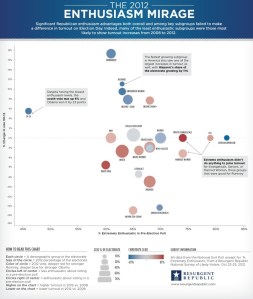
Resurgent Republic posted this infographic last week (which I swiped from an email from Pennsylvania political consultancy ColdSpark Media):

RR_Infographic

The full-size picture does it more justice.  It charts various groups, how strong their turnout was in 2012 versus 2008, and how excited the said they were to vote.

In the last month and a week, it seems like no two Republicans can talk to each other without a discussion of What Went Wrong.  It’s a great conversation because there’s no wrong answer.  Every person who says, “I’ll tell you what Romney missed out on…” and then fills in a reason is usually right.  So the tactical deficiency in that picture is a puzzle piece, but it isn’t the whole problem.

All that said, check out the bluest of the blue groups, staunch Obama demographics like single women, 18-29 year olds, and Hispanic voters.  Isn’t it funny that the blue groups that were least excited about voting but voted more than the red groups that were more excited?  Part of the vaunted Obama turnout operation was figuring out who needed to vote and doing what it took to drag them to the polls; this sure makes it look like the credit was well-deserved.

Careful what you wish for…

Politico points out today how the Obama 2012 machine has been thrilled with Rick Perry’s attacks on Mitt Romney, occasionally piling on to wound the erstwhile Massachusetts governor.  The reasoning goes that Perry (or anyone else from the GOP field) would be easier for the President to beat in the general election.

That may sound familiar.  In 2008, with their own nomination pretty much decided, some Republicans went to the polls in late primary states intending to affect the Democratic ballot.  In Texas, a vote for then-candidate Obama was a way to put the final nail in the coffin for the Clinton Era.  In Virginia, some Republicans insisted on voting for Obama to encourage the Democrats to nominate an inexperienced, first-term Senator as their nominee.

Whether as part of an “Anybody But Hillary” movement or whether they believed that Obama was the weaker candidate, would those Republicans vote the same way if they could go for a spin in Doc Brown’s DeLorean?   If they had a hot tub time machine, do you think the 2007 Patriots would have rooted a bit harder for the talented-on-paper Packers or the Cowboys to come out of the NFC for Superbowl 42?

Similarly, Team Obama may think Rick Perry, with his low poll numbers and early campaign missteps, would be a more attractive opponent in November 2012.  It certainly looks like that match up would favor the President prohibitively – and the President looks good up against any of the other GOP hopefuls, too.  It isn’t even November of 2011 yet, though – and a year is a long time.

Presidential Power Rankings: 10.22.2011

Every major professional sport except college football has an entire system to determine the best team. That doesn’t stop those covering each sport from postulating who the best team is on a week-to-week basis. Since the Presidential race has become an odd mix of reality television, sports, and horse racing, why not do the same?

Here’s what my white board looks like this week:

1. Barack Obama. Dean Wormer: Dead! Niedermeyer: Dead! Gaddafi: Dead! The President looked Presidential this week, and American Crossroads polling indicated his “tax the rich” rhetoric has a chance to resonate.

2. Mitt Romney. The sheen of inevitability was nicked in the last debate, but Romney continues to line up endorsements.

3. Rick Perry. The signs of life Perry showed in the Nevada debate should re-energize supporters, donors, and the rest of the campaign infrastructure for a short time. His points on domestic energy development, which he has been bringing up in debates consistently, give him a positive issue to run on that no other serious candidate is talking about.

4. Herman Cain. Cain is driving the Republican discussion with his 9-9-9 plan. The row over his pro-life beliefs won’t be a deal-breaker because there is no meat to it, but may be indicative of a more serious problem with message discipline. His ability to do the blocking and tackling it takes to build an election-winning organization is still suspect. Still the front-runner for the Vice President slot on the GOP ticket.

5. Ron Paul. Paul is still the life of the party. The troop withdrawal in Iraq will give him another chance to tell the rest of the party he told them so.

6. Michelle Bachmann. Her staff in New Hampshire wasn’t all that important, anyway. Iowa is Bachmann’s make-or-break playing field.

7. Chris Christie. Despite denials and endorsements to the contrary, still more likely to be President in 2013 than the last two people on this list. On the outside chance that Romney and Perry wind up in a brokered convention stalemate in August 2012, Christie looks like an obvious choice to unite the party. Sure, it’s a long shot, but still more likely than…

8. Rick Santorum. Santorum looked shrill and childish going after Romney in the Nevada debate, but he made his points. He could wind up as the kamikaze of the debate season.

9. John Huntsman. Still waiting for his mojo. His candidacy is tough to define, though his shots at Herman Cain in the previous debate were witty and clever.

Applauding the extreme

A thoughtful E.J. Dionne editorial this weekend lauds Dr. Martin Luther King Jr.  Obviously, that’s nothing new – outside of Klansmen and contrarians,  there aren’t a lot of people writing anti-MLK op eds.  What’s striking about Dionne’s piece is that it points out King’s radicalism:

This focus on calling out injustice — pointedly, heatedly, sometimes angrily — is what the people of King’s time, friend and foe alike, heard. It made many moderates (and so-called moderates) decidedly uncomfortable.

Anyone tempted to sanitize King into a go-along sort of guy should read his “Letter from Birmingham Jail,” from April 1963. It’s a sharp rebuke to a group of white ministers who criticized him as an outsider causing trouble and wanted him to back off his militancy…  And recall King’s response to being accused of extremism. Though “initially disappointed at being categorized as an extremist,” he wrote, “as I continued to think about the matter I gradually gained a measure of satisfaction from the label.” Jesus, he said, was called “an extremist for love,” and Amos “an extremist for justice.” The issue was: “Will we be extremists for hate or for love? Will we be extremists for the preservation of injustice or for the extension of justice?”

For a shorter version of that last quote, thumb over to Barry Goldwater‘s page in Bartlett’s: “I would remind you that extremism in the defense of liberty is no vice. And let me remind you also that moderation in the pursuit of justice is no virtue.”

In fact, Dionne’s characterization of King invites comparison to the coverage of the movement for smaller government.  (To his credit, Dionne has shown he recognizes this parallel to a degree; he’s one of the few left-leaning columnists able to discern the tea party from Republican politics.)

It deserves mentioning that there are plenty of differences: Tea party rallies aren’t being broken up with fire hoses, rubber (or real) bullets, tear gas, or the releasing of any hounds.  King and his allies risked life and limb to make a stand for their big idea.

But they did have that big idea, and believed in it so much that compromise was unacceptable.  People were either equal, or they weren’t; they were either allowed to attend the same schools and drink from the same water fountains, or they weren’t.

With that in mind, let’s look at our policy landscape here in 2011.  There’s a snowballing debt thanks to a governing culture that allows government to spend lavishly to help build a society and direct an economy.  The debt puts at risk the stability of our currency and by extension things like houses and other long-term investments.  More important, the services financed by that debt are generally sub-par and fail to accomplish intended goals.

Either that governing culture changes – reigning in spending, allowing people to make their own decisions about health care and retirement, and eliminating waste – or it doesn’t.

The casualties of this movement include moderate and Washington-centric politicians – such as Mike Castle and Bob Bennett in 2010.  It makes “moderates and so-called moderates” (to borrow Dionne’s term) like Sen. Orrin Hatch uncomfortable.

But if you believe strongly that the government was biting off more than it could chew to deliver failing policies, and that the promises of Social Security, Medicaid, Medicare, and other public assistance programs are a bad check which will be sent back marked “insufficient funds,” you should be fighting.  And supposed allies who favor a “wait-and-see” approach while continuing to conduct the business of government the same way it has been conducted for 80 years aren’t really allies.

That isn’t “extremism,” it’s political advocacy – and as observers from King to Dionne have understood, it’s how policy making works.
Ron Paul is not suffering from media bias

A strong and close second-place finish at the Ames Straw poll for Ron Paul ignited almost no media coverage whatsoever – until some folks realized that Paul wasn’t getting any media coverage, which then became the story.  It’s one thing for Paul supporters to air their grievances about being ignored, but in a rare moment of astute political insight, even the Daily Show called out the media’s Paul-sized blind spot.

Charles Krauthammer had a valid answer: Paul will not be President.  He will not be as successful when the straw polls give way to caucuses, and he will do worse yet when the decisions come from the ballot box.  For a media covering horse race politics, giving serious ink to Ron Paul is like giving ink to Mr. Ed – he’s interesting, but he ain’t beating Secretariat, or any other horse.  On the other hand, while Tim Carney admits that Paul is a bad candidate, he points out that the Congressman has been consistently proven correct in his assessment of domestic and foreign policy over several years.  Stewart quips that Paul planted the small government seeds that germinated into today’s grassroots tea party movement.

Carney and Stewart are correct.  The real issue is a political press that doesn’t understand politics beyond the tally of votes in the second week in November.  The small government ethos that inspired the tea party to take out incumbents in 2010 has been brewing since late in the first term of George W. Bush, when the Republican party was entrenched in the legislative and executive but without a clear governing vision.  Paul was an early banner carrier for that philosophy, and in many way is the heart and soul of the current Republican party.  As he chugs along with single-digit polling numbers, other candidates have been and will be elected with Paul’s ideas.

Many political mini-movements see their standard-bearers run into electoral machine gun fire early on.  Remember that in 2004, Howard Dean crystallized the Democratic left but failed to win a single primary or caucus (except for his home state of Vermont, and that came after he had dropped out of the race).  By 2006, Democrat activists were dumping off Joe Lieberman in a primary and in 2008 they put a charismatic leader in the White House – bit it was Dean in 2004 who lit the fire.  There are winning candidates, and there are important candidates; the two are not always the same.

Now’s a good time for minority outreach

President Obama is winning the majority of the American people with his rhetoric on the debt ceiling crisis.  But polls also show that he’s losing some support among key demographics – namely liberal and black voters, according to a Washington Post/ABC News poll reported by Politico.

If you’re looking for clues, stop right here Sherlock: the unemployment rate for black men is twice that of white men.  Economic policies intended to elevate the less fortunate are failing, leaving certain demographics behind more than others.

The case for smaller government and personal empowerment has never been more clear.  And the polls that show minority voters increasingly distrustful of the President demonstrate that, at least on some level, voters are also in a position to reject the big-government promises they have been sold for generations.

But only if the case is made to those voters, directly and on a person-to-person basis.

With the 2012 elections over a year away, it’s a good time for campaign organizations, party committees, and non-profits on the right to begin trying to make inroads into communities where they haven’t had much success.  It may take the form of voter registration or straight party recruitment efforts.

Imagine if a candidate like Michelle Bachmann, Tim Pawlenty, or Mitt Romney took the initiative to sat down with community leaders of black and/or Hispanic groups the way Herman Cain is doing with Muslim groups. It would likely be even more productive, since Cain is reaching out only after he seriously frayed his relations with that community.   The same outreach by key leaders of the conservative movement would be equally valuable.

It will still be low-yield; the cost per registrant will be high in the early going.  That’s the price of ignoring those communities for so long.  This wouldn’t be about volumes of new party voters, though.  Unlike many of the failing government programs that have been used to buy these communities’ votes in the past decades, this would be a legitimate investment in the future.

Cross-posted at PunditLeague.

Flake or B… uh, Witch?

Cross-posted on PunditLeague.us.

The top two Republican women who have made the most news recently have been Sarah Palin and Michele Bachmann – the latter for a recent rise in several Iowa polls, the former because… well, because Sarah Palin seems like she will be a political headline fixture for the next few months at least.  But there have also been a few rumblings about South Carolina Governor Nikki Haley playing hardball in her state government – rumblings which are becoming more relevant as Haley becomes a short-lister for the 2012 Vice Presidential spot and a potential 2016 candidate.

The stories about Bachmann and Palin are familiar; both are treated like intellectual lightweights.  Bachmann’s campaign was picking up some steam when she derailed her own momentum with an unfortunate accidental reference to a serial killer in her announcement speech (though, to be fair, she may just be a fan of creepy clown paintings).  It’s familiar territory for Palin, who has been mocked for being vacuous since she failed to make fun of Katie Couric for thinking newspapers still matter.

A completely different story is unfolding about Haley.  Republicans and Democrats are both painting her as a shrewd and deft politician wearing ambition on her sleeve, a sort of center-right Hillary Clinton with clear goals, an idea of how to get there, and the willingness to carry out an aggressive (or even ruthless) plan to do it. The derogatory term for a woman like those qualities rhymes with “witch,” and it looks like her opponents are ready to hang the scarlet B around Haley’s neck.

The Bachmann/Haley stories lead to a disheartening observation: women in politics tend to be portrayed as either airheaded or hardheaded, with very little middle ground.  It isn’t a case of anti-conservative media bias, either.  When George W. Bush tripped over his words, the mistakes were evidence of the former President’s folksy charm.  Barack Obama’s admonitions to his political opponents to “get serious” by acquiescing to his demands receives praise for taking charge.  Each has their detractors, but neither has received the same level of caricature  as Palin or Clinton.

So if one has to choose, which is better?  Palin and Bachmann are discovering the pitfall of being a populist woman.  Their ability to boil down issues to sound bites has seemingly backfired; their less-than-favorable coverage playing on their supposed intellectual shortcomings has made them almost impossible to envision as winning national candidates.

Maybe, for the sake her political future, it’s not such a bad thing for Nikki Haley to channel her inner Meredith Brooks.

Time for T-Paw to re-think video strategy?

For the most part, Tim Pawlenty has done a good job of using YouTube.  His team clearly understand the online video medium as a unique communications vehicle, rather than as a place to warehouse TV ads.  Pawlenty and Co. use video often, and the videos are stylistically consistent.

But this video, entitled “Behind-the-scenes at Gov. Tim Pawlenty’s announcement in Des Moines, IA” and posted last week, is a bit disappointing:

That’s not a “Behind the Scenes” video.  Those are actual scenes.  There are clips of the speech and clips from the media coverage of Pawlenty’s announcement, but no candid moments from the candidate.  The best part of the video is a mere ten-second stretch featuring Pawlenty supporters explaining their support.

Now imagine this as the “behind-the-scenes” video” instead:  60 seconds of people in the Pawlenty crowd talking about why they came out to support T-Paw, cut with pictures of homemade signs, and maybe even ten seconds of the candidate talking with supporters in a handshake line.  There would be no music and no voice-overs.

Tim Pawlenty is going to spend the next few months juxtaposed against two incredibly polished professional politicians in Mitt Romney and Barack Obama.  He will need to be able to contrast himself from both.  His videos are not bad, but standing alone they will give the impression that Pawlenty is trying to out-Romney Romney or out-Obama Obama.  If he tries to be someone he is not, Pawlenty will lose his fight for the nomination.

In a campaign where he constantly reiterates the need for honesty and sincerity, Pawlenty would be wise to let some of that come out – and let his videos create a mood rather than a separation between him and the voters.

T-Paw’s impeccable timing

He may not win the GOP nomination, but Tim Pawlenty has his timing down pat.

From the carefully timed announcement of his exploratory committee – before any other major contender, but not too early – to his Johnny-on-the-spot criticisms of the current administration, Pawlenty has been quick on the draw at just the right moment.

It happened again today, with Pawlenty’s official announcement of his Presidential bid.

The big story over the weekend was Mitch Daniels bowing out of the race.  The stories about the “weak” Republican field were already written: you saw them after Mike Huckabee’s exit earlier this month, and even after Donald Trump’s withdrawal before that.  Each time that story gets rewritten, it’s bad news for Tim Pawlenty; it makes the Republican field sound like Mitt Romney and the Seven Dwarfs, with him as one of the dwarfs.  (Possibly Bashful.)

By announcing just two days after Daniels’s deferral, Pawlenty answers those stories without whining that he’s being overlooked.  He keeps his donors and activists engaged, and he keeps his campaign moving forward.

And that’s all he has to do right now.  With Daniels stepping aside, the path for Pawlenty to the nomination becomes clearer:  has a sporting shot at winning the Iowa caucuses, and after he’s a very plausible contender in South Carolina and possibly Florida.  Coming out of the early states within striking distance of Romney would make Pawlenty a viable alternative for conservative activists who can’t get excited about Romney’s policy baggage (i.e. health care).

Slow and steady may not sound like the way to win a presidential race, but at this point who’s going to argue with Pawlenty’s timing?