Texans can be so creative

The Texas A&M chapter of Young Conservatives of Texas found a new way to illustrate what mandated health insurance.  According to CampusReform, they have launched an online petition to oppose the “Health Care Draft.”

Their basic message is good because it makes the health care debate more personal for each individual.  The health care debate takes on a different meaning when the discussion isn’t about insuring everybody but about the fines and jail time you could serve for not having health insurance.

Hope comes from more than deep pockets

The San Francisco Chronicle’s headline over a story about the California Republican state convention was correct: “California GOP Sees Hope On the Horizon.”  But they missed what may be the most important quote about the prospect of Republican prospects in all 50 states:

California Senate Republican Leader Dennis Hollingsworth urged party members to reach out to supporters of the anti-tax, anti-government tea parties that have been held across the country over the past several months.

“Here’s the challenge: They’re angry at everyone,” Hollingsworth said. “We have to make sure to earn their trust. These folks have to realize that their natural home is the Republican Party.”

During a recent friendly debate, a liberal friend told me the Republicans should ignore the tea-party types.  “Those people are going to vote for Republicans anyway,” he reasoned.  Hollingsworth isn’t so sure, though – and he has it right.

Hollingsworth’s decision to take nothing granted is reminiscent of an old political legend.  Tip O’Neill, former Speaker of the U.S. House and one of the most powerful politicians in the country, allegedly ran into an old acquaintance on Election Day one year.  This acquaintance, a little old lady who had known the Speaker for decades, mentioned that she had not voted for him; when the incredulous O’Neill asked why, she supposedly answered, “because you never asked me.”

My work alma mater and school alma mater collide

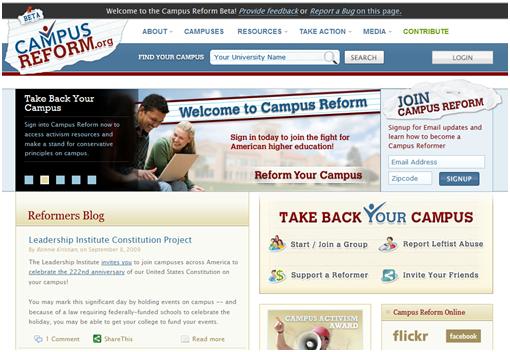
campusreformThe Leadership Institute (my former employer) will launch a new website, CampusReform.org, officially next week – but it’s live now if you want to take a look.

One of the challenges LI – or any similar organization – has always faced in campus outreach is connecting with interested students; though interested students are always out there, colleges represent fairly cloistered environments.  Previously, finding students to get involved in the conservative movement often meant physically going to campuses, setting up membership tables, and recruiting people face to face.  Considering that America has well over 2,000 four-year colleges, that method becomes a tedious (and expensive) fishing expedition.

Whether your business is starting conservative groups or selling dictionaries door-to-door, the best prospects are usually referrals or the potential customers who seek you out.  By establishing a broad web presence, LI is embracing that model of expansion.  CampusReform mobilizes student activists – rather than Washington, D.C.-based representatives – to strengthen the conservative movement in higher education.  It’s strategically smart and just good business.

There’s another benefit that CampusReform offers down the road, after it establishes an audience among college students: alumni relations.  With CampusReform, if I want to see what’s going on with the University of Massachusetts, I am just a click away.  If LI wanted to, they could create a fundraising option that would allow their donors to give directly to campuses and groups they care about.  (And if they wanted to get really advanced, LI could empower individual donors to create campaigns and recruit others to give money, as well.)

As a campus outreach effort, Campus Reform is a more effective conduit between interested students and the people trying to recruit them.  Its potential is greater: to function as a network connecting people trying to break into conservative politics with those in a position to help.

Frum bad to worse

David Frum makes a great point on the need for intellectualism in the conservative movement during a Bloggingheads diavlog – then provides an excellent example by senselessly deriding Matt Lewis as non-intellectual for using common online tools to advance ideas.

The comment to which Frum takes exception was a suggestion that those looking for an introduction to conservative thought start at the Wikipedia entry for Russel Kirk’s The Conservative Mind.  Wikipedia, Frum rightly points out, is a flawed informational resource – and thus, he concludes, Matt Lewis promotes a lightweight, pop-culture conservatism.

This completely ignores the strategic value of Wikipedia.

Have you ever read The Conservative Mind?  My grandfather gave it to me for Christmas a few years back.  It’s not a pamphlet; I’m relatively sure the third little pig could have gotten away with building his house out of several copies without worrying about the big bad wolf’s lungs.  If I’m trying to convince someone of my political philosophy, I wouldn’t give them a volume that they need a pushcart to carry.

I might, however, start them off on a place like Wikipedia, which is a familiar, non-threatening environment for a political novice.  It also contains links and citations to more reputable resources.  As a gateway to information, Wikipedia is a very good resource.

And, as any communications professional will tell you, a Wikipedia entry has value.  Many people – rightly or wrongly – use it as as their first read on a subject which is unfamiliar to them.  (Lewis’s comment on learning conservatism might even be interpreted as advice on which Wikipedia entry to start with – and recommending an entry about Russell Kirk over a more generic “conservative” entry is actually quite learned.)  Given the way most voters consume information, Frum’s criticism seems a little dated.

In the interest of full disclosure, I’ve known Matt Lewis for a while and worked with him at two different companies – so I can understand a bit better than Frum how much Lewis reads, and the variety of sources he consults to educate himself.  Of course, when I think of an intellectual conservative, Matt Lewis’s name is not the first that pops into my head.  That distinction belongs to another former colleague, Dan Flynn (who points out flaws in Frum’s own brand of “intellectualism”).

But as with any political movement, ideas are only half the battle; the other half is convincing people to buy into those ideas and vote for candidates that support them.
Jin-ed up?

Without mentioning him once, Governor Bobby Jindal went a long way toward recapturing the formula for Republican success which Ronald Reagan first captured nearly three decades ago.

Despite widespread criticism – even among Republican voices – his response to the unofficial State of the Union address last night struck the right tone for the GOP moving forward.

Unlike the gaggle of 2008 GOP hopefuls who felt they could excite their base by bandying about buzzwords like “conservative” and limited government,” Jindal illustrated the conservative view of government with stories. He recounted his commiseration with a local (Democrat) sheriff when federal bureaucrats stood in the way of Katrina rescue efforts. He talked about stimulating Louisiana’s economy by cutting taxes and promoting business. He talked about reforming education to empower people.

(Incidentally, in one of the poignant lines of his speech, Jindal even took back Katrina – the issue that served as an illustration for Democrats’ accusations that George W. Bush had lost touch with America. Jindal turned it around: “Today in Washington, some of us are promising that government will rescue us from the economic storms… those of us who lived through Katrina — we have our doubts.”)

Most importantly, Gov. Bobby Jindal talked more about what he was for than what he was against. The running theme of his speech was a line he got from his Dad: “Americans can do anything.”

And in that optimistic wisdom is the conservative message. We oppose bigger government not only because it doesn’t work, but because it imposes restrictions that take away the ability for Americans to use their own ingenuity and creativity to solve problems – a formula that has worked for 233 years and counting.

It isn’t enough to say it – voters need to see it. Which is why Governors like Bobby Jindal are still the best torch-bearers for a renewed GOP brand. And while the detractors on the right – who were likely looking for their own version of a “conservative Obama” pan his speech, they must remember that one person will not resurrect the party.

Bobby Jindal is a piece of a much bigger puzzle. For the Republican party to establish consistent electoral victories, they need to paint a picture of a positive party with answers – and like a puzzle, creating that picture requires multiple parts.

Bookmark and Share

Culture shock

Culture11 – a site dedicated to conservative-leaning cultural commentary – abruptly laid off its entire staff this week. While the site’s backers maintain that this isn’t the end, the future looks bleak without an influx of money.

Joshua Trevino chronicles a few key flaws of Culture11. The site sprang up not from a grassroots groundswell, but from a few key investors who apparently did not see a return on their investment quickly enough to justify further expenditures. Trevino argues that other popular blogs started much smaller and were allowed to “grow into” their ultimate size and influence.

There’s another problem with a site like Culture11, which seemed to be intended as a conservative alternative to The Huffington Post. Overt and admitted conservatism turns off a certain audience – usually who would claim to be simply uninterested in politics but extremely interested in entertainment. That’s why the overt-but-unadmitted liberalism of mainstream media outlets has such an impact.

Bookmark and Share

Man of Steele

Michael Steele is the new RNC Chairman. This is big for a few reasons.

First, and most obviously, is Steele’s race. The Republican Party has nominated a female vice presidential candidate and elected a black party chairman in the past six months. These events are helping answer criticism of the GOP as the “white male” party.

Second, is that Steele has experience fighting in Maryland, a deep blue state. Republicans must be aggressive in taking on their opponents. During the Bush Administration, the party seemed content with electoral losses in blue states, reasoning that those citizens just weren’t receptive to Republican messages. That is exclusionary thinking; and even if it’s true, the party cannot admit it as such. An optimistic party chair must at least pay lip service to the belief that all Americans would be receptive to his or her message – as Howard Dean did when he launched his 50 state strategy for the DNC.

Third, Steele is an aggressive communicator, which the GOP needs if they are to remain on offense even as the minority party. The Republican Party has fallen into a rut, pointing to their past successes and resting on their laurels, quoting Ronald Reagan and pining for a return to 1985. I don’t care how fast your DeLorean goes, that just isn’t happening.

Republicans need a positive, forward-looking message that goes beyond the past and certainly goes beyond waiting for President Obama and Congressional Democrats to screw up. (This Washington Times article should be required reading for all GOP and conservative activists.) Michael Steele appears poised to bring a voice that can deliver that message.

Bookmark and Share

We Are Republican

This is a video that is a long time coming. It sets a nice tone for Republicans over the next few years, translating exactly how Republican ideas work for people like me. That element – the answer to the question “how does this affect me” – has been missing from the GOP, arguably since the Katrina disaster.

I could do without the references to Ronald Reagan and Barry Goldwater, though – like Bird, McHale, and Parrish, they aren’t walking through that door.

Bookmark and Share

Two projects have launched in the wee small hours of the morning over the past couple of days that have caught my eye.

Patrick Ruffini, whose most fitting title may be “Republican organizational entrepreneur,” has announced “Project Battleground” on The Next Right. The project recruits bloggers by state and Congressional district. Aside from keeping out-of-work GOP political operatives engaged and ready for 2010 and 2012, Project Battleground will help build the grassroots communications networks that will be critical to future Republican victories. And it’s worth mentioning that grassroots online movements have had big election impacts in the recent past – like Ned Lamont’s primary upset of Joe Lieberman.

On the philosophical side, several conservative activists have teamed together to launch TheSupermajority, a site that defies categorization. Essentially, it serves to answer the policies of the Obama Administration and his Congressional allies with “solutions” – an important development. While it’s all well and good to criticize liberal and/or Democratic policies, The Supermajority offers positive alternatives. Perhaps even more important, the site offers activists tools to spread those ideas. Plus it looks nice.

Bookmark and Share

Two projects have launched in the wee small hours of the morning over the past couple of days that have caught my eye.

Patrick Ruffini, whose most fitting title may be “Republican organizational entrepreneur,” has announced “Project Battleground” on The Next Right. The project recruits bloggers by state and Congressional district. Aside from keeping out-of-work GOP political operatives engaged and ready for 2010 and 2012, Project Battleground will help build the grassroots communications networks that will be critical to future Republican victories. And it’s worth mentioning that grassroots online movements have had big election impacts in the recent past – like Ned Lamont’s primary upset of Joe Lieberman.

On the philosophical side, several conservative activists have teamed together to launch TheSupermajority, a site that defies categorization. Essentially, it serves to answer the policies of the Obama Administration and his Congressional allies with “solutions” – an important development. While it’s all well and good to criticize liberal and/or Democratic policies, The Supermajority offers positive alternatives. Perhaps even more important, the site offers activists tools to spread those ideas. Plus it looks nice.

Bookmark and Share