Maybe we shouldn’t be better than this?

The internet’s favorite candidate for public office right now isn’t Rand Paul, Joe Sestak, or Bill Halter.  He isn’t running for Congress, governor, the Senate, or even President.  But he is anti-establishment, railing against the “thugs and criminals” in power.  His name is Dale Peterson, and he’s running for the Alabama Agricultural Commission:

Peterson’s over-the-top honesty and evident frustration with politics as  usual might be attracting tongue-in-cheek derision from some bloggers and pundits, but he isn’t running to be on the National Press Club’s Agricultural Commission.  Lost in the yuks is the fact that Peterson, likely for very little money, now has an advertisement getting attention from all sorts of media outlets.  And though the white cowboy hat and the gun may seem over the top, his message really isn’t.  Did you know that the Alabama Agricultural Commission has $5 million to play with?  Heck, I don’t even know how much Virginia’s Agricultural Commission has to play with.

The exposure puts Peterson in front of in-state voters – and potentially out-of-state donors – who identify with his message, and who kind of like his style.

At least there’s no demon sheep.

A little bit Souder now…

It’s one thing to promote abstinence education, but it’s another thing to provide an example of why abstinence, sometimes, is the best policy.

Disgraced now-former Congressman Mark Souder is not only the most unlikely participant in a sex scandal (barring a late joint Arlen Specter announcement), but he conducted a video interview with the staffer he boinked about abstinence:

This, apparently, is what passes for a sex tape for Republicans – and that’s just fine.  Souder kind of looks like an early 90’s character actor – the type of person who’d play the neighbor in a short-lived sitcom.

Of course, today his bit role is as Richard Blumenthal’s best friend.

The next next generation of phone banking

It’s been a good week for Carly Fiorina’s campaign.  Buried underneath news of the controversy Sarah Palin stepped in by endorsing Fiorina, is the adoption yesterday of a pretty cool technology by the Campaign to unseat Boxer.  The platform, created by RealGood Technologies, plugs any mobile phone with text message capabilities into a candidate’s GOTV effort.

In January, Scott Brown’s campaign successfully used an internet-based phone bank from anywhere function to rally supporters from across the country; a Senate seat in California would be an equally significant pickup for Republicans.  If Fiorina goes on to win the Republican Primary and takes out Sen. Boxer, this tactic will be held up as one of the big Republican success stories of 2010.

Obey your instincts

Rep. Dave Obey saw the writing on the wall.

Despite his stature as a political institution, he was facing an electorate that has soured not only on liberal policies that he has championed, but also on the concept of incumbency.

More important, his opponent was young, telegenic, and media-savvy – the perfect counter – and, more important, was drawing attention from beyond the district.  This is the second big story for Sean Duffy in a week, the first being his victory in Gov. Tim Pawlenty’s PAC endorsement contest.  Clearly, Duffy would have money and support coming from outside the district from a Republican infrastructure eager to find a fresh new face.

Despite the fact that he looked like a long shot on May 4, Duffy’s campaign had the chance to follow a similar arc to Scott Brown’s victory in Massachusetts.  Running against a senior ideologue from the other party, Duffy could have tightened the polls gradually over the summer and been in position to score a big upset with a late push of volunteers and money from across the country – think online money bombs and remote get-out-the-vote call centers.

All politics are still local – but when the right candidate uses the right technology, a whole lot of people can become local.

Crist crossing party lines

It’s hard to portray yourself as an outsider when you sit in the governor’s mansion in one of the biggest states in the union.  But Gov. Charlie Crist did his best yesterday, positioning his decision to run as an independent as an answer to a broken system. And it just might work.

Though polls currently show Marco Rubio with a slight edge, they also show that 35-40% will likely win the race.  (Unlike Sen. Joe Lieberman’s 2006 run after losing the Connecticut Democrat primary, the opposition party is not laying down.)   Even though some Republican donors are sure to ask for their money back, Crist is a sitting governor through the beginning of next year and Florida is a state with plenty of commercial interests.  That math isn’t hard to do.

If Crist wins, the math gets even more fun.  Assuming he stays independent, he could become very difficult to topple as long as he maintains support in one third of the electorate.  That would make him an anomaly in American politics: a safe incumbent with 35% support.

How do you like that? Facebook and microtargeting

This was a big week for Facebook, which stepped up its presence in the battle with Google to control the internet on computers.  (This is slightly different from the battle to control the internet through your phone or the internet through your TV or the battle control the internet through the cord surgically affixed to your brain stem.)

By spreading tentacles throughout the web, Facebook will latch your profile more closely to your online activity.  Sure, it’s a little creepy, but it’s also voluntary; no one has to have a Facebook account after all.

Setting aside privacy concerns, this is a really big [BIDEN] deal in a year when political insurgency is all the rage (no pun intended).  In a great post at TechRepublican, Jordan Raynor outlines how establishment political support (such as Florida Governor Charlie Crist enjoyed a few months ago) can be trumped by a campaign which connects directly with supporters and leverages that energy to create its own momentum.

Facebook is going to become a better and better place to do that – providing in 2010 and 2012 what the concept of microtargeting was in 2002 and 2004.  In those years, Republicans used consumer data to identify potential supporters – if you shop at a certain place and subscribe to certain magazines, for instance, you might fit a profile of a Republican voter.

Now, you can profile your supporters (who may or may not belong to your party) and directly serve them online ads.  The possibilities are pretty exciting – unless you’re sick of political ads.

You will be.  You will be.

How deep is America’s distrust of Washington?

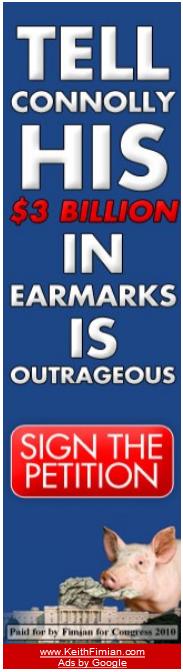
This ad showed up next to an online news story today:

Running for Congress by running against Congress is nothing new.  But running for Congress because your opponent brings too much money to the home district?  National politicians love to talk about pork barrel spending, but their tune changes when the conversation turns to their own district.  The battleground for Keith Fimian’s challenge to Rep. Gerry Connolly is VA-10, my current district of residence and one that probably gets a lot of money in federal funds.  Connolly is also a targeted freshman member of Congress, so Democratic leadership is probably eager to help him buy votes.

Of course, even if Fimian wins, he might not be any different – but the rhetoric of going to Washington, D.C. and sending less money home is still pretty notable.

The coming political apocalypse

Start the hand-wringing and eulogizing: 80% of Americans don’t trust the government.  Combined with the fact that some people like to own guns and the calls for rebellion by national policy experts like Glenn Beck and Sarah Palin are inciting rebellion with seditious rhetoric, the violent revolution can’t be far behind.

Our Republic is clearly doomed.

Based on what I caught on the Sunday Morning talk shows yesterday, here’s what we can expect in the coming months:

Increased antagonism between right-wing ideologues and progressive thought leaders. As experts examine previous social programs – and which new social programs must be implemented to fix them – the tea partiers will grow louder and louder.  Their simple-minded sentence fragments – such as a call for a more reserved and focused federal government which permits society to develop its own mores and guidelines organically to reflect those of the people combined with stronger states which work in harmony with federal officials to ensure that government services are optimized to best serve the needs of the people – will drown out the more educated progressives’ more refined and intellectual plans to pump up program budgets.

More people buying guns and getting violent. As if to gnash their metaphoric teeth in the wake of Tax Contribution Day, a bunch of right wing nut jobs got together in Northern Virginia this past weekend to rally for their Second Amendment rights.  Some even brought their guns to the rally!  In contrast, cooler heads held a rally opposing gun ownership just across the river in Washington, D.C. – where tight restrictions keep out gun violence.

Violent overthrow of the government. These bitter, angry people who distrust government may even coalesce into a bitter, angry mob and try to disrupt the November elections.  Foaming at the mouth and blinded by their hatred of the government, they may descend on local polling places, march in one by one, check in with a poll worker, show necessary identification if required, and then angrily pull levers other than the one with “Incumbent” written in next to it and thus tossing the people in office out instantly (after a careful counting of the votes and a two month transition period).

It wasn’t exactly clear how we’ll get from these initial steps to Beyond the Thunderdome.  We’ll have to tune in next Sunday morning to find out.

3 Ways the Democrats Won on 4/15

And that isn’t counting a penny of tax money, either.

Yesterday was a big news day. Tea partiers marched here in DC and elsewhere to define their core principle: that the federal government is too big, that high taxes siphon money out of the economy, and that government programs tend to make matters worse, not better. Overall, yesterday’s messaging seemed positive for limited government activists.

But the opposition was smart, too.  Nationally, Democrats drove three well-timed news stories – two by President Obama, one by Sen. Harry Reid – that added up to a communications masterstroke.

1.  President Obama announced we’re goin’ to Mars (eventually).

This was a good story to grab headlines on the other side of the tax day protests.  Instead of trying to directly engage, President Obama simply highlighted a use of taxpayer money that many folks from both sides of the aisle agree with: scientific research.  The space program specifically creates tons of jobs not only in research but in manufacturing the components of Major Tom’s tin can.

You can’t answer a call for lower taxes with the stance that taxes are just fine.  However, showing a positive use of tax dollars can undermine that message.  It wasn’t a happy coincidence – the Florida trip has been on the President’s schedule for weeks, if not months.

There’s another, more subtle attempt at differentiation here, too.  The announcement of an advanced science program will now be played on the same newscast with footage of grassroots protesters – citizen activists who, in their haste to participate, misspell signs and don’t have a staff of speechwriters to help them articulate their views.  Without actually saying it, Obama gets to present his side as better-educated and smarter than the knee-jerk, anti-tax tea partiers.

2.  President Obama signed an executive order permitting hospital visitation rights to same sex couples.

This is another point of differentiation – and a chance to bait his opponents.  Most of the focus of tea party activism has been on fiscal policy, and many Americans tend to agree with the most conservative segment of the electorate that the government spends too much and spends it wastefully.  For social issues, there is less common ground, and yesterday’s announcement has the potential to begin peeling off moderate voter support from the Republicans.

Making this announcement on a busy news day means that there won’t be much media discussion – unless someone at a tax day rally goes off message, and gets captured in a YouTube video proselytizing about moral codes.  Then it feeds the idea that tea parties are run by intolerant bigots.  It’s a win-win for Obama – either his announcement slips almost completely under the radar, or it’s a chance to take shots at the other side.

3.  Sen. Reid announced that financial reform package will hit the U.S. Senate floor next week.

The Democratic talking points for November are already written: Republicans are the party of Wall Street.  They will attempt to make this distinction with a bad financial services reform package scheduled to hit the floor next week.

Like the other two examples, Reid’s announcement serves to distinguish the Democrats from limited government activists by calling for a larger government for an ostensibly good cause – safeguarding consumers and investors.

There’s also a great strategy in this timing that has nothing to do with tea parties but everything to do with tax day.  The folks who would be most likely to oppose this legislation would be financial professionals, who understand that it isn’t all it’s cracked up to be.  If they had the time to do it, they might rally their customers and colleagues, making the case that the bill would actually hurt efforts to keep the players in the financial system honest, and mobilize a strong push against the bill.  They haven’t had time, of course, because over the last two weeks, financial professionals have been working around the clock at their day jobs – because yesterday was April 15.  So when the bill hits the floor next week, they won’t be ready to stir up opposition.

Gearing up already?

Passion is important in politics because it helps win over the uncommitted moderate voters; excited activists are the ones making phone calls, dragging people to the polls, and giving one side the image of a winner.  In 2008, then-candidate Obama’s campaign enjoyed demonstrable shows of emotion from his supporters.  In 2010 that excitement is trending toward the right – so far.

But it isn’t to early (or too late) for the President and his allies to begin letting some air out of that balloon.  The further he can create the perception of a gulf between conservative activists and the values of moderate voters, the more Republican chances in 2010 and 2012 will deflate.
140-character sponsorships

Though they haven’t shown up quite yet, the phrase of the day is “sponsored tweets” – Twitter’s long-overdue way to make money off its product. (When you hear anyone say “sponsored tweets,” scream real loud!)

I’ve searched a few terms that seemed like good candidates for these ads to show up but haven’t seen a sponsored tweet yet – which may be the first time anyone has ever wanted to see advertising but couldn’t find it.

Sponsored tweets do offer a new political tactic in advance of the 2010 elections.  Candidates have been using Google ads to frame themselves and their opponents for years, and 2010 will be no exception.  Search engine and Facebook ads, though, are closer to traditional advertising: you see creative (text or a picture), and if it’s interesting enough you take some sort of action.  Clicking on an online ad is a more instant (and measurable) reaction that buying something after seeing a television commercial, but the concept is the same.

Twitter ads appear to be more message advertising – so the “creative” may not even come directly from the ad sponsor.  Lets say you’re working for Republican Keith Fimian, running against Rep. Gerald Connolly to represent Virginia’s lovely 10th district (which includes this blog).  If someone searches for Connolly on Twitter, you might sponsor a tweet from a voter or activist – rather than from the official Fimian campaign Twitter account – that calls on Connolly to get heaved out of office.

This strategy has been tested somewhat with Google ads, but mostly as a joke – searching for John McCain, for instance, might bring up sponsored links for the AARP.   But Twitter ads give brands – political or corporate – a chance to use third party voices to frame search results.  No doubt this will become as much art as science as the 2010 elections approach.