More on mobile: the “App Class”

To follow up on a post about using mobile tactics from earlier this week, a Pew Research survey on mobile contains some interesting findings.  Unfortunately, Pew’s headline (as well as Mashable’s post covering it) miss an important aspect for campaigns.

Both highlight that the survey says one out of four adults use mobile apps.  This is true – behold this chart (courtesy Mashable):
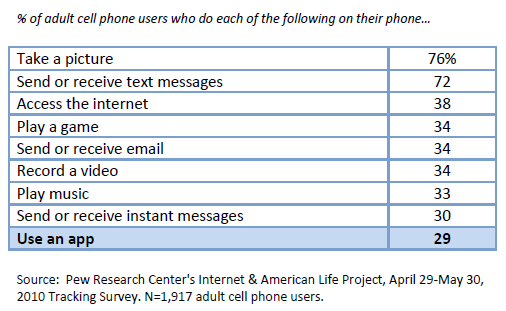
Where they see market growth (correctly), issue and candidate campaigns have to see stratification.  There are two mobile Americas: one which uses their mobile phone for games, music, news, directions, shopping, updating social networks, and other varied pursuits – an “App Class,” if you will – and another which really looks at the phone simply as a simple communication device to pass information viavoice (and occasionally text and picture).  About one out of three people look at their phone as a handheld computer.

If a campaign, therefore, is going to invest in an application, for instance, the design process has to consider that most people will not use it.  That doesn’t mean pulling the plug on the app – in fact, because the penetration of app-driven phones keeps increasing, it’s only a matter of time before every campaign has to have a customized app.  (Consultants, start your engines!)  What it does mean is that a wise campaign will ensure their app does the things the App Class will want to do.  As an example, it may be a better idea to have apps that connect with back-end campaign data to help precinct walkers and staff than to have apps that help people find their polling place.
Making online/mobile strategies count

Matt Lewis had me back on his podcast today, and we discuss the balance campaigns must strike between different tech tactics.  Specifically, we chat about Florida gubernatorial candidate Rick Scott’s very deliberate decision to avoid text messaging in favor of email to announce his running mate.  In this case, the Scott campaign decided that emails were more valuable to their campaign strategy than mobile numbers.  (Given Florida’s elderly population, it was probably a wise choice.  Also facto in the power of email’s reach – John Boehner actually sent an email update to his supporter list to draw attention to a tweet.  It sounds redundant but it’s actually the best way to make the tweet gets seen.)

As Matt and I discussed, the rumor from Scott’s consultants is that he is not averse to spending money – so this was an educated decision.

I’m excited to see the implementation of good mobile strategy – and text messaging is going in some exciting directions.  But too often, the people with resources to burn don’t stop to think through their online strategy.  This is especially true with issue or candidate campaigns which use tools like Facebook for messaging, but really don’t know what to do with their 10,000-person follower list after everyone clicks the like button.

To use an old-school campaign example, imagine going door to door for a candidate.  When the voter opens the door, you ask, “Hey, are you going to vote for my guy?”  The voter says, “Yup!” and the conversation ends.  You don’t take down their name, address, or phone number, or even ask if they’d like a lawn sign.  The same is true if think taking action on an issue you care about ends when you send an email to your Member of Congress.  Chances are, that email will be counted and deleted because the staff knows how easy it is for any crazy person to send them an email.  (That’s why advanced follow up is always recommended.)

No matter how advanced your tactic, if it isn’t applied with some measurable and impactful result, it’s a waste of time and resources.

Crist probably didn’t approve THIS message

From the Florida Senate race comes this re-mix of a Charlie Crist ad:

This video is well done, drives home a message simply and effectively, and may very well have been done on an activist’s home computer.  Aside from demonstrating that the campaign messages are sometimes best articulated by volunteers and voters, it shows the idiocy of campaign finance laws.

This isn’t necessarily a rogue activist popping off, but that is certainly a possibility.  Is that an in-kind donation to the Rubio campaign?  To Meek?  To both?  And how much is are the few hours of video editing worth?

The argument against campaign finance laws has always been that they fail to recognize the individual right of free speech.  When the only way to broadcast a message to a wide audience was through expensive broadcast media buys, it was harder to put the speech of a wealthy campaign supporter in the same category as Joe Q. Average sharing an opinion with friends and neighbors.  Today’s environment is different.  The person behind the video above understands that it doesn’t take a big dollar donation to get your point across anymore.

Recovery summer: Give credit where credit is due

This morning’s news reports included really bad poll numbers for Democrats, including a meager 40% who disapprove of the President’s handling of the economy.   Much of the blame goes to the White House’s alleged “Recovery Summer” – and last week’s employment numbers suggest this was a dismal failure.

But is that really fair?  After all, this summer has seen at least a 35-year high in the number of people running for Congress – which means more canvassers, more consultants, more GOTV callers, and more campaign operatives overall.

Who says the current administration hasn’t created jobs?

40Seats.com: A literal map to GOP victory

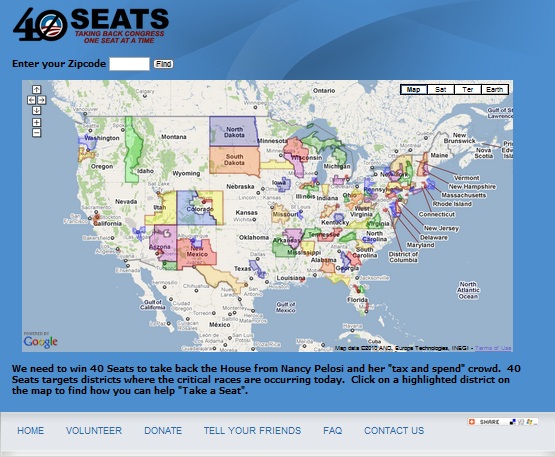
The historic highs Republicans are enjoying in this week’s generic ballot poll numbers are nice, but it alone won’t restore GOP control of Congress in November.  A pretty cool website called 40seats.com literally provides a map to GOP victory in November by allowing potential activists to be connected to nearby Congressional races which are up for grabs.

Ballots aren’t generic – and in some cases Democrats have plenty of advantages.  For instance, let’s say your Congressman had a long list of embarassments – maybe he famously accused an eight year old of attempting to carjack him, or promised to “earmark the [expletive] out of” appropriations under his purview, or said “I like to hit people” when describing his affinity for boxing, and/or had a birthday party interrupted by what eyewitness observers described as two girlfriends fighting.  Yet, the people of your district keep electing him to the House, apparently for earmarks and giggles.  But next door, maybe even in a Congressional district you lived in up until, say, June 28 of this year, your involvement could really help the folks on the ground.

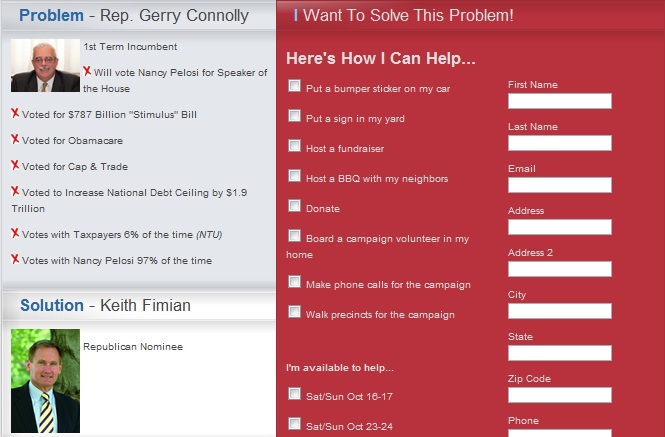
40Seats gives you an at-a-glance view of what’s wrong with the incumbent, and gives users options to allow varying degrees of activity – from making phone calls to putting a yard sign out to donating to walking precincts:

The credits indicate the site is mostly a mashup of tools that are open, available, and free – which is what makes 40Seats even smarter than it looks.

And no, sadly, Jim Moran is not targeted.


Deconstructing the primaries

What might be the best wrap-up of yesterday’s primary results was published before the returns came in.  As media outlets keep dropping over-simplistic terms like “tea party support” and “outsiders vs. insiders” to explain what happened, the Washington Examiner’s Timothy Carney boils the divide in Republican politics down as “the Tea Party Wing against the K Street Wing” – a divide which is not simply ideological or experiential:

The main distinction… might have less to do with policy platforms and more to do with a politician’s attitude toward the Washington nexus of power and money. Nevada’s Sharron Angle is anti-bailout and anti-subsidy. [Kentucky candidate Rand] Paul could try to shrink defense spending and ethanol subsidies. In Florida, Republican Marco Rubio isn’t a game player like [former Senator Bob] Dole’s buddy Crist is.

This morning, we hear that Lisa Murkowski is in trouble against “tea partier” Joe Miller, that John McCain bested an insurgent challenge from a more conservative candidate, and that established Republican Bill McCollum lost out to Rick Scott.

So if you’re scoring at home, “the establishment” won some and lost some, with Alaska up in the air – at least, according to most of the talking heads you see.

But can you call McCain an establishment Republican candidate?  McCain had bucked national party leadership in his own way for decades, often lashing out at the K Street types Carney mentions above.  As Matt Lewis noted – again, before polls closed yesterday – he fought a serious race against an opponent with more clear ties to K Street establishmentism.  Last week, the New York Times saw fit to print that Alaska’s rugged individualism was either inconsistent or an outright sham because of its dependence on federal money; regardless of how the final tallies go for the scion of the Murkowski family goes, her ability to keep winning earmarks did not lead to an easy victory lap.  And Bill McCollum was part of a Republican establishment in Florida rocked with a spending scandal earlier this year.

And of course, there’s the big caveat that each race has its own local interpretations of who counts as “the establishment” and who really is an “outsider.”  All the more reason to look at the results through Carney’s prism rather than the crystal ball which other analysts are trying to use.

A quarter million doesn’t go as far as it used to

Rand Paul’s $250,000 money bomb is being treated like a dud for failing to meet the lofty $400,000 goal the campaign set for it.  For a Kentucky Senate race, a cool quarter mil is far from chump change, but the dour coverage shows the value of managed expectations in setting benchmarks for online metrics.

Paul inherited from his father a reputation for both staunch libertarianism and savvy online organizing, which make his swings-and-misses at online fundraising and Facebook recruitment much more pronounced.  But Paul isn’t the only one who falls into the trap of easy metrics: dollars raised online, Facebook “likes”, Twitter follower counts, and other obvious numbers are easy to understand, so issue and candidate campaigns alike will use them as benchmarks for impact.

Two problems stem from this.  First, metrics which are easy to understand are not always easy to obtain.  Second, having big numbers doesn’t always translate to big impact.  Having 100,000 Facebook followers who don’t vote is just like having 100 Facebook followers who don’t vote.  Further, there comes a time when a campaign must balance the effort of recruitment with the reality of mobilization.

In the particular case of the campaign’s recent online fundraising attempt, Rand’s supporters may be suffering from money bomb fatigue, since the campaign has used the tactic regularly.  They might be feeling the pinch of a tough economy, and giving $25 where they would have given $50.  But none of that would be in the discussion if, at the outset, the campaign had set a reasonable benchmark for dollars.  There are plenty of completely legitimate explanations for why Paul raised “only” $250,000 – but what really requires explanation is the original expectation for $400,000.

Smart phone strategy

With Facebook announcing its Places geo-networking service – and with it, countless opportunities for social networking gone terribly wrong – it’s tempting to keep the discussion going about how campaigns can use location-based networks.  But it’s worth noting that using these networks and applications is part of a much bigger strategy – reaching voters on their mobile phone.

A friend who runs a political text message contact/mobile marketing technology shop recently pointed out that only a handful of the top targeted Senate races have texting strategies.  This is amazing considering how direct and effective the mobile phone is in terms of reaching someone:

Scott Goodstein ran Obama’s mobile communications campaign operations. He  said, “262 million Americans are using mobile phones. That’s roughly 84% of the total population… It’s the only device that’s truly with people for 15 to 24 hours a day.”

Another plus: mobile is a spam-free zone. One has to opt-in to receive texts, and a whopping 92% of  text messages are read by the recipient.

(Via TechRepublican.)

Location-based engagement and smartphone apps are great, but at the end of the day they are part of a bigger picture: getting into that little gizmo that just about everyone carries around almost every waking hour.

Location based social networks and the 2010 campaign

As discussed previously, no one is quite sure what to make of location-based networks yet – to the point where Christopher Walling of Project Virginia makes a compelling case that such technology won’t be impactful until at least 2012:

Not only are campaigns unable to reach a significant amount of voters, but I also don’t see using an LBSN [location-based social network] to disclose your candidate’s location as an overly effective tactic.  Most of the venues that candidates will “check-in” at are campaign events or fundraisers, which most would expect them to attend anyway.  If candidates choose to “check-in” at more “off-the-radar” locations, then they are essentially giving political trackers and their opponents an upper-hand, (don’t forget this is the year of the tracker) which could lead to more unsavory “gotcha” moments.

Not only is Walling right on about the time frame, he’s also right on about the concept of candidates checking in being kind of dumb – thought not because of the army of interns on both sides with flip video cameras and attitude problems.

Social networks involve two-way communication rather than one-way broadcast communication.  That’s why good online strategists look for opportunities to engage with supporters, rather than simply building giant email lists.  The bottom line is that few voters give a crap where a candidate is.

On the other hand, an activist may want everyone to know that he or she just checked into Campaign HQ to stuff envelopes for three hours; or they may want to know where polling places are.  If they have three hours to kill on a weekend, they may want to know if there’s a neighborhood nearby where no one has gotten around to knocking on doors.

In other words,it isn’t important for the candidate to be active for a campaign to get a lot out of a location-based social network; but as Walling mentions early on in his post, the supporters sure have to be.