For starters, the best way to win over the American public is not with an English accent. Going back to the 18th century, America, Great Britain, and stuff dumped in the ocean that interrupts commerce have a less-than-stellar relationship. But more than that, it’s clear that the top leaders of BP are not personally invested in the region. They may care a great deal, but they’re from England – it isn’t their home.
Stylistically, the use of still frames is artistically poignant, but doesn’t make the cleanup effort come to life the way video could.
The bottom line is that BP can say very little right now (outside of, “Hey, the oil stopped gushing!”) to mollify a justifiably upset American public. But their strategy of replying from the highest levels of the company with detached sympathy does them no favors.
Chris Kelly’s former job probably seemed like an asset when he jumped into the race for California Attorney General – in a state so closely identified with technological innovation, he was one of the executive leaders of Facebook.
The problem for Kelly now is that his title was Chief Privacy Officer. Having that position for Facebook is kind of like being a nutritionist for KFC – it doesn’t come with much credibility.
The internet’s favorite candidate for public office right now isn’t Rand Paul, Joe Sestak, or Bill Halter. He isn’t running for Congress, governor, the Senate, or even President. But he is anti-establishment, railing against the “thugs and criminals” in power. His name is Dale Peterson, and he’s running for the Alabama Agricultural Commission:
Peterson’s over-the-top honesty and evident frustration with politics as usual might be attracting tongue-in-cheek derision from some bloggers and pundits, but he isn’t running to be on the National Press Club’s Agricultural Commission. Lost in the yuks is the fact that Peterson, likely for very little money, now has an advertisement getting attention from all sorts of media outlets. And though the white cowboy hat and the gun may seem over the top, his message really isn’t. Did you know that the Alabama Agricultural Commission has $5 million to play with? Heck, I don’t even know how much Virginia’s Agricultural Commission has to play with.
The exposure puts Peterson in front of in-state voters – and potentially out-of-state donors – who identify with his message, and who kind of like his style.
By spreading tentacles throughout the web, Facebook will latch your profile more closely to your online activity. Sure, it’s a little creepy, but it’s also voluntary; no one has to have a Facebook account after all.
Setting aside privacy concerns, this is a really big [BIDEN] deal in a year when political insurgency is all the rage (no pun intended). In a great post at TechRepublican, Jordan Raynor outlines how establishment political support (such as Florida Governor Charlie Crist enjoyed a few months ago) can be trumped by a campaign which connects directly with supporters and leverages that energy to create its own momentum.
Facebook is going to become a better and better place to do that – providing in 2010 and 2012 what the concept of microtargeting was in 2002 and 2004. In those years, Republicans used consumer data to identify potential supporters – if you shop at a certain place and subscribe to certain magazines, for instance, you might fit a profile of a Republican voter.
Now, you can profile your supporters (who may or may not belong to your party) and directly serve them online ads. The possibilities are pretty exciting – unless you’re sick of political ads.
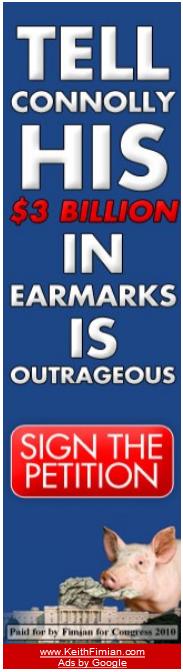
This ad showed up next to an online news story today:
Running for Congress by running against Congress is nothing new. But running for Congress because your opponent brings too much money to the home district? National politicians love to talk about pork barrel spending, but their tune changes when the conversation turns to their own district. The battleground for Keith Fimian’s challenge to Rep. Gerry Connolly is VA-10, my current district of residence and one that probably gets a lot of money in federal funds. Connolly is also a targeted freshman member of Congress, so Democratic leadership is probably eager to help him buy votes.
Of course, even if Fimian wins, he might not be any different – but the rhetoric of going to Washington, D.C. and sending less money home is still pretty notable.
I’ve searched a few terms that seemed like good candidates for these ads to show up but haven’t seen a sponsored tweet yet – which may be the first time anyone has ever wanted to see advertising but couldn’t find it.
Sponsored tweets do offer a new political tactic in advance of the 2010 elections. Candidates have been using Google ads to frame themselves and their opponents for years, and 2010 will be no exception. Search engine and Facebook ads, though, are closer to traditional advertising: you see creative (text or a picture), and if it’s interesting enough you take some sort of action. Clicking on an online ad is a more instant (and measurable) reaction that buying something after seeing a television commercial, but the concept is the same.
Twitter ads appear to be more message advertising – so the “creative” may not even come directly from the ad sponsor. Lets say you’re working for Republican Keith Fimian, running against Rep. Gerald Connolly to represent Virginia’s lovely 10th district (which includes this blog). If someone searches for Connolly on Twitter, you might sponsor a tweet from a voter or activist – rather than from the official Fimian campaign Twitter account – that calls on Connolly to get heaved out of office.
This strategy has been tested somewhat with Google ads, but mostly as a joke – searching for John McCain, for instance, might bring up sponsored links for the AARP. But Twitter ads give brands – political or corporate – a chance to use third party voices to frame search results. No doubt this will become as much art as science as the 2010 elections approach.
The message is subtle even if the delivery is not: the GOP has a message problem that goes beyond government policy, and the elevation of a voice like Hayworth’s would add to the stereotype. One would assume that McCain’s campaign has internal poling numbers which show this is a strong field for them to play on, and that Republican primary voters are vulnerable to fears that Hayworth will be perceived as a joke.
The McCain folks are certainly careful to tread cautiously to avoid offending activists – they use extreme-sounding quotes from Hayworth, but on selective issues. For instance, the video doesn’t take a stand on gay marriage, but it does quote Hayworth’s hyperbolic comparison of gay marriage to bestiality. This is followed by Hayworth overreacting to an off-hand comment from a political opponent who promised to metaphorically drive a stake through Hayworth’s heart – echoing the over-the-top rhetoric of some Democrats after the recent health care debate.
With this video, McCain tries to tell conservatives that Hayworth is simply not strong enough to carry their flag. It’s a pretty sophisticated message – and a good one for McCain to deliver, given his at-times-contentious relationship with conservative activists. And the video is funny, which always helps.
McCain does make one mistake in the presentation of his case that’s worth a chuckle or two. A quick glance of the official John McCain YouTube channel offers potential for misunderstanding; the thumbnail for the video happens to be the screen frame reading “Expose Obama’s Secret Kenyan Birthplace” – and it looks more like a campaign promise than a joke.
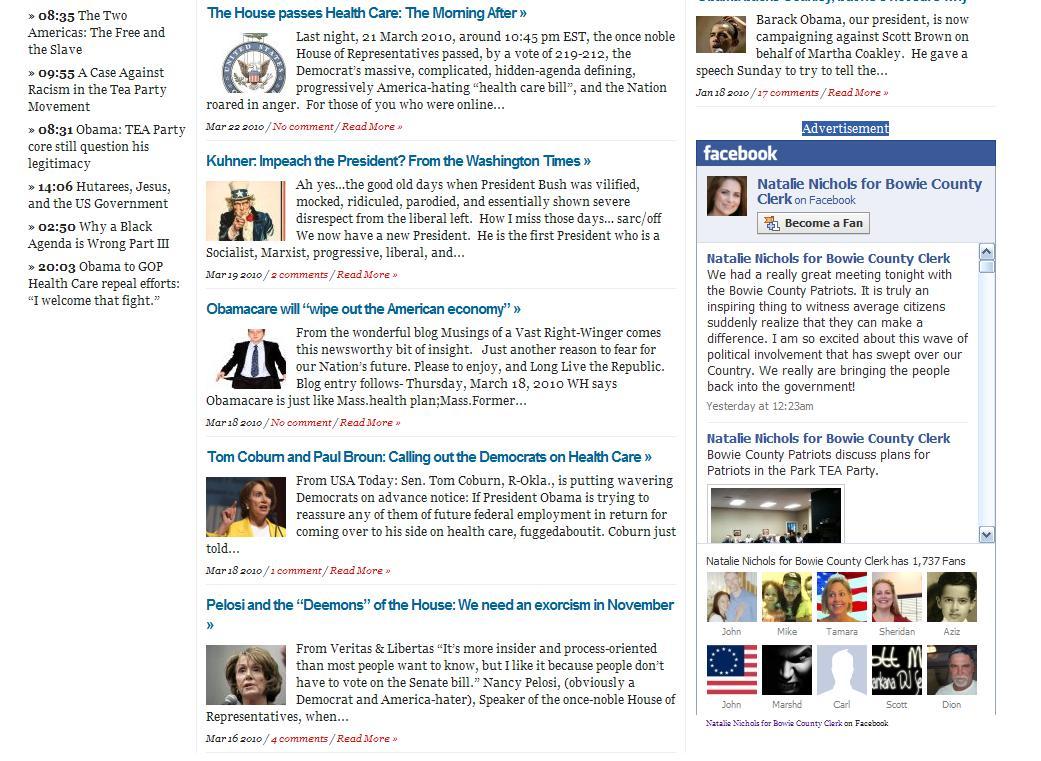
Readers of Political Integrity Now – or, most likely, any of several other websites – may have caught a nifty advertising tactic from Natalie Nichols, who’s running for Clerk down in Bowie County, Texas. Nichols’s campaign is using ads to direct people right to her Facebook page through a Fan Box.
Facebook created Fan Box widgets to let visitors of a given website see the corresponding fan page without having to click through or anything. Nichols is putting her Fan Box on other people’s networks by making it the creative of her ad campaign:
Nichols has a nice looking website, so why wouldn’t she just direct people back there and wow them with the flashy design? Because as impressive as it may look, people don’t visit Nichols’ campaign website every day. Many do visit Facebook every day. By directing people to the Facebook page, Nichols is getting people where they already operate. People who join her Facebook fan page are probably more likely to take further action down the road than folks who sign up for an email list and then forget two days later.
The Facebook Fan Box also has an advantages that shouldn’t be overlooked: it shows the pictures of people who have joined up. People are hard-wired to look for images of other people, and ads which feature people tend to draw our eyes more successfully. Nichols didn’t even have to design such an ad – she let the fan box do the work.
Best of all, readers of Political Integrity Now – or any other site on which the Fan Box appears – can join the cause in one click. Thus they are able to take a small yet significant action without leaving the site they were on in the first place.
Thanks to teaser trailers and shifting advertising philosophy, few Superbowl ads in recent years have been noticeably different from the types of ads played throughout the football season. But this year, one was jaw-droppingly shocking:
It’s a win for Letterman, obviously, who promoted his show with a memorable and hilarious ad. But even in appearing in a competitor’s ad, Leno helped his own cause considerably.
If Leno wants to return to the top of the ratings, he has to convince viewers he’s the same old, nice, safe Jay Leno they used to have on in the background as they fell asleep – and not a calculating, back-stabbing schmuck. Much like voters sizing up a candidate for office, the majority of late night viewers are looking for someone likeable who doesn’t resort to petty squabbling (at least, not obviously).
Leno’s first attempt to repair his image, an interview with Oprah, had mixed results. (Seriously, who quotes Bob Sugar while trying to win sympathy?) But in filming this ad, Leno is able to diffuse the situation and put the late night shakeup in perspective.
But this isn’t all image rehab; Leno gets some real, tangible benefits as well. Superbowl viewers were going to see an ad for the Late Show one way or another – it will likely be the highest rated program CBS airs all year, and they were not shy about pimping their own shows. Leno’s appearance puts him in front of a large viewing audience in a positive light. In essence, even though the ad displayed the Late Show logo, it was also an advertisement for Leno’s Tonight Show.
The content of the ad catered to Leno’s interests as well. As Leno’s 10:00 p.m. variety hour sabotaged NBC’s local news and late-night programming, Letterman has climbed to the top ratings spot after spending a decade playing second fiddle to the Tonight Show. So when Leno explains Letterman’s grumpiness by saying it’s “because I’m here,” it means more than just Oprah Winfrey’s Superbowl party.
And by the way, Oprah’s Superbowl party was kind of lame… perhaps it would have been better with Betty White and Abe Vigoda?

 Jim Eltringham