“I know it’s the law, but I’m a Kennedy.”

Massachusetts state law isn’t handed down by decree from the Kennedy compound in Hyannis – yet.  So Ted Kennedy has had to politely ask the leaders of his state government to change the laws which govern the filling of a Senate vacancy to allow the governor to directly appoint the next junior Senator from the Bay State.  Kennedy, who has been absent from most of the current Senate term, claims to be worried about Massachusetts having “continuity of representation.”  It seems clear that his worry stems from the current health care debate.

Despite its reputation as a deep blue abyss, Massachusetts Republicans have done well in statewide elections for most of the last two decades.  Those victories came on the back of an electorate which is largely registered “independent.”  Consider also some other possibilities: a bruising Democratic primary, or the chance of an independent jumping into the race (like former Democrat Tim Cahill, who is running an independent campaign for Governor).

It adds up to a lot more than a special election for an iconic seat in the Senate: it adds up to a multi-faceted referendum on President Obama’s health care reform plans.  And since it’s Massachusetts, where a Kennedy clone is expected, there are actually many ways this election can be portrayed as a “loss” for the President – and, more significantly, to the type of health care Kennedy champions.

Kennedy could have avoided this by stepping down several months ago, when a favorable political environment and an excited Democratic base would have made the popular vote on his hand-picked successor a formality.  Kennedy lost that opportunity, which is why he is now asking the state to crown his heir by selection, rather than election.

Whole Foods vs. Half-baked

whole_foods(1)(1)(1)Today I received an invitation to join the Facebook Group “Support Whole Foods and John Mackey.”  I knew, peripherally, that Mackey had written an op-ed that had drawn the ire of the supporters of government health care advocates, but I hadn’t ready his op-ed.  My interest was piqued.

There’s much more to Mackey’s article than simply a repudiation of the plans floating about Capitol Hill. Far from standing in the way of progress, Mackey actually makes the case for a different type of reform, outlining eight specific policy reforms.  Each would move health care decisions into patients’ hands – from breaking down interstate barriers on insurance sales to making it easier for employers to set up Health Savings Accounts for their employees.

Mackey is a good voice for this type of reform.  I would wager that most of his employees are not expecting to be life-long Whole Foods workers.  Like many Americans, they will change jobs and companies – and so for health care to be tied to their employment is as inconvenient as it is anachronistic.  Companies used to offer pensions, too; now they make contributions to 401(k) and IRA accounts – recognizing that they can, as part of a benefits package, offer an employment benefit that lasts beyond the term of employment.

Mackey has posed a new idea in the scope of the current debate – that individuals will need to take personal responsibility for their health care.  This is certainly a new way of looking at health care, and exactly the type of open and honest debate that we all should would welcome, right?  Well, not quite.  The other side is calling on shoppers to boycott Whole Foods.

This response is telling.  Mackey is being demonized as an opponent of reform – a position they probably got from this line from his piece:

“Health-care reform is very important.”

Or possibly this one:

“[W]e clearly need health-care reform.”

You can see how that can be misconstrued.

The boycotters either don’t understand or don’t want to understand that Mackey’s individual health care concerns aren’t an issue – with a CEO’s salary, they are probably well-taken care of, with or without company-sponsored insurance.  He’s talking about how to build insurance that will help his employees – the same employees who are much more likely than Mackey to be hurt (through layoffs or schedule cutbacks) by a decline in company revenue brought on by, say, a boycott.

A blogger at OpenLeft doesn’t seem to mind:

I think [the boycott] is a great idea. A stupendous idea…. There are downsides. For example, the people who work at Whole Foods could be negatively affected.

Never let the “little people” get in the way of a big idea, right?

Angry skanks are why I don’t use Blogger anymore

Manhattan’s Supreme Court has ruled that Google must surrender the name of the blogger behind Skanks in NYC, which was hosted on their Blogger platform (but is no longer active).  The ruling came in response to Canadian model Liskula Cohen, who the blogger allegedly accused of being a skank (apparently while she was in NYC).

The first reaction of many freedom-loving people upon seeing a story like this is to worry about limits to the first amendment – especially as it pertains to emerging online environments.  After all, doesn’t an individual have the right to post anonymous speech? This particular case, however, isn’t quite so simple.

First, the blogger in question was posting on someone else’s platform – in this case, Google’s – so they transfer many of their rights to that host.  Google fighting to keep their identity private was probably a good business decision, but in no way an obligation.

Second, the court ruling did not force the blog to stop publishing or stay down (which could have violated the US Supreme Court’s ban on prior restraint of speech).  All it did was ask the person to come from behind the curtain.

Cohen and her legal team will likely pursue a defamation of character suit against the blog – claiming that she is not, in fact, “a psychotic, lying, whoring, still going to clubs at her age, skank” – as the blog describes her.

The Manhattan Supreme Court Ruling doesn’t judge Cohen’s defamation case – and, based on previous US Supreme Court case law, as a public figure her burden of proof is high.  Essentially, Cohen must prove that Skanks in NYC acted with “actual malice” – that they knowingly portrayed her as a skank even though they knew, factually, that she was in fact not a skank.

It’s a tough case but one Cohen has every right to pursue – but there can’t be a case without a defendant, and the identity of that defendant has implication on their knowledge of Cohen’s skankiness or lack thereof.  The Manhattan ruling is the equivalent of a search or arrest warrant – since there may have been an offense committed, they are allowing Cohen’s legal team to pull back the curtain and investigate.

Depending on the circumstances, I would tend to side with the blogger – for many of the reasons outlined by his or her attorney, according to CNET:

The lawyer also offered the view that blogs have “mere venting purposes, affording the less outspoken a protected forum for voicing gripes, leveling invective, and ranting about anything at all.”

I doubt anyone will look at Cohen any differently because of this blog.  Most smart people take blogs with a grain of salt commensurate in size with the reputation of the blogger.  I never saw Skanks in NYC (at least, not the blog) but would imagine most of its fan base read the posts to laugh.

The US Supreme Court has warned about the “chilling effect” limits on free speech would have, and for that reason all courts must be careful – especially when considering cases like this.  Popular free speech rarely has to be defended; it’s the unpopular speech that tests our societal resolve for open discussion.

The Manhattan Supreme Court has ruled that the case is at least worth taking a look at – and that Cohen deserves her day in court, regardless of the outcome.  And, so far, that is all they have ruled.

Not crazy – just ahead of the curve

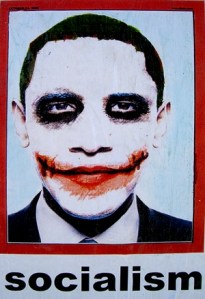
Obama-socialism_0This picture caused a bit of a stir in the blogosphere.  It was not meant as a conservative political statement – and, as Dan Flynn pointed out, it would have been an ineffective one.  And it certainly wasn’t a racist image, as some critics have claimed.

The picture is, however, evidence that occasionally images take on a life of their own, and that people sometimes see what they want to see.  If the narrative in your head is that the conservative movement has been dumbed down (as Flynn has written about before) you may see an aimless attempt at fusing politics and pop culture.  If you are looking for examples of the racial hatred you just know your opponents possess, you see a black man painted in white make-up.

At the end of the day, this was and is a picture doctored up by someone looking to have some fun and blow off steam after listening to months of hero worship.  Why so serious?

Bob Novak, Journalist

I never met Bob Novak, but I have met Tim Carney, who worked as a reporter for the Evans and Novak Political Report.  Carney used to lecture at the Leadership Institute while I worked there; while talking to aspiring conservative newspaper editors he would frequently impart a lesson he had learned working under Novak: “Nothing convinces people like facts they don’t already know.”

I promptly stole that line and repeated it as many times as I could.

That lesson is obvious in Carney’s heartfelt obituary of his former boss, who passed away today.

While clearly identified as a conservative commentator, Novak’s commentaries were rooted in fact and substance.  His subject matter came from a curiosity and investigative instinct that would put many current news reporters, let alone opinion writers, to shame.

As Carney succinctly put it: “Bob Novak was, above all, a reporter.”

Michael Vick: The best thing that ever happened to PETA

PETA is against factory farms, but it understands the value of milking every last drop of potential press attention from a story.

Michael Vick started practicing with the Philadelphia Eagles this weekend after signing a performance-based contract last week.  PETA was quick to speak out against the signing.  Previously, PETA had petitioned the NFL to mandate psychological testing after his prison term to determine whether Vick is a psychopath.  They asked Vick to take their own “empathy test” – then publicly released his answers, exposing his sixth-grade level essay answers to public ridicule (despite a pretty good score).   Earlier this year, they pulled a bait-and-switch during preliminary discussion of Vick appearing in a public service announcement.

And each time, PETA received press attention – which means they have fresh clips they can send to donors and prospective funders.  (As Townhall’s Dwayne Horner has shown, like many non-profit organizations, PETA takes more direction from their funders than they’d like you to know.)  If they ever kissed and made up with Vick, the media gravy train would stop – so don’t hold your breath waiting for that to happen.

If Vick and his handlers understand PR strategy they will ignore PETA – choosing instead to work with the ASPCA, local shelters, or other reputable organizations whose mission is to actually help animals.  But the more likely scenario is that Vick feels the pressure of the protesters who will likely be present at every game (especially the prime time ones) and works fruitlessly to come to soem sort of agreement with PETA – an effort that would be like trying to “come to an agreement” with his new rival’s defensive line.

Like a digital town meeting where everyone is screaming

The House email system has crashed, choked by the influx of emails on health care.  Sadly, this is about the worst way to contact your Member of Congress.

Email lets you communicate very easily with your elected representatives, but it also lets everyone else communicate with them just as easily.  Layered on top of that is the fact that some folks who run grassroots campaigns don’t understand this, and will target Members of Congress for floods of form emails.  And the increase in communication thanks to 2009 technology is going to offices with 1979 staffing models.

So, knowing it’s easy to send an email and the cheapest avenue for a grassroots campaign to generate large amounts of contact, would you pay attention to it if you were a Congressional staffer?