Dot-com 2.0?

I talking about social networks and online environments with a colleague this week, the 400-pound gorilla of the web 2.0 world came up: nobody is making any real money yet.  “What people don’t realize,” he said, “is that YouTube has a lot of views, but has been losing its shirt.  Facebook doesn’t make money.  Twitter doesn’t make money.”

It’s a good point.  Just as the “dot-com” craze launched a bubble and an eventual bust in the late 1990s and early 2000s, the Web 2.0 industry has a bubble of its own.  Outside of Google – who has made tons of money, but is seeing their business model coming under attack from privacy groups – most companies have been supported by venture capital.

For all their popularity, Facebook and Twitter will have to figure out some way to make money off the masses who use them or they could find themselves endangered. And while some recent innovations (like Facebook opening up it’s back-end programming) make these sites more useful to more people paradoxically make it harder to make money.

For the past year and a half especially, people have tracked and managed Twitter accounts via third-party programs either on their laptop or mobile phone – people rarely go to Twitter.com.   With Facebook opening up their programming, it invites the same pattern of usage.  In other words, both these sites promise to offer infrastructure for people to use for sharing content – but without having eyeballs on their actual sites, they can’t rely on the advertising revenue stream that so many other online companies have used as their bread and butter.  That’s why there’s some speculation that browser companies might take over social networking as an attractive add-on to Firefox, Chrome, or Internet Explorer.

At the same time, outside groups have an interest in keeping these services afloat.  Politicians and advocacy campaigns come to mind immediately as entities who have benefited from online networks.  But wherever monetization ultimately comes from, at some point the monied interests who have supported the web 2.0 bubble will look for a return on their investment.  If that return isn’t there, this bubble may burst, too.

Leaving the game before the game leaves you

For the first time in a while, I watched ESPN’s SportsCenter this morning.  Football season is starting early for them, as news has broken this week that Brett Favre looks like he’s making his annual decision to come out of retirement.   (As a side note don’t you have to be retired at some point to come out of retirement?)  The rumor even spurred rampant speculation on the whereabouts of Brad Childress, Minnesota Vikings Coach and star of Arrested Development.

Of course, the reaction seem to be nearly universal from the sports fans I’ve talked to: they feel Favre showed his age during the New York Jets’ 1-4 collapse last year and should leave the game with the dignity he still has, instead of rehashing his annual will-he-or-won’t-he dance that threatens to overshadow a career as an NFL icon.

But it made me wonder: do other professions have the same issue?  Is there a point in the career of a politician, journalist, or pundit where he or she should just pack it in – or, perhaps, do something different (just as an athlete might become a broadcaster)?

Karl Rove may be a good example.  The architect of George W. Bush’s political victories and many of the Republican gains of the 2000s is now nearly ubiquitous – regularly contributing to the Fox News Channel and the Wall Street Journal.

Rove is no wash-out, of course – he left the campaign business at the top of his game, having guided a President to election and re-election and having contributed to  the electoral victories that strengthened Republican majorities in both houses of Congress.

But you could also argue that Favre would have had the same stature if he had simply retired after the 2007 season, having lead a 13-3 Packers team to within a game of the Superbowl.  Who knows how we would think of Rove if he had pulled the equivalent of Favre’s move to the Jets – joining, perhaps, a losing 2008 primary campaign?  Instead, he maintained his personal brand and is still rightly considered an expert in his field.

Barry’s “Civil War”

marionbarryCity Council Member Marion Barry was the lone vote against a Washington, D.C. city ordinance to recognize same-sex marriages granted by other jurisdictions (i.e. real states).  Barry further warned of a coming “Civil War” over the issue because the black community’s opposition to gay marriage.
From the Washington Post’s DC Wire blog:

“What you’ve got to understand is 98 percent of my constituents are black and we don’t have but a handful of openly gay residents,” Barry said. “Secondly, at least 70 percent of those who express themselves to me about this are opposed to anything dealing with this issue. The ministers think it is a sin, and I have to be sensitive to that.”

Before resorting to the “What is he smoking?” jokes, I’d like to hold this up as another example of the Tip O’Neill Axiom – all politics is, indeed, local.  Marion Barry is in office today – after getting caught with drugs, serving time in jail, and multiple charges of tax evasion – because the voters of the Eighth Ward feel like he represents them.  If his next campaign finds his messages falling on deaf and distrustful ears, he’d be dragged out of office like he was dragged out of that hotel room (by police who were arresting him for smoking crack).

[Sidebar: do you realize how hard it is to find that video of Marion Barry getting busted on YouTube – or anywhere on the internet?]

Marion Barry may find some folks are alienated by his dissenting vote today, but it likely won’t cost him any votes the next time his name is on a ballot.  Perhaps Barry’s own campaign slogan – from when he first ran for city council after getting out of jail for possession – says it best: “He Mot Be Perfect, but He’s Perfect for DC.”

“Freedom Republicans”

Through CQ Politics today I caught Senator Jim DeMint’s Saturday Wall Street Journal piece about the future of the Republican Party.  One of the party’s most conservative voices in the Senate makes an important overture to moderate Republicans who Arlen Specter’s defection.

DeMint ties Republican failures to the Bush administration and the Republicans most closely allied with them – a likely preview for what Specter faces in his upcoming primary and general election.  He also frames the Republican argument very succinctly as the pursuit of freedom.

I’ve heard this before, from one of the GOP’s most liberal voices, Rudy Giuliani, who at the 2004 Republican Convention said the Republican Party was “at its best” when extending the cause of freedom.

Aside from being an easy message for unity, Senator DeMint’s train of thought states exactly what the Republican Party is for – rather than what it is against.  Complaining about spending and a growing federal government makes it very clear what a politician is against, but it doesn’t give an alternative; championing the cause of freedom offers voters a clearer choice.

Building the GOP’s future on five pillars

TechRepublican’s new editor, Meghann Parlett, reported on a conference call held by the GOP’s new New Media Director, Todd Herman.  Amid all the newness was Herman’s five (new) strategic pillars for online organizing, which are pretty good:

1.  Use New Media Properties to Expand GOP Reach.

2.  Acquire Actionable Data.

3.  Broadcast Impeccable Logic. (This involves creating a repository of online conservative thought.)

4.  Curate Passionate Stories.

5.  Establish Real Connections with Voters.

I suppose #3 might be a load-bearing pillar – a nod to conservative activists who feel the national party is out-of-touch with the rank-and-file activists.  But I don’t like it.  First off, the party should avoid getting into the business of defining conservatism, because Arlen Specter does have a point: what plays in Tuscaloosa may not play in Philadelphia, or vice versa.

The Republican Party has enjoyed success when it leaves power in decentralized hands.  The 1994 takeover of Congress and subsequent policies were great examples.  The 1994 campaign had no national figurehead, and battles fought and won on a district-by-district basis added up to a large national victory.  Similarly, a recurring policy theme involved pushing responsibility – and freedom – out to the states to ease the over-burdened Federal government, a theme which resulted in a reformed welfars system and budget surpluses.

A “central library of conservatism” may be asking the RNC to do too much.  Of course, I suspect this will be window dressing – a spot on the website with links to conservative think tanks while the rest of the team focuses on doing what a political part should: getting people elected.

Many of the others are good, basic ideas that encompass the “blocking and tackling” of what a party should be doing – such as fostering communication with potential voters and amassing as much data on the electorate as is possible.  These are things the Republican party has done well when their famous microtargeting and 72-hour get out the vote strategies were in full display in 2002 and 2004; Herman is wisely updating them to reflect the technology available today.

One of Herman’s pillars, however, strikes a particularly innovative chord: the concept of amassing “stories.”  Logic wins a debate but emotion wins elections.  Stockpiling stories will help create that emotional appeal – and since online media is probably the most efficient way to do it, Herman has apparently recognized that it’s a task that he’s uniquely positioned to help out with.

Jack Kemp’s playbook

This weekend’s news that Jack Kemp passed away invited the requisite serious of statements from politicians (as well as the NFL).  The younger news junkies may know him solely as a former Vice Presidential candidate, but Kemp was one of the key voices for the economic theory that maintained a strong economy throughout the 1980s and most of the 1990s.

Kemp is rightly identified as a key champion for supply-side economics, but he articulated his support for tax cuts and business-friendly policies in a different way than many.  Speaking to the blue-collar rust belt, Kemp’s conservatism was framed not by academic arguments of constitutionality or fairness, but by real-life benefits.  He engaged and spoke out on a range of issues – including urban issues that others in his party shied from – but did so without compromising his conservative positions.  Kemp bravely and fearlessly articulated how the policies he believed in would help everyone.

Maybe that’s common sense, but current Republicans – who seem to find themselves arguing against dramatic increases in economic spending technical arguments – might want to take a page from the former quarterback’s playbook.  The current economic policies are bad not because they’ll increase debt or devalue currency, but because they will make it harder for struggling families to put food on the table.  I think that’s how  Jack Kemp would say it – and aside from being right, it would be a lot easier to sell that message to the American people.

Catching up with John Galt

From CNN this week came news that the capitalism-themed works of Ayn Rand are in high demand.  As politicians on the right form their messages, this is worth paying attention to.

The only Rand book I’ve read is her most famous volume, Atlas Shrugged.  A 1200-page brick of a book, it was nevertheless a page-turner – and despite the set of beliefs and philosophies behind it, it was first and foremost an extremely well-written story.  Rand’s characters are interesting and her plot is compelling.

That’s exactly why big screen rumors have persisted for years – and there’s no time like now.

The genius of Rand’s social commentary is in its separation of the seemingly synonymous concepts of free market capitalism and “big business.”  She skewers lobbyists for large corporations who seek control of the cogs and wheels of government – in other words, she would have no sympathy for the automakers, banks, or other large companies parading, hat in hand, to Capitol Hill.  In Atlas Shrugged, as is the case today, big businesses are often the first to call for government involvement in the economy because they have the resources and influence to frame the policy.

And there couldn’t be a better way to deliver these messages than through compelling entertainment.  Inside-the-Beltway conservative talking heads just aren’t going to get it done.

And that may be the biggest impediment to a silver screen adaptation for Atlas Shrugged.  Despite a riveting and topical story, its core philosophy isn’t exactly in lockstep with the prevailing Hollywood liberalism.  Don’t get me wrong – there won’t be a conspiracy.  But if I’m a liberal studio executive, and all my friends are liberal studio executives, and most of my political conversations are with other liberals, it won’t take much to convince me that the only audience for Atlas Shrugged would be packs of black-clad anarchical-capitalist “Randroids.”

Perhaps a small, independent studio will take a chance on the product despite the paralyzing group think of industry leaders.  Given the story, that may be more appropriate.

Workers of Detroit, unite!

It’s a red-letter May Day, as working comrades in the UAW are taking over Chrysler.  By the looks of things, they same fate may befall GM if they cannot work out a deal with their creditors.

Some analysts feel this is a good thing – reasoning that the union would have to abandon a single-minded quest for higher wages to think about the company’s broader needs.  But in the era of bailouts and government safety nets, there really is no incentive to do that.

When life gives you swine flu, make bacon

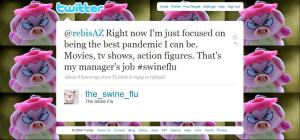
swineflu2 You can’t turn on a TV or load up a news site without seeing or hearing some expert weighing in about the swine flu.  But I’ve found it interesting to watch people deal with this soon-to-be pandemic.

In Mexico, people are decorating their surgical masks so that they can stand up to the epidemic with style and individuality.  And just today I learned about the Swine Flu Twitter Feed (@the_swine_flu), with updates on how the flu itself is going about its business of “being the best pandemic I can be.”  You know an epidemic has pop culture staying power when it inspires a Twitter account.  Filmmaker Evan Coyne Maloney asks whether “Swine Flu” or “Mexican Flu” is more politically incorrect.

As much unfortunate bad news as the Swine Flu has caused, this may all seem a bit inappropriate.  It’s a good sign, though – laughter is, after all, the best medicine.