Work for Google – for FREE!

Artists are bristling at Google’s invitation to help design skins for their Chrome browser, since Google is offering them the chance to work for free.  Critics are pointing to Google’s $1.4 billion profit margin in the first quarter of 2009 as evidence that they can afford to pay artists.

Google, of course, makes that profit from GMail, Google docs, Google Calendar, Blogger, YouTube, and a host of useful online tools that consumers have to pay for… right?  Actually, all of those are free services.  In fact, Google offers any web user an awful lot for free.

It’s not altruistic – Google does it for exposure, because the more you use their products the more they can advertise to you – and the more likely they can put an ad in front of your face.

Google, which started as a humble search engine, realized years ago that the availability of online tools meant the market would eventually set the price for certain things at $0.  Given a changing technological environment, Google changed their business model.

Good for the artists who have proclaimed that they don’t need Google for exposure – it means they are doing well enough that they don’t need to sacrifice salary for experience, the way an intern might.

The fact is, Google doesn’t need to pay for their services, either and will get their browser skin designed one way or another.  The big winners are artists seeking exposure who are willing  to sacrifice payment for their core services in exchange for a chance to be in front of more eyeballs – appropriately enough, the artists who think like Google.
The Futurama of Television

Fox is going back to the Futurama, ordering 26 new episodes of the quirky cartoon – which drew a niche audience for its first run, but seemed far to narrow in its appeal to stick on a network schedule. If that sounds familiar, it’s because this is the second time Fox has done this – the first time being for Family Guy.

Though it’s a hit now, seven years ago Family Guy was in and out of the Fox schedule, bounced around to different nights, and eventually drummed off the air.  But Family Guy found a new audience on cable, online (as college students and others with high speed connections downloaded episodes) and eventually on DVD.

Futurama followed the same path. After being bounced from Fox’s Sunday night animation block, it found a home on the Cartoon Network, grew into a hit, and was eventually brought back to network TV.

Does this mean TV networks need to change their models of success?  Obviously, both Family Guy and Futurama have a devoted audience, but took some time to find them.  And when they did, those audiences weren’t watching network TV during prime time – they were watching cable between 11:00 p.m. and 1:00 a.m.

Network TV is learning a lesson that marketers have – or should have – learned for decades: know where your audience is, and go there.

Sunday Funnies: And we’re living here in Arlington

Aside from being a funny romp through the county that lies in the shadow of Your Nation’s Capital, this represents an almost textbook case of viral marketing.  Posted on Thursday, the video made the rounds pretty quickly on Friday.  I got the link almost simultaneously from two different friends – who, incidentally, do not know each other.  That was followed quickly by an email from another friend, and later, an email from a friend in St. Louis who used to work with me in Arlington.  By the end of the day, almost everyone I talked to – coworkers, softball teammates – had seen this video.

Why?  Well, the producers obviously did a good job pushing it out through Twitter, Facebook, and email.  Their timing was perfect – the Thursday release meant that office workers could (and would) spend their Friday morning watching, laughing, and clicking “forward.”  They used recognizable landmarks from areas that had a mix of residences and businesses, meaning the video was highly recognizable. And they poked fun at behaviors you see on full display in Arlington, such as jogging in place at a traffic light, avoiding the Green Line, and of course the plethora of Starbucks locations.

But most importantly, the video is hilarious.  If you want to go viral, content is – as always – king.

Poltics: Not always appropriate

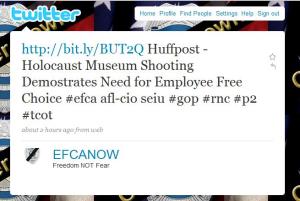
This appeared yesterday on @EFCANOW, the Twitter stream of an organized labor outfit called American Rights at Work (an organization which, paradoxically, seeks to limit your right to a secret ballot if you and your fellow workers vote on unionization):

EFCANOW1

The Huffington Post article mentioned previous attempts by security guards for more safety equipment.  In and of itself, this is an interesting and salient point: do we do enough to protect museum security guards?

It really has nothing to do with whether those guards are in a union or not, but that didn’t stop proponentsof the Employee Free Choice Act from trying to use the slaying of a security guard to advance an unrelated legislative agenda.

Unfortunately for @EFCANOW, Twitter doesn’t let you delete tweets anymore.  So when they realized their mistake later in the day, they had to scramble to make up for it.  They posted a second time, distancing themselves from the article – followed in rapid succession by several tweets much more relevant to the issue of forced unionization.

Is it sick?  Yes.  But since Big Labor’s fingerprints are all over American Rights at Work, maybe we shouldn’t be surprised at their insensitivity to violence.

Frum bad to worse

David Frum makes a great point on the need for intellectualism in the conservative movement during a Bloggingheads diavlog – then provides an excellent example by senselessly deriding Matt Lewis as non-intellectual for using common online tools to advance ideas.

The comment to which Frum takes exception was a suggestion that those looking for an introduction to conservative thought start at the Wikipedia entry for Russel Kirk’s The Conservative Mind.  Wikipedia, Frum rightly points out, is a flawed informational resource – and thus, he concludes, Matt Lewis promotes a lightweight, pop-culture conservatism.

This completely ignores the strategic value of Wikipedia.

Have you ever read The Conservative Mind?  My grandfather gave it to me for Christmas a few years back.  It’s not a pamphlet; I’m relatively sure the third little pig could have gotten away with building his house out of several copies without worrying about the big bad wolf’s lungs.  If I’m trying to convince someone of my political philosophy, I wouldn’t give them a volume that they need a pushcart to carry.

I might, however, start them off on a place like Wikipedia, which is a familiar, non-threatening environment for a political novice.  It also contains links and citations to more reputable resources.  As a gateway to information, Wikipedia is a very good resource.

And, as any communications professional will tell you, a Wikipedia entry has value.  Many people – rightly or wrongly – use it as as their first read on a subject which is unfamiliar to them.  (Lewis’s comment on learning conservatism might even be interpreted as advice on which Wikipedia entry to start with – and recommending an entry about Russell Kirk over a more generic “conservative” entry is actually quite learned.)  Given the way most voters consume information, Frum’s criticism seems a little dated.

In the interest of full disclosure, I’ve known Matt Lewis for a while and worked with him at two different companies – so I can understand a bit better than Frum how much Lewis reads, and the variety of sources he consults to educate himself.  Of course, when I think of an intellectual conservative, Matt Lewis’s name is not the first that pops into my head.  That distinction belongs to another former colleague, Dan Flynn (who points out flaws in Frum’s own brand of “intellectualism”).

But as with any political movement, ideas are only half the battle; the other half is convincing people to buy into those ideas and vote for candidates that support them.

Hey Deeds! How ’bout a card?

The mantle for the concept of unstoppable Democratic momentum is now squarely on the shoulders of Virginia’s Creigh Deeds.  If Deeds is the next governor of Virginia, then the story this November will be the continuing collapse of the Republican party; victories in Virginia and possibly New Jersey will go a long way toward changing the subject.  But while these states will have a big effect on the conversation in Washington, the opposite may not be true.

Colin Delany at ePolitics makes a good case that the selection of Deeds indicates a dissatisfaction with the incumbent political class among Democrats.  Consider that Deeds bested not only former DNC chairman Terry McAuliffe, but also Brian Moran who has been a prominent Northern Virginia figure (both for his own work and for that of his brother). Clearly, Virginia Democrats did not feel like their support was an entitlement for either candidate.

The elections in Virginia and New Jersey will continue to be big news in 2009 as pundits try to read the tea leaves for the 2010 and 2012 elections.  But as Deeds’s upset showed, state voters may have more important things on their mind than how their decisions will play in other cities along I-95.

To Høyre and back

I’m just back stateside after an all too brief trip to Oslo, Norway, where I spoke to activists from the Norwegian Conservative Party, Høyre, about online campaigning.  With parliamentary elections approaching this September – and the party performing poorly in recent polls – they had the same question being asked right now by any American campaigns, companies, and brands: How can we capture the wave of online excitement that Barack Obama rode to the White House?

One of the conference attendees asked a particularly helpful question: when deciding how to budget time, how should time be divided between online outreach and good old-fashioned knocking on doors.  The answer, of course, is that there is no substitute for the things that get you votes – offline actions like knocking on doors and physically bringing people to the polls so they can vote for your candidate.

Online tools should be implemented because they can help you do that, by creating relationships between a candidate and a voter or allowing the campaign to identify potential sources for volunteer hours, money, and of course votes.

The Obama campaign smartly did this, as the research for my presentation reminded me.  All online properties fed a database, and  communication through email, on Facebook, or through text messaging was always designed to spur supporters to vote, give money, and recruit their friends to do the same. You can communicate online, but votes are counted in real life – so online excitement is only good if it translates to offline action.

Speaking of communication, another lesson that was illustrated nicely by my Norway trip was the unimportance of words in political speeches.  I sat in on several party leaders’ addresses to the group of activists, and found it remarkably easy to follow each speech despite not speaking a word in Norwegian.  I’ve always heard that communication is 55% visual, 38% vocal (the tone and inflection of your voice), and just 7% verbal (the words you use).  The crowd reactions certainly help too, but I’ve never believed these percentages more strongly than I do now.

As further evidence, check out this activist-created (and wholly unofficial) video shown to me by my colleagues across the water.  Even if the original issue isn’t quite clear(a controversy over a policewoman in training questioning whether she could wear a burqa with her uniform) the producer’s take on the political response is pretty clear:

US stuck with factory-installed options

Tim Carney is as insightful a journalist as you’ll find in Washington, D.C., seeing connections where others allow conventional wisdom to draw conclusions for them.  He wrote a book about the link between big government and big business, writing about how large, corporate behemoths welcome excess government regulation because their smaller competitors can’t afford it.

As GM announces that bits and pieces are being sold off, Carney finds one piece that’s safe: General Motors, buoyed by taxpayer funds, will keep their lobbying operation open.  (I suppose this is another loophole in the Obama “no lobbyists working for the administration” rule.)

Congratulations, average American – you finally have a lobbyist working for you!