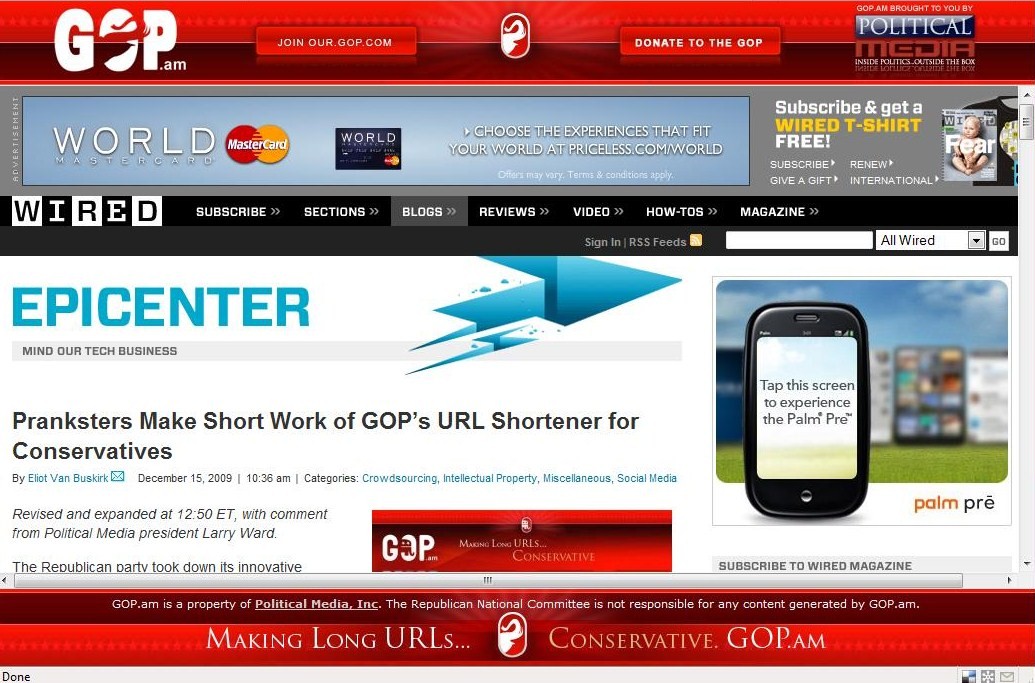
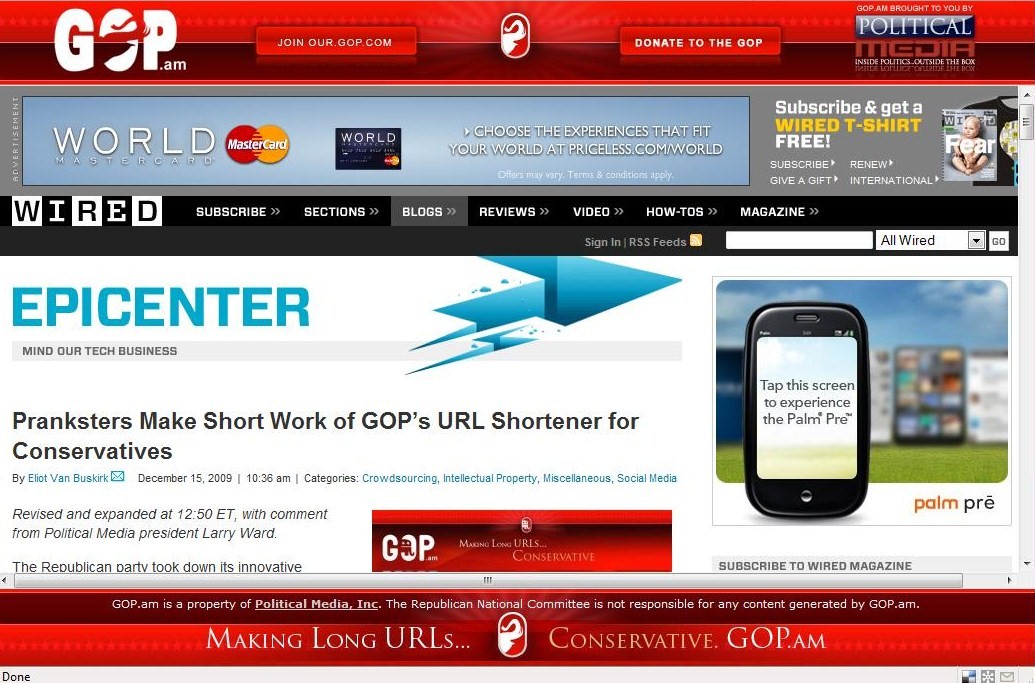
That’s one small URL for the GOP…

The Republican Party caught plenty of deserved flack for the hamfisted rollout of its website this year, but in the last couple of days there has actually been a pretty innovative development from the online right: the GOP.am URL shortener.

There are plenty of these handy devices for condensing website addresses, but GOP.am is different because it frames every website with banners directing users back to the sign up and donate sections of the GOP website.

Playful pranksters have used the link to put the GOP brand around less-than savory sites.  And, as the Bivings Report notes, the banners take up lots of space and have no obvious method for users to get rid of them.

But it’s also significant that this is not, as of yet, an official RNC project.  Remember that during the 2008 campaign, the Obama campaign benefited from user-generated videos and iPhone applications.   Even their MySpace page was started by a supporter.

Political movements which are successful online or offline have major components which are created by activists outside of the major party.  That makes projects like GOP.am important benchmarks to measure grassroots innovation – even if it isn’t perfect.

Internet schminternet

Ironically, Newsweek’s online archive is the best place to find this article from 1995 decrying the hype around the internet (which was emailed to me by a business associate).  Almost 15 years ago, Clifford Stoll claimed it was ludicrous to expect the online world to provide news, information, and social interaction.  “Baloney,” Stoll says.  “Do our computer pundits lack all common sense? The truth [is] no online database will replace your daily newspaper, no CD-ROM can take the place of a competent teacher and no computer network will change the way government works.”

Stoll’s arguments make sense if you remember the internet in 1995.  Back then, the online experience started with a screeching modem, and downloading a file took minutes rather than seconds.  And sending money was dicey to say the least, which made e-commerce a non-starter:

We’re promised instant catalog shopping–just point and click for great deals. We’ll order airline tickets over the network, make restaurant reservations and negotiate sales contracts.  Stores will become obsolete.  So how come my local mall does more business in an afternoon than the entire Internet handles in a month?  Even if there were a trustworthy way to send money over the Internet–which there isn’t–the network is missing a most essential ingredient of capitalism: salespeople.

Today, there are probably major malls that don’t do as much business during the Christmas season as the internet does in the blink of an eye, thanks to secure online payment systems.  It turns out, people don’t need salespeople when they have hordes of consumer sites and online reviews to get unvarnished information from.

But the shift has been more than technological.  There is a cultural acceptance of the online world that didn’t exist 15 years ago.  Further, the online world has self-organized in a way that Stoll and others did not anticipate.  For instance, Stoll bemoaned the Usenet bulletin boards, claiming that because everyone had a voice, everyone would get drowned out.  A similar criticism could have been made ten years later as blogs became more prevalent.  As society has become more comfortable online, they have found the sources of information they trust the most.  Anyone can have a blog, but not everyone will have a well-respected or popular blog.

Stoll was right about one very important thing, and that is the role of the internet in personal relationships.  “What’s missing from this electronic wonderland? Human contact.” Stoll concluded.  “Discount the fawning techno-burble about virtual communities. Computers and networks isolate us from one another.”  In 1995, internet enthusiasts envisioned a way to connect with people from around the world – “Play Mortal Kombat with a friend from Vietnam,” was the promise Jim Carrey made in The Cable Guy – and maybe Stoll was right to dismiss that idea.  As the internet evolved, though, it became a tool to maintain connections that would have otherwise frayed.  Facebook can make every day a twenty-first century high school reunion.

It’s hard to predict how technology will change in 15 years.  It’s hard to predict how people will change, too.
The Year in Google

Google has released their 2009 Zeitgeist report – a summary of popular search trends along various topics.  Lists like this are usually predictable – the most-searched-for baseball team was the Yankees; the alphabet soup of AIG, GM, and TARP led bailout-related searches.

But search results can also give a good concept of popular thinking on key news topics.  For instance, the top term used in healthcare-related searches is “Obama.”  That seems to indicate that, for better or worse, people are closely identifying the President with the health care reform issue.  Also interesting is that the Heritage Foundation was the #5 search term in this category – which could mean that Americans are open to hearing alternatives to what has been circulating on Capitol Hill.

Google also looks at localized search topics for several major cities.  Movie theaters and school websites dominated the results, especially colleges.  In DC, the top term was “fcps blackboard” – the portal for the Fairfax County public school system.  This actually says a lot about the Washington, DC workforce and commuting patterns.  (I knew I had company on my daily commutes into and out of Your Nation’s Capital from Merrifield, but had no idea it was enough to alter search results; Metro clearly needs more trains.)

That education websites are so popular also notes another trend.  Around the Thanksgiving table this year, my soon-to-be brother and sister in law commented that they hadn’t seen their daughter’s recent report card, despite the marking period having ended.  They explained that they just check her grades online.

Pollsters can call voters, ask questions, track answers, and get a pretty good idea of what folks are thinking.  Still, there’s an element of the Heisenberg Uncertainty Principle in that method – that the very act of measuring could affect the responses to poll questions.  Internet searches are somewhat anonymous.

As the old saying goes, you are who you are when no one is watching.

It’s in the dictionary now, and can’t be “unworded”

The verb “unfriend” is in the Oxford American Dictionary Word of the Year.  (It is also now officially a word.)

Of all the verbiage to come out of social networking and new online environments, it’s interesting that unfriend – the negative act of rescinding a connection – takes this honor.  The inclusion and exclusion of words in dictionaries is more a measure of culture than technology – technology creates new terms every day, but to be included in popular language those terms must have a crossover appeal that removes them from the realm of technical jargon and into the realm of word you might read in a newspaper article.

When most of us “unfriend” someone, it’s not because of an offline relationship that has gone south, but because the online relationship was more than we could handle.  Anyone with a Facebook account has had the friend who constantly sends requests or shares too much information.  Most people on Twitter have followed a friend who peppered their feeds with such witticisms as, “Making a sandwich and can’t decide – grape or strawberry jelly?!?”  Speaking of Twitter, after a spike earlier this year their new user numbers seem to be leveling off,and big companies that were excited to enter the medium have become absentee Tweeters.

In other words, we are settling into these new online environments by shifting from the mindset of signing up every new and shiny community or connecting with every long-lost high school class.  Perhaps we are getting better, both in terms of who we connect with and where we connect, at prioritizing what is best and most useful for us individually – and unfriending the rest.

App shoot

Upon reflecting more about recent, high-profile rejections from Apple’s App Store, one thing is becoming apparent: with the iPhone/iPod platform is gaining popularity, more developers are investing time and resources writing software for it only to see their creations rejected.

The closed-door approach makes sense for Apple – since their platform is the first of its kind, any questionable use would reflect back on their highly-recognizable brand rather than an anonymous developer.  If Saturday Night Live legend Garrett Morris developed a game for the iPhone called “Gonna Get Me a Shotgun and Kill all the Whities I See,” Apple would bear the brunt of the protests for allowing it rather than Morris.  (When Morris famously – and hilariously – sang that line on the air in 1976, the NBC switchboard probably got more calls than Morris’s home phone.  By citing the actual sketch, do I avoid somehow being called a racist for quoting it?)

But the closed door has implications for potentially revolutionary uses of mobile technology.  In 2008 a developer created an excellent application for the Obama Campaign, allowing volunteers to prioritize their contacts for get out the vote calls.  If the time and effort invested in creating an app is possibly wasted, how will small, volunteer-driven campaigns for local or Congressional offices – the types of campaigns who could really use the technology – justify exploring the possibilities of the platform?

From the “well, someone is making money, right?” file

The New York Times has a story in its tech section on Sunday that could just as easily have appeared in Style.  The piece profiled Rent the Runway, a company which rents high-end designer dresses online – just like Netflix does with movies.

Dressflix, if you will.

The silver lining of a down economy is that new markets emerge, and the astute businesses that find those new markets can carve out a niche for themselves.  That’s especially true for Rent the Runway, which makes money by helping people save money.

How many friends do you get to keep?

The Sunlight Foundation went into the weekend with a hit piece on the much-maligned re-designed GOP.com.  Over at TechRepublican, James Richardson started the week with a well-researched rebuttal, noting that Sunlight missed a couple of items in the shadows in decrying the projects price tag.

But for the site’s well-documented technical faults, on the internet content is king, so there’s at least reason to laud the Republican new media operation:  The Facebook Friendship Fairness Czar application.  The application tallies the number of your friends and assesses a “tax” reflecting how many you have over the average Facebook user’s 120-friend total.  It’s a pretty neat way to needle the Obama Administration’s tendency to entrust policy decisions to executives with no Congressional oversight.  The postcard alerting you of your tax is actually kind of funny, too:

friendship fairness

Facebook is a necessity for any new media operation – even MySpace knows that now.  That means finding creative ways to connect and keep people coming back.  Even if GOP.com has its problems, at least the Republican party is thinking strategically.

Virginia Voter Values Video

The Family Foundation, a socially conservative Virginia organization, is putting a new twist on the old tactic of a candidate scorecard by releasing theirs as a video:

It’s good, but pretty basic.  The video format gives the opportunity to include powerful imagery, and a group like the Family Foundation should be able to capitalize – shots of folks sitting down to dinner, or other family-friendly scenes would be much better than the waving American flag in the background.

(The Family Foundation may have had a good reason for being spartan – taking or even implying a stance for or against a candidate could have repercussions on tax-exempt status.  And hey, at least they’re trying.)

All activism must not be neutral

As the net neutrality argument heats up, pro-regulation groups are bashing AT&T’s efforts to mobilize their employees against the measure.  When AT&T sent an email detailing the issue and inviting workers to post comments opposing net neutrality, Free Press, a liberal media reform group, called them the a-word – “AstroTurf.”

Free Press, of course, admits to doing the same thing – but argues that their email messages to subscribers driving traffic to online comment forms are somehow different.  Their activists, apparently, REALLY oppose net neutrality; AT&T’s employees acting through fear of losing their jobs.

AT&T workers should be fearful of losing their jobs – regulating AT&T’s internet will have an impact on its bottom line.  Free Press has a flimsy argument if you think about it – but it certainly wasn’t made to evoke thought.

Pepsi uses new media well. Shame on them.

Pepsi, the Art Garfunkel of the soft drink world, released an iPhone app for its AMP energy drink that drew criticism for being sexist.  Amazingly, some company is trying to market their product by claiming to help boys attract girls.  That’s a first in the advertising world, right?

The idea of the app itself is actually impressive, strategically.  Pepsi and AMP know their target audience, and their target audience is interested in hooking up with young women and telling their friends – or at least sophomoric humor about hooking up with young women and telling their friends.  So the app provides information and enables users to brag about their conquests.  The content may be offensive, but the basics of the social strategy are sound: combining education with channels of communication.

But did it work?  Though Pepsi apologized for the application, it has not been discontinued – and is currently listed among the top ten applications being downloaded from iTunes.  As Mississippi State University opinion writer McNeill Williford points out, “The people at PepsiCo aren’t trying to push a male chauvinist agenda on anyone; they’re trying to sell drinks.”

Despite all the criticism – indeed, possibly because of it – Pepsi probably got what they wanted.