The senseless census

Census forms are to be mailed back this Friday, leading to a round of news stories and even paid advertising talking about the importance of participating.  If you received a form in the mail, you likely got a nice thick letter beforehand reminding you that it was coming; households that don’t return forms will get a visit from a census taker.   It sounds expensive because it is – especially if you fall into that category of having someone come to your door.  The census is estimated to cost $15 billion.  Since government projects tend to stay on track, that number surely won’t go up.

True enough, that tidy sum doesn’t represent that much of a dent in the budget, but couldn’t the census be organized a little better?  Isn’t it a bit surprising that it won’t be until 2020 – a quarter century after the internet became a big deal – that the census bureau figured out how to harness online communications to help count the citizenry?

Most organizations which rely on grassroots outreach have a tiered system, with online outreach as an initial step.  The first communication can go to a broad audience very cheaply, and those that participate online don’t require additional – and progressively more expensive – means of contact.

As an example, let’s say you are recruiting people for a political cause.  You might first reach out to that broad audience and invite them to sign up online.  Those that do can then be taken off the list.  Next, you might send them a piece of mail or two, then perhaps a live phone call, and finally, if all else fails, send someone to knock on their door.  At each stage in this simple example, you reduce your outreach list so that in successive stages you are spending only as much as you need.

Sending a postcard with a secure website address on it, where people could log on and answer the census questions, would be a good start to the census – and it could save millions in printing and delivery expenses of forms, letters, and other reminders.  It would have the additional benefit of painting a clearer picture of the national technological infrastructure, which would make broadband initiatives more focused.

Security of data is an important concern – and the one most often cited as an excuse for the census’s technological lagging.  Yet the IRS accepts tax return data online – which includes some of the same information.

The idea of an online census may be way off base; if that’s the case, I’d love to hear why.   But online communication is efficient, cheap, and secure – couldn’t any government program benefit from those qualities?
Crowdsourcing commencement

My former employer, the Leadership Institute, is collecting information on college commencement speakers through its Campus Reform blog.  And, instead of emailing their contacts and scanning the internet looking for that information (as we used to do back in my day) they’re relying on the wisdom of crowds to help them fill in information.  Users who don’t see their school or alma mater on the list can email the information, presumably to LI Worldwide Headquarters in Arlington, Va.

The list, predictably, shows a leftward bias, so LI further helps out by sharing tips on how to take action and provide a counter to the speakers.

Hopefully LI’s call to action will result in student-filmed user videos of the commencement speeches themselves.  Most of the big speakers – such as President Obama and other national politicians – will have their comments on C-SPAN, of course, but that won’t be the case for everyone.  Wouldn’t you be interested to see the things discussed during commencement season?

Freedom of Informa…

Last week, Big Government covered the exposure of US Deputy Chief Technology Officer Andrew McLaughlin’s personal contact list through Google Buzz.  Though many Gmail users had the same problem, McLaughlin’s personal electronic Rolodex was embarrassing because it contained people potentially affected by the policies he was in charge of.  Because of this, Consumer Watchdog filed a Freedom of Information Act request.

And then the information was gone.  Left in its place are some tough questions about data on government computers – and whether or not that qualifies as government data.  Does Google have to release any data they have on McLuahglin?  He may have deleted his Google Buzz account, but does Google have that information backed up somewhere?

Situations like this make it clear why last week some of the biggest names in technology called on the federal government to establish strict protections on personal data.  They don’t want to be forced to reveal your personal data because then it will become obvious just how much of your data they have.

Automatic to the People

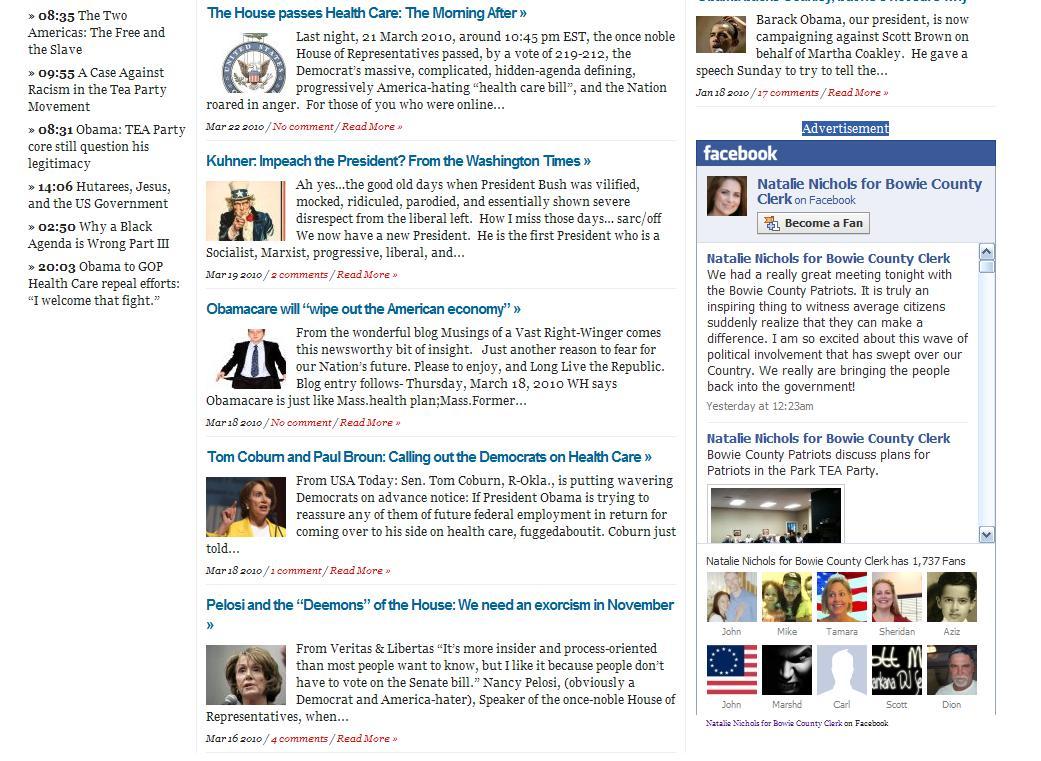
Readers of Political Integrity Now – or, most likely, any of several other websites – may have caught a nifty advertising tactic from Natalie Nichols, who’s running for Clerk down in Bowie County, Texas.  Nichols’s campaign is using ads to direct people right to her Facebook page through a Fan Box.

Facebook created Fan Box widgets to let visitors of a given website see the corresponding fan page without having to click through or anything.  Nichols is putting her Fan Box on other people’s networks by making it the creative of her ad campaign:

Nichols has a nice looking website, so why wouldn’t she just direct people back there and wow them with the flashy design?  Because as impressive as it may look, people don’t visit Nichols’ campaign website every day.  Many do visit Facebook every day.  By directing people to the Facebook page, Nichols is getting people where they already operate.  People who join her Facebook fan page are probably more likely to take further action down the road than folks who sign up for an email list and then forget two days later.

The Facebook Fan Box also has an advantages that shouldn’t be overlooked: it shows the pictures of people who have joined up.  People are hard-wired to look for images of other people, and ads which feature people tend to draw our eyes more successfully.  Nichols didn’t even have to design such an ad – she let the fan box do the work.

Best of all, readers of Political Integrity Now – or any other site on which the Fan Box appears – can join the cause in one click.  Thus they are able to take a small yet significant action without leaving the site they were on in the first place.

The YouTube Network

The first YouTube video was uploaded in April of 2005, making this month the five year anniversary of the online video revolution.

Wired celebrates with their top five reasons YouTube was successful, and all are valid: YouTube attracted viral content, found a workable business model (eventually), cooperated with those concerned their content was being uploaded illegally, gave rise to a new class of talent, and continues to innovate.  These were all instrumental in the rise of YouTube, but they missed an important factor that doesn’t fit into any of those qualities.

YouTube was one of the first sites to recognize that a website could be popular without anyone visiting it.  By making videos embeddable on any blog or website, YouTube didn’t have to bring you to www.youtube.com to get you to watch their videos.  Thus YouTube became less a video sharing website than a video sharing network – a distinction which invites more content.

The embed code on most YouTube videos is a string of letters and numbers that means little to most users.  Yet that string is why YouTube is where it is today: everywhere.

Apple, the iPad, and the Palin effect

The fact that Apple’s iPad will be released at the conclusion of Holy Week is entirely appropriate, given how some in the tech press are treating this arrival. (“Behold!  Your new God!”)

But as much fun as it would be to deflate the hype, the iPad will most likely be a runaway success – not only because it’s probably neat to play with, but because Apple is the Sarah Palin of the tech industry.

Hear me out.

Apple has had detractors for years – from complaints about the difficulty in transferring legally purchased but DRM-restricted songs among multiple devices to criticisms about the walled garden  that is the iPhone/iPod touch app store.

Yet, their track record for translating innovation to consumer success is built on a cultural coolness factor that transcends technical specifications.  And Apple capitalizes on this through the app store – inviting third parties to have some sort of vested interest in the product’s success.

The Wall Street Journal announced their iPad subscription model last week.  Amazon’s Kindle reader dominates the electronic book market today; but a free iPad application is an apparent nod to Apple’s emergence in that market.  Apple is so culturally entrenched they didn’t even have to pay for product placement when Modern Family devoted a show to the iPad release.

Apple has created a cycle – its products have been successful, so new product lines will attract third party support from companies looking to cash in – which will in turn make those new products successful.

The other new product debut from an established brand came on Fox News, where “Real American Stories” television special launched with Sarah Palin as the host.  The show’s debut comes a week after the announcement that she will host a documentary on Alaska for The Learning Channel.

Like Apple, Palin has cultivated a strong core following and reputation that invokes attention – from supporters and opponents alike.  Fox News and The Learning Channel both know this translates controversy, media buzz, and ultimately ratings.   And as is the case with Apple, third party groups (like TV networks) to have a stake in the attention that Palin receives.  In many ways, she doesn’t even have to be creative about how she’s presented – just as Apple largely relies on app developers to define how the iPad is used.  Those third parties benefit, and therefore have a vested interest in her continued visibility.

Lather, rinse, repeat.

So if you find yourself watching the coverage of the iPad and wondering whether or not it will earn enough industry support to eventually take off, ask yourself how long you’ll have to go before seeing something about Sarah Palin on TV.

NewTube

YouTube’s new design for its video player pages debuted yesterday.  The new, streamlined style highlights the video itself, with comments and share links underneath:

Previously, YouTube video pages had focused many of their functions “above the fold”: most of the functions and options were arranged so they could sit on your computer screen simultaneously with the video.  Like a work desk that has every document you need somewhere on the desktop, clutter accompanied convenience.  This design is more vertical and simple.

More subtle are some of the functional shifts: YouTube’s ratings system has been replaced with a Facebook-style “like” button, and the comment system has been tweaked to prioritize video responses and comments from frequent video uploaders and power users.

Perhaps most interesting is the explanation behind the changes, as reported by Wired:

Two members of YouTube’s team mentioned the fact that people watch YouTube for an average of 15 minutes at a time, while they tend to watch a staggering five hours of television at a stretch. YouTube aims to shrink that gap with its new playlists, which will present a selection of similar songs if you’re watching a music video, for instance. You’ll also see search results that follow you around the site so you can check out a number of them in succession, and rollover previews at the top of the screen.

Playing “What If”: A political privacy scandal

Successes of the past five or six years have made online grassroots outreach an absolute necessity for any serious campaign for major office.  And every day, the possibilities for online activism multiply in seemingly exponential rates.  The art of the online possible has grown from a framed wall painting into the Sistine Chapel, and the smart campaigns kept up.

Sadly, that’s probably where the problems will come from.

Consider mashups like Checkin Mania – a site that merges information various location-based networks and Google Maps.   Sites which merge data from various sources are popular with users because they can consolidate information – in this case, it helps you find your friends,  even if one is using Gowalla and another is using Foursquare.  The next “revolutionary” campaign will likely have components like this; when you sign up for Obama/Biden 2012 (or Pawlenty 2012, or Romney 2012, or Zombie Reagan 2012) you would have the ability to link other services as well.  In fact, you might even be able to sign up with Facebook Connect, immediately linking your Facebook profile and all other information that you reveal somewhat publicly.

Now, here’s where the what-ifs get interesting.

This means there will be lots of information flowing around not only the campaign site, but to and from several interconnected sites.  Leaks and mistakes are inevitable, and not from hackers – from random items being posted to networks the user did not intend to post them to.  It may mean embarrassing Facebook pictures being shared on the campaign site; it may means your meeting at the bondage club gets tweeted to your Twitter following.

Sound too far-fetched?  Facebook gets knocked for privacy violations every few months – most recently for an information-sharing in their privacy policyGoogle  Buzz was famously lazy about privacy considerations in its rollout.  And they optimize user experiences in social networks for a living, that’s how they earn their food money.

These mistakes come from innovation – designers trying to come up with ways to make the sites and services they offer easier.  Campaign tech teams worth their salt do the same – the lower the barrier to entry, the more supporters you can attract.

When you have a political team that – like Facebook’s development group – gets starry-eyed while looking at the art of the possible, some details on that fresco are bound to be missed.  When they are, the opposing campaign will be ready to pounce.

This isn’t to say campaigns should stop innovating.  But the “what if” game is an important part of innovating in the high stakes environment of political campaigns.  Privacy is becoming an ever more important issue on the web.  If companies like Google and Facebook have to be ready for these concerns, campaigns must be ready as well.

Bringing the politics to you

Minnesota Governor/2012 Presidential hopeful Tim Pawlenty is holding a  town hall meeting tomorrow.  Last night, California Senate candidate Chuck DeVore held a fundraiser with Andrew Breitbart.

You can go to either of these events without being in Minnesota or California – both will be online.  (Though, if you want to attend the DeVore event, you’re going to have to also find a way to channel 1.21 gigawatts into the flux capacitor, which may cost more than the $50 minimum donation.)

In Pawlenty’s case, the two-term governor is attempting to build a national base in advance of his 2012 run for the White House.  For people nosing around and still feeling out the contenders, it’s a low barrier of entry.   With the first primaries still more than 20 months away, Pawlenty wisely doesn’t want to burn out his activists; at the same time he wants to start building a list of engaged supporters.  Some of his likely primary opponents (like Mitt Romney, Mike Huckabee, and maybe Sarah Palin) already have exposure and campaign infrastructure from 2008.  The town hall could help Pawlenty catch up and – maybe even more important – allows him to build the perception of his candidacy being more firmly rooted in ideas than personality.

DeVore is trying to broaden his base, too – and continue extending his brand as one of the leaders among Republicans in the use of online tactics.  Thus far in the primary, DeVore has been the Martin Short of the Three Amigos running for the Republican nomination.  (If you’re wondering, Steve Martin was the best Amigo, followed closely by Chevy Chase.  Barbara Boxer is already El Guapo.)  The virtual pizza party may not put him on the Republican ticket to face Boxer in 2010, but it’s a good idea – one that could help other Republicans in 2010 or even DeVore himself in a future race.  After all, winning campaigns aren’t the only ones with good ideas.

Fake Twitter Accounts: A Big F***ing Deal

Leave it to Joe Biden.  After a year of contentious debate followed by 36 hours of talking heads trying to make sense of what the health care overhaul means, the Veep’s tidy summary was at once true, painfully obvious, hilarious, and in character with the caricature of Biden as an elder Dan Quayle redux… Which meant that the internet would have a field day with it.

Within hours, the Twitter feed @BigFnDealer was mocking Biden and chronicling the reactions.  This comes just a few months after  Carly Fiorina’s “Demon Sheep” web video spawned @DemonSheep. And @BOTeleprompter has been mocking Biden’s boss just about as long as the President has been in office.  Sarah Palin and Michael Steel have been targeted.

Fake Twitter have been giving alter egos to characters both fictional (@DarthVader) and real (@Michael_Bay) since Twitter launched.  They have generally been a hobby, but as the political examples show, they can also be a way to advance a message in a comic, snarky way.  Because they are generally anonymous, they are tough to engage unless the account owner does something stupid (like trying to claim the actual identity of the person being mocked).

As @BigFnDealer shows, getting in on the ground floor is a necessity – the internet moves fast.  And of course, satire only works as a powerful message advancement tool if it’s good; lame jokes tend to backfire.

But when it works, what better way to needle your opponent than to put words in his or her mouth?