Now America loves health care reform

In a reversal not seen since Springfield decided they loved the Burlesque House, poll numbers on the health care bill have just about flipped since its passage, with a small edge favoring the bill.

Those numbers will likely go up in the next few months.  Americans are overwhelmingly satisfied with their own health care, and most of the provisions of the health care legislation will roll out slowly over the next decade.   President Obama’s oh-so-Presidential taunts about health care overhaul – calling on Republicans to “look around” in “two months, six months” – are backed up by the fact that very little will happen in that time.

More evidence that “repeal the deal” would be a loser as a political slogan this November.  But what if the slogan was “finish the job”?

Buried in the bill (and this story on CNN) are limitations on Flex Spending Accounts – personal savings accounts people can use to save money for their own health care.  Along with silly items like taxes on tanning beds and regulations on the McDonald’s dollar menu, there are plenty of gaps in the program administered by our new health overlords.  Why not attack those in the name of making people healthier?

Framing real health reform this way is a winner – after all, as the polls show, America loves to back the winning horse.

Why ACORN cracked

ACORN is closing up shop and may have to file for bankruptcy.  There’s no mystery as to why: donors have refused to write checks to the organization since the now-infamous “pimp videos” featuring James O’Keefe and Hannah Giles.  The ensuing controversy that made ACORN radioactive had as much to do with the organization’s response as it did with the actual content of the videos.

A Wired article on Andrew Breitbart – whose Big Government was a platform for the videos – details the strategy behind the tiered release of the videos:

Breitbart initially released only the video from Acorn’s Baltimore bureau, which the group dismissed as an isolated incident. The next day, he posted a video of O’Keefe getting similar results in Washington, DC. Oops. Acorn stepped on the rake again, claiming the videos were doctored. Then Breitbart posted more — from New York City, San Diego, and Philadelphia. Congress started pulling Acorn’s funding, and The New York Times flagellated itself for its “slow reflexes” in covering the story.

A less savvy operative might have released all the videos at once to illustrate the scope of the problem.  They would have received some coverage, but the media would largely have dismissed the story.  After all, how many government and non-profit offices would you really have to walk into if you wanted to catch someone saying stupid on camera?

By releasing the videos in slow drips, O’Keefe and Breitbart established a pattern.  With each new video, the story became a bit bigger, and more media outlets paid attention.  This strategy also allowed ACORN to be dismissive of the first few releases, making them look all the more foolish when the “isolated incident” proved to be anything but.

On its own, video of O’Keefe and Giles would have told a compelling story about ACORN.  Handled smartly – as it was – this information became a tangible result.

Wait, who did we just screw over?

Health care reform passed on Sunday night.  On Monday, health care stocks soared – including shares of insurance companies.  It might seem counter-intuitive – after all, the talk of Washington has been that the health care overhaul would put patients ahead of “special interests.”

As with any Washington, DC mystery, the rhetoric is pointless and the real answers stem from who has their hands in the cookie jar.

Yesterday, passing healthcare seemed so far away

On Friday, Barack Obama was a one-term President.  The Democrats were swimming upstream against the political current, weighed down by an unpopular health care bill.  Scott Brown’s election meant that the Republicans would sweep the fall elections.

Today, the details of the health care bill are quite inconsequential: despite the fact that many Americans are saying they’d support a candidate who pledged to repeal the deal, Obamacare is now the law of the land.

If you can get past the needless potshots at conservative talk radio and other efforts to prove he’s really one of the cool kids, David Frum’s piece on CNN makes a few tidy points about how hard a straight repeal is:

Some Republicans talk of repealing the whole bill. That’s not very realistic… Will they vote to reopen the “doughnut” hole for prescription drugs for seniors? To allow health insurers to deny coverage to people with pre-existing conditions? To kick millions of people off Medicaid?

Kudos to Frum for the correct spelling of the word “doughnut” – and for laying several policy proposals to fix the bill that was passed last night.

He gets some of the policies wrong, but he gets the big point right: that the one-word campaign of “Repeal!” just won’t cut it.  Republicans will need to have a plan in place to do things Obama promised to do with his health plan – especially reducing cost and expanding access.

Obamacare’s opponents can no longer arguing against an unpopular proposal; they now must argue against an existing entitlement.  Polls may show that many voters opposed the health care overhaul last week, but those who would change the policy must now fight a different battle altogether.

3 Unfortunate Predictions about Health Care

Sunday looks like D-Day for President Obama’s push to overhaul health care.  There is plenty of speculation flying around about votes in the coming days and what those mean for votes in November.

How will health care affect the political environment over the coming eight months?  Some humble predictions:

1. Health care will only be a short-term political liability for Democrats if it doesn’t pass – if it does, it will be a short-term benefit.

The bitter battle over health care is one reason that voters are souring on everybody in Washington.  The sooner that debate is over, the sooner Democrats can focus on things like regulatory reform and passing out money like Jack Nicholson’s Joker in Batman ’89 while asking, “Who do you trust?” – both of which are much easier to craft messages for.

But there’s more than that.  The opposition to Obamacare (both official and unofficial) has highlighted long-term effects for the American health care system and federal budget – unfavorable comparisons to British and Canadian health care systems, excessive cost, and even shortages of care and care givers.  These won’t take effect by November 2010 or even 2012.

If the health care overhaul passes – and the expected state challenges are quick and quiet – Democrats will trumpet their progress for the next three years while accusing Republicans of lies and scare tactics.  Obama is right to link the passage of health care and his party’s political fortunes.

2. It’s probably going to pass, and it doesn’t matter how.

As Dan Flynn opines, the reason there hasn’t been a vote already is because there aren’t enough votes.  Until Nancy Pelosi can amass 216 Democrats to support whatever parliamentary gymnastics she has to do to get a bill through the House, there will not be a vote.  When the vote comes up, bet the house – it’s getting through.

3.  The “Repeal Obamacare” movement will get less traction than one might expect.

Entitlements are the gifts that keep on giving.  They don’t actually help end poverty, they don’t give people a comfortable retirement, and they don’t help people who have lost their jobs find new ones.  They do provide platforms for politicians to promise even more entitlements.  When entitlements fail to fix the problem they were meant to solve (or make it worse), the answer is generally to dump more funding into the failed program.

Even failed programs can be elevated to third-rail status.  Remember the left-wing backlash against President George W. Bush’s Social Security reform?  You can expect a similar reaction to future attempts to roll back Obamacare.

Like Social Security reform, real health care reform – that involves doing more than just getting more people into a broken system – will require a long-term, sustained effort that changes how our culture views our government.

Bonus prediction: By the way, whatever the outcome of the vote on Sunday, people with money will always get the health care they need and want.
Democrats eating their own

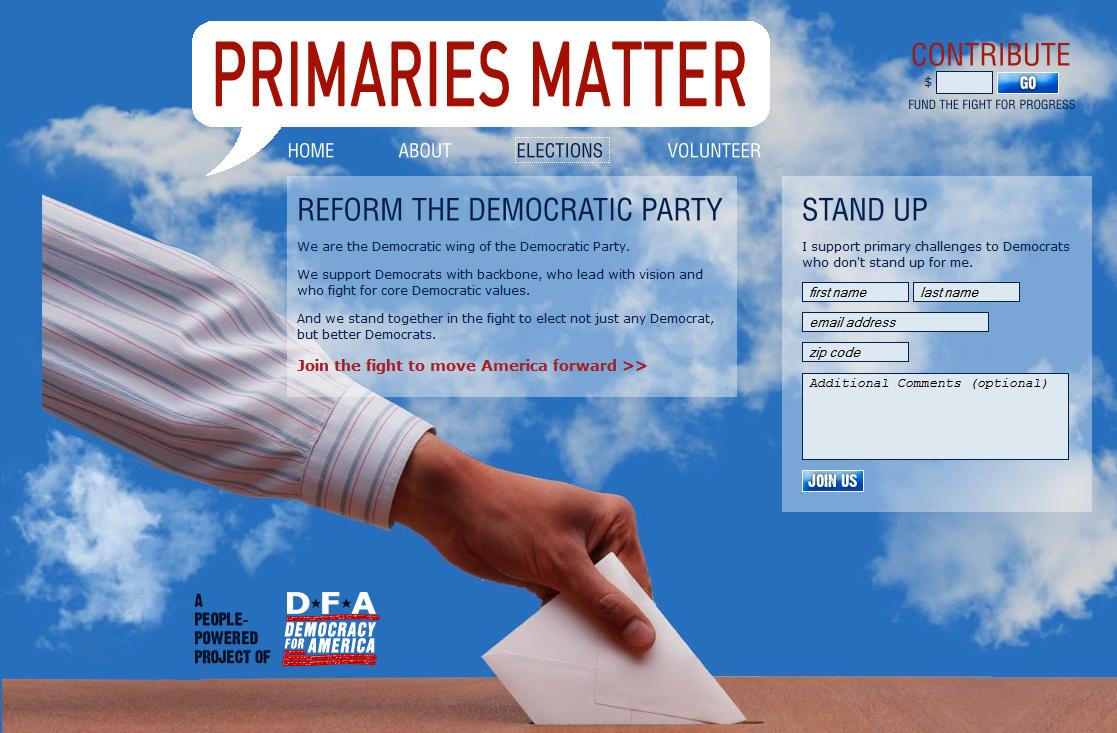
Democracy for America, the outgrowth of Howard Dean’s 2004 presidential campaign, is taking aim at moderate Democrats.   PrimariesMatter.com speaks to grassroots activists looking to oust ideologically impure incumbents in favor of more “progressive” challengers.

Weighed down by an unpopular health care bill and runaway government spending as the ubiquitous solution to every problem, voters will be looking for change in November 2010.  For Democrats, thinning the weaker candidates from the herd (especially any carrying that big target called a “voting record”) may be the only way to offer credible options for those voters.

Unfortunately for the Democratic party, the more liberal candidates will likely support policies (like the health care overhaul and increased government programs) which have proved so unpopular.

CoCoBama

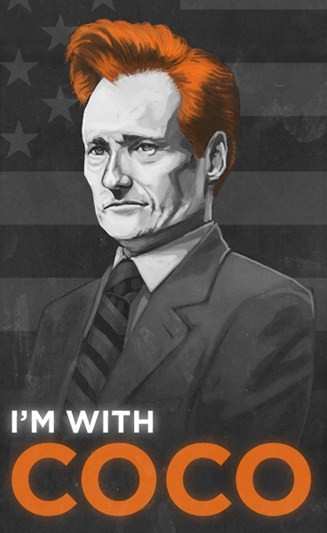
The official logo of Conan O’Brien’s upcoming Legally Prohibited from Being Funny On Television tour is based on the now-familiar illustration of a stoic O’Brien standing against the American flag, gray but for the bold orange pompadour rising from his head like a mighty wave rising from the ocean.  It may be the icon of Team CoCo, but it didn’t come from Team CoCo: the graphic was created by Mike Mitchell, an enthusiastic artist who had nothing to do with O’Brien other than being an avid fan with an idea and some spare time.

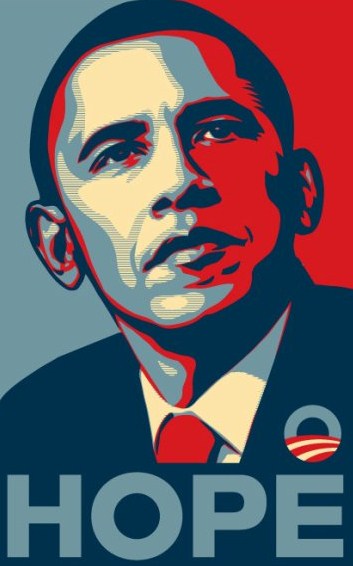
Largely on the back of the massive outpouring of support he enjoyed in the final weeks of his Tonight Show run, O’Brien stands to make a lot of money wherever he lands this fall.  O’Brien will be rewarded for embracing that organic excitement.  It’s similar to the smart moves made by the 2008 Obama Campaign, which enjoyed the creation of a similar iconic image created by Shepherd Fairey – an enthusiastic artist who had nothing to do with the campaign, but had an idea and some spare time.

A technical term for this is “advocate-generated content.”  Even that mouthful is easier said than done.  You can’t force people to identify with a cause, let alone feel so strongly about it that they are willing to make art.  Both Team CoCo and Obama 2008 benefited from a simple, direct, and resonant message.  The fancy artwork was just a symptom.

Carly’s Boxer Blimp

The Carly Fiorina campaign has released a follow-up to their much-lampooned “Demon Sheep” web video.  In this one, Barbara Boxer turns into a giant blimp because she’s full of hot air.  (Getcha popcorn ready, because it’s almost eight minutes long.)

Despite the ribbing from Fiorina’s primary opponents, ad maker Fred Davis claimed victory for the viral hit, pointing to its high number of YouTube views.  Davis might have a point.  The funny part of the Demon Sheep video – the campily costumed and Keds-clad sheep – came at the end, after the video had railed on fellow Republican candidate Tom Campbell’s fiscal street cred.  The Boxer Blimp wouldn’t attract nearly as much attention if it hadn’t been for its fluffy forefather.

Still, the video is as unfocused as it is comical and over the top.  The message shifts from the Senator being arrogant to incompetent to out of touch, and discusses taxes, environmental policy, financial restraint, national security, and Boxer’s personality with clumsy or non-existent segues.  The imagery is often uneven; at one point, the announcer accuses Boxer of being progressively “less and less effective” during her Senate tenure just as her image is smashing through the Capitol dome.

It does, however, tell a good story about Carly Fiorina – but unlike the Demon Sheep, the story comes after the CGI blimp attack.

But regardless of what anyone thinks of the style of the ads or how many viewers they attract, the one measure of effectiveness is at the polls.  That’s an area where Fiorina still lags behind.

(By the way, if you look closely, I’m pretty sure the shots of San Francisco include Alamo Square – more notably known as “Full House Hill” for its inclusion in the opening credits of the legendary and classic sitcom.)

“Who wants Google in Minnesota? Me, Al Franken.”

Sen. Al Franken is pushing for Google to come to Duluth, Minnesota and wire the whole place for internet.  It’s just one of many examples of cities begging Google to come and save them from choppy YouTube videos.

As the FCC debates broadband expansion plans that are beginning to sound like entitlement programs, Google is showing that acting in their own self-interest can have a public benefit:

Google makes its money connecting people with data and showing them ads along the way. Anything that increases the number of people on the internet and the amount of data they seek is good for the company. On most ISPs, YouTube videos can stutter or stop due to low connection speeds, even from “high-speed” providers. One way or another, Google seeks to quicken the net by connecting cities to high-speed fiber optic lines that transmit data with modulated light (updated) rather than the wire-based electrons employed by most ISPs (fiber-optic Verizon Fios [sic] excepted).

That said, these municipalities should remain vigilant.  No matter how free the broadband is, there are legitimate concerns about Google’s privacy record.

The Obama base

USA Today wonders about Barack Obama’s base being “disengaged” come 2012.  That may make the presidential election closer than it would have been otherwise, but it won’t tip the scales in favor of a Republican challenger.

George W. Bush had a similar problem in 2003.  Conservatives were grumbling about education reforms and the prescription drug benefit; there was even a healthy dose of disagreement on the Iraq war.  For many, it meant sitting on their hands – and one conservative writer even told me he voted for John Kerry because he felt anyone would be better than Bush.

Bush did, however, have a brilliant campaign apparatus in place and enough excited activists to overlook some specific policy disagreements.  Initially, it seems Obama can boast the same.

If Dick Cheney is to be turned into a prophet, it will not be due to former loyalists losing faith; more likely, it will be because independent voters don’t buy what those loyalists are selling, Obama may join the ranks of the unemployed.  A GOP version of John Kerry – or, to avoid crossing party lines, a re-enactment of Bob Dole’s uninspired 1996 campaign – will still run into a buzz saw.