Automatic to the People

Readers of Political Integrity Now – or, most likely, any of several other websites – may have caught a nifty advertising tactic from Natalie Nichols, who’s running for Clerk down in Bowie County, Texas.  Nichols’s campaign is using ads to direct people right to her Facebook page through a Fan Box.

Facebook created Fan Box widgets to let visitors of a given website see the corresponding fan page without having to click through or anything.  Nichols is putting her Fan Box on other people’s networks by making it the creative of her ad campaign:
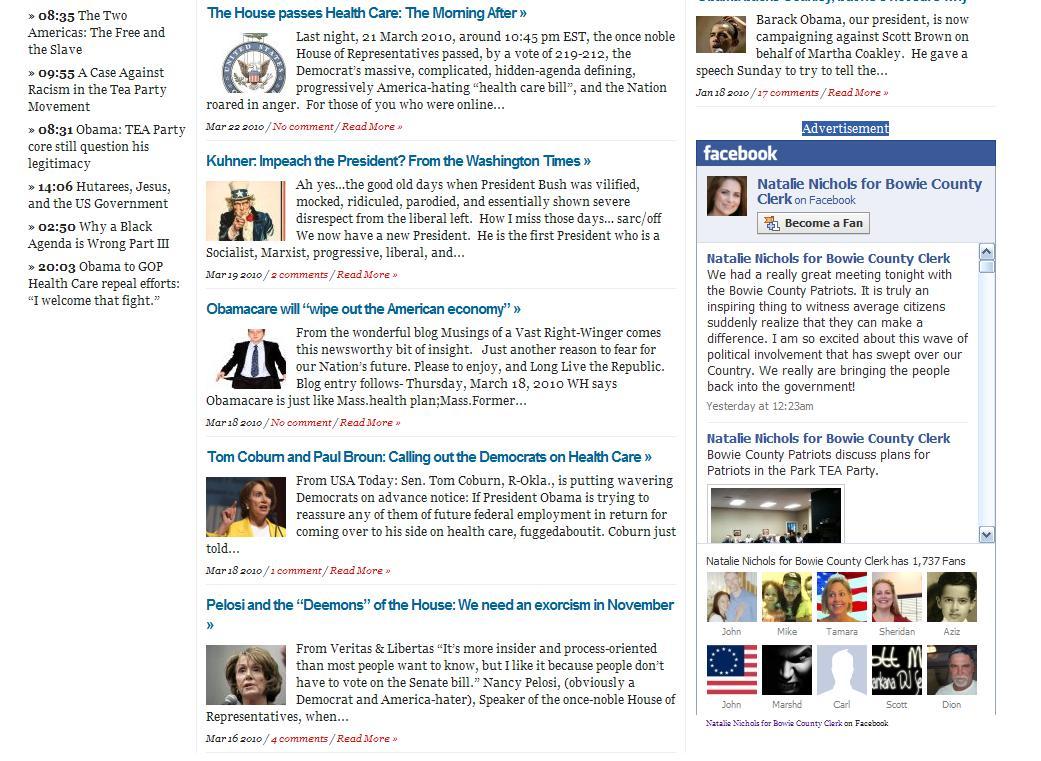
Nichols has a nice looking website, so why wouldn’t she just direct people back there and wow them with the flashy design?  Because as impressive as it may look, people don’t visit Nichols’ campaign website every day.  Many do visit Facebook every day.  By directing people to the Facebook page, Nichols is getting people where they already operate.  People who join her Facebook fan page are probably more likely to take further action down the road than folks who sign up for an email list and then forget two days later.

The Facebook Fan Box also has an advantages that shouldn’t be overlooked: it shows the pictures of people who have joined up.  People are hard-wired to look for images of other people, and ads which feature people tend to draw our eyes more successfully.  Nichols didn’t even have to design such an ad – she let the fan box do the work.

Best of all, readers of Political Integrity Now – or any other site on which the Fan Box appears – can join the cause in one click.  Thus they are able to take a small yet significant action without leaving the site they were on in the first place.
Flubs of Steele

Michael Steele shouldn’t have blamed his recent fundraising flaps on racism.  Luckily, he didn’t, despite the headlines crawling around today

Watch the clip: Race was actually brought into the discussion as part of a viewer question, which Steele answered honestly – and, to be fair, correctly.

Maybe Steele should have been a little clearer on the fact that he was speaking broadly about the fact that, although we have come pretty far in this country, black people still get the crap end of the stick more than they should.  He did bring it up as a bipartisan issue.

But his out-of-context quote has been framed to sound like an excuse and repeated over and over.  Any person who wrote a headline – or worse, a story – that implied that Steele was hiding behind race for the recent RNC scandal is either a political hack or a bad journalist.  (And ABC’s own site, which claimed Steele “played the race card today,” is no better.)

Again, watch the clip.

Last week the New York Times went over the top, implying that anyone who opposes government-run health care might as well be hanging with Ed Norton and Edward Furlong and giving out curb smileys to anyone who rooted for the Lakers over the Celtics in the 1980s.  In comparison, Steele’s mild observation is a much more reasoned and well-thought-out social commentary on race relations.

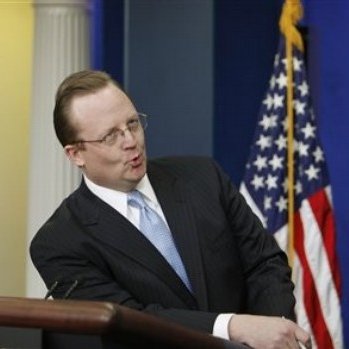
Thankfully, the White House’s Robert Gibbs set everything straight during the daily press briefing, calling the concept that black people and white people are treated different “fairly silly.”

Because there could be no better expert on race relations than this guy:

Apple, the iPad, and the Palin effect

The fact that Apple’s iPad will be released at the conclusion of Holy Week is entirely appropriate, given how some in the tech press are treating this arrival. (“Behold!  Your new God!”)

But as much fun as it would be to deflate the hype, the iPad will most likely be a runaway success – not only because it’s probably neat to play with, but because Apple is the Sarah Palin of the tech industry.

Hear me out.

Apple has had detractors for years – from complaints about the difficulty in transferring legally purchased but DRM-restricted songs among multiple devices to criticisms about the walled garden  that is the iPhone/iPod touch app store.

Yet, their track record for translating innovation to consumer success is built on a cultural coolness factor that transcends technical specifications.  And Apple capitalizes on this through the app store – inviting third parties to have some sort of vested interest in the product’s success.

The Wall Street Journal announced their iPad subscription model last week.  Amazon’s Kindle reader dominates the electronic book market today; but a free iPad application is an apparent nod to Apple’s emergence in that market.  Apple is so culturally entrenched they didn’t even have to pay for product placement when Modern Family devoted a show to the iPad release.

Apple has created a cycle – its products have been successful, so new product lines will attract third party support from companies looking to cash in – which will in turn make those new products successful.

The other new product debut from an established brand came on Fox News, where “Real American Stories” television special launched with Sarah Palin as the host.  The show’s debut comes a week after the announcement that she will host a documentary on Alaska for The Learning Channel.

Like Apple, Palin has cultivated a strong core following and reputation that invokes attention – from supporters and opponents alike.  Fox News and The Learning Channel both know this translates controversy, media buzz, and ultimately ratings.   And as is the case with Apple, third party groups (like TV networks) to have a stake in the attention that Palin receives.  In many ways, she doesn’t even have to be creative about how she’s presented – just as Apple largely relies on app developers to define how the iPad is used.  Those third parties benefit, and therefore have a vested interest in her continued visibility.

Lather, rinse, repeat.

So if you find yourself watching the coverage of the iPad and wondering whether or not it will earn enough industry support to eventually take off, ask yourself how long you’ll have to go before seeing something about Sarah Palin on TV.

We all get unicorns? Oh, it’s April Fools…

The National Republican Senatorial Committee celebrated April Fool’s Day by releasing a well-timed video chronicling the difference in President Obama’s promises and results:

Messaging on April Fool’s Day can be tricky for political groups.  As a private company with a reputation for lightheartedness, Google can make annual fake announcements without fear of retribution.  (This year they are renaming the company “Topeka” – reciprocating the promise of the free-broadband-seeking Topeka, Kansas to rename their city “Google” for a day.)

The NRSC did a good job with the video.  Because it’s obvious and over the top, it’s clearly an April Fools joke from the beginning.  Sure, that might make it a bit less funny, but the NRSC isn’t going for an award from a comedy film festival.  They were looking to do just what they did: use measured humor and creativity to deliver an important – and well-timed – political message.

Playing “What If”: A political privacy scandal

Successes of the past five or six years have made online grassroots outreach an absolute necessity for any serious campaign for major office.  And every day, the possibilities for online activism multiply in seemingly exponential rates.  The art of the online possible has grown from a framed wall painting into the Sistine Chapel, and the smart campaigns kept up.

Sadly, that’s probably where the problems will come from.

Consider mashups like Checkin Mania – a site that merges information various location-based networks and Google Maps.   Sites which merge data from various sources are popular with users because they can consolidate information – in this case, it helps you find your friends,  even if one is using Gowalla and another is using Foursquare.  The next “revolutionary” campaign will likely have components like this; when you sign up for Obama/Biden 2012 (or Pawlenty 2012, or Romney 2012, or Zombie Reagan 2012) you would have the ability to link other services as well.  In fact, you might even be able to sign up with Facebook Connect, immediately linking your Facebook profile and all other information that you reveal somewhat publicly.

Now, here’s where the what-ifs get interesting.

This means there will be lots of information flowing around not only the campaign site, but to and from several interconnected sites.  Leaks and mistakes are inevitable, and not from hackers – from random items being posted to networks the user did not intend to post them to.  It may mean embarrassing Facebook pictures being shared on the campaign site; it may means your meeting at the bondage club gets tweeted to your Twitter following.

Sound too far-fetched?  Facebook gets knocked for privacy violations every few months – most recently for an information-sharing in their privacy policyGoogle  Buzz was famously lazy about privacy considerations in its rollout.  And they optimize user experiences in social networks for a living, that’s how they earn their food money.

These mistakes come from innovation – designers trying to come up with ways to make the sites and services they offer easier.  Campaign tech teams worth their salt do the same – the lower the barrier to entry, the more supporters you can attract.

When you have a political team that – like Facebook’s development group – gets starry-eyed while looking at the art of the possible, some details on that fresco are bound to be missed.  When they are, the opposing campaign will be ready to pounce.

This isn’t to say campaigns should stop innovating.  But the “what if” game is an important part of innovating in the high stakes environment of political campaigns.  Privacy is becoming an ever more important issue on the web.  If companies like Google and Facebook have to be ready for these concerns, campaigns must be ready as well.

Bringing the politics to you

Minnesota Governor/2012 Presidential hopeful Tim Pawlenty is holding a  town hall meeting tomorrow.  Last night, California Senate candidate Chuck DeVore held a fundraiser with Andrew Breitbart.

You can go to either of these events without being in Minnesota or California – both will be online.  (Though, if you want to attend the DeVore event, you’re going to have to also find a way to channel 1.21 gigawatts into the flux capacitor, which may cost more than the $50 minimum donation.)

In Pawlenty’s case, the two-term governor is attempting to build a national base in advance of his 2012 run for the White House.  For people nosing around and still feeling out the contenders, it’s a low barrier of entry.   With the first primaries still more than 20 months away, Pawlenty wisely doesn’t want to burn out his activists; at the same time he wants to start building a list of engaged supporters.  Some of his likely primary opponents (like Mitt Romney, Mike Huckabee, and maybe Sarah Palin) already have exposure and campaign infrastructure from 2008.  The town hall could help Pawlenty catch up and – maybe even more important – allows him to build the perception of his candidacy being more firmly rooted in ideas than personality.

DeVore is trying to broaden his base, too – and continue extending his brand as one of the leaders among Republicans in the use of online tactics.  Thus far in the primary, DeVore has been the Martin Short of the Three Amigos running for the Republican nomination.  (If you’re wondering, Steve Martin was the best Amigo, followed closely by Chevy Chase.  Barbara Boxer is already El Guapo.)  The virtual pizza party may not put him on the Republican ticket to face Boxer in 2010, but it’s a good idea – one that could help other Republicans in 2010 or even DeVore himself in a future race.  After all, winning campaigns aren’t the only ones with good ideas.

Salary Capitol

Politico reports this morning that almost 2,000 folks working in House offices on Capitol Hill make six figures a year – and that doesn’t include the House Members themselves.  That’s a small slice of the folks working on the Hill, so it’s not like working in Congress automatically means you’re big pimpin’ and/or spendin’ cheese.  But the explanation from the Chief Administrative Office is somewhat amusing (emphasis added):

“Staff are compensated appropriately according to their skill sets, length of career within the CAO … and in direct relation to the salary grade similar professional credentials could achieve in the executive branch or in the private sector in a major metropolitan area like Washington, D.C.,” said CAO spokesman Jeff Ventura. “Salaries are designed to retain the talent necessary to successfully maintain operations of the House of Representatives.”

Sometimes design doesn’t equal results.  Not to say that the folks making this money don’t deserve it – considering they frequently work 20-hour days, spend lots of time away from their families, and have to be on call nearly 24 hours a day.  But finding “the talent necessary to successful maintain” Congress isn’t a matter of salary – it’s a matter of votes.

Frum leaves AEI

Today, the American Enterprise Institute let go of David Frum.  Frum’s explanation:

I have been a resident fellow at the American Enterprise Institute since 2003. At lunch today, AEI President Arthur Brooks and I came to a termination of that relationship.

It sounds like Brooks was the Bob Sugar to Frum’s Jerry Maguire:

Fake Twitter Accounts: A Big F***ing Deal

Leave it to Joe Biden.  After a year of contentious debate followed by 36 hours of talking heads trying to make sense of what the health care overhaul means, the Veep’s tidy summary was at once true, painfully obvious, hilarious, and in character with the caricature of Biden as an elder Dan Quayle redux… Which meant that the internet would have a field day with it.

Within hours, the Twitter feed @BigFnDealer was mocking Biden and chronicling the reactions.  This comes just a few months after  Carly Fiorina’s “Demon Sheep” web video spawned @DemonSheep. And @BOTeleprompter has been mocking Biden’s boss just about as long as the President has been in office.  Sarah Palin and Michael Steel have been targeted.

Fake Twitter have been giving alter egos to characters both fictional (@DarthVader) and real (@Michael_Bay) since Twitter launched.  They have generally been a hobby, but as the political examples show, they can also be a way to advance a message in a comic, snarky way.  Because they are generally anonymous, they are tough to engage unless the account owner does something stupid (like trying to claim the actual identity of the person being mocked).

As @BigFnDealer shows, getting in on the ground floor is a necessity – the internet moves fast.  And of course, satire only works as a powerful message advancement tool if it’s good; lame jokes tend to backfire.

But when it works, what better way to needle your opponent than to put words in his or her mouth?