Burying the lede: Whitman’s tech strategy

Catching up on some news from this weekend… From the San Jose Mercury News (via TechRepublican): “Whitman campaign counting on tech to fidht Democrats’ boots on the ground.”  The article mostly recounts Meg Whitman’s advantage in technology spending and notes that Jerry Brown’s strategy relies heavily on union organizers making “workplace visits.”  (No word on whether those visits involve lead pipes or any other aggressive GOTV strategies.)

The headline and lede make it sound like Whitman is simply spending money, but the details show a bit more refined strategy than that:

Whitman has also made use of increasingly sophisticated database technology to “micro-target” voters through an aggressive mail program. First made popular by GOP strategist Karl Rove in the 2004 presidential election, micro-targeting goes far beyond using bare-bones demographic information such as age and income. Voters get targeted mailers and phone calls based on the kind of cars they drive, food they eat and magazines they buy.

During the primary campaign, many Whitman volunteers eschewed traditional “boiler rooms” and joined online phone banks so they could dial for dollars in their pajamas — or ask voters for their support and record information on them while sitting on a beach with their BlackBerrys.

The technology expenditures appear to be put toward the purpose of making GOTV tactics – like phone calls and mailings – more efficient and easier for volunteers.  And, the article points out that the union goons are doing the same thing – identifying non-union “red county” voters who share their outlook on political issues and reaching out to them.

Tellingly, the missing link here is the Brown campaign, and the article quotes Brown himself calling Whitman’s $2.7 million in online spending wasteful.  The reality, though, is that any campaign tactic costs money.  The fabled 2008 Obama  campaign – still the most prominent example of online organizing – outspent the McCain campaign online, making wise early investments.  The technology didn’t create excitement, but it gave the campaign a way to harness it and translate it into votes.

The article likens Brown’s website to the 1974 Plymouth that Brown used to drive around to demonstrate his working class street cred.  The comparison is apt if Brown really thinks there is a dichotomy between online organizing and “boots on the ground.”  A car made in 1974 and a car made in 2010 both operate basically the same way, but the 2010 model has newer, more effective parts that allow it to perform more efficiently.

Maybe he could take some of that Matlock money and apply it to his site?
Whitman campaign counting on tech to fight Democrats’ boots on the ground

Foursquare of July

Like Mindy Finn of Engage and others, I’ve been trying to figure out Foursquare – not necessarily because I like it, but because it’s my job to know how it works, and how it can be applied.

Vincent Harris of TechRepublican has some good ideas about it, and businesses like Whole Foods have gotten on the bandwagon by asking users to check in.  Some offer discounts for check ins or mayorships.

Yesterday, I was chatting with a small business owner and soon-to-be restaurateur  about ways he could use it for his business.  He wasn’t sold on its utility.  When I checked in at Nationals Park to watch the Washington One-Man Show, a Facebook friend made fun of me for playing “that stalker game.”

It seems like many just aren’t quite sure what to make of Foursquare yet, which is reminiscent of another social media/network craze from a few years ago: Twitter.  When Twitter first hit, it instructed users to tell everyone what they were doing – making it sound like a glorified Facebook status update.  When people started understanding the ability to communicate in public conversations with 140 characters – and the concept of microblogging – Twitter became more than its founders probably imagined it would.

As Foursquare becomes more prevalent, more businesses, organizations, and campaigns will start to take advantage of the ability for people to check in electronically from their phone, and the utility will become more obvious.  Until then, here’s a very telling metric that indicates this isn’t a passing fad: Foursquare’s current value is $95 million, and they’re planning to expand.

Hunting Macaca

Politico’s headline “Democrats seek ‘Macaca moments” aptly describes the DNC’s new Accountability Project, which invites citizens to record and upload videos of Republican politicians saying dumb things.

Because it’s actually a good idea, this has resulted in some hand-wringing on the right amid fears that Democrats are better at grassroots internetting than Republicans.  But that ignores why this is a good idea: the Accountability Project is a national aggregator and message device.  It seeks to crowdsource the Democrats’ messaging to take to most loony Republicans they can find and hold them up as the standard.  It is a pretty clear attempt to re-gain the reins of the national policy debate, which have slipped through the Democrats’ fingers in the past few months.

All that said, by driving messages that show the Republicans are out of touch, Democrats will save their skin and keep control in November.  (They may have done so anyway, but a few macaca moments will help curb GOP momentum.)

So how to combat this?  It’s pretty easy.

Republicans have cameras too, and Democrats are just as prone to saying and doing stupid stuff in front of those cameras.  What if some enterprising conservative with a flip cam catches them in a gaffe, then uploads the video?  It would seem the obvious way to hold the Accountability Project accountable.

Compliment FAIL

FAIL Blog is upset.  A Meg Whitman campaign web video about Jerry Brown’s decades of political failure uses an image of their website.  The Cheezburger Network, the company that runs the FAIL Blog and other similar successful but vapid sites, has asked for an apology and for the video to be removed.

Here’s the video:

The FAIL Blog image, like the YouTube image, is a stylistic inclusion to frame the points.  But what FAIL Blog fails to understand is just how much of a compliment their inclusion is.  The video doesn’t use the image of FAIL Blog as an endorsement, but as an illustration of the depth of Brown’s incompetence.  The video’s point is that Brown is so inept, he belongs on FAIL Blog.

Usually, being synonymous with failure is a bad thing.  Ask the folks behind the Hindenburg, the Edsel,New Coke, Pepsi Clear, the DC Metro, and Jimmy Carter.  FAIL Blog should probably be embracing this.  Privately, they may very well be, if they’re smart.  But it makes for a bigger story if they complain that Whitman has somehow wronged them.  After all, we probably wouldn’t be talking about them if they didn’t pipe up.

Washington, TMZ

The Washington Post’s David Weigel found himself the object of DC gossip columnists for venting on a journalists-only message board – and, before that, for – gasp – dancing at a wedding.

Weigel was a target for this because of his coverage of Congressman Bob Etheridge’s reaction to a couple political paparazzi.  (And incidentally, Weigel was right – Etheridge does look like he’s hugging the camera guy.)  The reaction that he went easy on Etheridge led to his explosion on the list, which snowballed into an even bigger deal, and led to his resignation.  Both his situation and Etheridge’s are part of a bigger trend in DC media.

The last few years have seen the launch of several DC gossip blogs and columns.  Instead of tracking the latest developments on pending legislation (as, say, an MLB gossip blog might cover trade rumors) they cover such matters of national import as the dressing habits and sometime stupidity of summer interns.  It’s not altogether bad, as it’s often entertaining;  But it’s a noticeable trend.

It would be easy to blame this trend on media saturation, but that would be an oversimplification.  This is an environment built on purpose by politicians and their communications professionals.  From state dinners to the White House Correspondents’ dinner, events which were once matters of course are increasingly staged as red carpet galas.  (This year, Politico likened the White House Correspondents’ dinner to the Oscars.)  Celebrities are routinely invited to testify before Congress as experts.

At the same time, much like Hollywood, Washington has created supporting industries around its main business, governing.  Just as movie makers need agents, consultants, special effects companies, costume designers, and other supporting industries, politicians need… well, agents, consultants, special effects companies, and costume designers.  With a community built around a central function, there’s bound to be an esprit de corps that binds people together even more than partisan leanings.

The casualties in this are, of course, old school folks like Etheridge and Weigel.  However, it’s important to note that their failures to adapt are for somewhat different reasons.  Etheridge isn’t used to have to answer questions directly; while Weigel is likely accustomed to the direct, personal questioning that is often a casualty of gossip blog culture.

It’s still better than WGN

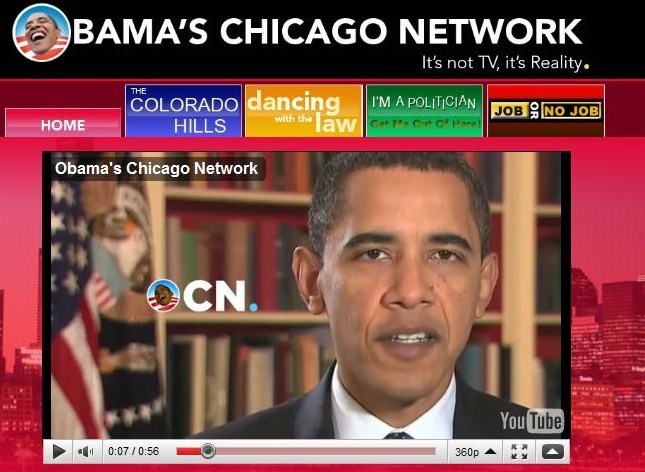
Looking to keep stories about the White House’s dabbling in primary elections alive, the RNC launched the “Obama Chicago Network” in an email to supporters this afternoon.

The site boasts four “shows” that deal with various negative stories surrounding the Sestak/Romanoff could-have-been-bribery affairs, plus Rod Blagojevich thrown in for fun:

Even if it is somewhat dated in the pop culture references (some of the shows they are spoofing are past their prime or canceled), it’s pretty funny, makes good use of news clips, and has a poll to collect people’s contact information.  With Blagojevich in the news, it does a good job of tying the administration As a lead generator, the site is good, but it’s missing something that could make it a really useful tool for Republican messaging: a section where users could “pitch” their own shows.  Not only is audience participation a good thing, but it might make for some must-see TV.

McChrystal unclear

That General McChrystal’s rift with his commander-in-chief was aired in a Rolling Stone interview is a troubling sign for more reasons than simple insubordination.

NewsBusters notes the airing of previous greivances – although none of the situations are quite as bad as McChrystal’s.  But the Washington Post draws an interesting comparison that puts the real problem in context:

Much of McChrystal’s career was spent in the military’s secretive special operations community, which has little experience dealing with the press… The general’s relationship with the press contrasts significantly with that of Gen. David Petraeus, who spent a far larger segment of his career in Washington and is far more practiced in dealing with reporters and the civilian leadership.

Disagreements are not wrong, but clumsily airing those disagreements is.  Unless he’s angling for a dismissal and job as a military expert talking head (or a spot on the GOP ticket in 2012), McChrystal’s misstep seems to come from his lack of savvy in how his comments would look in print.

Combined with the previous criticism, the clear trend is that PR expertise is becoming a requirement fgor military leadership – along with an aptitude for killing people and breaking things, which is the core competency of the military.

Or at least, it’s supposed to be.

The smart move would have been to turn down the interview with Rolling Stone.  In this failing, McChrystal can’t be alone – surely there were several more information officers who thought the interview would be a good idea.  The concept of the “celebrity general” isn’t new – heck, we have one printed on our most-used currency, and several Presidents have followed.  But as with any project or campaign, the folks who speak to the press should be ready to do so – and not pushed out there because of an overly-politicized media environment that seems to demand that everyone have something to say.  It isn’t fair to the general, the troops, or the people watching the news.

It’s one thing to dress a spokesman up in a warrior’s fatigues for the cameras; it’s much more difficult to stuff a warrior into the civilian role of PR director.

Politics, policy, and the President’s speech

Criticism of the President’s speech last night ranged from the lack of specific policy asks to the aggressive tone he took in describing what BP would be forced to do.  But those elements are what made the speech a short term winner – and possibly the only viable course of action.

Though it breaks a personal moratorium on referencing Ronald Reagan, the purpose of this speech should have been similar to the 1986 speech after the Challenger disaster.  That speech sought to restore confidence in American ingenuity, which had just taken a very dazzling and public hit.

Obama’s speech had a similar goal – channel and focus people’s emotions.  In his case, he wanted to empathize with Gulf residents and all Americans who will feel the environmental brunt of a company’s mistake.  The policy ideas he put forward are window dressing for the bigger message – he feels your pain, and he’s going to inflict some of it on BP through a relief fund that the oil company will fund but not direct.   (Something that would have been a good idea for BP to set up in the first place.)

Could he come out of this swinging and missing?  Could BP challenge the seizure of their assets in court – and, conceivably, win?  Perhaps, but after waiting 57 days to make this statement, it’s the best message the President has.

Plus, if BP weasels out of the bill some how, the President will still have a chance to make them the bad guy.  Just because a James Bond villain jumps in an escape pod and eludes capture doesn’t make Bond’s effort any less heroic.  It just means that Obama will have to find new and creative ways to hold BP accountable – something like tax credits for owners of local BP gas stations  owners who want to change  their affiliation.

It may not be good policy, but it’s good politics.  As the old saying goes, when you see a mob coming with pitchforks and torches, either grab a torch and join the crowd or start running in another direction.

BP slogs, Exxon blogs

This week, Exxon Mobil launched Perspectives, a blog about “issues, policies, technologies, and trends” surrounding energy development.  Yes, that includes oil, and yes, they kick off by talking about the mess in the Gulf of Mexico.

No, Lionel Osbourne is not a featured blogger.

BP has received the lion’s share of the public scorn since the spill, but other companies remain vulnerable to regulations and increased taxes.  It isn’t an immediate challenge, but Exxon Mobil didn’t wait for the problem to come to them.

It would have been easier, in the short term, for Exxon Mobil to act like the accomplice of the kid who gets punished for a grade school food fight – sit on their hands, let BP continue to be yelled at by authority figures, and keep quiet hoping none of the outrage falls on you.  The problem with that strategy is that, eventually, the story will not be about BP’s specific failings but the failings – and potential failings – of the industry as a whole.

Of course the blog is biased and slanted, but Exxon Mobil makes no effort to hide its involvement.  Perspectives is clearly branded as the official Exxon Mobil company line – take it for what its worth.  And doing that now will help Exxon Mobil’s credibility (at least somewhat) in future discussions about what their obligations should be.  Plus they’ll likely to have some thoughts on what BP’s obligations are too.

Fantastic.

Tell me, who the #$%& are you?

Politics in the Carolinas has been good for comedians over the last few weeks, and Congressman Bob Etheridge was able to keep it going with this now-famous video:

“Who are you?”?!?  He’s a guy with a camera, genius.

That’s what makes this so hilarious:   Etheridge had all the cards and lost the hand.

Option A: Some scrubby little schmuck with a camera and a blue blazer comes pointing a camera in his face, and apparently asks if he supports “the Obama Agenda.”  A smile, a polite question back (“Well, what do you think the ‘Obama Agenda’ is, sir?”), and a re-framing of the issue (“I support policies that will help my constituents, and I’ll work with anyone who wants to help – yes, if they’re the President of the United States.”) and this go away.  Congressman Etheridge walks away laughing, and the kid with his face blurred out has no good footage.  Or, if he’s feeling especially saucy, he stays and has a civil discussion – after all, he has to have an intellectual foundation for what he believes in.  If camera boy doesn’t want to be civil, chuckle and invite him to your office sometime for coffee to talk further.

Option B: Grab his arm, bear hug him like you’re posing for a picture, and ask him who he is.  Gain internet fame.

Etheridge, who has obviously never heard the phrase, “Don’t lose your temper except on purpose,” chose B.  He chose poorly.

The fallout could go beyond Etheridge’s own district, too.  The video offers another example of Congressional egotism and entitlement.  News media outlets like to talk about an anti-incumbent sentiment among the electorate, but that can’t exist without folks like Congressman Etheridge stoking the flame.