Recovery summer: Give credit where credit is due

This morning’s news reports included really bad poll numbers for Democrats, including a meager 40% who disapprove of the President’s handling of the economy.   Much of the blame goes to the White House’s alleged “Recovery Summer” – and last week’s employment numbers suggest this was a dismal failure.

But is that really fair?  After all, this summer has seen at least a 35-year high in the number of people running for Congress – which means more canvassers, more consultants, more GOTV callers, and more campaign operatives overall.

Who says the current administration hasn’t created jobs?

Winning on Iraq

Last night’s Presidential address on Iraq was written and shaped, in part, by John Boehner.  Boehner re-drew the rhetorical battle lines on Iraq, neutering the administration looking for a win heading into campaign season.

Throughout August, Boehner and Republicans have been talking about Iraq with a fairly consistent message of thanks to the troops for their service in Iraq, crediting them for victory.  It’s not a controversial message, but one they beat the drum on pretty well.  That made it difficult for the Obama Administration to give the speech they probably would have liked to give last night.

Did you notice (as  Politico’s Roger Simon did) that the thrust of the speech had little to do with the Iraq war itself?  When the President spoke on Iraq, he echoed Boehner’s talking points in speaking about the troops’ resolve.  The final half of the speech delved into future military strategy, and then wended into domestic policy in an awkward attempt to tie policy consensus to support for the troops.

In a vacuum, a skilled orator like Obama might have claimed credit for ending the conflict started by his predecessor – a tack he has used repeatedly for his economic policies – and called for unity after a long national nightmare.  There might have even been a few digs at the rationale behind the war in the first place, Easter eggs for the far left supporters who will be crucial campaign activists in the coming elections.

Instead, Obama gave a speech which reads like it could have been given by John Boehner.

UPDATE: I meant to include this earlier, and just plum forgot.  To get a sense of what the speech may have looked like in the imagined vacuum, check out the opening of the email Organizing for America sent around last night over the President’s signature:

Tonight marks the end of the American combat mission in Iraq.

As a candidate for this office, I pledged to end this war responsibly. And, as President, that is what I am doing.

Since I became Commander-in-Chief, we’ve brought home nearly 100,000 U.S. troops. We’ve closed or turned over to Iraq hundreds of our bases… Ending this war is not only in Iraq’s interest — it is in our own. Our nation has paid a huge price to put Iraq’s future in the hands of its people. We have sent our men and women in uniform to make enormous sacrifices. We have spent vast resources abroad in the face of several years of recession at home.

40Seats.com: A literal map to GOP victory

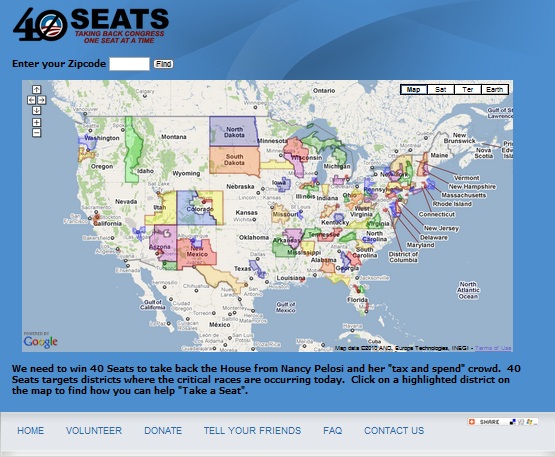
The historic highs Republicans are enjoying in this week’s generic ballot poll numbers are nice, but it alone won’t restore GOP control of Congress in November.  A pretty cool website called 40seats.com literally provides a map to GOP victory in November by allowing potential activists to be connected to nearby Congressional races which are up for grabs.

Ballots aren’t generic – and in some cases Democrats have plenty of advantages.  For instance, let’s say your Congressman had a long list of embarassments – maybe he famously accused an eight year old of attempting to carjack him, or promised to “earmark the [expletive] out of” appropriations under his purview, or said “I like to hit people” when describing his affinity for boxing, and/or had a birthday party interrupted by what eyewitness observers described as two girlfriends fighting.  Yet, the people of your district keep electing him to the House, apparently for earmarks and giggles.  But next door, maybe even in a Congressional district you lived in up until, say, June 28 of this year, your involvement could really help the folks on the ground.

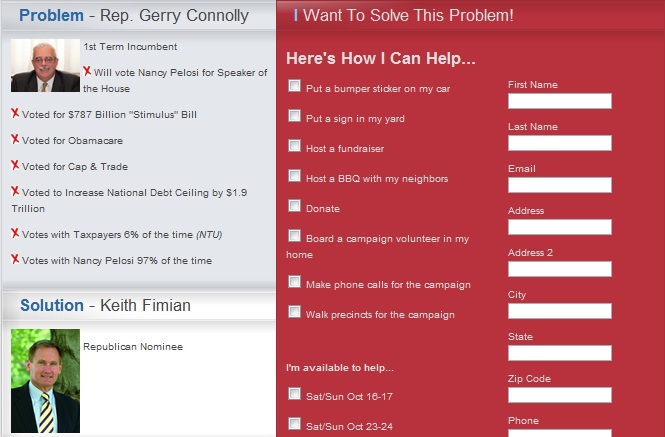
40Seats gives you an at-a-glance view of what’s wrong with the incumbent, and gives users options to allow varying degrees of activity – from making phone calls to putting a yard sign out to donating to walking precincts:

The credits indicate the site is mostly a mashup of tools that are open, available, and free – which is what makes 40Seats even smarter than it looks.

And no, sadly, Jim Moran is not targeted.


Digg, Reddit, and activists

Anyone who seeks to build an online following should pay close attention to the hot steaming mess that Digg stepped in this week.

The social news site announced changes which sounded like a good idea (at least I thought so) a few weeks ago, changes which promised to expand Digg’s following by making it more accessible to outsiders.  The one problem was Digg’s existing audience, which liked the way the site worked just fine.

Over the past 12 hours, Digg’s main news page has been riddled with submissions from competitor site Reddit – and it looks like Diggers offended by the site renovation are more than happy to help the enemy game the system, given the amount of complaints that have been flying about the redesign.

Digg’s mistake lies in not understanding what their community was passionate about.  Diggers liked a community that worked on certain rules and had certain values, and changing those rules and values to let others in diluted what they held dear.  Put another way, you can get more people at the Star Wars club meeting if you let the Star Trek people in; but the people who started coming to the meetings in the first place may not want more people if it means half the room will be wearing Spock ears.

Any membership organization runs a similar risk.  People join groups – whether it’s a social news site, a political party, a club, or a gang – because of some common ground.  When you peck away at that boundary, you risk alienating your members.

Your thoughts and the NRSC

An ad from the National Republican Senatorial Committee showed up in my GMail this week, asking me to take a survey.  The survey was pretty basic – asking which issues I care about, and things like that.  But with unofficial Campaign Kickoff Weekend just a week away, it’s a good idea.

The NRSC has been taking some flack this week, but this is a pretty good idea – and not just because surveys and petitions make it easier to capture my email address and information.  Even better, it follows a good pattern – between this, America Speaking Out, and YouCut, there’s a consistent pattern of engagement with voters and activists.  That outreach in the context of the NRSC survey will help them craft communication that speaks a bit more directly to me when they follow up.

If you’re an optimist, it’s about connecting with the voters; if you’re a cynic, it’s about refining strategy so match talking points with the things people actually care about.  Either way, it’s a good strategy.

The New Yorker: Koch fiend

This lesson in investigative journalism is brought to you by The New Yorker’s hit piece on Charles and David Koch’s political activities:

1.  Find some fact that isn’t particularly widely known.  Save time by finding a fact that isn’t widely known because it isn’t particularly interesting.

2.  Pretend that the fact is not widely known because of a conspiracy.

3.  Write a hit piece that calls out political activists for their political activism.

Koch industries has issued their rebuttal, and the story will likely blow over pretty quickly, but The New Yorker’s story deserves a second look as a primer on journalism mistakes to avoid.

Most Americans probably don’t know the extent to which federal government activity buoys the Washington, D.C. job market.  In addition to government jobs, there are countless lobbying firms, public affairs shops, and of course think tanks whose existence is based on the fact that the government is so complex.  Both the left and the right have their think tanks, and if you stroll through the halls of similar organizations on either side you’ll start to see similar names on the plaques which commemorate donors.  One of those names on the conservative side is Koch.

The New Yorker article paints David and Charles Koch as clandestine movers and shakers among the center-right, starting sham organizations to debunk global warming theories and government regulations.  The hilarious part about this is that the Koch brothers have never made any secret of their interest in politics – or their willingness to spend money advancing ideas.

In the interest of full disclosure, I’ve had a few dealings with the Charles G. Koch Charitable Foundation.  I’ve had friends who work there, and I’ve spoken to their Associates program (a widely advertised course which trains people to run think tanks) a couple of times a few years back.  In fact, to thank me for appearing, they gave me a Swiss army knife key chain with “Charles G. Koch Charitable Foundation” stamped on the side.  If you’re running a secret conspiracy group, you don’t make up key chains advertising it.

Buried in the conspiratorial tone of the story and the apparently necessary examples of inflammatory rhetoric at tea party rallies are a few interesting facts about the priorities of Koch-funded organizations and the priorities of Koch industries.  But lost in the shuffle is the consistency with which the Koch brothers have held to libertarian ideals – ideals which are actually quite rare in the business world.

And then there’s the big story The New Yorker completely whiffs on – that a large, activist government that picks winners and losers will attract attention and activism from large corporate players.

Internet and technology companies are weighing in on policies like net neutrality.  Health care companies were all over the place on both sides of the health care takeover.  Railroad companies are plugging for railroad subsidies; farmers are plugging for farm subsidies.  In fact, the devious “Koch agenda” is unique only in that while most companies are clamoring for their piece of the pie, the Koch brothers are among the few saying “just leave us alone – we got this.”

Had the author not spent valuable mental energy dreaming up the term “Kochtopus” to describe the many tentacles of activity funded by the Koch brothers, she might have had some left over to explore some of the other octopi in the D.C. ocean.

Plus, I’m pretty sure Ziggy already wrote this story.
Better yard signs? We have the technology

Supporters love yard signs.  Not only is it an easy way to demonstrate support for a candidate, it also offers an unofficial measure of how a campaign is doing.  Driving through a neighborhood amid an ocean of your favored candidate’s name is a big morale builder.

Political activists hate yard signs.  They’re expensive, and a volunteer sticking a signpost in the ground is generally not a volunteer walking through a precinct and talking to his or her friends and neighbors.  To that point, Alex Lundry has a great post about the utility of location-based apps, and mentions how campaigns may be able to use location-based services to give their yard signs greater impact.

A Spanish company, whimsically called Macanudos, is going one better.  They’re working on creating a quick-response (QR) code technology that would allow users to scan images and instantly “like” something.  These QR codes would operate like bar codes, and if they’re on a lawn sign, someone walking down the street could immediately like a candidate with a smartphone.

Of course, Facebook followers are like lawn signs: they both provide a nice stat that is, without further action, ultimately meaningless.  But what happens if we mash up Lundry’s idea for incorporating location-based services with Macanudo’s ability to instantly scan-like something?  Campaigns might then be able to figure out roughly where the scan-likes were coming from and give the list to the appropriate precinct captains, who could then in turn follow up with the individual voter.

Creepy?  Maybe a little.  But hey, you wanted yard signs…

Deconstructing the primaries

What might be the best wrap-up of yesterday’s primary results was published before the returns came in.  As media outlets keep dropping over-simplistic terms like “tea party support” and “outsiders vs. insiders” to explain what happened, the Washington Examiner’s Timothy Carney boils the divide in Republican politics down as “the Tea Party Wing against the K Street Wing” – a divide which is not simply ideological or experiential:

The main distinction… might have less to do with policy platforms and more to do with a politician’s attitude toward the Washington nexus of power and money. Nevada’s Sharron Angle is anti-bailout and anti-subsidy. [Kentucky candidate Rand] Paul could try to shrink defense spending and ethanol subsidies. In Florida, Republican Marco Rubio isn’t a game player like [former Senator Bob] Dole’s buddy Crist is.

This morning, we hear that Lisa Murkowski is in trouble against “tea partier” Joe Miller, that John McCain bested an insurgent challenge from a more conservative candidate, and that established Republican Bill McCollum lost out to Rick Scott.

So if you’re scoring at home, “the establishment” won some and lost some, with Alaska up in the air – at least, according to most of the talking heads you see.

But can you call McCain an establishment Republican candidate?  McCain had bucked national party leadership in his own way for decades, often lashing out at the K Street types Carney mentions above.  As Matt Lewis noted – again, before polls closed yesterday – he fought a serious race against an opponent with more clear ties to K Street establishmentism.  Last week, the New York Times saw fit to print that Alaska’s rugged individualism was either inconsistent or an outright sham because of its dependence on federal money; regardless of how the final tallies go for the scion of the Murkowski family goes, her ability to keep winning earmarks did not lead to an easy victory lap.  And Bill McCollum was part of a Republican establishment in Florida rocked with a spending scandal earlier this year.

And of course, there’s the big caveat that each race has its own local interpretations of who counts as “the establishment” and who really is an “outsider.”  All the more reason to look at the results through Carney’s prism rather than the crystal ball which other analysts are trying to use.

A quarter million doesn’t go as far as it used to

Rand Paul’s $250,000 money bomb is being treated like a dud for failing to meet the lofty $400,000 goal the campaign set for it.  For a Kentucky Senate race, a cool quarter mil is far from chump change, but the dour coverage shows the value of managed expectations in setting benchmarks for online metrics.

Paul inherited from his father a reputation for both staunch libertarianism and savvy online organizing, which make his swings-and-misses at online fundraising and Facebook recruitment much more pronounced.  But Paul isn’t the only one who falls into the trap of easy metrics: dollars raised online, Facebook “likes”, Twitter follower counts, and other obvious numbers are easy to understand, so issue and candidate campaigns alike will use them as benchmarks for impact.

Two problems stem from this.  First, metrics which are easy to understand are not always easy to obtain.  Second, having big numbers doesn’t always translate to big impact.  Having 100,000 Facebook followers who don’t vote is just like having 100 Facebook followers who don’t vote.  Further, there comes a time when a campaign must balance the effort of recruitment with the reality of mobilization.

In the particular case of the campaign’s recent online fundraising attempt, Rand’s supporters may be suffering from money bomb fatigue, since the campaign has used the tactic regularly.  They might be feeling the pinch of a tough economy, and giving $25 where they would have given $50.  But none of that would be in the discussion if, at the outset, the campaign had set a reasonable benchmark for dollars.  There are plenty of completely legitimate explanations for why Paul raised “only” $250,000 – but what really requires explanation is the original expectation for $400,000.